



TrxR-IN-6
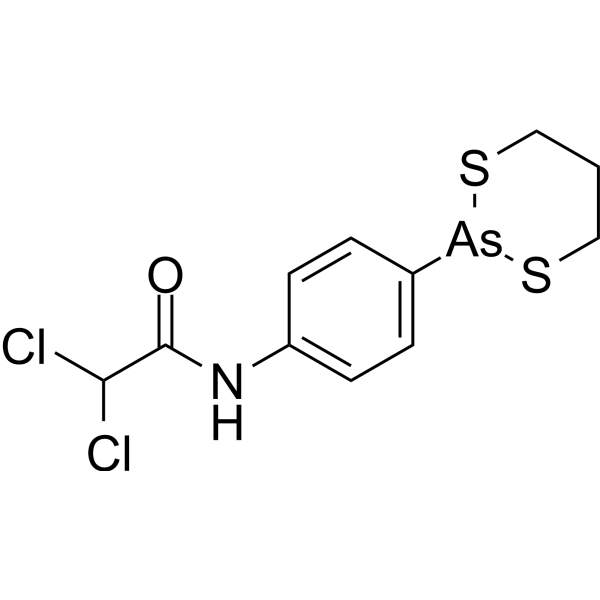
TrxR-IN-6 is a thioredoxin reductase (TrxR) inhibitor. TrxR-IN-6 induces reactive oxygen species (ROS) accumulation and cell apoptosis. TrxR-IN-6 induces mitochondrial dysfunction, endoplasmic reticulum stress and DNA damage. TrxR-IN-6 can be used for the research of breast cancer, leukemia.
For research use only. We do not sell to patients.
- CAS No.: 3032446-53-7
- Formula: C11H12AsCl2NOS2
- Molecular Weight:384.18
-
Storage:
Please store the product under the recommended conditions in the Certificate of Analysis.

To place orders, for customer services and technical support, please contact: MedChemExpress USA
Tel: 609-228-6898 E-mail: [email protected] [email protected]


-
 Biological Activity
-
Chemical Information
- Protocols
- Purity & Documentation
- References
-
 Help & FAQs




Biological Activity
Description
Cellular Effect
|
Cell Line

|
Type | Value | Description | References |
|---|---|---|---|---|
| 4T1 | IC50 |
0.98 μM
Compound: 1b
|
Antiproliferative activity against mouse 4T1 cells assessed as inhibition of cell growth incubated for 24 hrs by MTT assay
Antiproliferative activity against mouse 4T1 cells assessed as inhibition of cell growth incubated for 24 hrs by MTT assay
|
[PMID: 37688544] |
| COS-7 | IC50 |
3.74 μM
Compound: 1b
|
Antiproliferative activity against African green monkey COS7 cells assessed as inhibition of cell growth incubated for 24 hrs by MTT assay
Antiproliferative activity against African green monkey COS7 cells assessed as inhibition of cell growth incubated for 24 hrs by MTT assay
|
[PMID: 37688544] |
| HeLa | IC50 |
0.69 μM
Compound: 1b
|
Antiproliferative activity against human HeLa cells assessed as inhibition of cell growth incubated for 24 hrs by MTT assay
Antiproliferative activity against human HeLa cells assessed as inhibition of cell growth incubated for 24 hrs by MTT assay
|
[PMID: 37688544] |
| MCF7 | IC50 |
1.79 μM
Compound: 1b
|
Antiproliferative activity against human MCF7 cells assessed as inhibition of cell growth incubated for 24 hrs by MTT assay
Antiproliferative activity against human MCF7 cells assessed as inhibition of cell growth incubated for 24 hrs by MTT assay
|
[PMID: 37688544] |
| MOLM-13 | IC50 |
0.91 μM
Compound: 1b
|
Antiproliferative activity against human MOLM-13 cells assessed as inhibition of cell growth incubated for 24 hrs by MTT assay
Antiproliferative activity against human MOLM-13 cells assessed as inhibition of cell growth incubated for 24 hrs by MTT assay
|
[PMID: 37688544] |
| NB-4 | IC50 |
0.96 μM
Compound: 1b
|
Antiproliferative activity against human NB4 cells assessed as inhibition of cell growth incubated for 24 hrs by MTT assay
Antiproliferative activity against human NB4 cells assessed as inhibition of cell growth incubated for 24 hrs by MTT assay
|
[PMID: 37688544] |
In Vitro
TrxR-IN-6 (Compound 1d) (24-48 h) potently inhibits proliferation of 4T1, MCF-7, HeLa, Molm-13, and K562 cancer cells with IC50 values ranging from 0.45 μM to 0.74 μM, while exhibiting low toxicity to COS-7 normal cells and PBMC[1].
TrxR-IN-6 (0.5-2 μM; 12-24 h) selectively inhibits TrxR activity in 4T1 and MCF-7 cancer cells in vitro in a concentration-dependent manner, with no effect on TrxR activity in COS-7 normal cells or on GR/GPx activity in 4T1 cells[1].
TrxR-IN-6 (0.5-2 μM; 24 h) reduces TrxR system mRNA and protein levels in 4T1 and MCF-7 cancer cells, but not in COS-7 normal cells, and its anti-proliferative and pro-apoptotic effects are dependent on TrxR expression in 4T1 cells[1].
TrxR-IN-6 (0.5-2 μM; 3-24 h) induces irreversible oxidative stress in 4T1 cells[1].
TrxR-IN-6 (0.5-2 μM; 12-24 h) triggers endoplasmic reticulum stress and unfolded protein response in 4T1 cells by upregulating ER stress-related proteins and disrupting cytoplasmic calcium homeostasis[1].
TrxR-IN-6 (0.5-2 μM; 12-24 h) induces mitochondrial dysfunction in 4T1 cells by reducing membrane potential and ATP levels, altering Bcl-2 family protein expression, activating the caspase apoptotic cascade, inducing DNA fragmentation, and causing structural mitochondrial damage[1].
TrxR-IN-6 (1-2 μM; 24 h) induces caspase-dependent apoptosis in 4T1 cells in vitro in a concentration-dependent manner[1].
MedChemExpress (MCE) has not independently confirmed the accuracy of these methods. They are for reference only.
-
Cell Line:4T1
-
Concentration:0.5 μM; 1 μM; 2 μM
-
Incubation Time:24 h
-
Result:Upregulated the levels of relevant proteins involved in ER stress, including GRP78, PERK, ATF4, and CHOP.
Strongly upregulated ubiquitinated protein levels.
-
Cell Line:4T1
-
Concentration:0.5 μM; 1 μM; 2 μM
-
Incubation Time:24 h
-
Result:Upregulated the expression of Bax, c-casp9, c-casp-3 and c-parp.
Downregulated the expression of Bcl-2.
-
Cell Line:4T1
-
Concentration:0.5 μM; 1 μM; 2 μM
-
Incubation Time:24 h
-
Result:Induced apoptosis in a concentration-dependent manner, with 21.8% early apoptosis and 29.9% late apoptosis/necrosis at 2 μM.
In Vivo
MedChemExpress (MCE) has not independently confirmed the accuracy of these methods. They are for reference only.
-
Animal Model:BALB/c (female, 4-week-old, 18-22 g, subcutaneous injection of 2 × 10⁶ 4T1 cells)[1]
-
Dosage:1.5 mg/kg
-
Administration:i.p.; once weekly; 2 weeks
-
Result:Induced 90% tumor shrinkage, resulting in significantly smaller tumor volumes and lower tumor weights compared to control and auranofin-treated groups.
Reduced protein levels of TrxR1, Trx1, TrxR2, and Trx2 in tumor tissue.
Triggered a robust ROS burst in tumors.
Did not cause significant changes in mouse body weight.
Reversed spleen enlargement observed in control tumor-bearing mice.
Protected liver cells from tumor-related damage with no obvious abnormalities in other organs.
Normalized hematological parameters including white blood cells, neutrophils, lymphocytes, and monocytes compared to control tumor-bearing mice.
- Detection of Apoptosis
- TUNEL staining for apoptotic DNA fragmentation
- Annexin V plus membrane-impermeant dye apoptosis staining
- ROS/oxidative-stress fluorescent staining
- Mitochondrial membrane-potential and mitochondrial mass staining
- Apoptosis Solutions
- Breast Cancer Modeling
- Genotoxicity/Mutagenicity Study


Chemical Information
-
CAS No. 3032446-53-7
-
Molecular Weight 384.18
-
Formula C11H12AsCl2NOS2
-
SMILES
O=C(NC1=CC=C([As]2SCCCS2)C=C1)C(Cl)Cl
-
Shipping
Room temperature in continental US; may vary elsewhere.
-
Storage
Please store the product under the recommended conditions in the Certificate of Analysis.


Purity & Documentation
References

Calculators
Concentration (start) × Volume (start) = Concentration (final) × Volume (final)


TrxR-IN-6 Related Classifications
HY-157158 Related Classifications
 Powered by Bioz