



TrxR1
TrxR1 (TXNRD1) is a cytosolic, FAD-containing selenoenzyme that reduces thioredoxin and supports cellular redox homeostasis, growth, and differentiation[1][2]. Mechanistically, TrxR1 connects NADPH-dependent thioredoxin reduction with antioxidant defense, including ubiquinone reduction and regulation of the Nrf2-Keap1 stress-response system[2][3]. In developmental models, Txnrd1 loss shows that cytoplasmic thioredoxin reductase is essential for embryogenesis in most developing tissues, supporting its value in genetic redox-biology studies[4]. In cancer models, TXNRD1 inhibition induces oxidative stress in hepatocellular carcinoma and promotes ferroptosis in head and neck squamous cell carcinoma with NRF2 activation and poor anti-PD-1 response[5][6]. Compared with mitochondrial TrxR2, cytosolic TrxR1 shows distinct substrate and metal-inhibitor specificities, including efficient reduction of both Trx1 and Trx2, which supports isoform-focused experimental design[7]. For applications, irreversible TrxR1 inhibitors such as TRi-1 enable selective cytosolic TXNRD1 targeting, while RX1 provides a cellular probe for TrxR1 activity and inhibitor screening[8][9].
References:
- [1]. Fritz-Wolf K, et al. Crystal structure of the human thioredoxin reductase-thioredoxin complex. Nat Commun. 2011 Jul 12;2:383. [Content Brief]
- [2]. Xia L, et al. The mammalian cytosolic selenoenzyme thioredoxin reductase reduces ubiquinone. A novel mechanism for defense against oxidative stress. J Biol Chem. 2003 Jan 24;278(4):2141-6. [Content Brief]
- [3]. Cebula M, et al. TrxR1 as a potent regulator of the Nrf2-Keap1 response system. Antioxid Redox Signal. 2015 Oct 1;23(10):823-53. [Content Brief]
- [4]. Jakupoglu C, et al. Cytoplasmic thioredoxin reductase is essential for embryogenesis but dispensable for cardiac development. Mol Cell Biol. 2005 Mar;25(5):1980-8. [Content Brief]
- [5]. Lee D, et al. Induction of Oxidative Stress Through Inhibition of Thioredoxin Reductase 1 Is an Effective Therapeutic Approach for Hepatocellular Carcinoma. Hepatology. 2019 Apr;69(4):1768-1786. [Content Brief]
- [6]. Hsieh MS, et al. Therapeutic targeting of thioredoxin reductase 1 causes ferroptosis while potentiating anti-PD-1 efficacy in head and neck cancer. Chem Biol Interact. 2024 May 25;395:111004. [Content Brief]
- [7]. Rackham O, et al. Substrate and inhibitor specificities differ between human cytosolic and mitochondrial thioredoxin reductases: Implications for development of specific inhibitors. Free Radic Biol Med. 2011 Mar 15;50(6):689-99. [Content Brief]
- [8]. Stafford WC, et al. Irreversible inhibition of cytosolic thioredoxin reductase 1 as a mechanistic basis for anticancer therapy. Sci Transl Med. 2018 Feb 14;10(428):eaaf7444. [Content Brief]
- [9]. Zeisel L, et al. Selective cellular probes for mammalian thioredoxin reductase TrxR1: rational design of RX1, a modular 1,2-thiaselenane redox probe. Chem. 2022 May 12;8(5):1493-1517. [Content Brief]
All Product Categories
-
TrxR1 Related Products (5)
Related Products (5)

-
Aurothiomalate tetramer sodium
 0 ImagesCat. No.: HY-106381APurity: 98.0%Aurothiomalate tetramer sodium is the tetrameric form of Aurothiomalate sodium (HY-106381). Aurothiomalate sodium acts as an inhibitor of PKCI and TrxR1. Aurothiomalate sodium disrupts the PKCI-Par6-Rac1 signaling pathway, and also inhibits TrxR1 activity, TNFα-induced NF-κB activation, and the expression of pro-inflammatory genes. Aurothiomalate sodium blocks Kras-mediated BASC expansion and lung tumor growth, inhibits anchorage-independent growth and tumorigenicity of lung cancer cells, and suppresses neutrophil chemotaxis, phagocytosis, and leukocyte extravasation. Aurothiomalate sodium can be used in research related to rheumatoid arthritis and non-small cell lung cancer.
-
PMX464
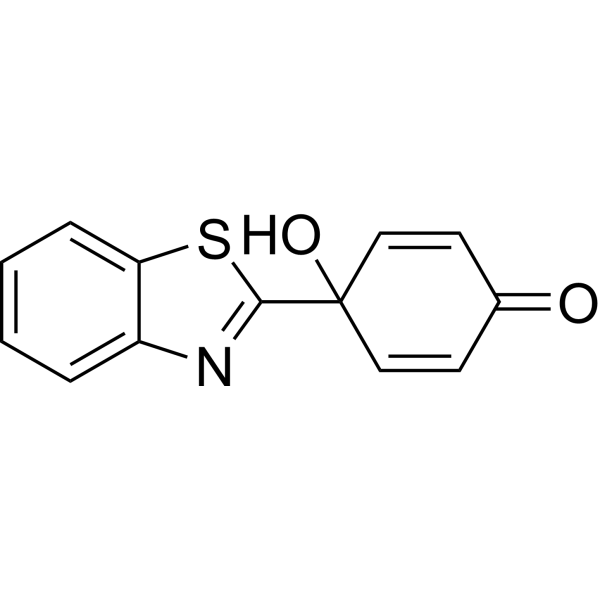 0 ImagesCat. No.: HY-108534CAS No.: 485842-97-5Synonyms: AW 464PMX464 (AW 464) is a thiol-reactive quinol compound and an inhibitor of the thioredoxin-thioredoxin reductase (Trx/TrxR) system, with an IC50 value of 6.5 μM against TrxR. PMX464 acts by irreversibly inhibiting the thioredoxin (Trx-1) system, blocking HIF-1α transcriptional activation and the NF-κB inflammatory pathway, inducing apoptosis, attenuating platelet function and inhibiting thrombosis, and specifically disrupting the trypanothione antioxidant metabolic network in parasites. PMX464 is used in research concerning malignant tumors (colorectal cancer, breast cancer, renal cancer, and leukemia), pulmonary inflammation, African sleeping sickness, and antithrombotic applications.

-
TrxR1-IN-3
 0 ImagesCat. No.: HY-184328CAS No.: 3028398-90-2TrxR1-IN-3 is a selective TrxR1 inhibitor with an IC50 of 1.19 μM. TrxR1-IN-3 increases intracellular reactive oxygen species (ROS) levels, induces endoplasmic reticulum (ER) stress, and activates Caspase-dependent Apoptosis. TrxR1-IN-3 exhibits anticancer activity against multiple breast cancer subtypes, including triple-negative breast cancer (TNBC). TrxR1-IN-3 can be used in breast cancer-related research.
-
Platinum(IV) Prodrug-1
 0 ImagesCat. No.: HY-183544Platinum (IV) Prodrug-1 is a Pt (IV) prodrug and selective TrxR1 inhibitor. Platinum (IV) Prodrug-1 induces ferroptosis (Ferroptosis) by depleting glutathione, accumulating intracellular lipid peroxides, and inactivating Glutathione peroxidase 4. Platinum (IV) Prodrug-1 triggers endoplasmic reticulum stress and immunogenic cell death via excessive accumulation of intracellular ROS. Platinum (IV) Prodrug-1 exhibits anticancer activity against both Cisplatin (HY-17394)-sensitive and Cisplatin-resistant triple-negative breast cancer cells. Platinum (IV) Prodrug-1 can be used for the research of triple-negative breast cancer.



