



Acoziborole
Based on 3 publication(s) in Google Scholar
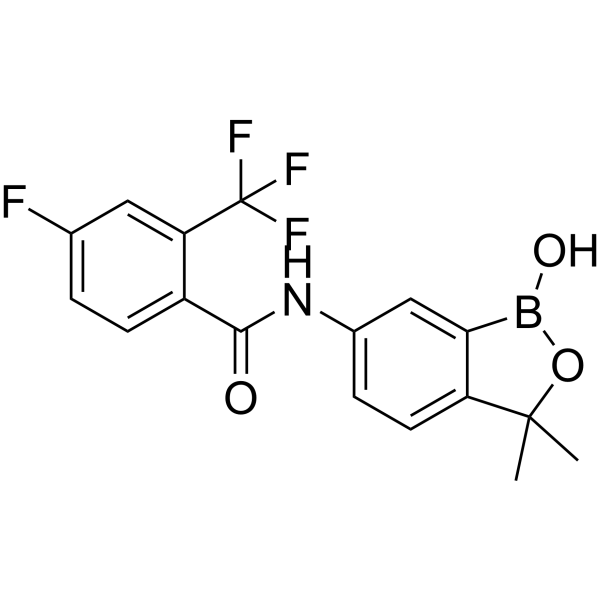
Acoziborole (SCYX-7158) is an effective, safe and orally active antiprotozoal agent for the research of human african trypanosomiasis (HAT). In the T. b. brucei S427 strain, the MIC value for SCYX-7158 is 0.6 μg/mL.
For research use only. We do not sell to patients.
- Purity: 99.78%
- CAS No.: 1266084-51-8
- Formula: C17H14BF4NO3
- Molecular Weight:367.10
-
Storage:Powder -20°C, 3 years , 4°C, 2 years ; In solvent -80°C, 2 years , -20°C, 1 year


-
 Biological Activity
-
Chemical Information
-
Solvent & Solubility
- Protocol
- Purity & Documentation
- References
-
 Help & FAQs
-

Anti-Infection Compound Library
HY-L002
-
Clinical Compound Library
HY-L026
-
Drug Repurposing Compound Library
HY-L035
-
Covalent Screening Library
HY-L036
-
Anti-COVID-19 Compound Library
HY-L052
-
Antiparasitic Compound library
HY-L082
-
Rare Diseases Drug Library
HY-L102
-
Bioactive Compound Library Max
HY-L181
-
MCE Bioactive Compound Library
HY-L001V
-
Covalent Screening Library Plus
HY-L036P
-
Drug Repurposing Compound Library Plus
HY-L035P
-
Clinical Compound Library Plus
HY-L026P
-
Bioactive Compound Library
HY-L001
-
High-Throughput Bioactive Compound Library
HY-L205
-
RNA Binding Bioactive Compound Library
HY-L248


Publications Citing Use of MedChemExpress (MCE) Acoziborole
MoreAll Parasite Isoforms
More

Biological Activity
|
Trypanosoma |
|
Cell Line

|
Type | Value | Description | References |
|---|---|---|---|---|
| Peritoneal macrophage | CC50 |
>64 μM
Compound: 1; AN556
|
Cytotoxicity against mouse primary peritoneal macrophages measured after 3 days by resazurin staining based fluorometric analysis
Cytotoxicity against mouse primary peritoneal macrophages measured after 3 days by resazurin staining based fluorometric analysis
|
[PMID: 34711050] |
Acoziborole is active in vitro against relevant strains of Trypanosoma brucei, including T. b. rhodesiense and T. b. gambiense.In whole cell assays, Acoziborole exhibits potent activity against representative T. b. brucei, T. b. rhodesiense and T. b. gambiense strains. IC50 values for Acoziborole are approximately 0.07 μg/mL to 0.37 μg/mL following incubation of the parasite strains with Acoziborole for 72 h. In the T. b. brucei S427 strain, the MIC value for Acoziborole is 0.6 μg/mL, approximately two times the IC50 measured for this strain. In contrast to the potent activity of Acoziborole against trypanosomes, no significant inhibition of cell proliferation is observed in an in vitro mammalian cell (L929 mouse cell line) assay at drug concentrations up to 50 μg/mL. The potential for Acoziborole to inhibit cytochrome P450 (CYP) enzymes is evaluated using P450-Glo assays for the human isoforms CYP3A4, CYP1A2, CYP2C19, CYP2C9 and CYP2D6. The IC50 values for Acoziborole in these assays are all above 10 μM[1].
MedChemExpress (MCE) has not independently confirmed the accuracy of these methods. They are for reference only.
MedChemExpress (MCE) has not independently confirmed the accuracy of these methods. They are for reference only.
| NCT Number | Sponsor | Condition | Start Date |
Phase
|
|---|---|---|---|---|
| NCT01329991 | Plexxikon| | 2011-05 | PHASE1 |


Chemical Information
-
CAS No. 1266084-51-8
-
Appearance Solid
-
Molecular Weight 367.10
-
Formula C17H14BF4NO3
-
Color Off-white to light yellow
-
SMILES
O=C(NC1=CC=C2C(C)(C)OB(O)C2=C1)C3=CC=C(F)C=C3C(F)(F)F
-
Synonyms
SCYX-7158; AN5568
-
Shipping
Room temperature in continental US; may vary elsewhere.
-
Storage
Powder -20°C 3 years 4°C 2 years In solvent -80°C 2 years -20°C 1 year


Publications (3)
-
Journal Impact Factor
-
Most Recent
-
-
Biomed Chromatogr
LC-MS/MS determination of HY072808, a novel candidate for treating atopic dermatitis, and its active metabolite: Application to a first-in-human pharmacokinetic study. [Abstract]2023 Feb;37(2):e5542. PMID: 36330676 -


Solvent & Solubility
DMSO : ≥ 125 mg/mL (340.51 mM; Hygroscopic DMSO has a significant impact on the solubility of product, please use newly opened DMSO)
* "≥" means soluble, but saturation unknown.
Please refer to the solubility information to select the appropriate solvent. Once prepared, please aliquot and store the solution to prevent product inactivation from repeated freeze-thaw cycles.
Storage method and period of stock solution: -80°C, 2 years; -20°C, 1 year. When stored at -80°C, please use it within 2 years. When stored at -20°C, please use it within 1 year.
Please refer to the solubility information to select the appropriate solvent. Once prepared, please aliquot and store the solution to prevent product inactivation from repeated freeze-thaw cycles.
Storage method and period of stock solution: -80°C, 2 years; -20°C, 1 year. When stored at -80°C, please use it within 2 years. When stored at -20°C, please use it within 1 year.
Concentration (start) × Volume (start) = Concentration (final) × Volume (final)
Select the appropriate dissolution method based on your experimental animal and administration route.
- For the following dissolution methods, please ensure to first prepare a clear stock solution using an In Vitro approach and then sequentially add co-solvents:
- To ensure reliable experimental results, the clarified stock solution can be appropriately stored based on storage conditions. As for the working solution for In Vivo experiments, it is recommended to prepare freshly and use it on the same day.
- The percentages shown for the solvents indicate their volumetric ratio in the final prepared solution. If precipitation or phase separation occurs during preparation, heat and/or sonication can be used to aid dissolution.
Add each solvent one by one: 10% DMSO 40% PEG300 5% Tween-80 45% Saline
Solubility: ≥ 5 mg/mL (13.62 mM); Clear solution
This protocol yields a clear solution of ≥ 5 mg/mL (saturation unknown).
Taking 1 mL working solution as an example, add 100 μL DMSO stock solution (50.0 mg/mL) to 400 μL PEG300, and mix evenly; then add 50 μL Tween-80 and mix evenly; then add 450 μL Saline to adjust the volume to 1 mL.
Preparation of Saline: Dissolve 0.9 g sodium chloride in ddH₂O and dilute to 100 mL to obtain a clear Saline solution.
Please enter the basic information of animal experiments:
-
-
-
-
Recommended: Prepare an additional quantity of animals to account for potential losses during experiments.
Please enter your animal formula composition:
-
%DMSO +
Recommended: Keep the proportion of DMSO in working solution below 2% if your animal is weak.
-
%+
-
+%Tween-80 + +
-
%Saline +
The co-solvents required include: DMSO, . All of co-solvents are available by MedChemExpress (MCE). , Tween 80. All of co-solvents are available by MedChemExpress (MCE).
Working solution concentration: 0.22 mg/mL
Method for preparing stock solution: mg drug dissolved in μL DMSO. Stock solution concentration: mg/mL.
1. Take μL DMSO stock solution;
2. Add μL .
μL , mix evenly;
3. Then add μL Tween 80, mix evenly;
4. Then add μL
Please ensure that the stock solution in the first step is dissolved to a clear state, and add co-solvents in sequence. You can use ultrasonic heating (ultrasonic cleaner, recommended frequency 20-40 kHz), vortexing, etc. to assist dissolution.

Protocol
Compounds (e.g., Acoziborole) to be tested are serially diluted in DMSO and added to 96-well plates to give final concentrations ranging from 5 to 0.01 µg/mL. T. b. brucei parasites in the log phase of growth are diluted in HMI-9 media and added to each well for a final concentration of 1×10⁴ parasites per well. For the sensitivity assays using T. b. rhodesiense and T. b. gambiense, pararasites are cultured in MEM supplemented with Baltz components, diluted in the aforementioned culture media, and added to each well at a density of 1×10³ cells/well. The final concentration of DMSO is 0.5% and the total volume is 100 µL/well. After 72 h incubation, Resazurin is added to each well (20 µL of 25 mg/100 mL stock in PBS) and incubated for an additional 4-6 h. To assess cell viability, fluorescence is quantified using an EnVision Multilabel Plate Reader at an excitation wavelength of 530 nm and emission of 590 nm. Triplicate data points are averaged to generate sigmoidal dose-response curves and determine IC50 values using XLfit curve fitting software. The IC50 is defined as the amount of compound required to decrease parasite or cell viability by 50% compared to those grown in the absence of the test compound. The MIC, defined as the lowest concentration of compound that completely inhibits visible parasite growth, is determined by visual inspection of 96-well plates after 48-72 h of incubation with the test compounds. To evaluate the effects of serum on trypanocidal activity, assays are performed in the presence of increasing concentration (2.5% to 50%) of fetal calf serum. The results are expressed as a fold-change in IC50 values relative to standard conditions (10% FCS) [1].
MedChemExpress (MCE) has not independently confirmed the accuracy of these methods. They are for reference only.
Mice, Rats and Monkeys[1]
Male CD-1 mice (~25 g), male Sprague-Dawley rats (~225 g), or male cynomolgus monkeys (~3-5 kg) are administered test article by either bolus intravenous injection (IV) or oral gavage. Male CD-1 mice, Sprague-Dawley rats, cynomolgus monkeys or male beagle dogs are administered a single oral dose of Acoziborole at a dose of 25 mg/kg (mouse, rat) or 10 mg/kg (monkey, dog). Blood samples are collected and analyzed.
MedChemExpress (MCE) has not independently confirmed the accuracy of these methods. They are for reference only.


Purity & Documentation
-
Data Sheet (293 KB)
-
SDS (252 KB)
- English - EN (252 KB)
- Français - FR (252 KB)
- Deutsch - DE (252 KB)
- Norwegian - NO (252 KB)
- Español - ES (252 KB)
- Swedish - SV (252 KB)
- Italian - IT (252 KB)
- Portuguese - PT (252 KB)
-
Handling Instructions (2659 KB)
References


Complete Stock Solution Preparation Table
Please refer to the solubility information to select the appropriate solvent. Once prepared, please aliquot and store the solution to prevent product inactivation from repeated freeze-thaw cycles.
Storage method and period of stock solution: -80°C, 2 years; -20°C, 1 year. When stored at -80°C, please use it within 2 years. When stored at -20°C, please use it within 1 year.
| Optional Solvent | Concentration Solvent Mass | 1 mg | 5 mg | 10 mg | 25 mg |
|---|---|---|---|---|---|
| DMSO | 1 mM | 2.7241 mL | 13.6203 mL | 27.2405 mL | 68.1013 mL |
| 5 mM | 0.5448 mL | 2.7241 mL | 5.4481 mL | 13.6203 mL | |
| 10 mM | 0.2724 mL | 1.3620 mL | 2.7241 mL | 6.8101 mL | |
| 15 mM | 0.1816 mL | 0.9080 mL | 1.8160 mL | 4.5401 mL | |
| 20 mM | 0.1362 mL | 0.6810 mL | 1.3620 mL | 3.4051 mL | |
| 25 mM | 0.1090 mL | 0.5448 mL | 1.0896 mL | 2.7241 mL | |
| 30 mM | 0.0908 mL | 0.4540 mL | 0.9080 mL | 2.2700 mL | |
| 40 mM | 0.0681 mL | 0.3405 mL | 0.6810 mL | 1.7025 mL | |
| 50 mM | 0.0545 mL | 0.2724 mL | 0.5448 mL | 1.3620 mL | |
| 60 mM | 0.0454 mL | 0.2270 mL | 0.4540 mL | 1.1350 mL | |
| 80 mM | 0.0341 mL | 0.1703 mL | 0.3405 mL | 0.8513 mL | |
| 100 mM | 0.0272 mL | 0.1362 mL | 0.2724 mL | 0.6810 mL |


 Powered by Bioz