



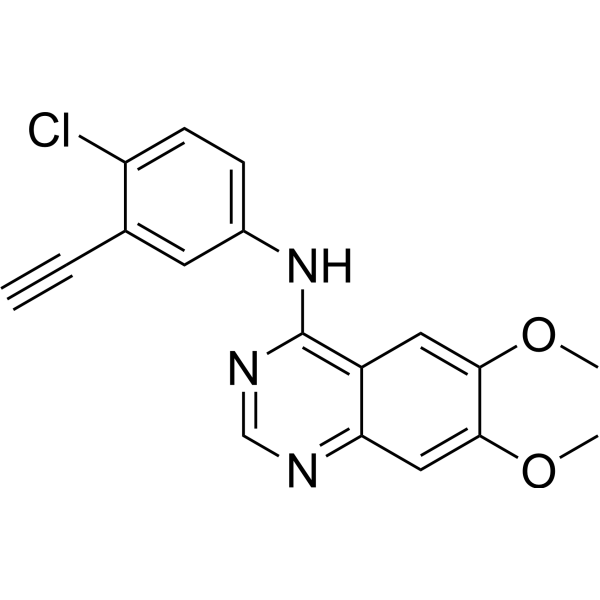
UNC-CA359
UNC-CA359 is a potent epidermal growth factor receptor (EGFR) inhibitor, with an IC50 value of 18 nM. UNC-CA359 exhibits strong anti-tumor activity, can be used to Chordoma research. UNC-CA359 is a click chemistry reagent, it contains an Alkyne group and can undergo copper-catalyzed azide-alkyne cycloaddition (CuAAc) with molecules containing Azide groups.
연구목적의 판매만을 진행합니다. 환자를 대상으로 한 판매는 하지 않습니다.
- CAS No.: 2676156-05-9
- 화학식: C18H14ClN3O2
- 분자량:339.78
-
보관:
Please store the product under the recommended conditions in the Certificate of Analysis.

To place orders, for customer services and technical support, please contact: MedChemExpress USA
Tel: 609-228-6898 E-mail: [email protected] [email protected]


-
 Biological Activity
-
Chemical Information
- Protocol
- 순도&문서
- References
-
 Help & FAQs


All EGFR Isoforms
More

Biological Activity
제품 설명
IC50 & Target
IC50: 18 nM (EGFR)[1]
In Vitro
UNC-CA359 (compound 45) loses activity on U-CH1, leaves some activity on U-CH2, and maintains inhibition on EGFR, with IC50s of >100 μM, 35 μM, and 18 nM, respectively[1].
UNC-CA359 (1 nM-0.1 mM; 72 h) has activity against chordoma with IC50s of 1.2 μM (CH22), and 3.0 μM (U-CH12), respectively[1].
UNC-CA359 shows
UNC-CA359 (compound 102) has three main collateral kinase targets, and shows high potency towards SLK/STK10 with a promising selectivity ratio (NAK over SLK/STK10) of 22, while the binding constant Ki values are 3.4 nM (GAK), 0.33 μM (SLK), 0.075 μM (STK10), respectively[2].
GAK: cyclin G associated kinase; SLK: STE20-like serine/threonine-protein kinase; STK10: serine/threonine-protein kinase 10.
MedChemExpress (MCE) has not independently confirmed the accuracy of these methods. They are for reference only.
-
Cell Line:Chordoma cell lines: CH22, UM-Chor1, U-CH12 and U-CH7; WS1
-
Concentration:1 nM-100 μM
-
Incubation Time:72 hours
-
Result:Demonstrated good potential against chordoma cells, with IC50s of 1.2 μM (CH22), 3.0 μM (U-CH12), 60 μM (UM-Chor1), 74 μM (U-CH7), respectively.
Showed no toxicity towards WS1 cell (IC50 >100 μM).


Chemical Information
-
CAS No. 2676156-05-9
-
분자량 339.78
-
화학식 C18H14ClN3O2
-
SMILES
ClC(C(C#C)=C1)=CC=C1NC2=C3C(C=C(C(OC)=C3)OC)=NC=N2
-
선적
Room temperature in continental US; may vary elsewhere.
-
보관
Please store the product under the recommended conditions in the Certificate of Analysis.


순도&문서
References
[1]. Bieberich AA, et al. Optimization of the 4-anilinoquin(az)oline scaffold as epidermal growth factor receptor (EGFR) inhibitors for chordoma utilizing a toxicology profiling assay platform. Sci Rep. 2022 Jul 27. 12(1):12820. [Content Brief]
[2]. Asquith CRM, et al. Design and Analysis of the 4-Anilinoquin(az)oline Kinase Inhibition Profiles of GAK/SLK/STK10 Using Quantitative Structure-Activity Relationships. ChemMedChem. 2020 Jan 7. 15(1):26-49. [Content Brief]

Calculators
Concentration (start) × Volume (start) = Concentration (final) × Volume (final)


UNC-CA359 Related Classifications
HY-150782 Related Classifications
 Powered by Bioz