



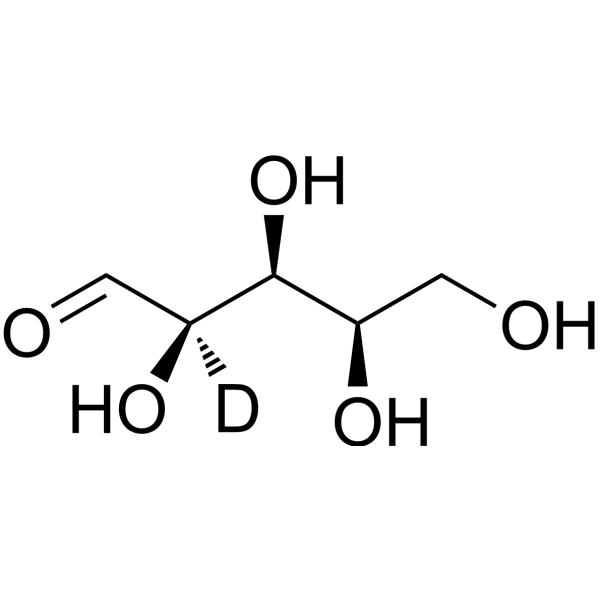
Xylose-d-4
Xylose-d-4 is the deuterium labeled Xylose.
For research use only. We do not sell to patients.
- CAS No.: 288846-91-3
- Formula: C5H9DO5
- Molecular Weight:151.14
-
Storage:
Please store the product under the recommended conditions in the Certificate of Analysis.

To place orders, for customer services and technical support, please contact: MedChemExpress USA
Tel: 609-228-6898 E-mail: [email protected] [email protected]


-
 Biological Activity
-
Chemical Information
- Purity & Documentation
- References
-
 Help & FAQs


All Endogenous Metabolite Isoforms
More

Biological Activity
Description
In Vitro
Stable heavy isotopes of hydrogen, carbon, and other elements have been incorporated into drug molecules, largely as tracers for quantitation during the drug development process. Deuteration has gained attention because of its potential to affect the pharmacokinetic and metabolic profiles of drugs[1].
MedChemExpress (MCE) has not independently confirmed the accuracy of these methods. They are for reference only. .
Application
1. This compound can be used as a tracer
2. This compound can be used as an internal standard for quantitative analysis by NMR, GC-MS, or LC-MS.


Chemical Information
-
CAS No. 288846-91-3
-
Unlabeled CAS 58-86-6
-
Molecular Weight 151.14
-
Formula C5H9DO5
-
SMILES
O=C[C@]([C@H]([C@@H](CO)O)O)([2H])O
-
Synonyms
D-(+)-Xylose-d-4; (+)-Xylose-d-4; Wood sugar-d1-4
-
Shipping
Room temperature in continental US; may vary elsewhere.
-
Storage
Please store the product under the recommended conditions in the Certificate of Analysis.


Purity & Documentation
References
[1]. Wang XX, et al. The implementation of high fermentative 2,3-butanediol production from xylose by simultaneous additions of yeast extract, Na2EDTA, and acetic acid. N Biotechnol. 2015 Aug 3.;Bingyin Peng, et al. Bacterial xylose isomerases from the mammal [Content Brief]
[2]. Peng B, et al. Bacterial xylose isomerases from the mammal gut Bacteroidetes cluster function in Saccharomyces cerevisiae for effective xylose fermentation. Microb Cell Fact. 2015 May 17;14:70. [Content Brief]
[3]. Wang XX, et al. The implementation of high fermentative 2,3-butanediol production from xylose by simultaneous additions of yeast extract, Na2EDTA, and acetic acid. N Biotechnol. 2016 Jan 25;33(1):16-22. [Content Brief]

Calculators
Concentration (start) × Volume (start) = Concentration (final) × Volume (final)


Xylose-d-4 Related Classifications
HY-N0537S13 Related Classifications
 Powered by Bioz