



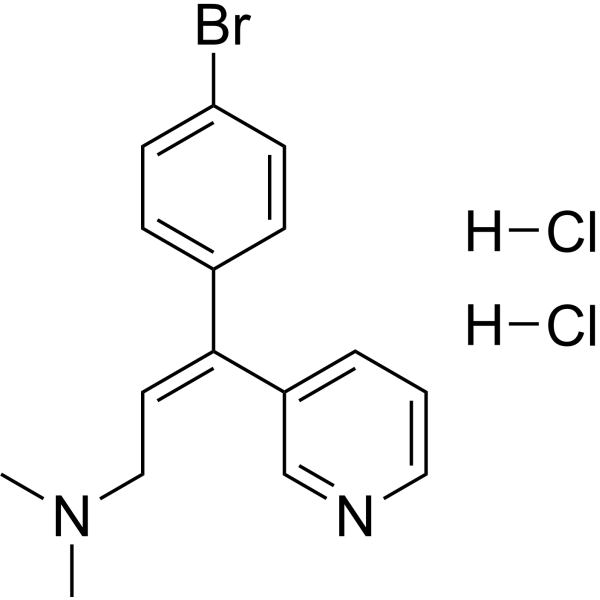
Zimelidine dihydrochloride

Based on 1 Customer Validation
Zimelidine dihydrochloride is an orally active selective serotonin reuptake inhibitor. Zimelidine dihydrochloride competitively inhibits central 5-HT uptake and desensitizes 5-HT autoreceptors in dorsal raphe nucleus. Zimelidine dihydrochloride time-dependently modulates 5-HT neuronal firing and hippocampal CA3 responses. Zimelidine dihydrochloride strengthens central serotonergic neurotransmission and produces related behavioral changes. Zimelidine dihydrochloride exerts anxiolytic, analgesic, feeding-suppressive and tolerance-attenuating effects. Zimelidine dihydrochloride is used for the study of depressive disorders and analgesic tolerance.
For research use only. We do not sell to patients.
- Purity : 98.08%
- CAS No.: 60525-15-7
- Formula: C16H19BrCl2N2
- Molecular Weight:390.15
-
Storage:
-20°C, sealed storage, away from moisture
* In solvent : -80°C, 6 months; -20°C, 1 month (sealed storage, away from moisture)

To place orders, for customer services and technical support, please contact: MedChemExpress USA
Tel: 609-228-6898 E-mail: [email protected] [email protected]


-
 Biological Activity
-
Chemical Information
-
Solvent & Solubility
- Purity & Documentation
- References
-
 Help & FAQs




Biological Activity
Description
IC50 & Target
[4]|
5-HT2C Receptor |
In Vitro
Zimelidine dihydrochloride potently and selectively inhibits serotonin uptake in rat hypothalamic synaptosomes, mouse cerebral cortical slices, and mouse striatal slices, with IC50 values of 0.33 μmol/L, 3.3 μmol/L, and 9.1 μmol/L respectively, and shows far weaker inhibition of noradrenaline and dopamine uptake[2].
Zimelidine dihydrochloride inhibits serotonin uptake into human platelets in vitro with an IC50 of 2.6 μmol/L[2].
Zimelidine dihydrochloride has low affinity for postsynaptic serotonin, α-noradrenergic, β-noradrenergic, and dopamine receptors in vitro[2].
MedChemExpress (MCE) has not independently confirmed the accuracy of these methods. They are for reference only.
In Vivo
Zimelidine (5 mg/kg; i.p.; daily; 2-14 days) dihydrochloride causes an initial reduction in 5-HT neuron activity followed by gradual restoration of normal activity and desensitization of 5-HT autoreceptors after 14 days of treatment[1].
Zimelidine (i.p.) dihydrochloride inhibits H75/12- and PCA-induced 5-HT depletion in rat brain with ED50 values of 4 mg/kg (H75/12) and 1.5 mg/kg (PCA)[1].
Zimelidine (i.p.; p.o.) dihydrochloride potentiates 5-HTP-induced head twitches in mice, with an ED50 of 3.2 μmol/kg (p.o.) and 8.6 μmol/kg (i.p.)[2].
Zimelidine dihydrochloride reduces serotonin's inhibitory effects on visual cortex responses in rabbits following chronic treatment[2].
Zimelidine (15 mg/kg; i.p.; single dose) dihydrochloride significantly attenuates the development of induced antinociceptive tolerance in rats[3].
Zimelidine (0.2-20 nmol/100 nL; bilateral medial amygdaloid nucleus microinjection; single dose) dihydrochloride administered via bilateral MeA microinjection produces a dose-dependent hypophagic effect in fasted male Wistar rats[4].
Zimelidine (2 nmol/100 nL; bilateral medial amygdaloid nucleus microinjection; single dose; administered 15 minutes after SB-242084 (HY-13409) or vehicle pretreatment) (2 nmol via bilateral MeA microinjection) dihydrochloride in fasted male Wistar rats is mediated by MeA 5-HT2C receptors[4].
Zimelidine (20 mg/kg; intraperitoneal injection; single dose; administered 15 minutes after SB-242084 or vehicle pretreatment) dihydrochloride in fasted male Wistar rats is mediated by MeA 5-HT2C receptors[4].
Zimelidine (2 nmol/100 nL; bilateral medial amygdaloid nucleus microinjection; single dose; administered 15 minutes after WAY-100635 (HY-10349) or vehicle pretreatment) (2 nmol via bilateral MeA microinjection) dihydrochloride in fasted male Wistar rats is not mediated by MeA 5-HT1A receptors[4].
Zimelidine (2 nmol/100 nL; bilateral medial amygdaloid nucleus microinjection; single dose; administered 15 minutes after SB-216641 or vehicle pretreatment) (2 nmol via bilateral MeA microinjection) dihydrochloride in fasted male Wistar rats is not mediated by MeA 5-HT1B receptors[4].
MedChemExpress (MCE) has not independently confirmed the accuracy of these methods. They are for reference only.
-
Animal Model:Sprague-Dawley (male, 150-250 gm)[1]
-
Dosage:5 mg/kg
-
Administration:i.p.; daily; 14 days
-
Result:Increased suppression of CA3 hippocampal pyramidal neuron firing induced by electrical stimulation of the ascending 5-HT pathway compared to controls; at 160 μA stimulation, showed a 20-msec reduction in firing probability while controls had no suppression, and at 300 μA stimulation, had a longer period of suppression.
Did not significantly alter I·T50 values for 5-HT (185) or GABA (169) compared to control values (5-HT: 168; GABA: 200).
-
Animal Model:Sprague-Dawley (male, 150-250 gm)[1]
-
Dosage:5 mg/kg
-
Administration:i.p.; daily; 2 days; 7 days; 14 days
-
Result:Reduced the number of spontaneously discharging 5-HT neurons to 0.8 per 1-mm track after 2 days of treatment, compared to 4.2 per 1-mm track in controls.
Restored the number of active 5-HT neurons to 5.3 per 1-mm track after 7 days of treatment, but reduced their mean firing rate to 0.9 Hz, compared to 1.2 Hz in controls.
Restored both the number of active 5-HT units (4.1 per 1-mm track) and their mean firing rate (1.1 Hz) to normal range after 14 days of treatment.
Increased the ED50 of LSD by 2.5-fold after 14 days of treatment, and reduced firing by only 49% with 10 μg/kg i.v.
LSD, compared to 100% reduction in controls.
-
Animal Model:Wistar albino (adult male, 160-180 g, morphine-induced antinociceptive tolerance model)[3]
-
Dosage:15 mg/kg
-
Administration:i.p.; single dose
-
Result:Produced significantly higher antinociceptive effect (43.50 %MPE vs. 0.53 %MPE in saline) at 60 min in the hot-plate test.
Reached maximal antinociceptive effect at 60 min in both tail-flick and hot-plate tests when administered alone.
Significantly reduced the development of analgesic tolerance, showing higher %MPE in drug-tolerant rats receiving zimelidine than in untreated tolerant rats in tail-flick and hot-plate tests.
Achieved peak %MPE of 51.66 at 30 min (tail-flick) and 54.00 at 30 min (hot-plate) when combined with opioid analgesics.
Produced additive antinociceptive effect with opioid analgesics, yielding the highest maximal effect across all groups in both tests.
-
Animal Model:Wistar (male, 230-270 g, 18-hour fasted or fed)[4]
-
Dosage:0.2, 2, 20 nmol/100 nL
-
Administration:bilateral medial amygdaloid nucleus microinjection; single dose
-
Result:Reduced food intake significantly in fasted rats relative to vehicle-treated fasted rats.
Exhibited a significant dose-dependent correlation with reduced food intake in fasted rats.
-
Animal Model:Wistar (male, 230-270 g, 18-hour fasted or fed)[4]
-
Dosage:2 nmol/100 nL
-
Administration:bilateral medial amygdaloid nucleus microinjection; single dose; administered 15 minutes after SB-242084 or vehicle pretreatment
-
Result:Produced a significant hypophagic effect in fasted rats relative to vehicle-treated fasted rats.
Had its hypophagic effect blocked by pretreatment with 5-HT2C receptor antagonist SB-242084.
-
Animal Model:Wistar (male, 230-270 g, 18-hour fasted or fed)[4]
-
Dosage:2 nmol/100 nL
-
Administration:bilateral medial amygdaloid nucleus microinjection; single dose; administered 15 minutes after WAY-100635 or vehicle pretreatment
-
Result:Produced a significant hypophagic effect in fasted rats relative to vehicle-treated fasted rats.
Had its hypophagic effect not blocked by pretreatment with 5-HT1A receptor antagonist WAY-100635.
-
Animal Model:Wistar (male, 230-270 g, 18-hour fasted or fed)[4]
-
Dosage:2 nmol/100 nL
-
Administration:bilateral medial amygdaloid nucleus microinjection; single dose; administered 15 minutes after SB-216641 or vehicle pretreatment
-
Result:Produced a significant hypophagic effect in fasted rats relative to vehicle-treated fasted rats.
Had its hypophagic effect not blocked by pretreatment with 5-HT1B receptor antagonist SB-216641.
-
Animal Model:Wistar (male, 230-270 g, 18-hour fasted or fed)[4]
-
Dosage:20 mg/kg
-
Administration:intraperitoneal injection; single dose; administered 15 minutes after SB-242084 or vehicle pretreatment
-
Result:Produced a significant hypophagic effect in fasted rats relative to vehicle-treated fasted rats.
Had its hypophagic effect blocked by pretreatment with 5-HT2C receptor antagonist SB-242084 injected into the MeA.


Chemical Information
-
CAS No. 60525-15-7
-
Appearance Solid
-
Molecular Weight 390.15
-
Formula C16H19BrCl2N2
-
Color White to off-white
-
SMILES
CN(C/C=C(C1=CC=CN=C1)/C2=CC=C(C=C2)Br)C.[H]Cl.[H]Cl
-
Shipping
Room temperature in continental US; may vary elsewhere.
-
Storage
-20°C, sealed storage, away from moisture
* In solvent : -80°C, 6 months; -20°C, 1 month (sealed storage, away from moisture)


Solvent & Solubility
In Vitro:
DMSO : 125 mg/mL (320.39 mM; Need ultrasonic; Hygroscopic DMSO has a significant impact on the solubility of product, please use newly opened DMSO)
Please refer to the solubility information to select the appropriate solvent. Once prepared, please aliquot and store the solution to prevent product inactivation from repeated freeze-thaw cycles.
Storage method and period of stock solution: -80°C, 6 months; -20°C, 1 month (sealed storage, away from moisture). When stored at -80°C, please use it within 6 months. When stored at -20°C, please use it within 1 month.
Please refer to the solubility information to select the appropriate solvent. Once prepared, please aliquot and store the solution to prevent product inactivation from repeated freeze-thaw cycles.
Storage method and period of stock solution: -80°C, 6 months; -20°C, 1 month (sealed storage, away from moisture). When stored at -80°C, please use it within 6 months. When stored at -20°C, please use it within 1 month.
Concentration (start) × Volume (start) = Concentration (final) × Volume (final)


Purity & Documentation
-
Data Sheet (286 KB)
-
SDS (394 KB)
- English - EN (394 KB)
- Français - FR (394 KB)
- Deutsch - DE (394 KB)
- Norwegian - NO (394 KB)
- Español - ES (394 KB)
- Swedish - SV (394 KB)
- Italian - IT (394 KB)
- Korean - KR (394 KB)
- Portuguese - PT (394 KB)
-
Handling Instructions (2659 KB)
References
[2]. Heel RC, et al. Zimelidine: a review of its pharmacological properties and therapeutic efficacy in depressive illness. Drugs. 1982;24(3):169-206. [Content Brief]
[3]. Ozdemir E, et al. Zimelidine attenuates the development of tolerance to morphine-induced antinociception. Indian J Pharmacol. 2012;44(2):215-218. [Content Brief]
[4]. Scopinho AA, et al. Medial amygdaloid nucleus 5-HT₂c receptors are involved in the hypophagic effect caused by zimelidine in rats. Neuropharmacology. 2012;63(2):301-309. [Content Brief]


Complete Stock Solution Preparation Table
Please refer to the solubility information to select the appropriate solvent. Once prepared, please aliquot and store the solution to prevent product inactivation from repeated freeze-thaw cycles.
Storage method and period of stock solution: -80°C, 6 months; -20°C, 1 month (sealed storage, away from moisture). When stored at -80°C, please use it within 6 months. When stored at -20°C, please use it within 1 month.
| Optional Solvent | Concentration Solvent Mass | 1 mg | 5 mg | 10 mg | 25 mg |
|---|---|---|---|---|---|
| DMSO | 1 mM | 2.5631 mL | 12.8156 mL | 25.6312 mL | 64.0779 mL |
| 5 mM | 0.5126 mL | 2.5631 mL | 5.1262 mL | 12.8156 mL | |
| 10 mM | 0.2563 mL | 1.2816 mL | 2.5631 mL | 6.4078 mL | |
| 15 mM | 0.1709 mL | 0.8544 mL | 1.7087 mL | 4.2719 mL | |
| 20 mM | 0.1282 mL | 0.6408 mL | 1.2816 mL | 3.2039 mL | |
| 25 mM | 0.1025 mL | 0.5126 mL | 1.0252 mL | 2.5631 mL | |
| 30 mM | 0.0854 mL | 0.4272 mL | 0.8544 mL | 2.1359 mL | |
| 40 mM | 0.0641 mL | 0.3204 mL | 0.6408 mL | 1.6019 mL | |
| 50 mM | 0.0513 mL | 0.2563 mL | 0.5126 mL | 1.2816 mL | |
| 60 mM | 0.0427 mL | 0.2136 mL | 0.4272 mL | 1.0680 mL | |
| 80 mM | 0.0320 mL | 0.1602 mL | 0.3204 mL | 0.8010 mL | |
| 100 mM | 0.0256 mL | 0.1282 mL | 0.2563 mL | 0.6408 mL |


Zimelidine dihydrochloride Related Classifications
HY-110023 Related Classifications
 Powered by Bioz
Keywords
- Zimelidine
- 60525-15-7
- Serotonin Transporter
- CA3 hippocampus pyramidal neuron
- major depression
- serotonin transporter
- rat hypothalamic synaptosomes
- dorsal raphe 5-HT neuron
- central nervous system serotonin uptake
- 5-HT2C receptors
- human platelets
- 5-HT autoreceptors
- morphine-induced antinociceptive tolerance
- Inhibitor
- inhibitor
- inhibit