



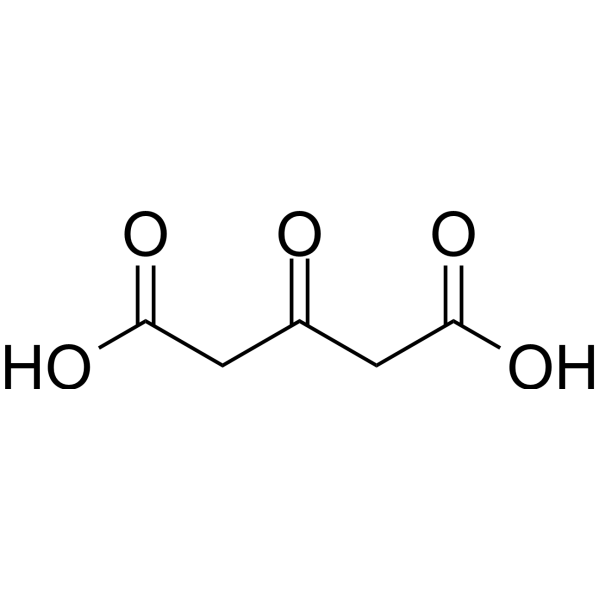
3-Oxopentanedioic acid

Based on 1 Customer Validation
3-Oxopentanedioic acid is a dicarboxylic acid that is easily brominated. 3-Oxopentanedioic acid can be used as an intermediate in organic chemical synthesis.
商品は「研究用試薬」です。人や動物の医療用・臨床診断用・食品用の製品ではありません。
研究用途以外に使用した場合、当社は一切の責任を負いかねます。
- 純度 : 97.0%
- CAS 番号: 542-05-2
- 分子式: C5H6O5
- 分子量:146.10
-
保管条件:
-20°C, sealed storage, away from moisture
* The compound is unstable in solutions, freshly prepared is recommended.

To place orders, for customer services and technical support, please contact: MedChemExpress USA
Tel: 609-228-6898 E-mail: [email protected] [email protected]


-
 生物活性
生物活性
-
化学情報
-
溶剤 & 溶解度
- 純度とドキュメンテーション
- 参考文献
-
 Help & FAQs


-
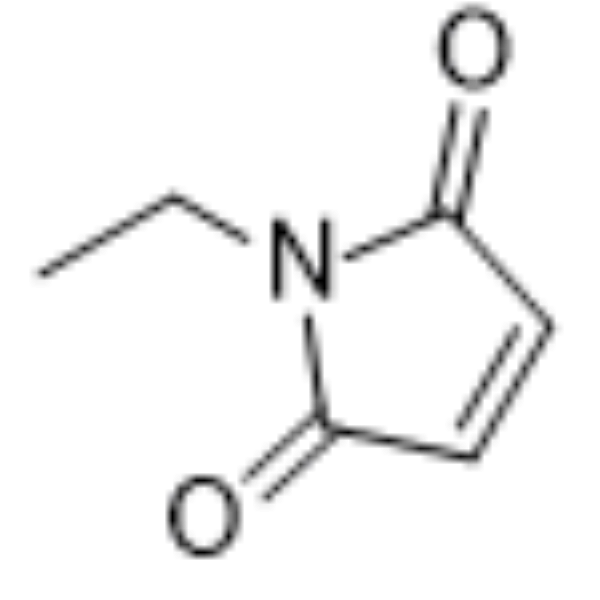
HY-D0843
N-EthylmaleimideCysteine Residues Modifier -

HY-W007752R
3-Oxopentanedioic acid (Standard)Intermediate -
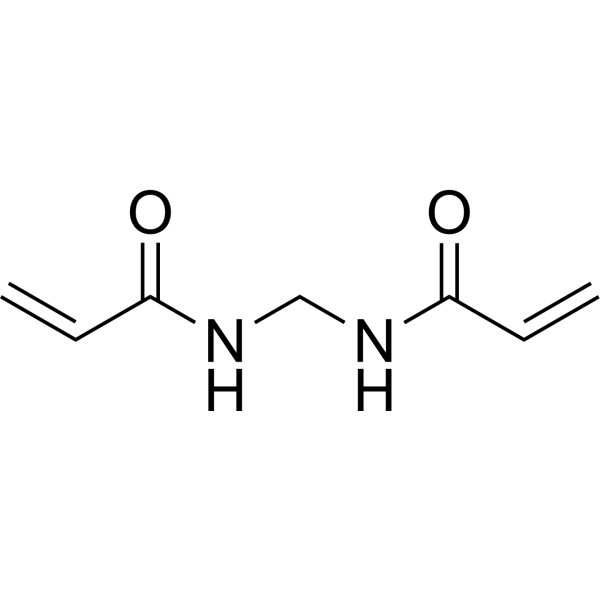
HY-D0848
N,N'-MethylenebisacrylamideCrosslinker -

HY-W017061
1,6-BismaleimidohexaneBiochemical Assay Reagent -
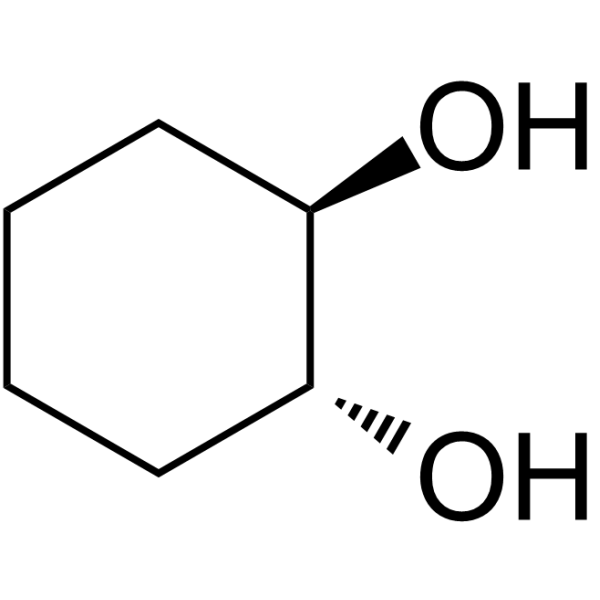
HY-W010514
trans-Cyclohexane-1,2-diolNuclear Pore Complex Dilator -
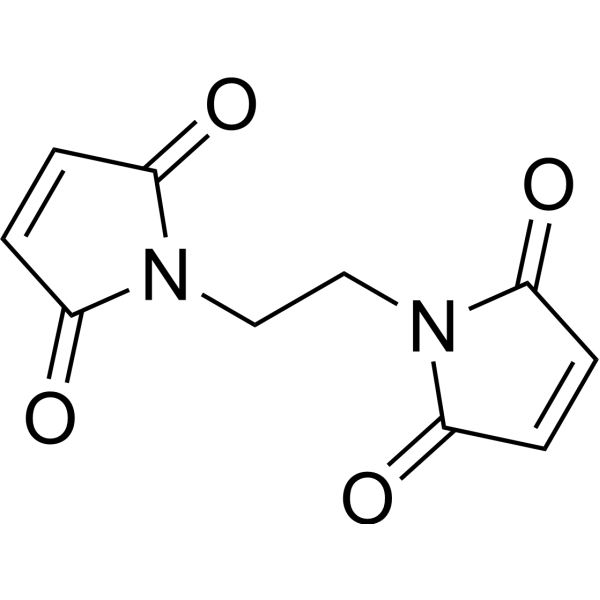
HY-W013538
1,2-Bis(maleimido)ethaneProtein Cross-Linking Agent -
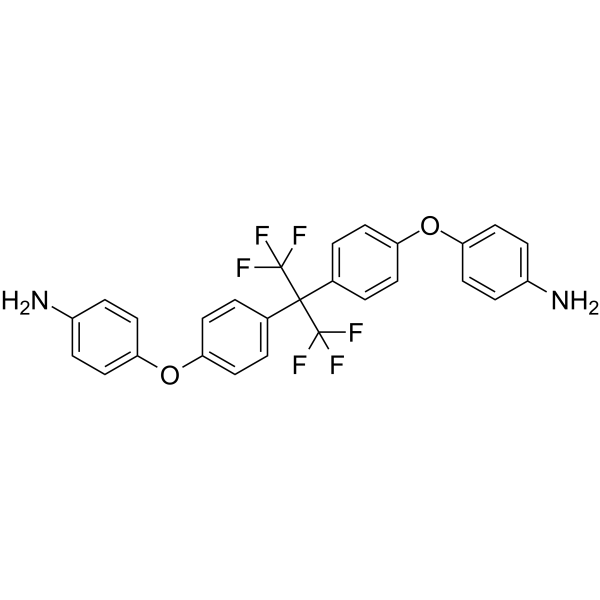
HY-W013712
GI-530159TREK1/2 Channels Opener -

HY-W095198
N-(2-Hydroxyethyl)acrylamideAmphiphilic Polymer -

HY-W011957
1,4-Bis-maleimidobutaneBiochemical Reagent -
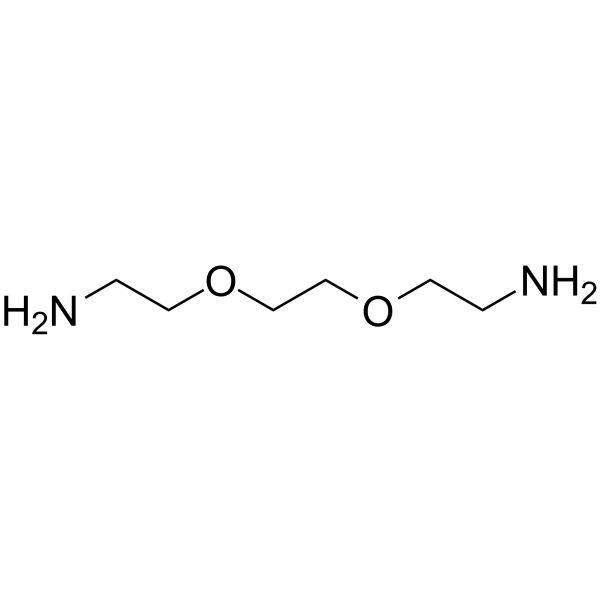
HY-128833
Bis-NH2-PEG2PROTAC Linkers -
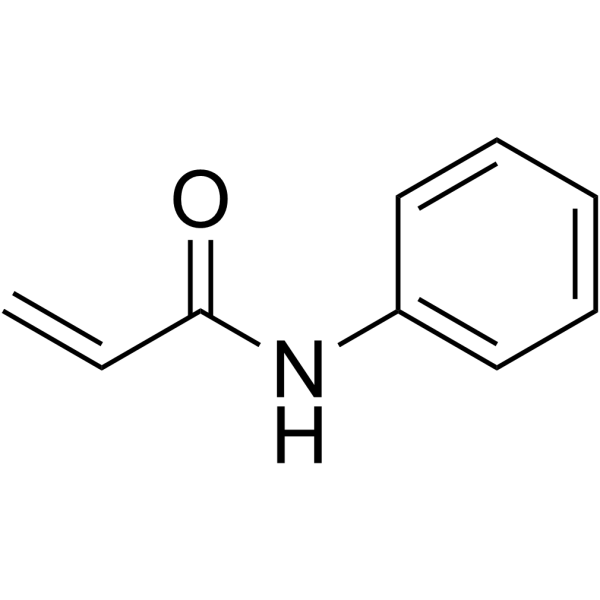
HY-W018582
N-PhenylacrylamideOchratoxin A Binder -

HY-119526
Bismaleimide
Endogenous Metabolite アイソフォーム固有の製品をすべて表示
More

生物活性
製品説明
体外実験
3-Oxopentanedioic acid is an aliphatic β-dicarbonyl acid, which can be used as a model compound for relevant structures in natural organic matter to study the formation mechanism of brominated trihalomethanes during chlorination, bromination and ozonation of saline water[3].
MedChemExpress (MCE) has not independently confirmed the accuracy of these methods. They are for reference only.


化学情報
-
CAS 番号 542-05-2
-
性状 Solid
-
分子量 146.10
-
分子式 C5H6O5
-
Color White to off-white
-
SMILES
O=C(CC(O)=O)CC(O)=O
-
別名
3-オキソグルタル酸; 1,3-アセトンジカルボン酸
-
Structure Classification
-
Initial Source
-
輸送条件
Room temperature in continental US; may vary elsewhere.
-
保管条件
-20°C, sealed storage, away from moisture
* The compound is unstable in solutions, freshly prepared is recommended.


溶剤 & 溶解度
体外:
H2O : 100 mg/mL (684.46 mM; Need ultrasonic)
DMSO : 100 mg/mL (684.46 mM; Need ultrasonic; Hygroscopic DMSO has a significant impact on the solubility of product, please use newly opened DMSO)
Please refer to the solubility information to select the appropriate solvent. The compound is unstable in solutions, freshly prepared is recommended.
* Note: If you choose water as the stock solution, please dilute it to the working solution, then filter and sterilize it with a 0.22 μm filter before use.
Please refer to the solubility information to select the appropriate solvent. The compound is unstable in solutions, freshly prepared is recommended.
* Note: If you choose water as the stock solution, please dilute it to the working solution, then filter and sterilize it with a 0.22 μm filter before use.
濃度 (開始) × 体積 (開始) = 濃度 (終了) × 体積 (終了)
体内:
Select the appropriate dissolution method based on your experimental animal and administration route.
- For the following dissolution methods, please ensure to first prepare a clear stock solution using an In Vitro approach and then sequentially add co-solvents:
- To ensure reliable experimental results, the clarified stock solution can be appropriately stored based on storage conditions. As for the working solution for In Vivo experiments, it is recommended to prepare freshly and use it on the same day.
- The percentages shown for the solvents indicate their volumetric ratio in the final prepared solution. If precipitation or phase separation occurs during preparation, heat and/or sonication can be used to aid dissolution.
Add each solvent one by one: 10% DMSO 40% PEG300 5% Tween-80 45% Saline
Solubility: ≥ 3 mg/mL (20.53 mM); Clear solution
This protocol yields a clear solution of ≥ 3 mg/mL (saturation unknown).
Taking 1 mL working solution as an example, add 100 μL DMSO stock solution (30.0 mg/mL) to 400 μL PEG300, and mix evenly; then add 50 μL Tween-80 and mix evenly; then add 450 μL Saline to adjust the volume to 1 mL.
Preparation of Saline: Dissolve 0.9 g sodium chloride in ddH₂O and dilute to 100 mL to obtain a clear Saline solution.
Add each solvent one by one: 10% DMSO 90% (20% SBE-β-CD in Saline)
Solubility: ≥ 3 mg/mL (20.53 mM); Clear solution
This protocol yields a clear solution of ≥ 3 mg/mL (saturation unknown).
Taking 1 mL working solution as an example, add 100 μL DMSO stock solution (30.0 mg/mL) to 900 μL 20% SBE-β-CD in Saline, and mix evenly.
Preparation of 20% SBE-β-CD in Saline (4°C, storage for one week): 2 g SBE-β-CD powder is dissolved in 10 mL Saline, completely dissolve until clear.
In Vivo Dissolution Calculator
Please enter the basic information of animal experiments:
-
-
-
-
Recommended: Prepare an additional quantity of animals to account for potential losses during experiments.
Working solution concentration: 0.22 mg/mL
This product has good water solubility, please refer to the measured solubility data in water/PBS/Saline for details.


純度とドキュメンテーション
-
データシート (276 KB)
-
SDS (394 KB)
- English - EN (394 KB)
- Français - FR (394 KB)
- Deutsch - DE (394 KB)
- Norwegian - NO (394 KB)
- Español - ES (394 KB)
- Swedish - SV (394 KB)
- Italian - IT (394 KB)
- Korean - KR (394 KB)
- Portuguese - PT (394 KB)
-
取扱説明書 (2659 KB)
参考文献
[1]. Sevcík P, et al. Carbon dioxide evolution in a Belousov-Zhabotinsky type oscillating reaction with acetonedicarboxylic acid. J Phys Chem A. 2007 Oct 11;111(40):10050-4. [Content Brief]
[3]. Liu ZQ, et al. Formation of brominated trihalomethanes during chlorination or ozonation of natural organic matter extracts and model compounds in saline water. Water Res. 2018 Oct 15;143:492-502. [Content Brief]


Complete Stock Solution Preparation Table
Please refer to the solubility information to select the appropriate solvent. The compound is unstable in solutions, freshly prepared is recommended.
| Optional Solvent | Concentration Solvent Mass | 1 mg | 5 mg | 10 mg | 25 mg |
|---|---|---|---|---|---|
| H2O / DMSO | 1 mM | 6.8446 mL | 34.2231 mL | 68.4463 mL | 171.1157 mL |
| 5 mM | 1.3689 mL | 6.8446 mL | 13.6893 mL | 34.2231 mL | |
| 10 mM | 0.6845 mL | 3.4223 mL | 6.8446 mL | 17.1116 mL | |
| 15 mM | 0.4563 mL | 2.2815 mL | 4.5631 mL | 11.4077 mL | |
| 20 mM | 0.3422 mL | 1.7112 mL | 3.4223 mL | 8.5558 mL | |
| 25 mM | 0.2738 mL | 1.3689 mL | 2.7379 mL | 6.8446 mL | |
| 30 mM | 0.2282 mL | 1.1408 mL | 2.2815 mL | 5.7039 mL | |
| 40 mM | 0.1711 mL | 0.8556 mL | 1.7112 mL | 4.2779 mL | |
| 50 mM | 0.1369 mL | 0.6845 mL | 1.3689 mL | 3.4223 mL | |
| 60 mM | 0.1141 mL | 0.5704 mL | 1.1408 mL | 2.8519 mL | |
| 80 mM | 0.0856 mL | 0.4278 mL | 0.8556 mL | 2.1389 mL | |
| 100 mM | 0.0684 mL | 0.3422 mL | 0.6845 mL | 1.7112 mL |
* Note: If you choose water as the stock solution, please dilute it to the working solution, then filter and sterilize it with a 0.22 μm filter before use.


3-Oxopentanedioic acid 関連分類
HY-W007752 関連分類
 Powered by Bioz