



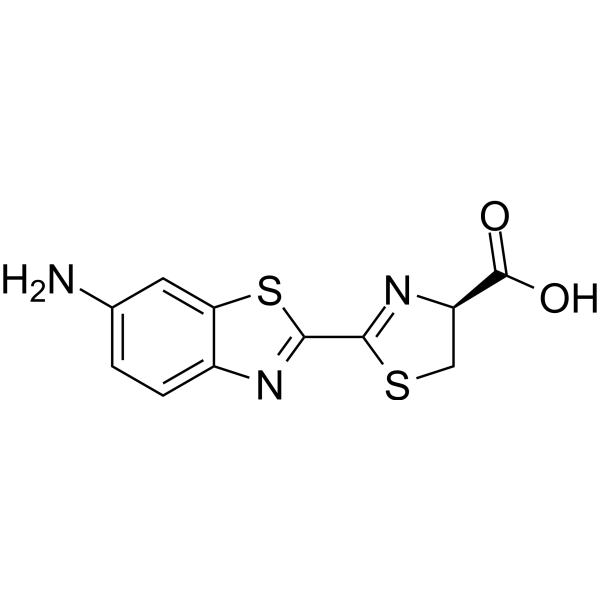
6′-Amino-D-luciferin

Based on 1 Customer Validation
6’-Amino-D-luciferin is a derivative of D-luciferin (HY-12591A) with an amino group replacing the 6-hydroxyl group. 6’-Amino-D-luciferin is a natural substrate of luciferase (Luc) and can be used for IVIS imaging in cell/animal experiments[1][2][3].
For research use only. We do not sell to patients.
- Purity : 98.45%
- CAS No.: 161055-47-6
- Formula: C11H9N3O2S2
- Molecular Weight:279.34
-
Storage:Powder -20°C, 3 years , 4°C, 2 years ; In solvent -80°C, 6 months , -20°C, 1 month

To place orders, for customer services and technical support, please contact: MedChemExpress USA
Tel: 609-228-6898 E-mail: [email protected] [email protected]


-
 Biological Activity
-
Chemical Information
-
Solvent & Solubility
- Purity & Documentation
- References
-
 Help & FAQs




Biological Activity
Description
In Vitro
6′-Amino-D-luciferin (0.5 mg/mL; 2 min) causes a red shift in the bioluminescence spectrum of green-yellow light-emitting luciferases and a blue shift in the spectrum of red light-emitting luciferases in recombinant beetle luciferase assays, while the spectrum of the 5,5-dimethyl analog is almost identical to that of aminoluciferin[1].
6′-Amino-D-luciferin (100 μM; 20 μL; 10-40 min) produces a total luminescence output approximately 74% that of native luciferin[2].
N-Z-DEVD-aLuc (1-100 μM; 45 min) increases caspase-3 activity; at 10 μM, this effect can be completely inhibited by Z-VAD-fmk (HY-16658B)[3].
6′-Amino-D-luciferin is suitable for IVIS imaging in cell and animal experiments and can be used to analyze interactions with mutant active sites (λmax=588 nm).
Guidelines (The following is our recommended protocol. This protocol is provided for reference only and should be modified according to your specific needs).
1. Enzyme Activity and Kinetic Assays
In vitro experiments[1]:
Reaction system: 5-10 μL ATP/MgSO4 mixture (40 mM/80 mM) + 10 μL enzyme solution (0.5-1 mg/mL) + 80-85 μL 0.5 mM 6′-Amino-D-luciferin (pH 8.0 Tris-HCl); bioluminescence intensity is measured at 22°C.
Cell experiments[2]:
FLuc+ cells (MDA-MB-468): seed 6×10⁴ cells/well, add 100 μM 6′-Amino-D-luciferin, and monitor luminescence kinetics using an IVIS200 imaging system (10-second integration, no filter).
2. Bioluminescence Spectral Analysis
In vitro spectroscopy[2]:
40 μL PBS + 20 μL ATP buffer (0.5 mM ATP, 0.5 mM CoA, 10 mM MgSO4) + 1 μL substrate (1.5 mM) + 5 μL FLuc (130 μg/mL). Spectra are collected using a FluoroMax-3 fluorometer (excitation light path blocked, 1 nm increments, 10 nm emission slit width).
In vivo imaging[2]:
FLuc+ tumor cells are subcutaneously implanted into nude mice, followed by tail vein injection of 2.5 mM 6′-Amino-D-luciferin (100 μL). Imaging is performed using an IVIS200 system (30-second integration, no filter), and tumor signals are normalized.
MedChemExpress (MCE) has not independently confirmed the accuracy of these methods. They are for reference only.
In Vivo
MedChemExpress (MCE) has not independently confirmed the accuracy of these methods. They are for reference only.


Chemical Information
-
CAS No. 161055-47-6
-
Appearance Solid
-
Molecular Weight 279.34
-
Formula C11H9N3O2S2
-
Color Light yellow to brown
-
SMILES
O=C([C@@H]1N=C(C2=NC3=CC=C(N)C=C3S2)SC1)O
-
Shipping
Room temperature in continental US; may vary elsewhere.
-
Storage
Powder -20°C 3 years 4°C 2 years In solvent -80°C 6 months -20°C 1 month


Solvent & Solubility
In Vitro:
DMSO : 100 mg/mL (357.99 mM; Need ultrasonic; Hygroscopic DMSO has a significant impact on the solubility of product, please use newly opened DMSO)
Please refer to the solubility information to select the appropriate solvent. Once prepared, please aliquot and store the solution to prevent product inactivation from repeated freeze-thaw cycles.
Storage method and period of stock solution: -80°C, 6 months; -20°C, 1 month. When stored at -80°C, please use it within 6 months. When stored at -20°C, please use it within 1 month.
Please refer to the solubility information to select the appropriate solvent. Once prepared, please aliquot and store the solution to prevent product inactivation from repeated freeze-thaw cycles.
Storage method and period of stock solution: -80°C, 6 months; -20°C, 1 month. When stored at -80°C, please use it within 6 months. When stored at -20°C, please use it within 1 month.
Concentration (start) × Volume (start) = Concentration (final) × Volume (final)


Purity & Documentation
-
Data Sheet (274 KB)
-
SDS (393 KB)
- English - EN (393 KB)
- Français - FR (393 KB)
- Deutsch - DE (393 KB)
- Norwegian - NO (393 KB)
- Español - ES (393 KB)
- Swedish - SV (393 KB)
- Italian - IT (393 KB)
- Korean - KR (393 KB)
- Portuguese - PT (393 KB)
-
Handling Instructions (2659 KB)
References
[1]. Viviani VR, et al. Bioluminescence of beetle luciferases with 6'-amino-D-luciferin analogues reveals excited keto-oxyluciferin as the emitter and phenolate/luciferin binding site interactions modulate bioluminescence colors. Biochemistry. 2014 Aug 19;53(32):5208-20 [Content Brief]
[2]. Conley NR, et al. A selenium analogue of firefly D-luciferin with red-shifted bioluminescence emission. Angew Chem Int Ed Engl. 2012 Apr 2;51(14):3350-3. [Content Brief]
[3]. Kovács AK, et al. Synthesis of N-peptide-6-amino-D-luciferin Conjugates. Front Chem. 2018 Apr 19;6:120. [Content Brief]


Complete Stock Solution Preparation Table
Please refer to the solubility information to select the appropriate solvent. Once prepared, please aliquot and store the solution to prevent product inactivation from repeated freeze-thaw cycles.
Storage method and period of stock solution: -80°C, 6 months; -20°C, 1 month. When stored at -80°C, please use it within 6 months. When stored at -20°C, please use it within 1 month.
| Optional Solvent | Concentration Solvent Mass | 1 mg | 5 mg | 10 mg | 25 mg |
|---|---|---|---|---|---|
| DMSO | 1 mM | 3.5799 mL | 17.8993 mL | 35.7987 mL | 89.4967 mL |
| 5 mM | 0.7160 mL | 3.5799 mL | 7.1597 mL | 17.8993 mL | |
| 10 mM | 0.3580 mL | 1.7899 mL | 3.5799 mL | 8.9497 mL | |
| 15 mM | 0.2387 mL | 1.1933 mL | 2.3866 mL | 5.9664 mL | |
| 20 mM | 0.1790 mL | 0.8950 mL | 1.7899 mL | 4.4748 mL | |
| 25 mM | 0.1432 mL | 0.7160 mL | 1.4319 mL | 3.5799 mL | |
| 30 mM | 0.1193 mL | 0.5966 mL | 1.1933 mL | 2.9832 mL | |
| 40 mM | 0.0895 mL | 0.4475 mL | 0.8950 mL | 2.2374 mL | |
| 50 mM | 0.0716 mL | 0.3580 mL | 0.7160 mL | 1.7899 mL | |
| 60 mM | 0.0597 mL | 0.2983 mL | 0.5966 mL | 1.4916 mL | |
| 80 mM | 0.0447 mL | 0.2237 mL | 0.4475 mL | 1.1187 mL | |
| 100 mM | 0.0358 mL | 0.1790 mL | 0.3580 mL | 0.8950 mL |


6′-Amino-D-luciferin Related Classifications
HY-126994 Related Classifications
 Powered by Bioz