



Zoligratinib
Based on 3 publication(s) in Google Scholar
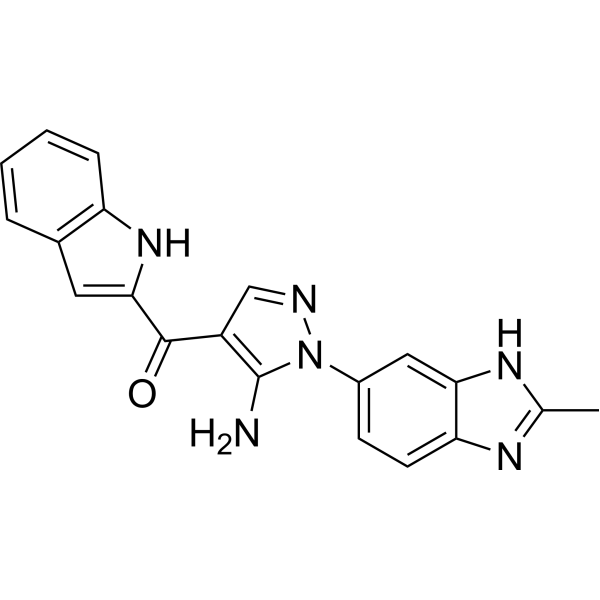
Zoligratinib (Debio 1347) is an orally available and selective FGFR inhibitor with IC50s of 9.3, 7.6, and 22 nM for FGFR1, FGFR2, FGFR3, and FGFR4, respectively.
Nur für Forschungszwecke. Wir verkaufen nicht an Patienten.
- Reinheit : 99.76%
- CAS. Nr.: 1265229-25-1
- Formel: C20H16N6O
- Molecular Weight:356.38
-
Speicherung:Powder -20°C, 3 years , 4°C, 2 years ; In solvent -80°C, 2 years , -20°C, 1 year

To place orders, for customer services and technical support, please contact: MedChemExpress USA
Tel: 609-228-6898 E-mail: [email protected] [email protected]


-
 Biologische Aktivität
-
Chemical Information
-
Lösungsmittel & Löslichkeit
- Reinheit & Dokumentation
- Verweise
-
 Help & FAQs


-
HY-13330
FexagratinibFGFR Inhibitor -
HY-13311
InfigratinibFGFR Inhibitor -
HY-18708
ErdafitinibFGFR Inhibitor -
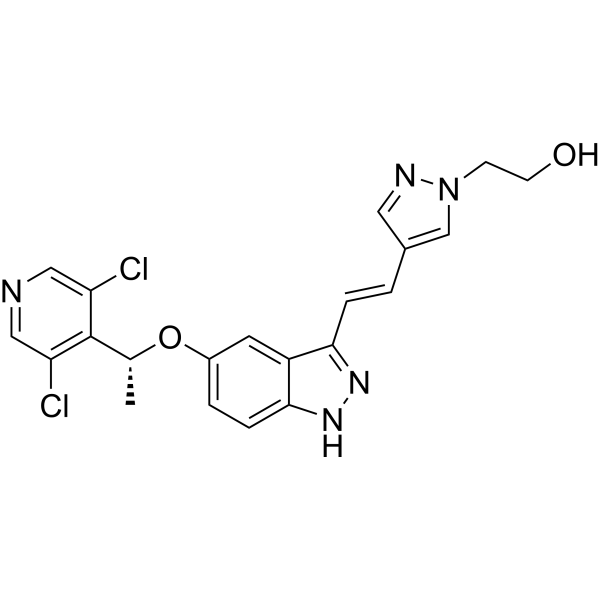
HY-13304
LY2874455FGFR Inhibitor -
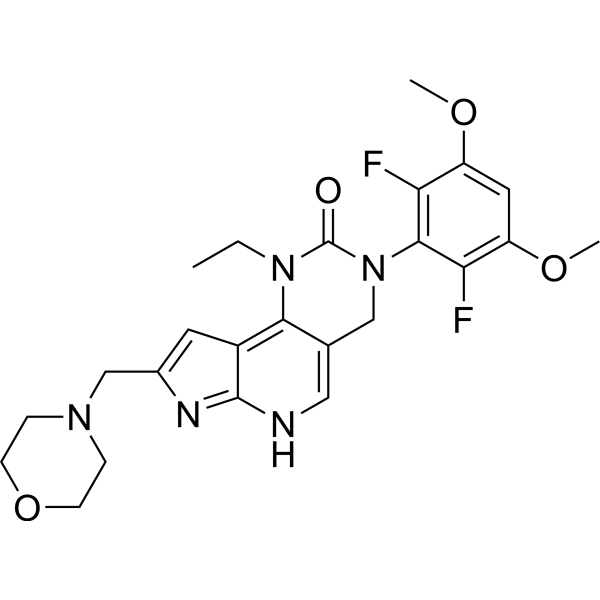
HY-109099
PemigatinibFGFR Inhibitor -
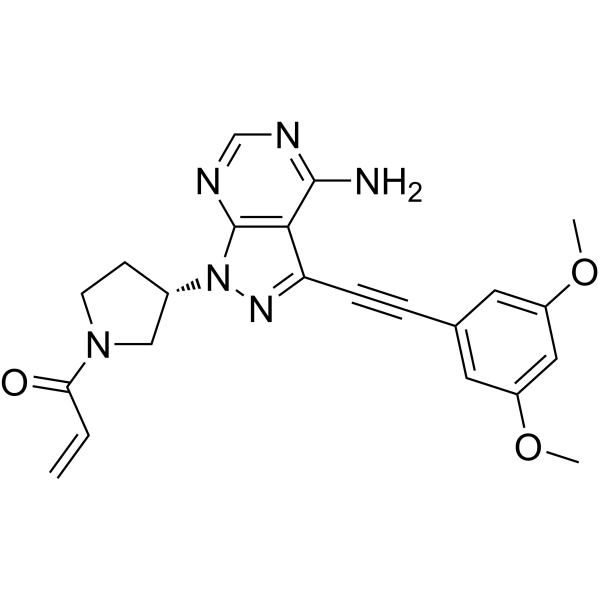
HY-100818
FutibatinibFGFR Inhibitor -
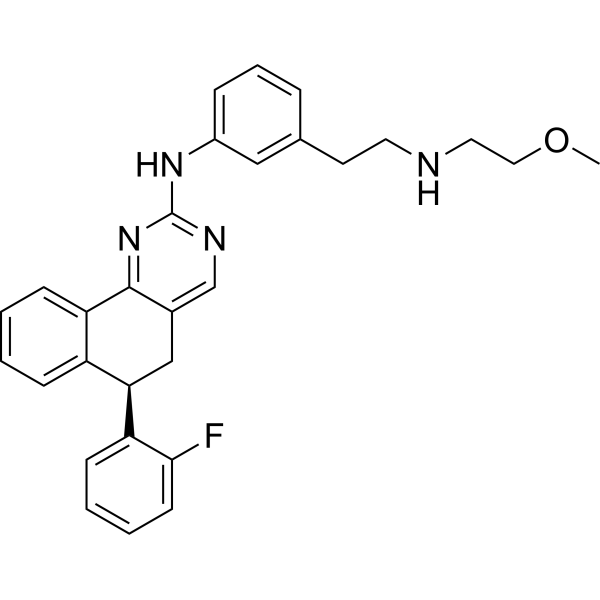
HY-19981
Derazantinib -
HY-100434
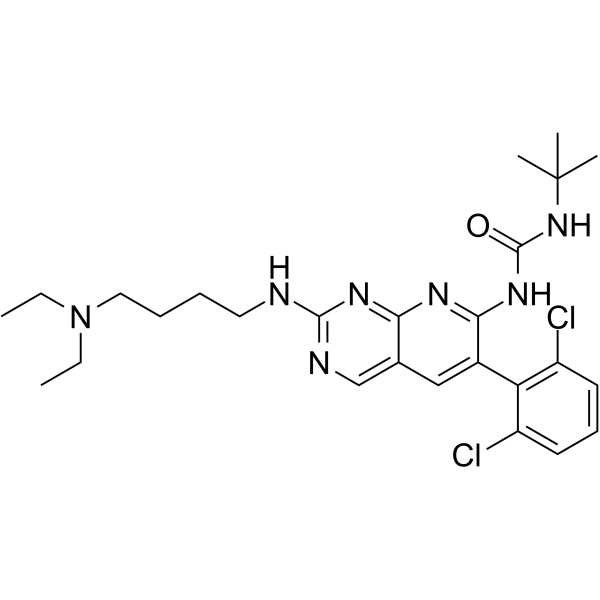
PD-161570FGFR1 Inhibitor -
HY-100492
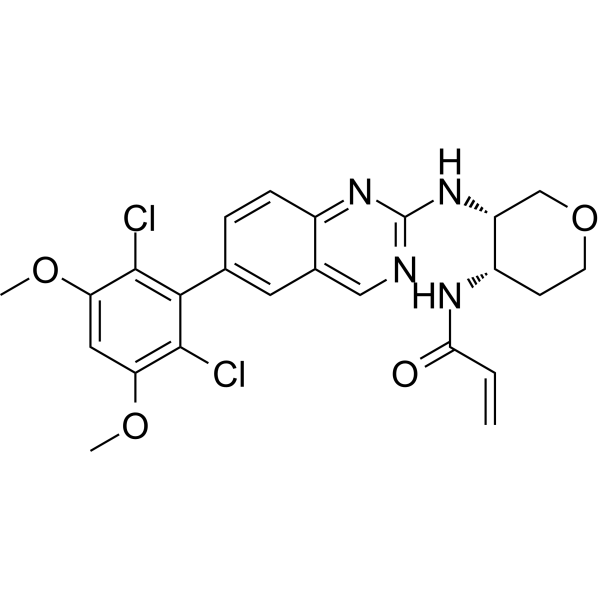
FisogatinibFGFR4 Inhibitor -
HY-100019
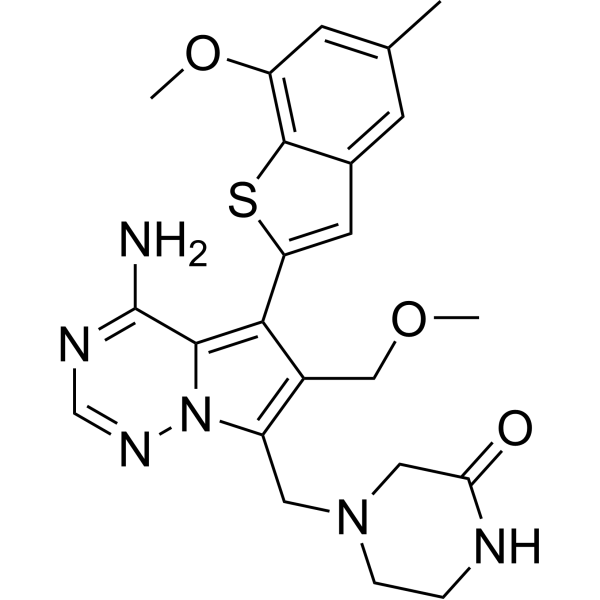
RogaratinibFGFR1-4 Inhibitor -
HY-15391
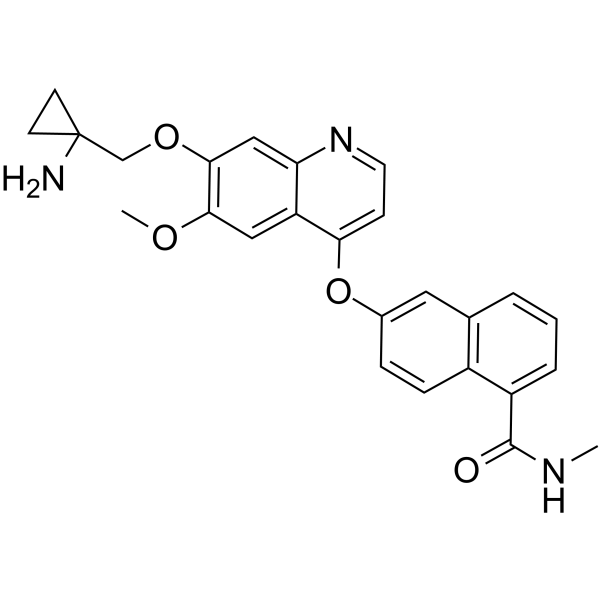
LucitanibVEGFR/FGFR Inhibitor -
HY-10179
DanusertibAurora Kinase Inhibitor
Publications Citing Use of MedChemExpress (MCE) Zoligratinib
More

Biologische Aktivität
Beschreibung
IC50 & Target
[1]|
FGFR1 9.3 nM (IC50) |
FGFR2 7.6 nM (IC50) |
FGFR3 22 nM (IC50) |
FGFR4 290 nM (IC50) |
Cellular Effect
|
Cell Line

|
Type | Value | Description | References |
|---|---|---|---|---|
| BaF3 | GI50 |
8.24 μM
Compound: 5; debio-1347
|
Growth inhibition of mouse BaF3 cells harboring TEL-FGFR3 V555M mutant incubated for 72 hrs by Alamar blue assay
Growth inhibition of mouse BaF3 cells harboring TEL-FGFR3 V555M mutant incubated for 72 hrs by Alamar blue assay
|
[PMID: 35436119] |
| CHO | IC50 |
6.9 μM
Compound: 8; CH5183284; Debio 1347
|
Inhibition of human ERG expressed in CHO cells assessed as reduction in channel currents at -80 mV holding potential by automated whole-cell patch clamp method
Inhibition of human ERG expressed in CHO cells assessed as reduction in channel currents at -80 mV holding potential by automated whole-cell patch clamp method
|
[PMID: 27933954] |
| HCT-116 | IC50 |
5900 nM
Compound: 8; CH5183284; Debio 1347
|
Antiproliferative activity against human HCT116 cells incubated for 4 days by CCK8 assay
Antiproliferative activity against human HCT116 cells incubated for 4 days by CCK8 assay
|
[PMID: 27933954] |
| SNU-16 | IC50 |
17 nM
Compound: 8; CH5183284; Debio 1347
|
Antiproliferative activity against human SNU16 cells incubated for 4 days by CCK8 assay
Antiproliferative activity against human SNU16 cells incubated for 4 days by CCK8 assay
|
[PMID: 27933954] |
In Vitro
Zoligratinib is well balanced in cellular antiproliferative activity against SNU-16 and stability in human liver microsome. The selectivity of 8 to inhibit FGFR over KDR is suggested to be caused by the difference in the interaction with M535 in FGFR1 and L889 in KDR[1]. The IC50 of Zoligratinib is 29 nM for FGF-dependent proliferation and 780 nM for VEGF-dependent proliferation[2].
MedChemExpress (MCE) has not independently confirmed the accuracy of these methods. They are for reference only.
In Vivo
MedChemExpress (MCE) has not independently confirmed the accuracy of these methods. They are for reference only.
Clinical Trial
| NCT Number | Sponsor | Condition | Start Date |
Phase
|
|---|---|---|---|---|
| NCT01329991 | Plexxikon| | 2011-05 | PHASE1 |


Chemical Information
-
CAS. Nr. 1265229-25-1
-
Appearance Solid
-
Molecular Weight 356.38
-
Formel C20H16N6O
-
Color Off-white to yellow
-
SMILES
O=C(C1=C(N)N(C2=CC=C3N=C(C)NC3=C2)N=C1)C(N4)=CC5=C4C=CC=C5
-
Synonyms
Debio 1347; CH5183284
-
Versand
Room temperature in continental US; may vary elsewhere.
-
Speicherung
Powder -20°C 3 years 4°C 2 years In solvent -80°C 2 years -20°C 1 year


Publications (3)
-
Journal Impact Factor
-
Most Recent
-
Nature
2022 Aug;608(7923):609-617. PMID: 35948633 -
Cell Rep
IMPDH2 dephosphorylation under FGFR signaling promotes S-phase progression and tumor growth. [Abstract]2024 Dec 30;44(1):115116. PMID: 39739531 -
Oncotarget
2020 Nov 3;11(44):3921-3932. PMID: 33216841


Lösungsmittel & Löslichkeit
In Vitro:
DMSO : 25 mg/mL (70.15 mM; ultrasonic and warming and heat to 50°C; Hygroscopic DMSO has a significant impact on the solubility of product, please use newly opened DMSO)
Please refer to the solubility information to select the appropriate solvent. Once prepared, please aliquot and store the solution to prevent product inactivation from repeated freeze-thaw cycles.
Storage method and period of stock solution: -80°C, 2 years; -20°C, 1 year. When stored at -80°C, please use it within 2 years. When stored at -20°C, please use it within 1 year.
Please refer to the solubility information to select the appropriate solvent. Once prepared, please aliquot and store the solution to prevent product inactivation from repeated freeze-thaw cycles.
Storage method and period of stock solution: -80°C, 2 years; -20°C, 1 year. When stored at -80°C, please use it within 2 years. When stored at -20°C, please use it within 1 year.
Konzentration (Stammlösung) × Volumen (Stammlösung) = Konzentration (Ziellösung) × Volumen (Ziellösung)
In Vivo:
Select the appropriate dissolution method based on your experimental animal and administration route.
- For the following dissolution methods, please ensure to first prepare a clear stock solution using an In Vitro approach and then sequentially add co-solvents:
- To ensure reliable experimental results, the clarified stock solution can be appropriately stored based on storage conditions. As for the working solution for In Vivo experiments, it is recommended to prepare freshly and use it on the same day.
- The percentages shown for the solvents indicate their volumetric ratio in the final prepared solution. If precipitation or phase separation occurs during preparation, heat and/or sonication can be used to aid dissolution.
Add each solvent one by one: 10% DMSO 40% PEG300 5% Tween-80 45% Saline
Solubility: ≥ 2.08 mg/mL (5.84 mM); Clear solution
This protocol yields a clear solution of ≥ 2.08 mg/mL (saturation unknown).
Taking 1 mL working solution as an example, add 100 μL DMSO stock solution (20.8 mg/mL) to 400 μL PEG300, and mix evenly; then add 50 μL Tween-80 and mix evenly; then add 450 μL Saline to adjust the volume to 1 mL.
Preparation of Saline: Dissolve 0.9 g sodium chloride in ddH₂O and dilute to 100 mL to obtain a clear Saline solution.
Add each solvent one by one: 10% DMSO 90% (20% SBE-β-CD in Saline)
Solubility: ≥ 2.08 mg/mL (5.84 mM); Clear solution
This protocol yields a clear solution of ≥ 2.08 mg/mL (saturation unknown).
Taking 1 mL working solution as an example, add 100 μL DMSO stock solution (20.8 mg/mL) to 900 μL 20% SBE-β-CD in Saline, and mix evenly.
Preparation of 20% SBE-β-CD in Saline (4°C, storage for one week): 2 g SBE-β-CD powder is dissolved in 10 mL Saline, completely dissolve until clear.
In Vivo Dissolution Calculator
Please enter the basic information of animal experiments:
-
-
-
-
Recommended: Prepare an additional quantity of animals to account for potential losses during experiments.
Please enter your animal formula composition:
-
%DMSO +
Recommended: Keep the proportion of DMSO in working solution below 2% if your animal is weak.
-
%+
-
+%Tween-80 + +
-
%Saline +
The co-solvents required include: DMSO, . All of co-solvents are available by MedChemExpress (MCE). , Tween 80. All of co-solvents are available by MedChemExpress (MCE).
Working solution concentration: 0.22 mg/mL
Method for preparing stock solution: mg drug dissolved in μL DMSO. Stock solution concentration: mg/mL.
1. Take μL DMSO stock solution;
2. Add μL .
μL , mix evenly;
3. Then add μL Tween 80, mix evenly;
4. Then add μL
Please ensure that the stock solution in the first step is dissolved to a clear state, and add co-solvents in sequence. You can use ultrasonic heating (ultrasonic cleaner, recommended frequency 20-40 kHz), vortexing, etc. to assist dissolution.


Reinheit & Dokumentation
-
Data Sheet (280 KB)
-
SDS (254 KB)
- English - EN (254 KB)
- Français - FR (254 KB)
- Deutsch - DE (254 KB)
- Norwegian - NO (254 KB)
- Español - ES (254 KB)
- Swedish - SV (254 KB)
- Italian - IT (254 KB)
- Korean - KR (254 KB)
- Portuguese - PT (254 KB)
-
Handling Instructions (2659 KB)
Verweise
[1]. Nakanishi Y, et al. The fibroblast growth factor receptor genetic status as a potential predictor of the sensitivity to CH5183284/Debio 1347, a novel selective FGFR inhibitor. Mol Cancer Ther. 2014 Nov;13(11):2547-58. [Content Brief]
[2]. Nakanishi Y, et al. Mechanism of Oncogenic Signal Activation by the Novel Fusion Kinase FGFR3-BAIAP2L1. Mol Cancer Ther. 2015 Mar;14(3):704-12. [Content Brief]
[3]. Nakanishi Y, et al. ERK Signal Suppression and Sensitivity to CH5183284/Debio 1347, a Selective FGFR Inhibitor. Mol Cancer Ther. 2015 Dec;14(12):2831-9. [Content Brief]


Complete Stock Solution Preparation Table
Please refer to the solubility information to select the appropriate solvent. Once prepared, please aliquot and store the solution to prevent product inactivation from repeated freeze-thaw cycles.
Storage method and period of stock solution: -80°C, 2 years; -20°C, 1 year. When stored at -80°C, please use it within 2 years. When stored at -20°C, please use it within 1 year.
| Optional Solvent | Concentration Solvent Mass | 1 mg | 5 mg | 10 mg | 25 mg |
|---|---|---|---|---|---|
| DMSO | 1 mM | 2.8060 mL | 14.0300 mL | 28.0599 mL | 70.1498 mL |
| 5 mM | 0.5612 mL | 2.8060 mL | 5.6120 mL | 14.0300 mL | |
| 10 mM | 0.2806 mL | 1.4030 mL | 2.8060 mL | 7.0150 mL | |
| 15 mM | 0.1871 mL | 0.9353 mL | 1.8707 mL | 4.6767 mL | |
| 20 mM | 0.1403 mL | 0.7015 mL | 1.4030 mL | 3.5075 mL | |
| 25 mM | 0.1122 mL | 0.5612 mL | 1.1224 mL | 2.8060 mL | |
| 30 mM | 0.0935 mL | 0.4677 mL | 0.9353 mL | 2.3383 mL | |
| 40 mM | 0.0701 mL | 0.3507 mL | 0.7015 mL | 1.7537 mL | |
| 50 mM | 0.0561 mL | 0.2806 mL | 0.5612 mL | 1.4030 mL | |
| 60 mM | 0.0468 mL | 0.2338 mL | 0.4677 mL | 1.1692 mL |


Zoligratinib Related Classifications
HY-19957 Related Classifications
 Powered by Bioz