



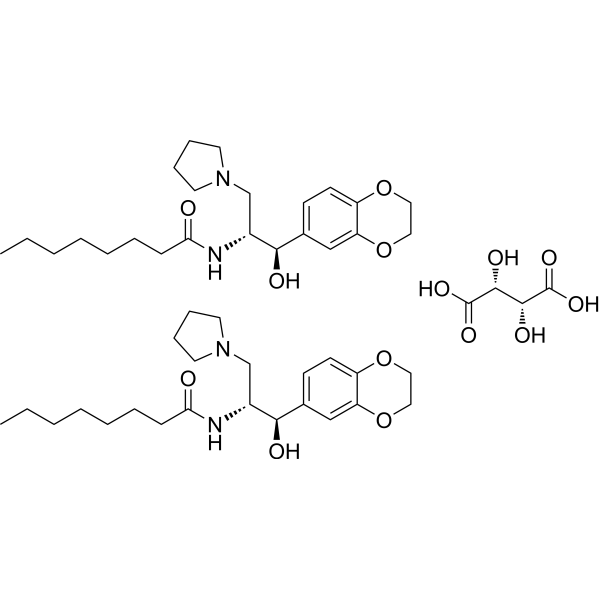
Eliglustat hemitartrate
Based on 13 publication(s) in Google Scholar
Eliglustat hemitartrate is an specific, potent and orally active glucocerebroside synthase inhibitor with an IC50 of 24 nM.
For research use only. We do not sell to patients.
- Purity : 98.93%
- CAS No.: 928659-70-5
- Formula: C50H78N4O14
- Molecular Weight:959.17
-
Storage:
4°C, sealed storage, away from moisture
* In solvent : -80°C, 6 months; -20°C, 1 month (sealed storage, away from moisture)

To place orders, for customer services and technical support, please contact: MedChemExpress USA
Tel: 609-228-6898 E-mail: [email protected] [email protected]


-
 Biological Activity
-
Chemical Information
-
Solvent & Solubility
- Purity & Documentation
- References
-
 Help & FAQs


-
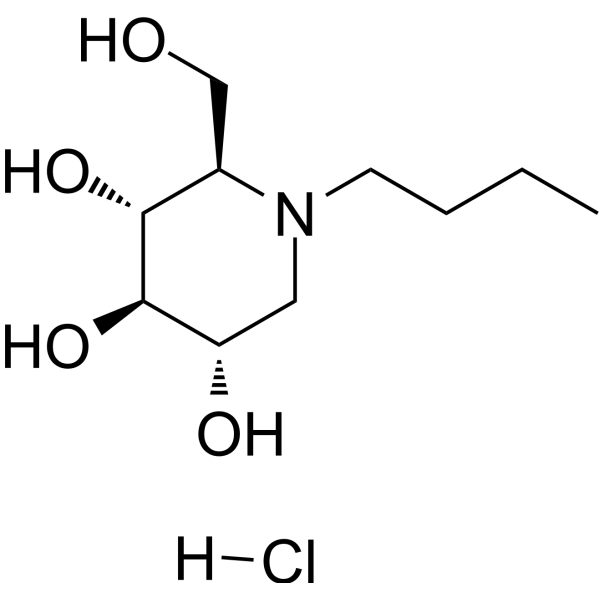
HY-17020A
Miglustat hydrochlorideGlucosylceramide Synthase Inhibitor -
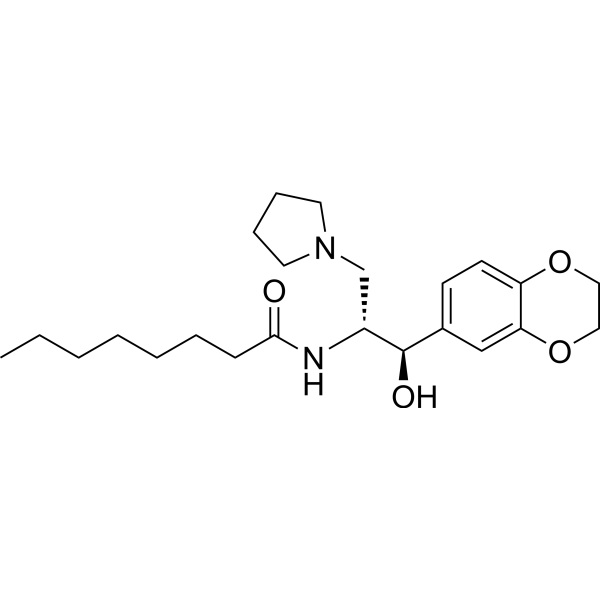
HY-14885
EliglustatGlucocerebroside Synthase Inhibitor -
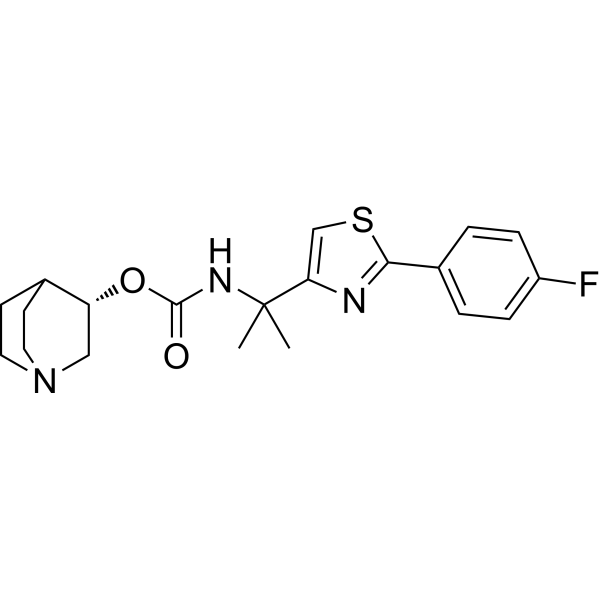
HY-16743
IbiglustatGlucosylceramide Synthase Inhibitor -
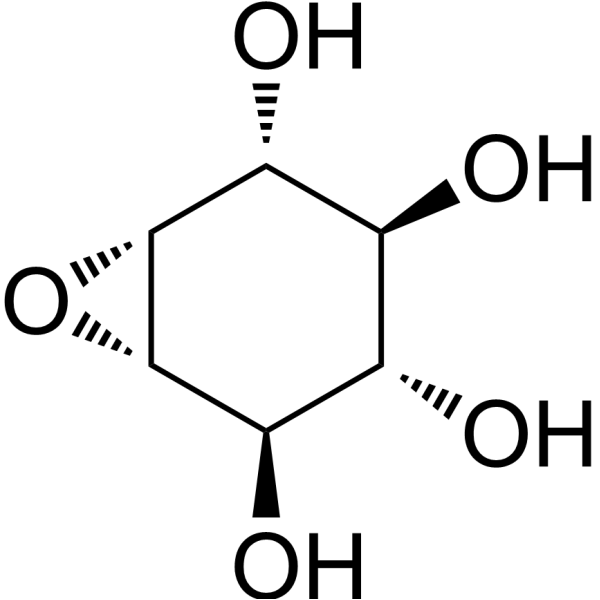
HY-100944
Conduritol B epoxideGcase Inhibitor -
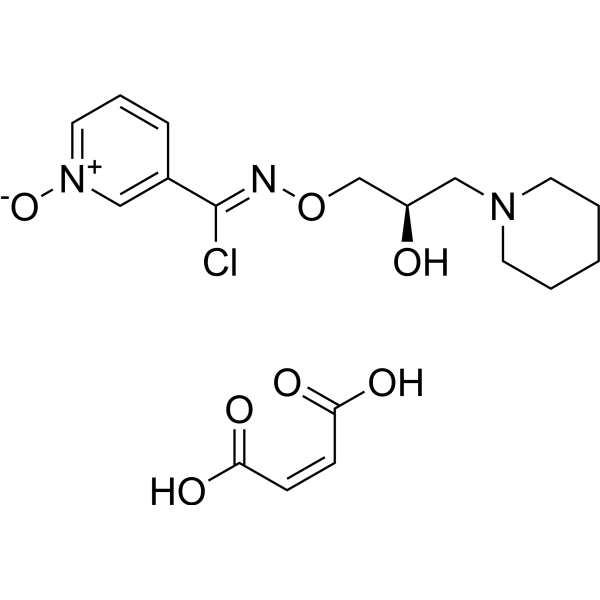
HY-106443A
Arimoclomol maleateHSP Co-Inducer -
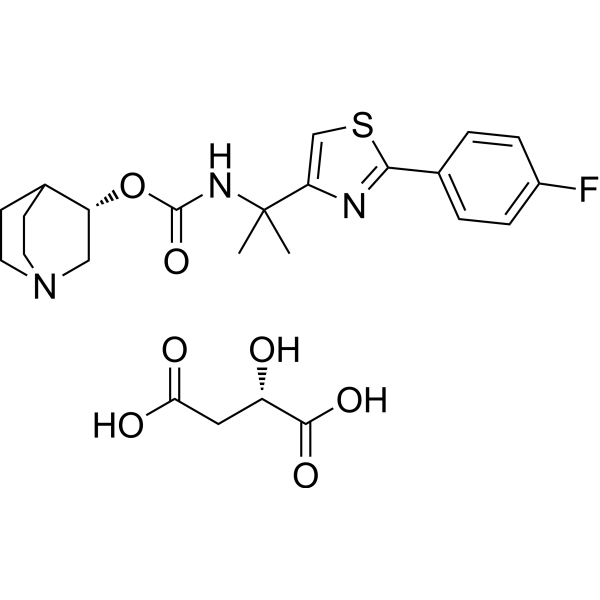
HY-16743A
Ibiglustat (L-Malic acid)Glucosylceramide Synthase Inhibitor -

HY-14885R
Eliglustat (Standard)Glucocerebroside Synthase Inhibitor -

HY-17020AR
Miglustat hydrochloride (Standard)Glucosylceramide Synthase Inhibitor
Publications Citing Use of MedChemExpress (MCE) Eliglustat hemitartrate
More- Immunity. 2021 Jan 12;54(1):132-150.e9. [Abstract]
- Cancer Discov. 2023 Feb 6;13(2):454-473. [Abstract]
- Nat Commun. 2024 Aug 14;15(1):6970. [Abstract]
- Nat Commun. 2020 Aug 27;11(1):4279. [Abstract]
- Sci Adv. 2025 Oct 31;11(44):eaea1212. [Abstract]
- Cell Death Dis. 2021 Oct 6;12(10):911. [Abstract]
- Int J Biol Macromol. 2025 Jan:285:138303. [Abstract]
- EMBO J. 2023 Jan 16;42(2):e110553. [Abstract]
- PLoS Biol. 2025 Sep 11;23(9):e3003362. [Abstract]
- Stem Cells Transl Med. 2021 Jul;10(7):1081-1094. [Abstract]
- PLoS One. 2021 Oct 25;16(10):e0247211. [Abstract]
- Leiden University. 2022 Jun 15.
- bioRxiv. 2021 Feb 2.
 Customer Validation & Images

-
WB
-
Cell Proliferation/Viability Assay
-
Cell Imaging/Staining
-
WB
-
IHC


Biological Activity
Description
IC50 & Target
IC50: 24 nM (glucocerebroside synthase)[1]
In Vitro
Eliglustat tartrate shows good potency with an IC50 of 24 nM and specificity against the target enzyme[1].Incubating K562 or B16/F10 cells for 72 h with increasing amounts of Genz-112638 (0.6-1000 nM) results in a dose-dependent reduction of cell surface levels of both GM1 and GM3. The mean IC50 value for inhibiting the cell surface presentation of GM1 in K562 cells was 24 nM (range 14-34 nM) and that for GM3 in B16/F10 cells was 29 nM (range 12-48 nM)[1].
MedChemExpress (MCE) has not independently confirmed the accuracy of these methods. They are for reference only. .
In Vivo
MedChemExpress (MCE) has not independently confirmed the accuracy of these methods. They are for reference only.
Clinical Trial
| NCT Number | Sponsor | Condition | Start Date |
Phase

|
|---|---|---|---|---|
| NCT01329991 | Plexxikon| | 2011-05 | PHASE1 |


Chemical Information
-
CAS No. 928659-70-5
-
Appearance Solid
-
Molecular Weight 959.17
-
Formula C50H78N4O14
-
Color White to off-white
-
SMILES
CCCCCCCC(N[C@H](CN1CCCC1)[C@@H](C2=CC=C(OCCO3)C3=C2)O)=O.CCCCCCCC(N[C@H](CN4CCCC4)[C@@H](C5=CC=C(OCCO6)C6=C5)O)=O.O=C(O)[C@H](O)[C@@H](O)C(O)=O
-
Synonyms
Genz-112638; Eliglustat tartrate
-
Shipping
Room temperature in continental US; may vary elsewhere.
-
Storage
4°C, sealed storage, away from moisture
* In solvent : -80°C, 6 months; -20°C, 1 month (sealed storage, away from moisture)


Publications (13)
-
Journal Impact Factor
-
Most Recent
-
Immunity
The SPPL3-Defined Glycosphingolipid Repertoire Orchestrates HLA Class I-Mediated Immune Responses. [Abstract]2021 Jan 12;54(1):132-150.e9. PMID: 33271119 -
Cancer Discov
2023 Feb 6;13(2):454-473. PMID: 36331284 -
Nat Commun
Inhibition of glycosphingolipid synthesis with eliglustat in combination with immune checkpoint inhibitors in advanced cancers: preclinical evidence and phase I clinical trial. [Abstract]2024 Aug 14;15(1):6970. PMID: 39138212 -
Nat Commun
Caveolin-1-mediated sphingolipid oncometabolism underlies a metabolic vulnerability of prostate cancer. [Abstract]2020 Aug 27;11(1):4279. PMID: 32855410
Eliglustat hemitartrate purchased from MedChemExpress. Usage Cited in: Nat Commun. 2020 Aug 27;11(1):4279. [Abstract]
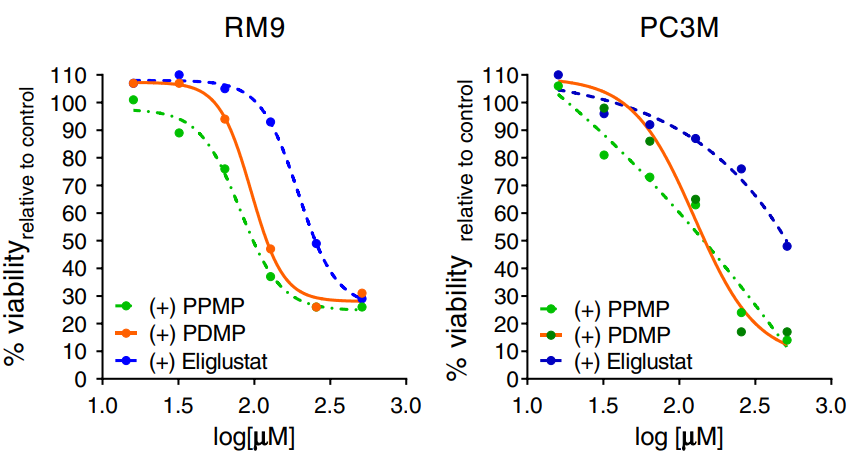
Viability curves for RM-9 and PC-3M cells following 48 h treatment with vehicle (ethanol), Eliglustat (128 μM), PDMP or PPMP.
Eliglustat hemitartrate purchased from MedChemExpress. Usage Cited in: Nat Commun. 2020 Aug 27;11(1):4279. [Abstract]
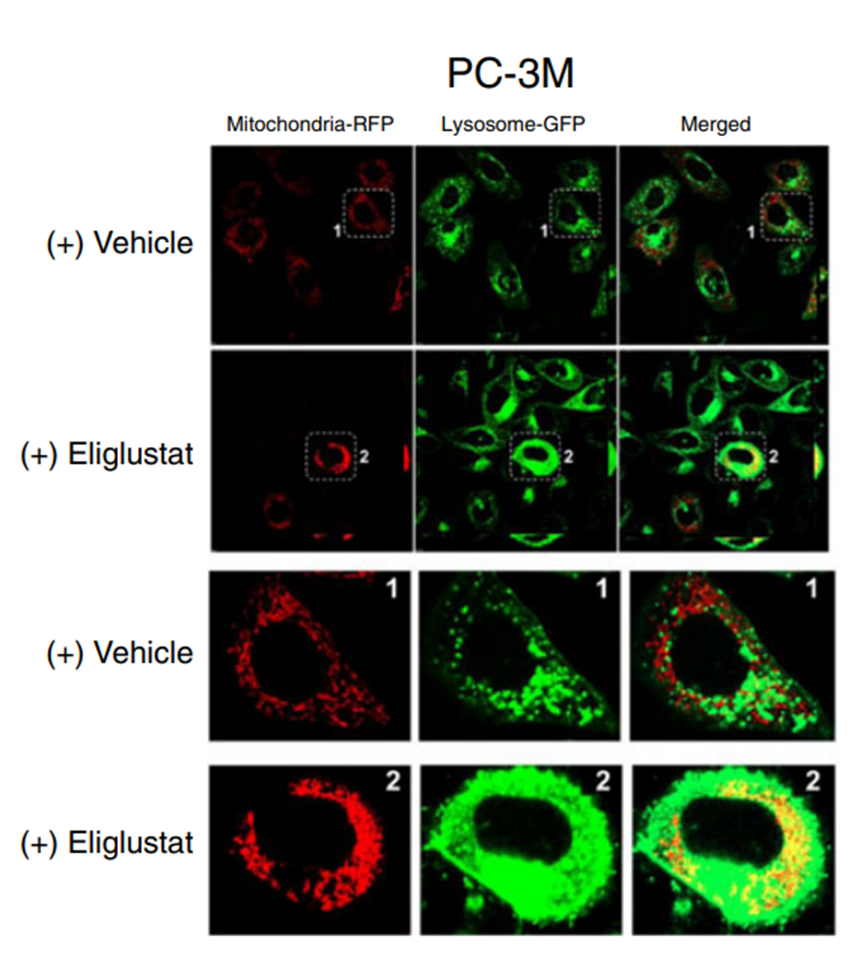
Treatment with Eliglustat (128 μM) indicated loss of the branched, fused-like-mitochondrial architecture, and accumulation of punctate mitochondria co-localized with the lysosome.
Eliglustat hemitartrate purchased from MedChemExpress. Usage Cited in: Nat Commun. 2020 Aug 27;11(1):4279. [Abstract]
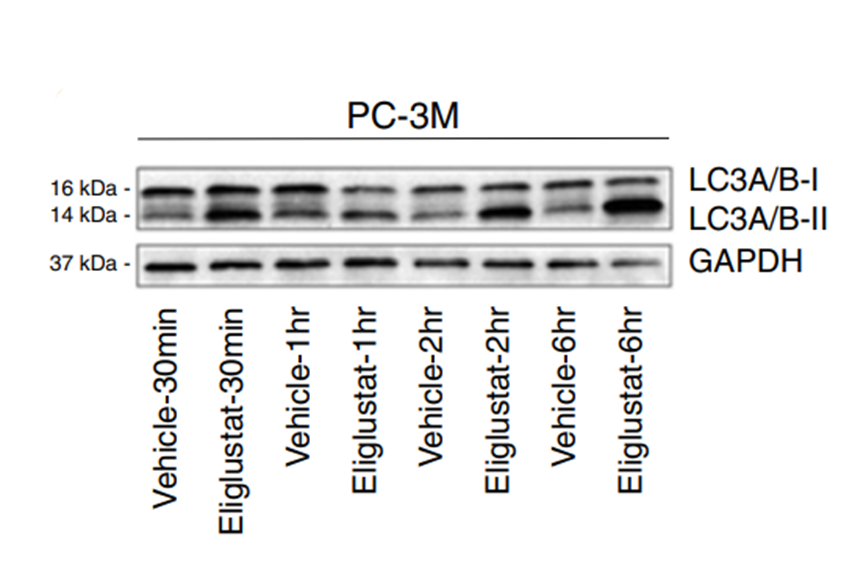
Treatment of PC-3M cells with Eliglustat (128 μM) increased protein expression of the mitophagy-associated markers LC3B-II.
Eliglustat hemitartrate purchased from MedChemExpress. Usage Cited in: Nat Commun. 2020 Aug 27;11(1):4279. [Abstract]
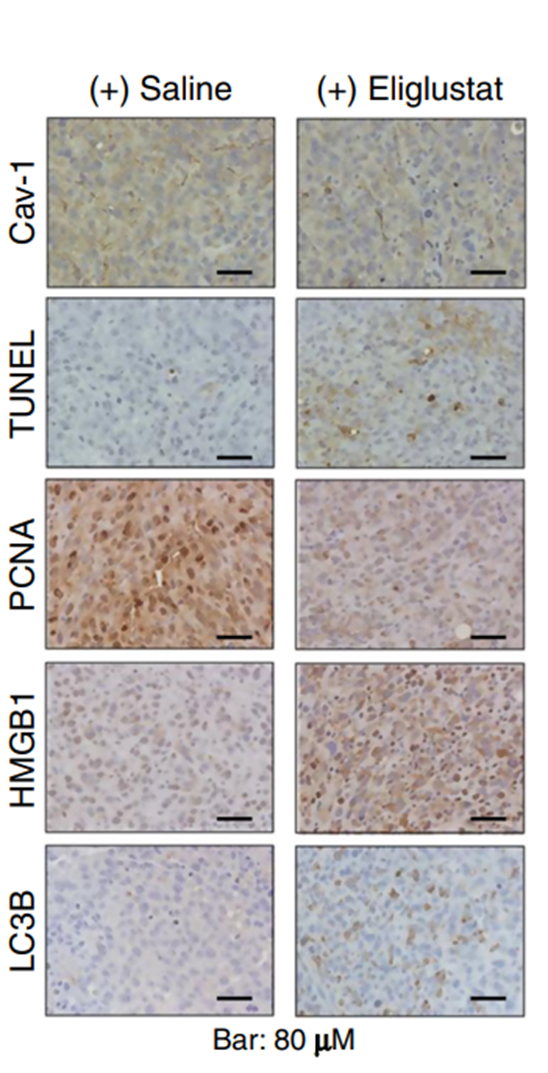
Representative immunohistochemistry staining for Cav-1, BrdU-TUNEL, PCNA, HMGB1, and LC3B in RM-9 tumors following treatment with either saline or Eliglustat (60 mg/kg, i.p.).
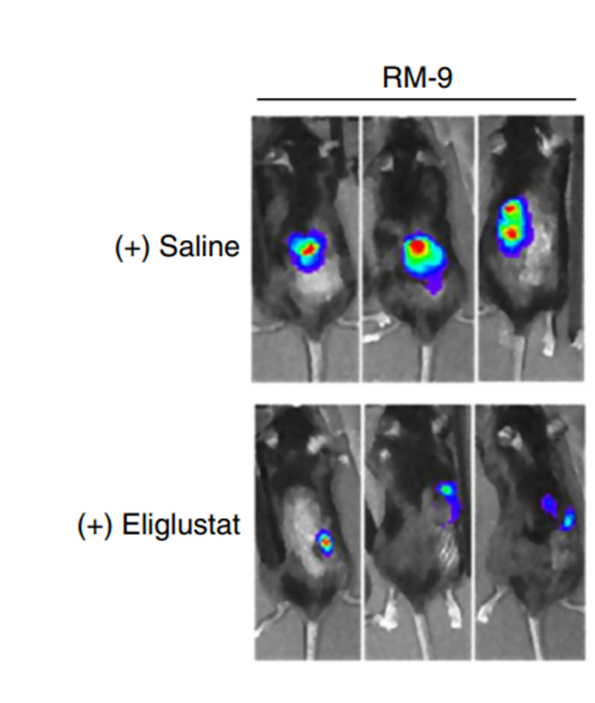
Eliglustat hemitartrate purchased from MedChemExpress. Usage Cited in: Nat Commun. 2020 Aug 27;11(1):4279. [Abstract]
Representative IVIS images following treatment with saline or Eliglustat (60 mg/kg, i.p.).
-
Sci Adv
Tumor-derived RAC1A159V mutation promotes an immunosuppressive microenvironment that represses response to immune checkpoint inhibitor. [Abstract]2025 Oct 31;11(44):eaea1212. PMID: 41160695 -
Cell Death Dis
ECHS1, an interacting protein of LASP1, induces sphingolipid-metabolism imbalance to promote colorectal cancer progression by regulating ceramide glycosylation. [Abstract]2021 Oct 6;12(10):911. PMID: 34615856 -
Int J Biol Macromol
2025 Jan:285:138303. PMID: 39631580 -
EMBO J
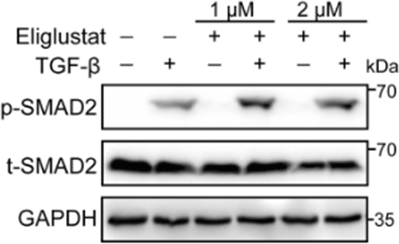
ST3GAL5-catalyzed gangliosides inhibit TGF-β-induced epithelial-mesenchymal transition via TβRI degradation. [Abstract]2023 Jan 16;42(2):e110553. PMID: 36504224
Eliglustat hemitartrate purchased from MedChemExpress. Usage Cited in: EMBO J. 2023 Jan 16;42(2):e110553. [Abstract]
Eliglustat (1, 2 μM; 6 days) strongly promotes TGF-β-induced SMAD2 phosphorylation in A549-VIM-RFP cells. Eliglustat incubate for 4 days and then treat with TGF-β or vehicle control for another 2 days.
-
PLoS Biol
The mTORC2 subunit RICTOR drives breast cancer progression by promoting ganglioside biosynthesis through transcriptional and epigenetic mechanisms. [Abstract]2025 Sep 11;23(9):e3003362. PMID: 40934285 -
Stem Cells Transl Med
Elevated glucosylsphingosine in Gaucher disease induced pluripotent stem cell neurons deregulates lysosomal compartment through mammalian target of rapamycin complex 1. [Abstract]2021 Jul;10(7):1081-1094. PMID: 33656802 -
PLoS One
Cellular and biochemical response to chaperone versus substrate reduction therapies in neuropathic Gaucher disease. [Abstract]2021 Oct 25;16(10):e0247211. PMID: 34695170 -
-


Solvent & Solubility
In Vitro:
DMSO : 100 mg/mL (104.26 mM; Need ultrasonic; Hygroscopic DMSO has a significant impact on the solubility of product, please use newly opened DMSO)
H2O : ≥ 50 mg/mL (52.13 mM)
* "≥" means soluble, but saturation unknown.
Please refer to the solubility information to select the appropriate solvent. Once prepared, please aliquot and store the solution to prevent product inactivation from repeated freeze-thaw cycles.
Storage method and period of stock solution: -80°C, 6 months; -20°C, 1 month (sealed storage, away from moisture). When stored at -80°C, please use it within 6 months. When stored at -20°C, please use it within 1 month.
* Note: If you choose water as the stock solution, please dilute it to the working solution, then filter and sterilize it with a 0.22 μm filter before use.
Please refer to the solubility information to select the appropriate solvent. Once prepared, please aliquot and store the solution to prevent product inactivation from repeated freeze-thaw cycles.
Storage method and period of stock solution: -80°C, 6 months; -20°C, 1 month (sealed storage, away from moisture). When stored at -80°C, please use it within 6 months. When stored at -20°C, please use it within 1 month.
* Note: If you choose water as the stock solution, please dilute it to the working solution, then filter and sterilize it with a 0.22 μm filter before use.
Concentration (start) × Volume (start) = Concentration (final) × Volume (final)
In Vivo:
Select the appropriate dissolution method based on your experimental animal and administration route.
- For the following dissolution methods, please ensure to first prepare a clear stock solution using an In Vitro approach and then sequentially add co-solvents:
- To ensure reliable experimental results, the clarified stock solution can be appropriately stored based on storage conditions. As for the working solution for In Vivo experiments, it is recommended to prepare freshly and use it on the same day.
- The percentages shown for the solvents indicate their volumetric ratio in the final prepared solution. If precipitation or phase separation occurs during preparation, heat and/or sonication can be used to aid dissolution.
Add each solvent one by one: 10% DMSO 40% PEG300 5% Tween-80 45% Saline
Solubility: ≥ 2.75 mg/mL (2.87 mM); Clear solution
This protocol yields a clear solution of ≥ 2.75 mg/mL (saturation unknown).
Taking 1 mL working solution as an example, add 100 μL DMSO stock solution (27.5 mg/mL) to 400 μL PEG300, and mix evenly; then add 50 μL Tween-80 and mix evenly; then add 450 μL Saline to adjust the volume to 1 mL.
Preparation of Saline: Dissolve 0.9 g sodium chloride in ddH₂O and dilute to 100 mL to obtain a clear Saline solution.
Add each solvent one by one: 10% DMSO 90% (20% SBE-β-CD in Saline)
Solubility: ≥ 2.75 mg/mL (2.87 mM); Clear solution
This protocol yields a clear solution of ≥ 2.75 mg/mL (saturation unknown).
Taking 1 mL working solution as an example, add 100 μL DMSO stock solution (27.5 mg/mL) to 900 μL 20% SBE-β-CD in Saline, and mix evenly.
Preparation of 20% SBE-β-CD in Saline (4°C, storage for one week): 2 g SBE-β-CD powder is dissolved in 10 mL Saline, completely dissolve until clear.
For the following dissolution methods, please prepare the working solution directly:
It is recommended to prepare fresh solutions and use them promptly within a short period of time.
The percentages shown for the solvents indicate their volumetric ratio in the final prepared solution. If precipitation or phase separation occurs during preparation, heat and/or sonication can be used to aid dissolution.
Add each solvent one by one: PBS
Solubility: 150 mg/mL (156.39 mM); Clear solution; Need ultrasonic
In Vivo Dissolution Calculator
Please enter the basic information of animal experiments:
-
-
-
-
Recommended: Prepare an additional quantity of animals to account for potential losses during experiments.
Working solution concentration: 0.22 mg/mL
This product has good water solubility, please refer to the measured solubility data in water/PBS/Saline for details.


Purity & Documentation
-
Data Sheet (276 KB)
-
SDS (644 KB)
- English - EN (644 KB)
- Français - FR (644 KB)
- Deutsch - DE (644 KB)
- Norwegian - NO (644 KB)
- Español - ES (644 KB)
- Swedish - SV (644 KB)
- Italian - IT (644 KB)
- Korean - KR (644 KB)
- Portuguese - PT (644 KB)
-
Handling Instructions (2659 KB)
References


Complete Stock Solution Preparation Table
Please refer to the solubility information to select the appropriate solvent. Once prepared, please aliquot and store the solution to prevent product inactivation from repeated freeze-thaw cycles.
Storage method and period of stock solution: -80°C, 6 months; -20°C, 1 month (sealed storage, away from moisture). When stored at -80°C, please use it within 6 months. When stored at -20°C, please use it within 1 month.
| Optional Solvent | Concentration Solvent Mass | 1 mg | 5 mg | 10 mg | 25 mg |
|---|---|---|---|---|---|
| H2O / DMSO | 1 mM | 1.0426 mL | 5.2128 mL | 10.4257 mL | 26.0642 mL |
| 5 mM | 0.2085 mL | 1.0426 mL | 2.0851 mL | 5.2128 mL | |
| 10 mM | 0.1043 mL | 0.5213 mL | 1.0426 mL | 2.6064 mL | |
| 15 mM | 0.0695 mL | 0.3475 mL | 0.6950 mL | 1.7376 mL | |
| 20 mM | 0.0521 mL | 0.2606 mL | 0.5213 mL | 1.3032 mL | |
| 25 mM | 0.0417 mL | 0.2085 mL | 0.4170 mL | 1.0426 mL | |
| 30 mM | 0.0348 mL | 0.1738 mL | 0.3475 mL | 0.8688 mL | |
| 40 mM | 0.0261 mL | 0.1303 mL | 0.2606 mL | 0.6516 mL | |
| 50 mM | 0.0209 mL | 0.1043 mL | 0.2085 mL | 0.5213 mL | |
| DMSO | 60 mM | 0.0174 mL | 0.0869 mL | 0.1738 mL | 0.4344 mL |
| 80 mM | 0.0130 mL | 0.0652 mL | 0.1303 mL | 0.3258 mL | |
| 100 mM | 0.0104 mL | 0.0521 mL | 0.1043 mL | 0.2606 mL |
* Note: If you choose water as the stock solution, please dilute it to the working solution, then filter and sterilize it with a 0.22 μm filter before use.


Eliglustat hemitartrate Related Classifications
HY-14885A Related Classifications
 Powered by Bioz