



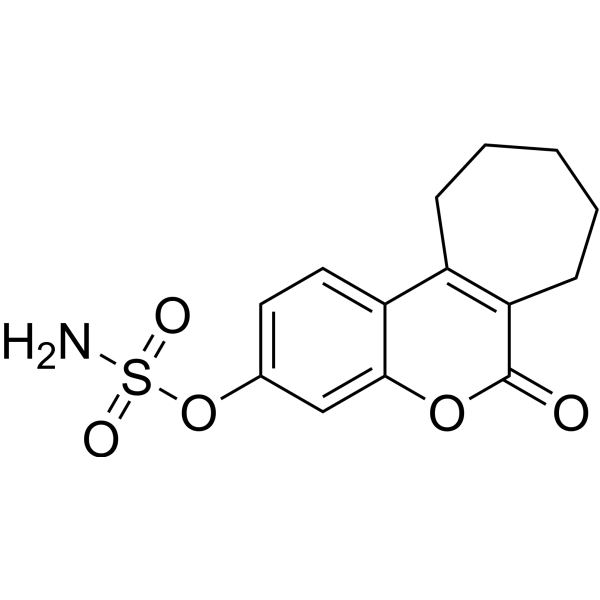
Irosustat
Based on 1 publication(s) in Google Scholar
Irosustat is a potent steroid sulfatase inhibitor, with an IC50 of 8 nM, and exhibits anti-breast cancer activity.
For research use only. We do not sell to patients.
- Purity : 99.72%
- CAS No.: 288628-05-7
- Formula: C14H15NO5S
- Molecular Weight:309.34
-
Storage:Powder -20°C, 3 years , 4°C, 2 years ; In solvent -80°C, 2 years , -20°C, 1 year

To place orders, for customer services and technical support, please contact: MedChemExpress USA
Tel: 609-228-6898 E-mail: [email protected] [email protected]


-
 Biological Activity
-
Chemical Information
-
Solvent & Solubility
- Protocols
- Purity & Documentation
- References
-
 Help & FAQs


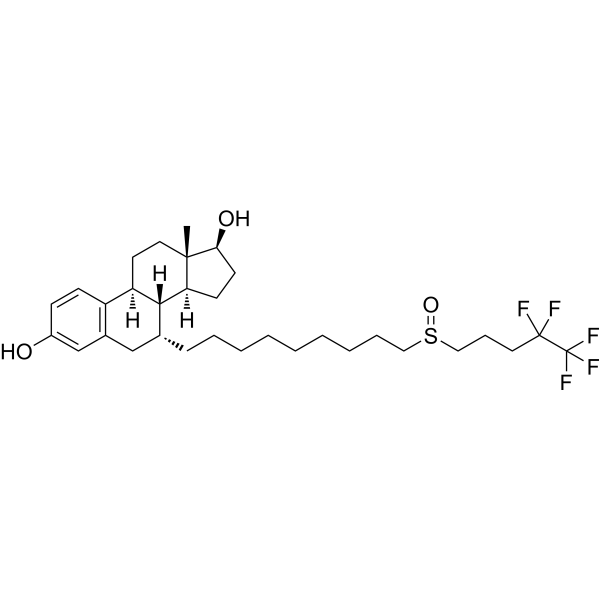
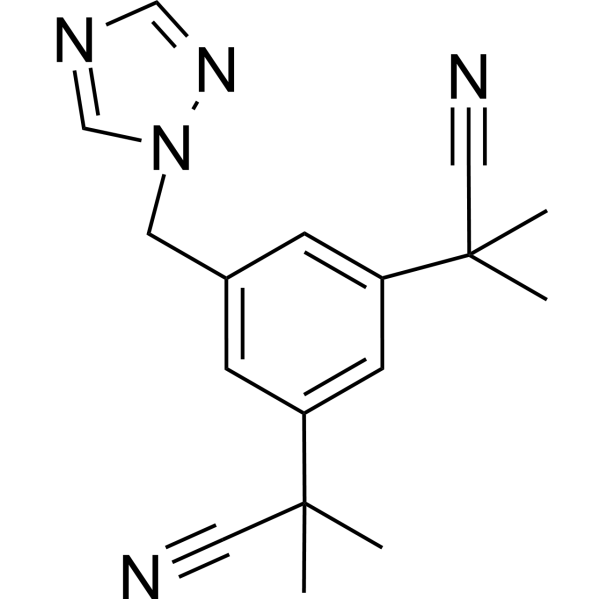
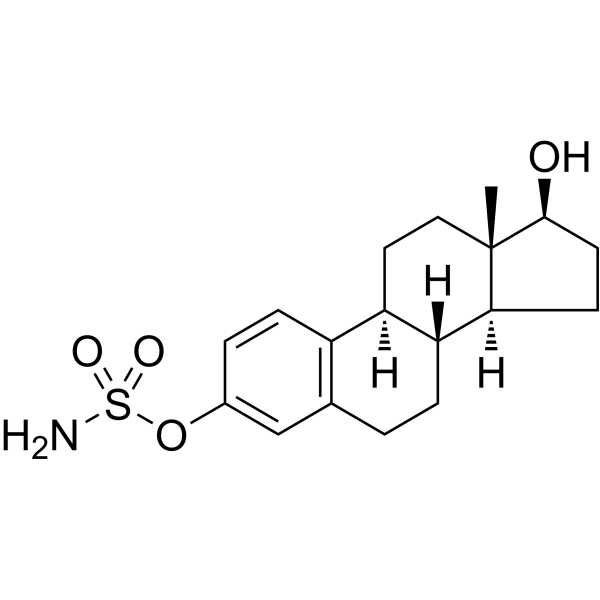
Publications Citing Use of MedChemExpress (MCE) Irosustat
More

Biological Activity
Description
IC50 & Target
IC50: 8 nM (Steroid sulfatase)[1], 0.2 nM (Steroid sulfatase, MCF-7 cells)[2]
Cellular Effect
|
Cell Line

|
Type | Value | Description | References |
|---|---|---|---|---|
| JEG-3 | IC50 |
0.421 μM
Compound: STX64
|
Inhibition of steroid sulfatase in human JEG-3 cells assessed as [14C]-Estrone formation using [3H]E1S as substrate
Inhibition of steroid sulfatase in human JEG-3 cells assessed as [14C]-Estrone formation using [3H]E1S as substrate
|
[PMID: 27143133] |
| JEG-3 | IC50 |
1.5 nM
Compound: 1, STX64, BN83495
|
Inhibition of steroid sulfatase in human JEG3 cells by scintillation spectrometry
Inhibition of steroid sulfatase in human JEG3 cells by scintillation spectrometry
|
[PMID: 20148564] |
| JEG-3 | IC50 |
1.5 nM
Compound: STX64
|
Inhibition of steroid sulfatase activity in human JEG3 cells
Inhibition of steroid sulfatase activity in human JEG3 cells
|
[PMID: 18590272] |
| JEG-3 | IC50 |
1.5 nM
Compound: STX64, 667COUMATE, BN83495
|
Inhibition of steroid sulfatase in JEG3 cell membrane
Inhibition of steroid sulfatase in JEG3 cell membrane
|
[PMID: 17580845] |
| JEG-3 | IC50 |
2.1 nM
Compound: STX-64; BN83495
|
Inhibition of steroid sulfatase in human JEG3 cells using [3H] E1S as substrate incubated for 20 hrs by scintillation spectrometry analysis
Inhibition of steroid sulfatase in human JEG3 cells using [3H] E1S as substrate incubated for 20 hrs by scintillation spectrometry analysis
|
[PMID: 32173116] |
| JEG-3 | IC50 |
300 nM
Compound: 1, STX64, BN83495
|
Inhibition of aromatase in human JEG3 cells by scintillation spectrometry
Inhibition of aromatase in human JEG3 cells by scintillation spectrometry
|
[PMID: 20148564] |
| JEG-3 | IC50 |
300 nM
Compound: STX64
|
Inhibition of aromatase activity in human JEG3 cells
Inhibition of aromatase activity in human JEG3 cells
|
[PMID: 18590272] |
| JEG-3 | IC50 |
6.4 nM
Compound: STX-64; BN83495
|
Inhibition of steroid sulfatase in human JEG3 cell lysates using [3H] E1S as substrate after 1 hr by scintillation spectrometry analysis
Inhibition of steroid sulfatase in human JEG3 cell lysates using [3H] E1S as substrate after 1 hr by scintillation spectrometry analysis
|
[PMID: 32173116] |
| MCF7 | IC50 |
350 nM
Compound: 1, 667-Coumate
|
Irreversible inhibition of steroid sulfatase in human intact MCF7 cells
Irreversible inhibition of steroid sulfatase in human intact MCF7 cells
|
[PMID: 22264754] |
| MCF7 | IC50 |
350 nM
Compound: 3, 667-Coumate
|
Inhibition of steroid sulfatase in human intact MCF7 cells
Inhibition of steroid sulfatase in human intact MCF7 cells
|
[PMID: 21925885] |
| RAW264.7 | IC50 |
81.04 nM
Compound: STX-64, BN83495
|
Antiinflammatory activity against mouse RAW264.7 cells assessed as inhibition of LPS-induced PGE2 production administered 1 hr prior to LPS-challenge measured after 24 hrs by EIA
Antiinflammatory activity against mouse RAW264.7 cells assessed as inhibition of LPS-induced PGE2 production administered 1 hr prior to LPS-challenge measured after 24 hrs by EIA
|
[PMID: 24360561] |
| RAW264.7 | IC50 |
85.76 μM
Compound: STX-64, BN83495
|
Antiinflammatory activity against mouse RAW264.7 cells assessed as inhibition of LPS-induced NO production administered 1 hr prior to LPS-challenge measured after 24 hrs by Griess assay
Antiinflammatory activity against mouse RAW264.7 cells assessed as inhibition of LPS-induced NO production administered 1 hr prior to LPS-challenge measured after 24 hrs by Griess assay
|
[PMID: 24360561] |
| T47D | IC50 |
0.92 μM
Compound: STX-64; BN83495
|
Antiproliferative activity against human T47D cells assessed as reduction in cell proliferation measured after 5 days in presence of estradiol sulfate by crystal violet staining based assay
Antiproliferative activity against human T47D cells assessed as reduction in cell proliferation measured after 5 days in presence of estradiol sulfate by crystal violet staining based assay
|
[PMID: 32173116] |
In Vitro
Irosustat (667 COUMATE) is a potent steroid sulfatase inhibitor, with an IC50 of 8 nM[1]. Irosustat (667 COUMATE) inhibits steroid sulphatase (STS) activity in MCF-7 cells with an IC50 of 0.2 nM, but has no effect on the morphology or proliferation of MCF-7 cells at 10 μM[2].
MedChemExpress (MCE) has not independently confirmed the accuracy of these methods. They are for reference only. Further protocols information, click here.
In Vivo
MedChemExpress (MCE) has not independently confirmed the accuracy of these methods. They are for reference only.
Clinical Trial
| NCT Number | Sponsor | Condition | Start Date |
Phase
|
|---|---|---|---|---|
| NCT01329991 | Plexxikon| | 2011-05 | PHASE1 |


Chemical Information
-
CAS No. 288628-05-7
-
Appearance Solid
-
Molecular Weight 309.34
-
Formula C14H15NO5S
-
Color White to off-white
-
SMILES
O=C1OC2=CC(OS(=O)(N)=O)=CC=C2C3=C1CCCCC3
-
Synonyms
STX64; BN83495; 667-Coumate
-
Shipping
Room temperature in continental US; may vary elsewhere.
-
Storage
Powder -20°C 3 years 4°C 2 years In solvent -80°C 2 years -20°C 1 year


Publications (1)
-
Journal Impact Factor
-
Most Recent
-
Mol Cell Endocrinol
Bisphenol A-sulfate conjugate disrupts AURKA transcription and cell cycle in BeWo cytotrophoblasts. [Abstract]2022 Apr 5:545:111561. PMID: 35041905


Solvent & Solubility
In Vitro:
DMSO : 100 mg/mL (323.27 mM; Need ultrasonic; Hygroscopic DMSO has a significant impact on the solubility of product, please use newly opened DMSO)
H2O : < 0.1 mg/mL (insoluble)
Please refer to the solubility information to select the appropriate solvent. Once prepared, please aliquot and store the solution to prevent product inactivation from repeated freeze-thaw cycles.
Storage method and period of stock solution: -80°C, 2 years; -20°C, 1 year. When stored at -80°C, please use it within 2 years. When stored at -20°C, please use it within 1 year.
Please refer to the solubility information to select the appropriate solvent. Once prepared, please aliquot and store the solution to prevent product inactivation from repeated freeze-thaw cycles.
Storage method and period of stock solution: -80°C, 2 years; -20°C, 1 year. When stored at -80°C, please use it within 2 years. When stored at -20°C, please use it within 1 year.
Concentration (start) × Volume (start) = Concentration (final) × Volume (final)
In Vivo:
Select the appropriate dissolution method based on your experimental animal and administration route.
- For the following dissolution methods, please ensure to first prepare a clear stock solution using an In Vitro approach and then sequentially add co-solvents:
- To ensure reliable experimental results, the clarified stock solution can be appropriately stored based on storage conditions. As for the working solution for In Vivo experiments, it is recommended to prepare freshly and use it on the same day.
- The percentages shown for the solvents indicate their volumetric ratio in the final prepared solution. If precipitation or phase separation occurs during preparation, heat and/or sonication can be used to aid dissolution.
Add each solvent one by one: 10% DMSO 40% PEG300 5% Tween-80 45% Saline
Solubility: ≥ 2.5 mg/mL (8.08 mM); Clear solution
This protocol yields a clear solution of ≥ 2.5 mg/mL (saturation unknown).
Taking 1 mL working solution as an example, add 100 μL DMSO stock solution (25.0 mg/mL) to 400 μL PEG300, and mix evenly; then add 50 μL Tween-80 and mix evenly; then add 450 μL Saline to adjust the volume to 1 mL.
Preparation of Saline: Dissolve 0.9 g sodium chloride in ddH₂O and dilute to 100 mL to obtain a clear Saline solution.
Add each solvent one by one: 10% DMSO 90% (20% SBE-β-CD in Saline)
Solubility: ≥ 2.5 mg/mL (8.08 mM); Clear solution
This protocol yields a clear solution of ≥ 2.5 mg/mL (saturation unknown).
Taking 1 mL working solution as an example, add 100 μL DMSO stock solution (25.0 mg/mL) to 900 μL 20% SBE-β-CD in Saline, and mix evenly.
Preparation of 20% SBE-β-CD in Saline (4°C, storage for one week): 2 g SBE-β-CD powder is dissolved in 10 mL Saline, completely dissolve until clear.
For the following dissolution methods, please prepare the working solution directly:
It is recommended to prepare fresh solutions and use them promptly within a short period of time.
The percentages shown for the solvents indicate their volumetric ratio in the final prepared solution. If precipitation or phase separation occurs during preparation, heat and/or sonication can be used to aid dissolution.
In Vivo Dissolution Calculator
Please enter the basic information of animal experiments:
-
-
-
-
Recommended: Prepare an additional quantity of animals to account for potential losses during experiments.
Please enter your animal formula composition:
-
%DMSO +
Recommended: Keep the proportion of DMSO in working solution below 2% if your animal is weak.
-
%+
-
+%Tween-80 + +
-
%Saline +
The co-solvents required include: DMSO, . All of co-solvents are available by MedChemExpress (MCE). , Tween 80. All of co-solvents are available by MedChemExpress (MCE).
Working solution concentration: 0.22 mg/mL
Method for preparing stock solution: mg drug dissolved in μL DMSO. Stock solution concentration: mg/mL.
1. Take μL DMSO stock solution;
2. Add μL .
μL , mix evenly;
3. Then add μL Tween 80, mix evenly;
4. Then add μL
Please ensure that the stock solution in the first step is dissolved to a clear state, and add co-solvents in sequence. You can use ultrasonic heating (ultrasonic cleaner, recommended frequency 20-40 kHz), vortexing, etc. to assist dissolution.

Protocols
-
Breast Cancer Modeling
Breast cancer is a heterogeneous cancer, and it has been distinguished into four subtypes: luminal A, luminal B, HER2-positive and basal-like. Molecular mutations, epigenetic alterations, hormone exposure and immune microenvironment are related to the progression of breast cancer.


Purity & Documentation
-
Data Sheet (279 KB)
-
SDS (396 KB)
- English - EN (396 KB)
- Français - FR (396 KB)
- Deutsch - DE (396 KB)
- Norwegian - NO (396 KB)
- Español - ES (396 KB)
- Swedish - SV (396 KB)
- Italian - IT (396 KB)
- Korean - KR (396 KB)
- Portuguese - PT (396 KB)
-
Handling Instructions (2659 KB)
References
[1]. Purohit A, et al. In vivo inhibition of estrone sulfatase activity and growth of nitrosomethylurea-induced mammary tumors by 667 COUMATE. Cancer Res. 2000 Jul 1;60(13):3394-6. [Content Brief]
[2]. Raobaikady B, et al. Inhibition of MCF-7 breast cancer cell proliferation and in vivo steroid sulphatase activity by 2-methoxyoestradiol-bis-sulphamate. J Steroid Biochem Mol Biol. 2003 Feb;84(2-3):351-8. [Content Brief]


Complete Stock Solution Preparation Table
Please refer to the solubility information to select the appropriate solvent. Once prepared, please aliquot and store the solution to prevent product inactivation from repeated freeze-thaw cycles.
Storage method and period of stock solution: -80°C, 2 years; -20°C, 1 year. When stored at -80°C, please use it within 2 years. When stored at -20°C, please use it within 1 year.
| Optional Solvent | Concentration Solvent Mass | 1 mg | 5 mg | 10 mg | 25 mg |
|---|---|---|---|---|---|
| DMSO | 1 mM | 3.2327 mL | 16.1634 mL | 32.3269 mL | 80.8172 mL |
| 5 mM | 0.6465 mL | 3.2327 mL | 6.4654 mL | 16.1634 mL | |
| 10 mM | 0.3233 mL | 1.6163 mL | 3.2327 mL | 8.0817 mL | |
| 15 mM | 0.2155 mL | 1.0776 mL | 2.1551 mL | 5.3878 mL | |
| 20 mM | 0.1616 mL | 0.8082 mL | 1.6163 mL | 4.0409 mL | |
| 25 mM | 0.1293 mL | 0.6465 mL | 1.2931 mL | 3.2327 mL | |
| 30 mM | 0.1078 mL | 0.5388 mL | 1.0776 mL | 2.6939 mL | |
| 40 mM | 0.0808 mL | 0.4041 mL | 0.8082 mL | 2.0204 mL | |
| 50 mM | 0.0647 mL | 0.3233 mL | 0.6465 mL | 1.6163 mL | |
| 60 mM | 0.0539 mL | 0.2694 mL | 0.5388 mL | 1.3470 mL | |
| 80 mM | 0.0404 mL | 0.2020 mL | 0.4041 mL | 1.0102 mL | |
| 100 mM | 0.0323 mL | 0.1616 mL | 0.3233 mL | 0.8082 mL |


Irosustat Related Classifications
HY-14586 Related Classifications
 Powered by Bioz