



NIBR189
Based on 3 publication(s) in Google Scholar
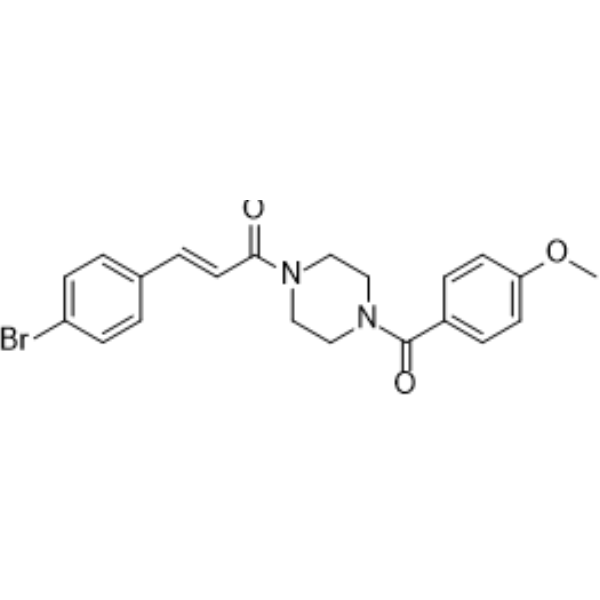
NIBR189 is an EBI2 (Epstein-Barr virus-induced gene 2) antagonist. NIBR189 inhibits human and mouse EBI2 with IC50s of 11 and 16 nM, respectively. NIBR189 can be used for the research of autoimmune diseases.
For research use only. We do not sell to patients.
- Purity : 99.71%
- CAS No.: 1599432-08-2
- Formula: C21H21BrN2O3
- Molecular Weight:429.31
-
Storage:Powder -20°C, 3 years , 4°C, 2 years ; In solvent -80°C, 2 years , -20°C, 1 year

To place orders, for customer services and technical support, please contact: MedChemExpress USA
Tel: 609-228-6898 E-mail: [email protected] [email protected]


-
 Biological Activity
-
Chemical Information
-
Solvent & Solubility
- Purity & Documentation
- References
-
 Help & FAQs


-
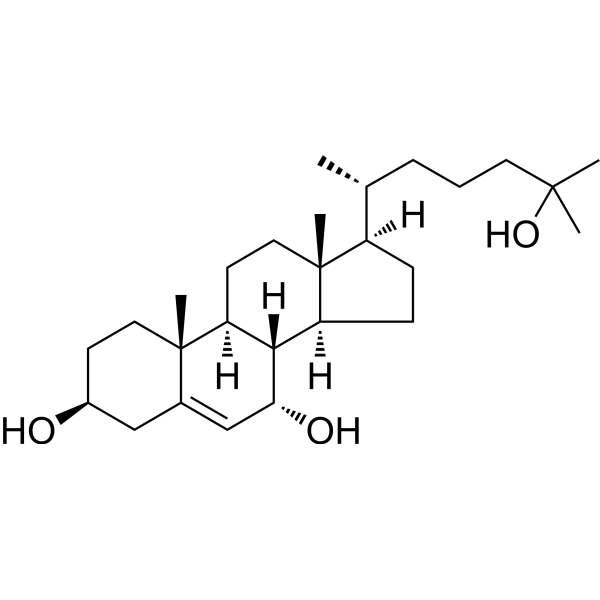
HY-113962
7α,25-DihydroxycholesterolGPR183 Agonist -
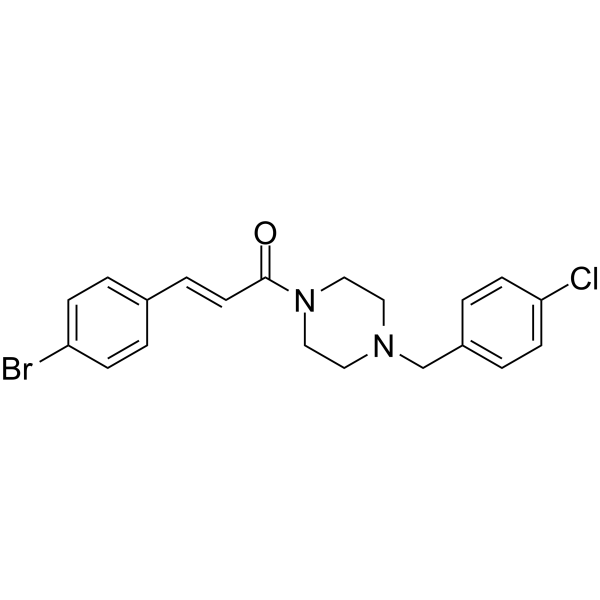
HY-116814
ML401 -
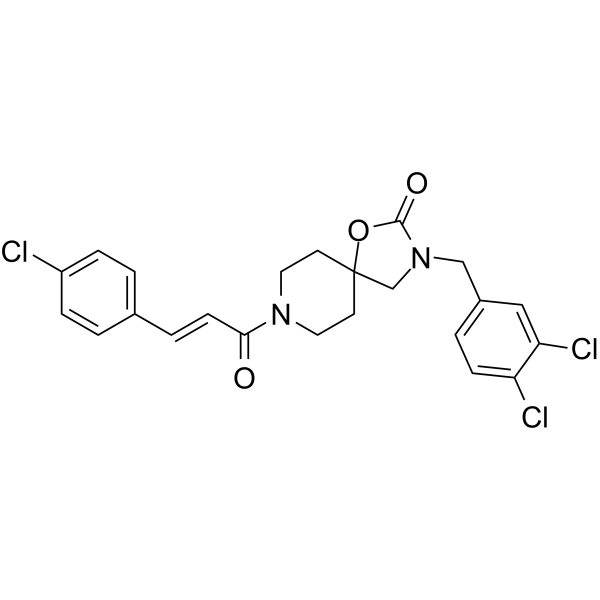
HY-101192
GSK682753AEBI2 Inverse Agonist -
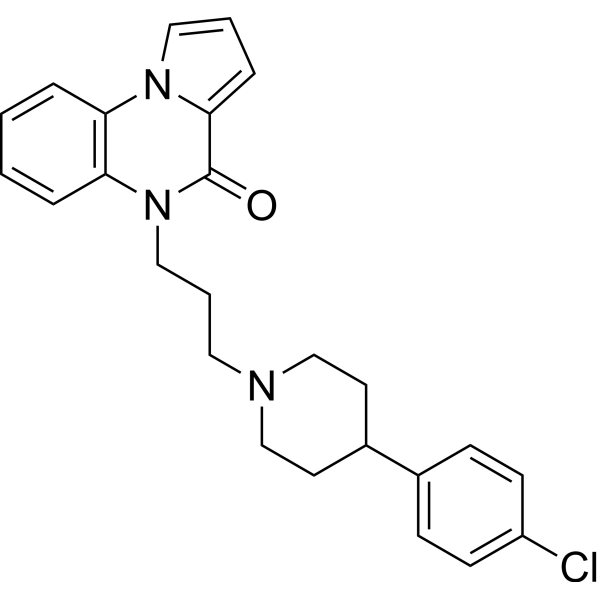
HY-123918
JMS-17-2CX3CR1 Antagonist -
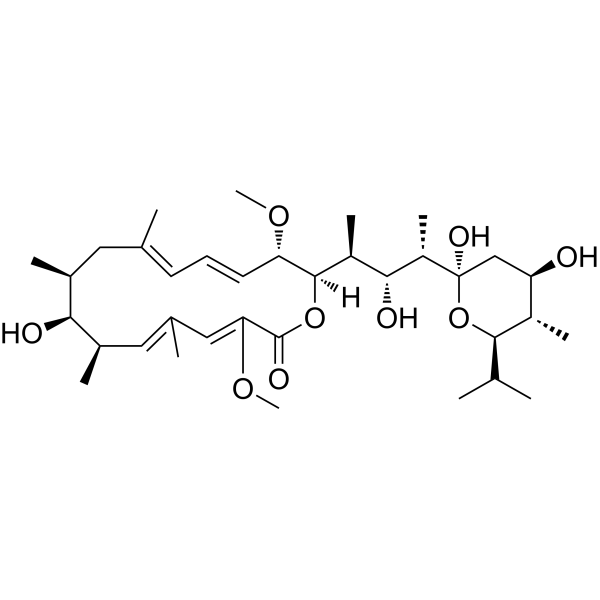
HY-100558
Bafilomycin A1V-ATPase Inhibitor -
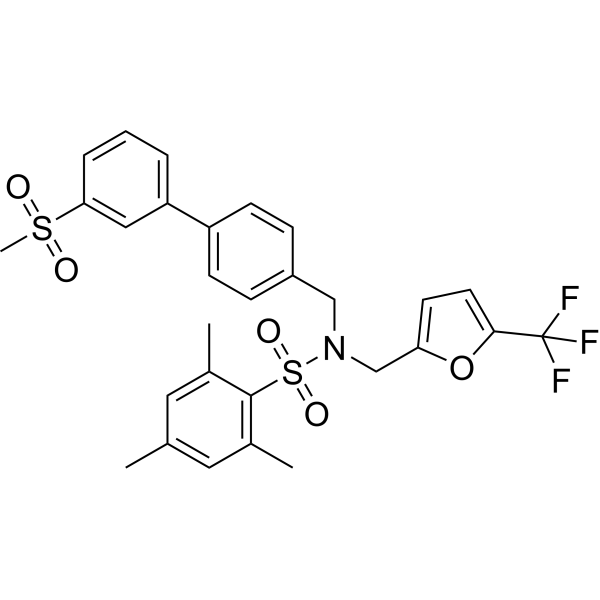
HY-108688
GSK2033LXR Antagonist -
HY-K1006
Penicillin-Streptomycin (100×), Sterile -
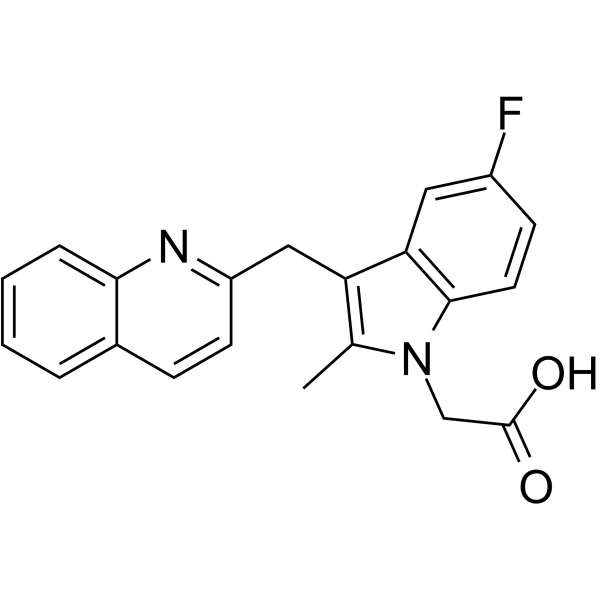
HY-15342
TimapiprantProstaglandin Receptor Antagonist -
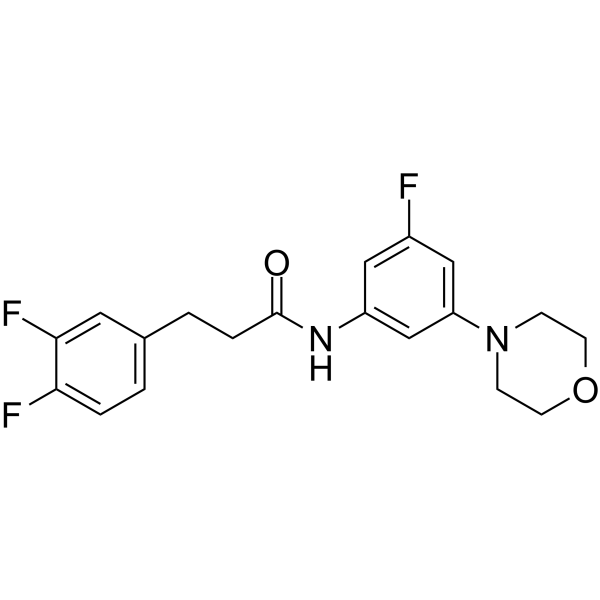
HY-147222
SAE-14GPR183 Antagonist -
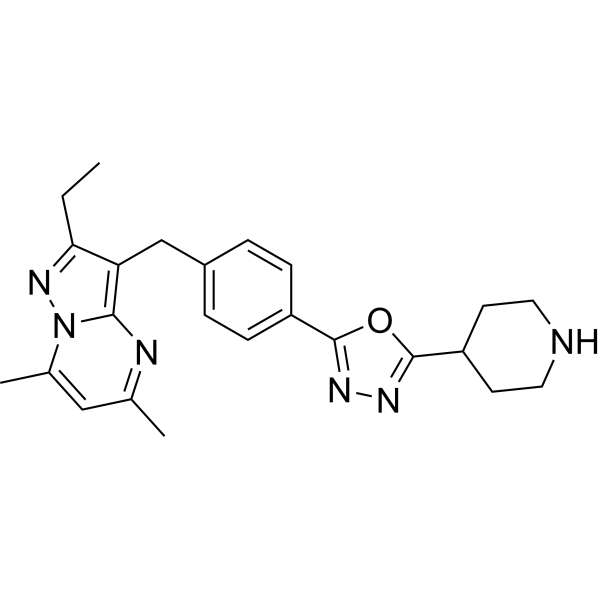
HY-101784
NE 52-QQ57GPR4 Antagonist -
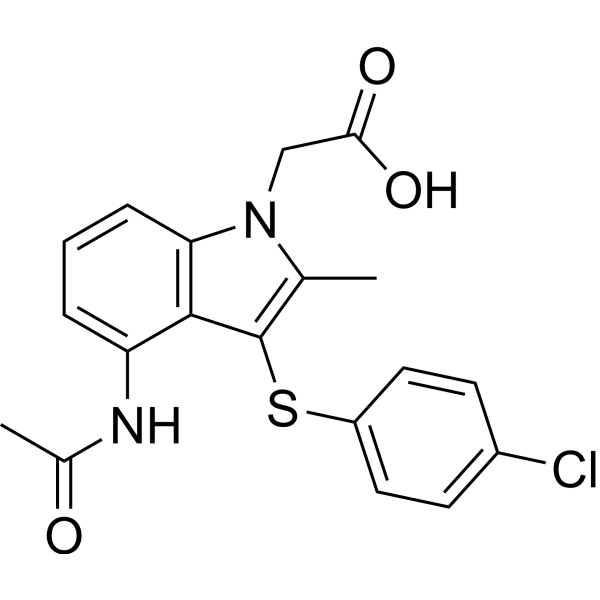
HY-15950
AZD1981GPR44 Antagonist -
HY-12764
6-OAUGPR84 Agonist
Publications Citing Use of MedChemExpress (MCE) NIBR189
More Customer Validation & Images

-
Flow Cytometry
-
Cell Proliferation/Viability Assay
-
Microbiological Assay
-
Microbiological Assay


Biological Activity
Description
Cellular Effect
|
Cell Line

|
Type | Value | Description | References |
|---|---|---|---|---|
| CHO | IC50 |
11 nM
Compound: 4m, NIBR189
|
Antagonist activity at recombinant human EBI2 receptor expressed in CHO cells assessed as inhibition of NIBR51-induced intracellular calcium release measured for 3 mins by FLIPR assay
Antagonist activity at recombinant human EBI2 receptor expressed in CHO cells assessed as inhibition of NIBR51-induced intracellular calcium release measured for 3 mins by FLIPR assay
|
[PMID: 24678947] |
| CHO | IC50 |
15 nM
Compound: 4m, NIBR189
|
Antagonist activity at recombinant mouse EBI2 receptor expressed in CHO cells assessed as inhibition of NIBR51-induced intracellular calcium release measured for 3 mins by FLIPR assay
Antagonist activity at recombinant mouse EBI2 receptor expressed in CHO cells assessed as inhibition of NIBR51-induced intracellular calcium release measured for 3 mins by FLIPR assay
|
[PMID: 24678947] |
| CHO | IC50 |
7 nM
Compound: 4m, NIBR189
|
Antagonist activity at recombinant human EBI2 receptor expressed in CHO cells assessed as inhibition of 0.1 nM oxysterol-induced [35S]GTPgammaS binding after 1 hr by scintillation counting analysis
Antagonist activity at recombinant human EBI2 receptor expressed in CHO cells assessed as inhibition of 0.1 nM oxysterol-induced [35S]GTPgammaS binding after 1 hr by scintillation counting analysis
|
[PMID: 24678947] |
| CHO | IC50 |
8.5 nM
Compound: 4m, NIBR189
|
Antagonist activity at recombinant human EBI2 receptor expressed in CHO cells assessed as inhibition of 0.33 nM oxysterol-induced [35S]GTPgammaS binding after 1 hr by scintillation counting analysis
Antagonist activity at recombinant human EBI2 receptor expressed in CHO cells assessed as inhibition of 0.33 nM oxysterol-induced [35S]GTPgammaS binding after 1 hr by scintillation counting analysis
|
[PMID: 24678947] |
| U-937 | IC50 |
0.3 nM
Compound: 4m, NIBR189
|
Antagonist activity at EBI2 receptor in human U937 cells assessed as inhibition of 7-alpha,25-OHC-induced cell migration after 3 hrs by flow cytometric analysis
Antagonist activity at EBI2 receptor in human U937 cells assessed as inhibition of 7-alpha,25-OHC-induced cell migration after 3 hrs by flow cytometric analysis
|
[PMID: 24678947] |
| U-937 | IC50 |
4.5 nM
Compound: 4; NIBR189
|
Antimigratory activity against human U-937 cells assessed as inhibition of 7alpha,25-dihydroxycholesterol induced cell migration by CCK-8 method
Antimigratory activity against human U-937 cells assessed as inhibition of 7alpha,25-dihydroxycholesterol induced cell migration by CCK-8 method
|
[PMID: 38417036] |
| U-937 | IC50 |
9 nM
Compound: 4m, NIBR189
|
Antagonist activity at EBI2 receptor in human U937 cells assessed as inhibition of oxysterol-induced calcium release measured for 3 mins by FLIPR assay
Antagonist activity at EBI2 receptor in human U937 cells assessed as inhibition of oxysterol-induced calcium release measured for 3 mins by FLIPR assay
|
[PMID: 24678947] |
In Vitro
NIBR189 (0-1 μM; 3 h) blocks migration of U937 cells[1]. NIBR189 (0-10 μM) blocks oxysterol-dependent activation with an IC50 value of 9 nM[1].
MedChemExpress (MCE) has not independently confirmed the accuracy of these methods. They are for reference only.
-
Cell Line:U937 cell lines
-
Concentration:0-1 μM
-
Incubation Time:3 hours
-
Result:Blocked the direct migration of U937 cells with an IC50 value of 0.3 nM.
In Vivo
| Mice IV 1 mg/kg |
Mice PO 3 mg/kg |
|
| CL (μL/min/mg) | 16 | |
| t1/2 (h) | 1.1 | |
| Vss (L/kg) | 1.4 | |
| AUC (nmol·h/L) | 2435 | 3608 |
| Cmax (nmol/L) | 835 | |
| tmax (h) | 1 | |
| F (%) | 49 | |
MedChemExpress (MCE) has not independently confirmed the accuracy of these methods. They are for reference only.


Chemical Information
-
CAS No. 1599432-08-2
-
Appearance Solid
-
Molecular Weight 429.31
-
Formula C21H21BrN2O3
-
Color White to off-white
-
SMILES
O=C(N1CCN(C(C2=CC=C(OC)C=C2)=O)CC1)/C=C/C3=CC=C(Br)C=C3
-
Shipping
Room temperature in continental US; may vary elsewhere.
-
Storage
Powder -20°C 3 years 4°C 2 years In solvent -80°C 2 years -20°C 1 year


Publications (3)
-
Journal Impact Factor
-
Most Recent
-
Nat Aging
Mitochondria-enriched hematopoietic stem cells exhibit elevated self-renewal capabilities, thriving within the context of aged bone marrow. [Abstract]2025 May;5(5):831-847. PMID: 40050412
NIBR189 purchased from MedChemExpress. Usage Cited in: Nat Aging. 2025 May;5(5):831-847. [Abstract]
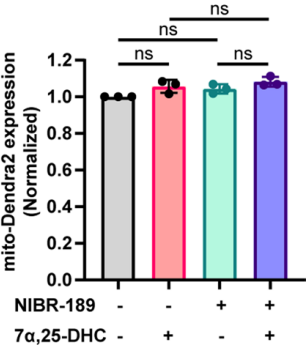
Relative mito-Dendra2 expression following NIBR189 (25 μg/mL; 48 h) and/or 7α,25-DHC treatment, with normalized MFI values (n = 3).
-
Nat Commun
Human iPSC-based Modeling of Pulmonary Fibrosis Reveals p300/CBP Inhibition Suppresses Alveolar Transitional Cell State. [Abstract]2026 Feb 12;17(1):1214. PMID: 41680175 -
Microb Pathog
Downregulation of GPR183 on infection restricts the early infection and intracellular replication of mycobacterium tuberculosis in macrophage. [Abstract]2020 Aug:145:104234. PMID: 32353576
NIBR189 purchased from MedChemExpress. Usage Cited in: Microb Pathog. 2020 Aug:145:104234. [Abstract]
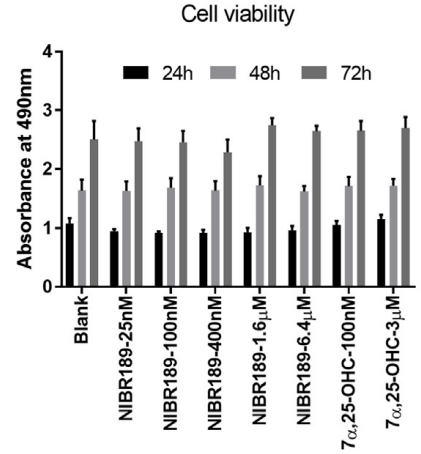
The cell viability under the treatment of NIBR189 (6.4-25 μM; 24-72 h) and 7α,25-OHC at different time points changes little, determined by MTS assay (n = 5).
NIBR189 purchased from MedChemExpress. Usage Cited in: Microb Pathog. 2020 Aug:145:104234. [Abstract]
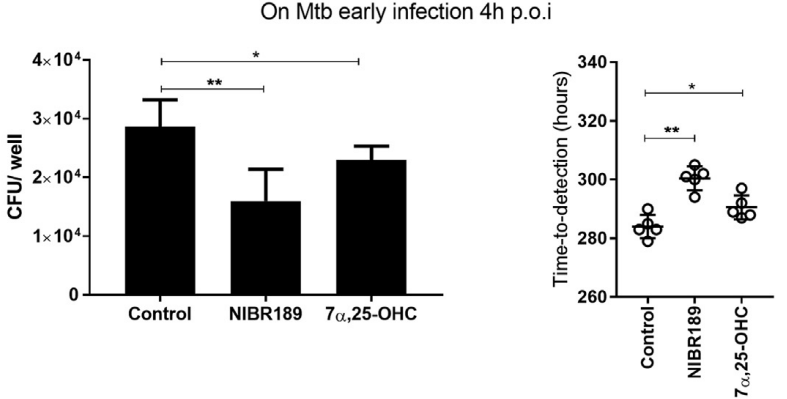
Bacterial early infection (4 h poi) is compromised under the treatment of NIBR189 (25 nM) and 7α,25-OHC in RAW264.7. (CFU in left panel, TTD in right panel).
NIBR189 purchased from MedChemExpress. Usage Cited in: Microb Pathog. 2020 Aug:145:104234. [Abstract]
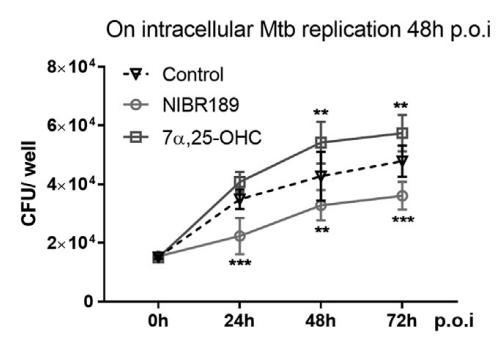
The effect of NIBR189 (25 nM) and 7α,25-OHC on intracellular Mtb replication is compared using cfu at different time points after infection in RAW264.7 (n = 5). NIBR189 reduced the intracellular Mtb at the stages after phagocytosis.


Solvent & Solubility
In Vitro:
DMSO : 50 mg/mL (116.47 mM; ultrasonic and warming and heat to 60°C; Hygroscopic DMSO has a significant impact on the solubility of product, please use newly opened DMSO)
Please refer to the solubility information to select the appropriate solvent. Once prepared, please aliquot and store the solution to prevent product inactivation from repeated freeze-thaw cycles.
Storage method and period of stock solution: -80°C, 2 years; -20°C, 1 year. When stored at -80°C, please use it within 2 years. When stored at -20°C, please use it within 1 year.
Please refer to the solubility information to select the appropriate solvent. Once prepared, please aliquot and store the solution to prevent product inactivation from repeated freeze-thaw cycles.
Storage method and period of stock solution: -80°C, 2 years; -20°C, 1 year. When stored at -80°C, please use it within 2 years. When stored at -20°C, please use it within 1 year.
Concentration (start) × Volume (start) = Concentration (final) × Volume (final)
In Vivo:
Select the appropriate dissolution method based on your experimental animal and administration route.
- For the following dissolution methods, please ensure to first prepare a clear stock solution using an In Vitro approach and then sequentially add co-solvents:
- To ensure reliable experimental results, the clarified stock solution can be appropriately stored based on storage conditions. As for the working solution for In Vivo experiments, it is recommended to prepare freshly and use it on the same day.
- The percentages shown for the solvents indicate their volumetric ratio in the final prepared solution. If precipitation or phase separation occurs during preparation, heat and/or sonication can be used to aid dissolution.
Add each solvent one by one: 10% DMSO 90% (20% SBE-β-CD in Saline)
Solubility: 2.5 mg/mL (5.82 mM); Suspended solution; Need ultrasonic
This protocol yields a suspended solution of 2.5 mg/mL. Suspended solution can be used for oral and intraperitoneal injection.
Taking 1 mL working solution as an example, add 100 μL DMSO stock solution (25.0 mg/mL) to 900 μL 20% SBE-β-CD in Saline, and mix evenly.
Preparation of 20% SBE-β-CD in Saline (4°C, storage for one week): 2 g SBE-β-CD powder is dissolved in 10 mL Saline, completely dissolve until clear.
In Vivo Dissolution Calculator
Please enter the basic information of animal experiments:
-
-
-
-
Recommended: Prepare an additional quantity of animals to account for potential losses during experiments.
Please enter your animal formula composition:
-
%DMSO +
Recommended: Keep the proportion of DMSO in working solution below 2% if your animal is weak.
-
%+
-
+%Tween-80 + +
-
%Saline +
The co-solvents required include: DMSO, . All of co-solvents are available by MedChemExpress (MCE). , Tween 80. All of co-solvents are available by MedChemExpress (MCE).
Working solution concentration: 0.22 mg/mL
Method for preparing stock solution: mg drug dissolved in μL DMSO. Stock solution concentration: mg/mL.
1. Take μL DMSO stock solution;
2. Add μL .
μL , mix evenly;
3. Then add μL Tween 80, mix evenly;
4. Then add μL
Please ensure that the stock solution in the first step is dissolved to a clear state, and add co-solvents in sequence. You can use ultrasonic heating (ultrasonic cleaner, recommended frequency 20-40 kHz), vortexing, etc. to assist dissolution.


Purity & Documentation
-
Data Sheet (272 KB)
-
SDS (393 KB)
- English - EN (393 KB)
- Français - FR (393 KB)
- Deutsch - DE (393 KB)
- Norwegian - NO (393 KB)
- Español - ES (393 KB)
- Swedish - SV (393 KB)
- Italian - IT (393 KB)
- Korean - KR (393 KB)
- Portuguese - PT (393 KB)
-
Handling Instructions (2659 KB)
References


Complete Stock Solution Preparation Table
Please refer to the solubility information to select the appropriate solvent. Once prepared, please aliquot and store the solution to prevent product inactivation from repeated freeze-thaw cycles.
Storage method and period of stock solution: -80°C, 2 years; -20°C, 1 year. When stored at -80°C, please use it within 2 years. When stored at -20°C, please use it within 1 year.
| Optional Solvent | Concentration Solvent Mass | 1 mg | 5 mg | 10 mg | 25 mg |
|---|---|---|---|---|---|
| DMSO | 1 mM | 2.3293 mL | 11.6466 mL | 23.2932 mL | 58.2330 mL |
| 5 mM | 0.4659 mL | 2.3293 mL | 4.6586 mL | 11.6466 mL | |
| 10 mM | 0.2329 mL | 1.1647 mL | 2.3293 mL | 5.8233 mL | |
| 15 mM | 0.1553 mL | 0.7764 mL | 1.5529 mL | 3.8822 mL | |
| 20 mM | 0.1165 mL | 0.5823 mL | 1.1647 mL | 2.9116 mL | |
| 25 mM | 0.0932 mL | 0.4659 mL | 0.9317 mL | 2.3293 mL | |
| 30 mM | 0.0776 mL | 0.3882 mL | 0.7764 mL | 1.9411 mL | |
| 40 mM | 0.0582 mL | 0.2912 mL | 0.5823 mL | 1.4558 mL | |
| 50 mM | 0.0466 mL | 0.2329 mL | 0.4659 mL | 1.1647 mL | |
| 60 mM | 0.0388 mL | 0.1941 mL | 0.3882 mL | 0.9705 mL | |
| 80 mM | 0.0291 mL | 0.1456 mL | 0.2912 mL | 0.7279 mL | |
| 100 mM | 0.0233 mL | 0.1165 mL | 0.2329 mL | 0.5823 mL |


NIBR189 Related Classifications
HY-12336 Related Classifications
 Powered by Bioz