



Taranabant
Based on 2 publication(s) in Google Scholar
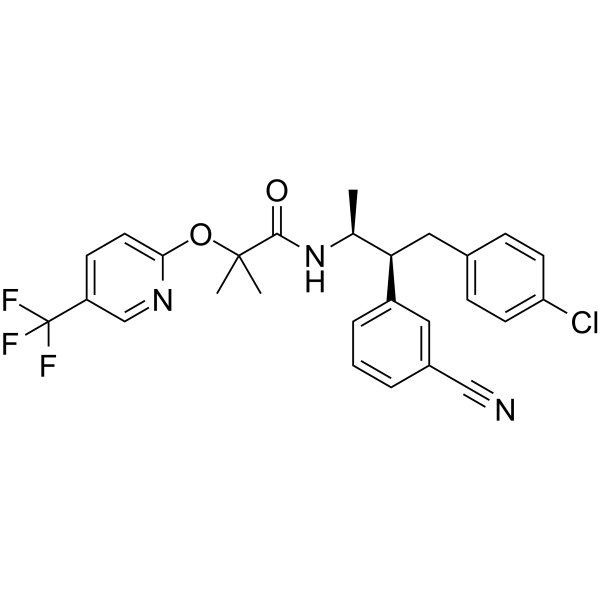
Taranabant is a highly potent and selective cannabinoid 1 (CB1) receptor inverse agonist that inhibits the binding and functional activity of various agonists, with a binding Ki of 0.13 nM for the human CB1R in vitro.
For research use only. We do not sell to patients.
- Purity : 99.95%
- CAS No.: 701977-09-5
- Formula: C27H25ClF3N3O2
- Molecular Weight:515.95
-
Storage:Powder -20°C, 3 years , 4°C, 2 years ; In solvent -80°C, 2 years , -20°C, 1 year

To place orders, for customer services and technical support, please contact: MedChemExpress USA
Tel: 609-228-6898 E-mail: [email protected] [email protected]


-
 Biological Activity
-
Chemical Information
-
Solvent & Solubility
- Purity & Documentation
- References
-
 Help & FAQs


-
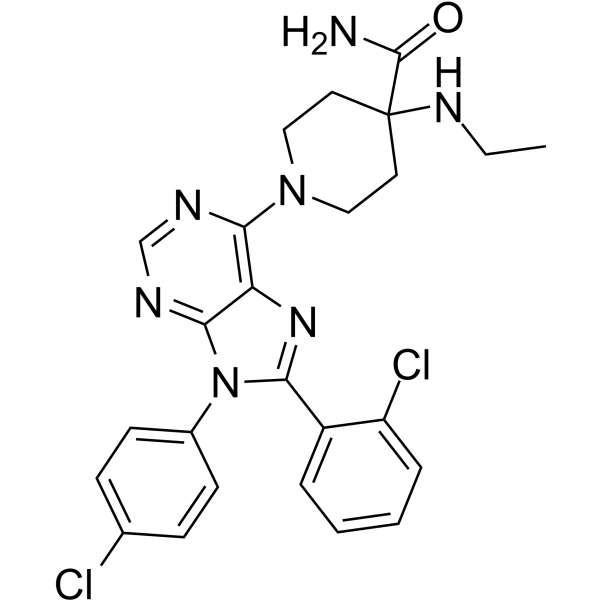
HY-10871
OtenabantCannabinoid Receptor Antagonist -
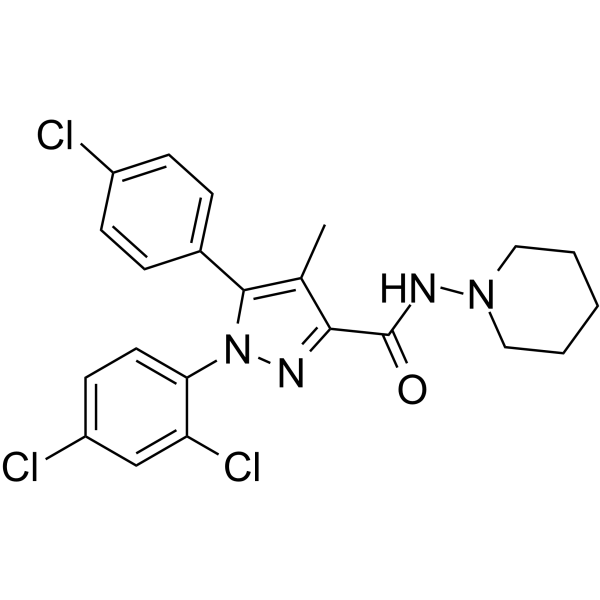
HY-14136
Rimonabant -
HY-13439
SR144528CB2 Receptor Antagonist -
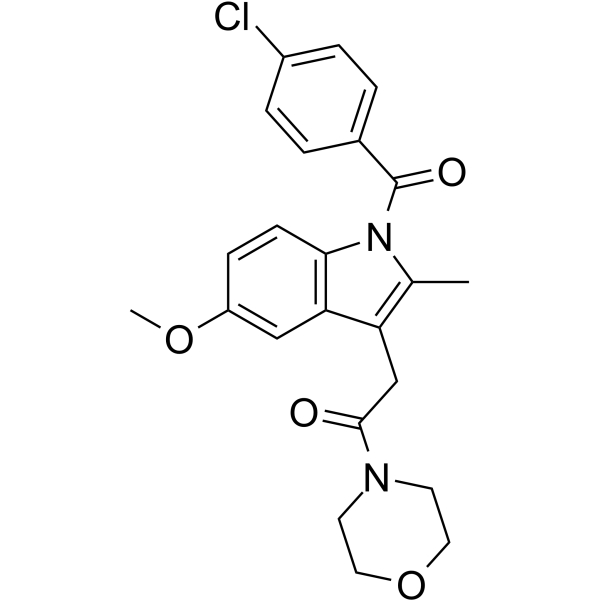
HY-15420
BML-190Cannabinoid Receptor Agonist -
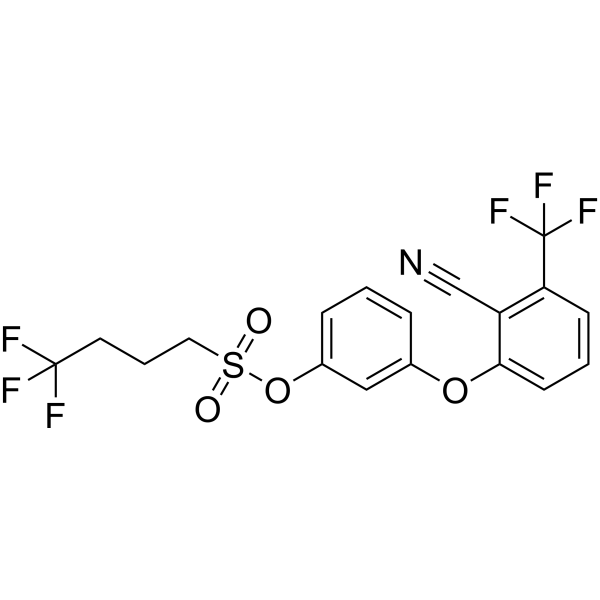
HY-100488
Bay 59-3074CB1/CB2 Receptor Agonist -
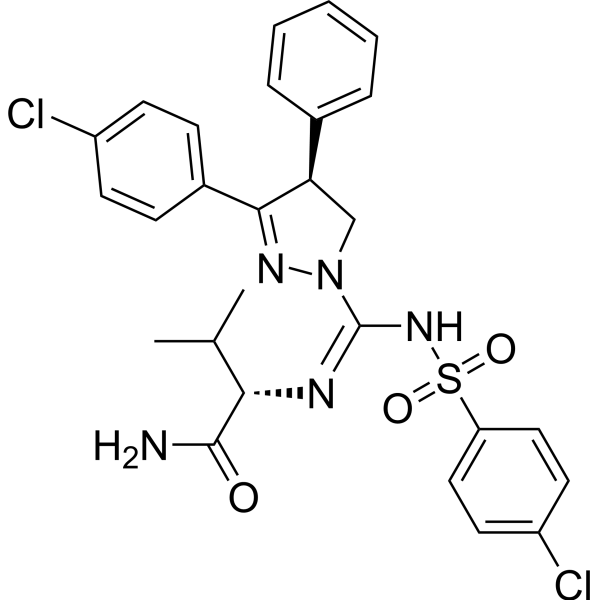
HY-18697
JD-5037CB1 Receptor Antagonist -
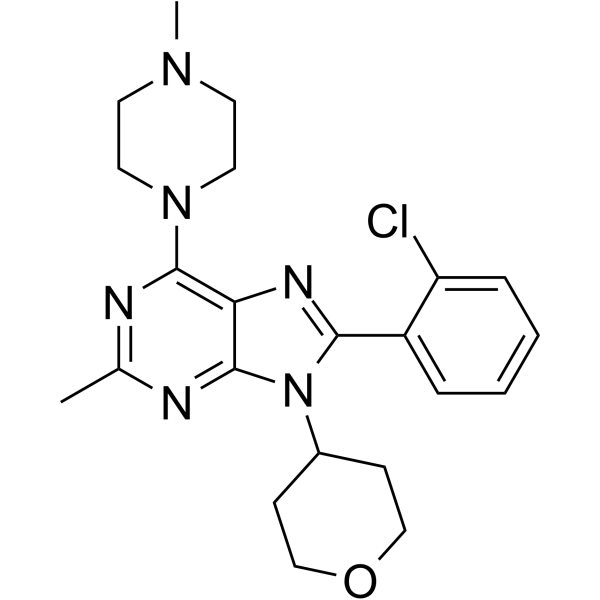
HY-16642A
LY2828360 -
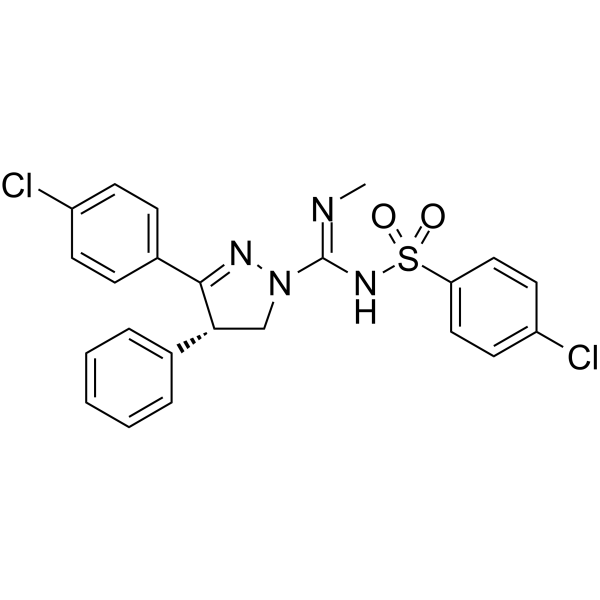
HY-14791
IbipinabantCB1 Antagonist -
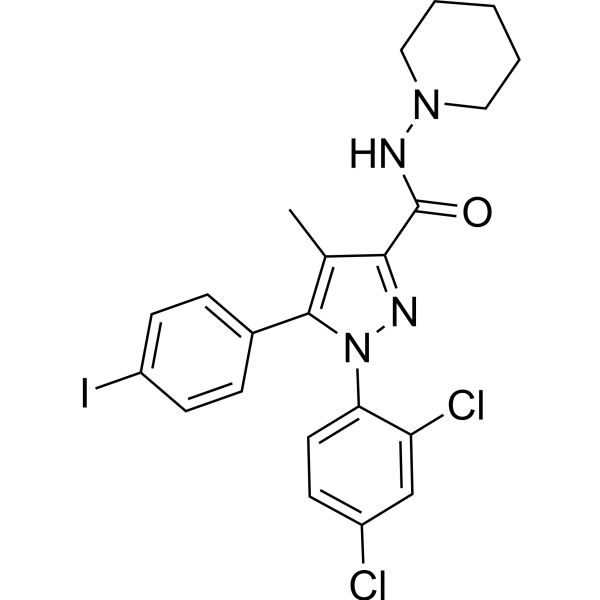
HY-15443
AM251CB1 Receptor Antagonist -
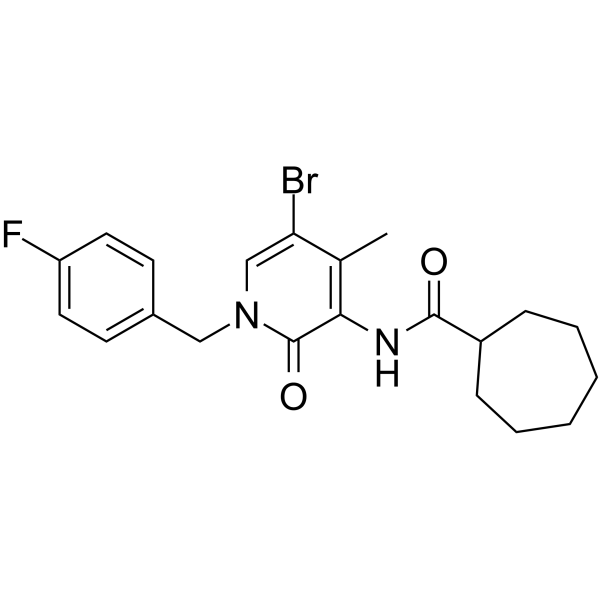
HY-131004
CB2R PAMCB2Rs Positive Allosteric Modulator -
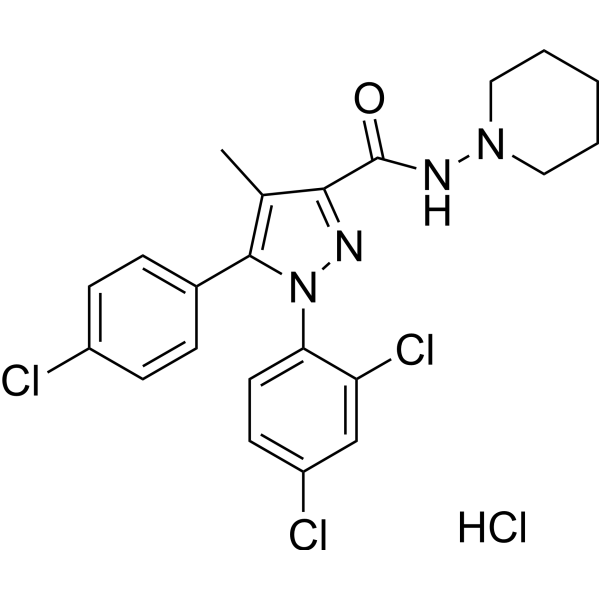
HY-14137
Rimonabant HydrochlorideCB1 Antagonist -
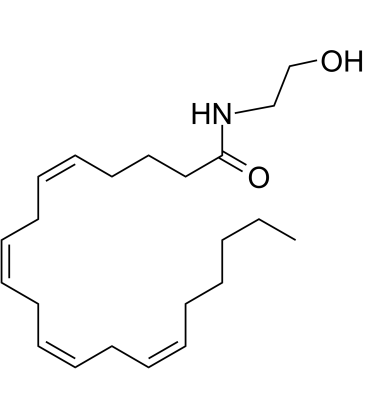
HY-10863
AnandamideCB1/2 Agonist
Publications Citing Use of MedChemExpress (MCE) Taranabant
More

Biological Activity
Description
IC50 & Target
IC50: 0.3 nM (hCB1R), 0.4 nM (rCB1R)[1]
Ki: 0.13 nM (hCB1R), 0.27 nM (rCB1R)[1]
Cellular Effect
|
Cell Line

|
Type | Value | Description | References |
|---|---|---|---|---|
| CHO | EC50 |
2.4 nM
Compound: 48, MK-0364
|
Inverse agonist activity at human recombinant CB1 receptor assessed as inhibition of forskolin-induced cAMP production in CHO cells
Inverse agonist activity at human recombinant CB1 receptor assessed as inhibition of forskolin-induced cAMP production in CHO cells
|
[PMID: 17181138] |
| CHO | IC50 |
0.094 nM
Compound: taranabant,, MK-0364
|
Displacement of [3H]SR-141716 from human wild type CB1R expressed in CHO cells
Displacement of [3H]SR-141716 from human wild type CB1R expressed in CHO cells
|
[PMID: 18333607] |
| CHO | IC50 |
0.29 nM
Compound: 55
|
Displacement of [3H]CP-55940 from human CB1 receptor expressed in CHO cells
Displacement of [3H]CP-55940 from human CB1 receptor expressed in CHO cells
|
[PMID: 18570365] |
| CHO | IC50 |
0.3 nM
Compound: 63
|
Inhibition of radiolabeled CP5549 binding to human Cannabinoid receptor 1 expressed in CHO cells by competition assay
Inhibition of radiolabeled CP5549 binding to human Cannabinoid receptor 1 expressed in CHO cells by competition assay
|
[PMID: 31497963] |
| CHO | IC50 |
0.3 nM
Compound: 1
|
Displacement of [3H]CP-55940 from human recombinant CB1R expressed in CHO cells
Displacement of [3H]CP-55940 from human recombinant CB1R expressed in CHO cells
|
[PMID: 17608398] |
| CHO | IC50 |
0.3 nM
Compound: 2, MK-0634
|
Displacement of [3H]CP-55940 from recombinant human CB1 receptor expressed in CHO cells
Displacement of [3H]CP-55940 from recombinant human CB1 receptor expressed in CHO cells
|
[PMID: 19632830] |
| CHO | IC50 |
0.3 nM
Compound: 48, MK-0364
|
Inhibition of [3H]CP-55940 binding to human recombinant CB1 receptor in CHO cells
Inhibition of [3H]CP-55940 binding to human recombinant CB1 receptor in CHO cells
|
[PMID: 17181138] |
| CHO | IC50 |
0.74 nM
Compound: 1
|
Displacement of [3H]CP55490 from human recombinant cannabinoid CB1 receptor expressed in CHO cells
Displacement of [3H]CP55490 from human recombinant cannabinoid CB1 receptor expressed in CHO cells
|
[PMID: 20643546] |
| CHO | IC50 |
0.74 nM
Compound: taranabant,, MK-0364
|
Displacement of [3H]CP-55940 from human wild type CB1R expressed in CHO cells
Displacement of [3H]CP-55940 from human wild type CB1R expressed in CHO cells
|
[PMID: 18333607] |
| CHO | IC50 |
1.2 nM
Compound: taranabant,, MK-0364
|
Displacement of [3H]CP-55940 from human CB1R K192L mutant expressed in CHO cells
Displacement of [3H]CP-55940 from human CB1R K192L mutant expressed in CHO cells
|
[PMID: 18333607] |
| CHO | IC50 |
19 nM
Compound: taranabant,, MK-0364
|
Displacement of [3H]SR-141716 from human CBR1 S383A mutant expressed in CHO cells
Displacement of [3H]SR-141716 from human CBR1 S383A mutant expressed in CHO cells
|
[PMID: 18333607] |
| CHO | IC50 |
22 nM
Compound: taranabant,, MK-0364
|
Displacement of [3H]CP-55940 from human CB1R F170L mutant expressed in CHO cells
Displacement of [3H]CP-55940 from human CB1R F170L mutant expressed in CHO cells
|
[PMID: 18333607] |
| CHO | IC50 |
285 nM
Compound: 2, MK-0634
|
Displacement of [3H]CP-55940 from recombinant human CB2 receptor expressed in CHO cell
Displacement of [3H]CP-55940 from recombinant human CB2 receptor expressed in CHO cell
|
[PMID: 19632830] |
| CHO | IC50 |
290 nM
Compound: 48, MK-0364
|
Inhibition of [3H]CP-55940 binding to human recombinant CB2 receptor in CHO cells
Inhibition of [3H]CP-55940 binding to human recombinant CB2 receptor in CHO cells
|
[PMID: 17181138] |
| CHO | IC50 |
4.9 nM
Compound: taranabant,, MK-0364
|
Displacement of [3H]CP-55940 from human CB1R W279A mutant expressed in CHO cells
Displacement of [3H]CP-55940 from human CB1R W279A mutant expressed in CHO cells
|
[PMID: 18333607] |
| CHO | IC50 |
5 nM
Compound: taranabant,, MK-0364
|
Displacement of [3H]CP-55940 from human CB1R F200L mutant expressed in CHO cells
Displacement of [3H]CP-55940 from human CB1R F200L mutant expressed in CHO cells
|
[PMID: 18333607] |
| CHO-K1 | IC50 |
1170 nM
Compound: 3, MK-0364
|
Displacement of [3H]WIN-55212-2 from human CB2 receptor expressed in CHOK1 cells by liquid scintillation spectrometry
Displacement of [3H]WIN-55212-2 from human CB2 receptor expressed in CHOK1 cells by liquid scintillation spectrometry
|
[PMID: 18954042] |
| HEK293 | IC50 |
0.3 nM
Compound: 7, MK-0364
|
Displacement of [3H]CP-55940 from human CB1R expressed in HEK293 cells
Displacement of [3H]CP-55940 from human CB1R expressed in HEK293 cells
|
[PMID: 18335976] |
In Vitro
Taranabant (MK-0364) binds to human or rat CB1R with an IC50 of 0.3 and 0.4 nM, respectively, corresponding to a Ki value of 0.13 and 0.27 nM, respectively. Taranabant binds to the human or rat CB2R with an IC50 value of 290 and 470 nM, respectively, corresponding to a Ki value of 170 and 310 nM, respectively. The selectivity ratio of CB1R over CB2R is approximately 1000-fold[1]. Taranabant (MK-0364) is a novel, acyclic cannabinoid-1 receptor inverse agonist for the treatment of obesity. IC50s of Taranabant for CB1R and CB2R by substituted amides is 0.3±0.1 nM, and 290±60 nM, respectively. Taranabant is a CB1R inverse agonist with minimal potential for covalent protein binding. Taranabant is an exceptionally potent and selective (900-fold over CB2) CB1R inverse agonist with >500-fold improvement in affinity over the original lead. In a functional assay of cyclic-AMP production, Taranabant is determined to be an inverse agonist (EC50=2.4±1.4 nM)[2].
MedChemExpress (MCE) has not independently confirmed the accuracy of these methods. They are for reference only. .
In Vivo
MedChemExpress (MCE) has not independently confirmed the accuracy of these methods. They are for reference only.
Clinical Trial
| NCT Number | Sponsor | Condition | Start Date |
Phase
|
|---|---|---|---|---|
| NCT01329991 | Plexxikon| | 2011-05 | PHASE1 |


Chemical Information
-
CAS No. 701977-09-5
-
Appearance Solid
-
Molecular Weight 515.95
-
Formula C27H25ClF3N3O2
-
Color White to off-white
-
SMILES
ClC1=CC=C(C[C@@H](C2=CC=CC(C#N)=C2)[C@@H](NC(C(C)(OC3=CC=C(C=N3)C(F)(F)F)C)=O)C)C=C1
-
Synonyms
MK-0364
-
Shipping
Room temperature in continental US; may vary elsewhere.
-
Storage
Powder -20°C 3 years 4°C 2 years In solvent -80°C 2 years -20°C 1 year


Publications (2)
-
Journal Impact Factor
-
Most Recent


Solvent & Solubility
In Vitro:
DMSO : ≥ 50 mg/mL (96.91 mM; Hygroscopic DMSO has a significant impact on the solubility of product, please use newly opened DMSO)
* "≥" means soluble, but saturation unknown.
Please refer to the solubility information to select the appropriate solvent. Once prepared, please aliquot and store the solution to prevent product inactivation from repeated freeze-thaw cycles.
Storage method and period of stock solution: -80°C, 2 years; -20°C, 1 year. When stored at -80°C, please use it within 2 years. When stored at -20°C, please use it within 1 year.
Please refer to the solubility information to select the appropriate solvent. Once prepared, please aliquot and store the solution to prevent product inactivation from repeated freeze-thaw cycles.
Storage method and period of stock solution: -80°C, 2 years; -20°C, 1 year. When stored at -80°C, please use it within 2 years. When stored at -20°C, please use it within 1 year.
Concentration (start) × Volume (start) = Concentration (final) × Volume (final)
In Vivo:
Select the appropriate dissolution method based on your experimental animal and administration route.
- For the following dissolution methods, please ensure to first prepare a clear stock solution using an In Vitro approach and then sequentially add co-solvents:
- To ensure reliable experimental results, the clarified stock solution can be appropriately stored based on storage conditions. As for the working solution for In Vivo experiments, it is recommended to prepare freshly and use it on the same day.
- The percentages shown for the solvents indicate their volumetric ratio in the final prepared solution. If precipitation or phase separation occurs during preparation, heat and/or sonication can be used to aid dissolution.
Add each solvent one by one: 10% DMSO 40% PEG300 5% Tween-80 45% Saline
Solubility: ≥ 2.5 mg/mL (4.85 mM); Clear solution
This protocol yields a clear solution of ≥ 2.5 mg/mL (saturation unknown).
Taking 1 mL working solution as an example, add 100 μL DMSO stock solution (25.0 mg/mL) to 400 μL PEG300, and mix evenly; then add 50 μL Tween-80 and mix evenly; then add 450 μL Saline to adjust the volume to 1 mL.
Preparation of Saline: Dissolve 0.9 g sodium chloride in ddH₂O and dilute to 100 mL to obtain a clear Saline solution.
In Vivo Dissolution Calculator
Please enter the basic information of animal experiments:
-
-
-
-
Recommended: Prepare an additional quantity of animals to account for potential losses during experiments.
Please enter your animal formula composition:
-
%DMSO +
Recommended: Keep the proportion of DMSO in working solution below 2% if your animal is weak.
-
%+
-
+%Tween-80 + +
-
%Saline +
The co-solvents required include: DMSO, . All of co-solvents are available by MedChemExpress (MCE). , Tween 80. All of co-solvents are available by MedChemExpress (MCE).
Working solution concentration: 0.22 mg/mL
Method for preparing stock solution: mg drug dissolved in μL DMSO. Stock solution concentration: mg/mL.
1. Take μL DMSO stock solution;
2. Add μL .
μL , mix evenly;
3. Then add μL Tween 80, mix evenly;
4. Then add μL
Please ensure that the stock solution in the first step is dissolved to a clear state, and add co-solvents in sequence. You can use ultrasonic heating (ultrasonic cleaner, recommended frequency 20-40 kHz), vortexing, etc. to assist dissolution.


Purity & Documentation
-
Data Sheet (279 KB)
-
SDS (563 KB)
- English - EN (563 KB)
- Français - FR (563 KB)
- Deutsch - DE (563 KB)
- Norwegian - NO (563 KB)
- Español - ES (563 KB)
- Swedish - SV (563 KB)
- Italian - IT (563 KB)
- Korean - KR (563 KB)
- Portuguese - PT (563 KB)
-
Handling Instructions (2659 KB)
References
[1]. Fong TM, et al. Antiobesity Efficacy of a Novel Cannabinoid-1 Receptor Inverse Agonist, N-[(1S,2S)-3-(4-Chlorophenyl)-2-(3-cyanophenyl)-1-methylpropyl]-2 -methyl-2-{[5-(trifluoromethyl)pyridin-2-yl]oxy}propanamide (MK-0364), in Rodents. J Pharmacol Exp T [Content Brief]
[2]. Lin LS, et al. Discovery of N-[(1S,2S)-3-(4-Chlorophenyl)-2- (3-cyanophenyl)-1-methylpropyl]-2-methyl-2- {[5-(trifluoromethyl)pyridin-2-yl]oxy}propanamide (MK-0364), a novel, acyclic cannabinoid-1 receptor inverse agonist for the treatment of obesity. J M [Content Brief]


Complete Stock Solution Preparation Table
Please refer to the solubility information to select the appropriate solvent. Once prepared, please aliquot and store the solution to prevent product inactivation from repeated freeze-thaw cycles.
Storage method and period of stock solution: -80°C, 2 years; -20°C, 1 year. When stored at -80°C, please use it within 2 years. When stored at -20°C, please use it within 1 year.
| Optional Solvent | Concentration Solvent Mass | 1 mg | 5 mg | 10 mg | 25 mg |
|---|---|---|---|---|---|
| DMSO | 1 mM | 1.9382 mL | 9.6909 mL | 19.3817 mL | 48.4543 mL |
| 5 mM | 0.3876 mL | 1.9382 mL | 3.8763 mL | 9.6909 mL | |
| 10 mM | 0.1938 mL | 0.9691 mL | 1.9382 mL | 4.8454 mL | |
| 15 mM | 0.1292 mL | 0.6461 mL | 1.2921 mL | 3.2303 mL | |
| 20 mM | 0.0969 mL | 0.4845 mL | 0.9691 mL | 2.4227 mL | |
| 25 mM | 0.0775 mL | 0.3876 mL | 0.7753 mL | 1.9382 mL | |
| 30 mM | 0.0646 mL | 0.3230 mL | 0.6461 mL | 1.6151 mL | |
| 40 mM | 0.0485 mL | 0.2423 mL | 0.4845 mL | 1.2114 mL | |
| 50 mM | 0.0388 mL | 0.1938 mL | 0.3876 mL | 0.9691 mL | |
| 60 mM | 0.0323 mL | 0.1615 mL | 0.3230 mL | 0.8076 mL | |
| 80 mM | 0.0242 mL | 0.1211 mL | 0.2423 mL | 0.6057 mL |


Taranabant Related Classifications
HY-10013 Related Classifications
 Powered by Bioz