



USP1
Deubiquitinase USP1 regulates DNA damage response by removing ubiquitin from FANCD2, FANCI, and PCNA, thereby controlling Fanconi anemia signaling and translesion DNA synthesis[1][2]. Mechanistically, USP1 functions with UAF1, which activates USP1 and supports FANCD2 and PCNA deubiquitination in DNA repair contexts[2][3]. In homologous recombination models, USP1/UAF1 promotes double-strand break repair and suppresses nonhomologous end joining[3]. DNA and RAD51AP1 further support efficient FANCD2 deubiquitination by the USP1-UAF1 complex[4]. Compared with broader USP family activity, USP1 shows substrate specificity through its conserved N-terminus, which drives FANCD2 deubiquitination but is not required for PCNA or FANCI deubiquitination[5]. In cancer models, selective USP1/UAF1 inhibitors such as ML323, pimozide, and GW7647 enhance cisplatin responses in non-small cell lung cancer, osteosarcoma, and cisplatin-resistant NSCLC cells[2][6]. In HPV-negative HNSCC models, reduced SERPINB3 decreases USP1-mediated FANCD2-FANCI deubiquitination and increases cisplatin-induced apoptosis[7]. Therefore, USP1 inhibitors serve as practical probes for studying DNA repair, Fanconi anemia pathway regulation, and chemotherapy response mechanisms[2][6].
References:
- [1]. Nijman SM, et al. The deubiquitinating enzyme USP1 regulates the Fanconi anemia pathway. Mol Cell. 2005 Feb 4;17(3):331-9. [Content Brief]
- [2]. Liang Q, et al. A selective USP1-UAF1 inhibitor links deubiquitination to DNA damage responses. Nat Chem Biol. 2014 Apr;10(4):298-304. [Content Brief]
- [3]. Murai J, et al. The USP1/UAF1 complex promotes double-strand break repair through homologous recombination. Mol Cell Biol. 2011 Jun;31(12):2462-9. [Content Brief]
- [4]. Liang F, et al. DNA requirement in FANCD2 deubiquitination by USP1-UAF1-RAD51AP1 in the Fanconi anemia DNA damage response. Nat Commun. 2019 Jun 28;10(1):2849. [Content Brief]
- [5]. Arkinson C, et al. Specificity for deubiquitination of monoubiquitinated FANCD2 is driven by the N-terminus of USP1. Life Sci Alliance. 2018 Oct 12;1(5):e201800162. [Content Brief]
- [6]. Chen J, et al. Selective and cell-active inhibitors of the USP1/ UAF1 deubiquitinase complex reverse cisplatin resistance in non-small cell lung cancer cells. Chem Biol. 2011 Nov 23;18(11):1390-400. [Content Brief]
- [7]. Huang Z, et al. HPV Enhances HNSCC Chemosensitization by Inhibiting SERPINB3 Expression to Disrupt the Fanconi Anemia Pathway. Adv Sci (Weinh). 2022 Nov 16;10(1):e2202437. [Content Brief]
All Product Categories
-
USP1 Related Products (11)
Related Products (11)

- 1

-
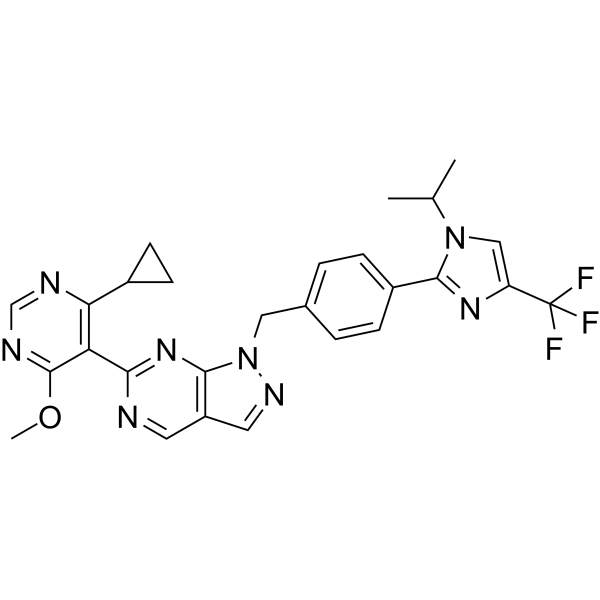
USP1-IN-2
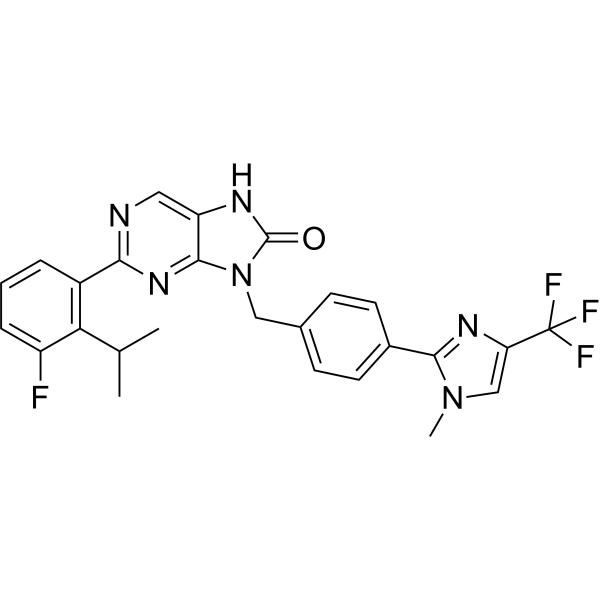 0 ImagesUSP1-IN-2 (Compound I-193) is a potent ubiquitin-specific protease 1 (USP1) inhibitor with an IC50 of less than about 50 nM. USP1-IN-2 can be used for the study of cancers such as osteosarcoma.
-
USP1-IN-18
 0 ImagesCat. No.: HY-183581CAS No.: 3064481-29-1USP1-IN-18 is an orally active USP1 inhibitor with a human IC50 of 17.0 nM. USP1-IN-18 inhibits USP1-UAF1 deubiquitinase activity and drives ubiquitinated PCNA accumulation. USP1-IN-18 induces DNA damage, replication stress, and G2-M phase cell cycle arrest. USP1-IN-18 can be used for the research of triple-negative breast cancer.
-
USP1-IN-13
 0 ImagesCat. No.: HY-176704CAS No.: 2974433-50-4
-
USP1-IN-16
 0 ImagesCat. No.: HY-181702CAS No.: 3084671-46-2USP1-IN-16 is a USP1 inhibitor with an USP1-UAF1 IC50 value of 0.002 μM. USP1-IN-16 can be used in the research of USP1-related malignancies.
-
USP1-IN-10
 0 ImagesCat. No.: HY-161878CAS No.: 2857051-98-8USP1-IN-10 (compound 2) is a potent tricyclic USP1 inhibitor with an IC50 of 7.6 nM. USP1-IN-10 inhibits MDA-MB-436 viability (IC50=21.58 nM). USP1-IN-10 has the potential for cancers research.
-
USP1-IN-12
 0 ImagesCat. No.: HY-176703CAS No.: 2961035-60-7USP1-IN-12 (compound 4) is a potent and orally activeUSP1 inhibitor with an IC50 value of 0.00366 µM. USP1-IN-12 inhibits cell clone formation.
-
USP1-IN-15
 0 ImagesCat. No.: HY-180216USP1-IN-15 is an orally active and selective USP1 inhibitor with an IC50 of 12.3 nM. USP1-IN-15 has a high specificity for USP1 with negligible inhibition against all off-target DUBs. USP1-IN-15 suppresses colony formation, induces S-phase arrest, and stabilizes ubiquitinated PCNA. USP1-IN-15 also shows synergistic antiproliferative activity. USP1-IN-15 achieves significant tumor growth inhibition in vivo. USP1-IN-15 can be used for BRCA-mutated breast cancer.
-
USP1-IN-14
 0 ImagesCat. No.: HY-179292CAS No.: 3084277-96-0
-
USP1-IN-4
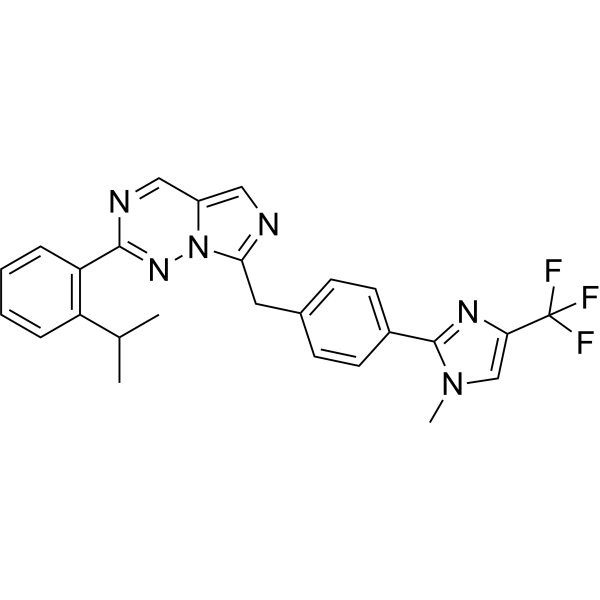 0 ImagesCat. No.: HY-153731CAS No.: 2878441-72-4USP1-IN-4 (compound 10) is an effective USP1 inhibitor with an IC50 value of 2.44 nM. USP1-IN-4 has anticancer activity and synergistic activity with various anticancer drugs.
- 1



