



EAAT4
EAAT4 is a human aspartate/glutamate transporter predominantly expressed in the cerebellum and functions as a ligand-gated chloride channel[1]. Mechanistically, EAAT4 localizes mainly to Purkinje cell dendrites, forms parasagittal cerebellar compartments, and concentrates near synapses in dendritic membranes facing astroglia[2][3]. Compared with EAAT1-EAAT3, EAAT4 shows high-affinity, low-capacity glutamate transport, slower kinetics, and distinct voltage dependence, supporting a role in binding residual extracellular glutamate rather than rapid bulk uptake[4]. In cerebellar models, EAAT4 shapes mGluR signaling, controls synaptic plasticity, and limits transmitter diffusion from climbing fibers[5][6]. Loss-of-function studies show that EAAT4 loss alters Purkinje cell firing and survival, distinguishing neuronal EAAT4 from glial GLAST/EAAT1 in cerebellar disease-relevant mechanisms[7]. For experimental applications, TBOA inhibits EAAT4 currents and can help test transporter-dependent glutamate uptake and anion conductance in heterologous or cerebellar preparations[4].- EAAT4 links glutamate clearance, chloride conductance, and Purkinje cell compartmental signaling.- EAAT4 differs from EAAT1-EAAT3 by slower, high-affinity, low-capacity transport kinetics.- TBOA-based inhibition supports functional testing of EAAT4-dependent glutamate uptake mechanisms.
References:
- [1]. Fairman WA, et al. An excitatory amino-acid transporter with properties of a ligand-gated chloride channel. Nature. 1995 Jun 15;375(6532):599-603. [Content Brief]
- [2]. Nagao S, et al. EAAT4, a glutamate transporter with properties of a chloride channel, is predominantly localized in Purkinje cell dendrites, and forms parasagittal compartments in rat cerebellum. Neuroscience. 1997 Jun;78(4):929-33. [Content Brief]
- [3]. Dehnes Y, et al. The glutamate transporter EAAT4 in rat cerebellar Purkinje cells: a glutamate-gated chloride channel concentrated near the synapse in parts of the dendritic membrane facing astroglia. J Neurosci. 1998 May 15;18(10):3606-19. [Content Brief]
- [4]. Mim C, et al. The glutamate transporter subtypes EAAT4 and EAATs 1-3 transport glutamate with dramatically different kinetics and voltage dependence but share a common uptake mechanism. J Gen Physiol. 2005 Dec;126(6):571-89. [Content Brief]
- [5]. Wadiche JI, et al. Patterned expression of Purkinje cell glutamate transporters controls synaptic plasticity. Nat Neurosci. 2005 Oct;8(10):1329-34. [Content Brief]
- [6]. Satake S, et al. Glutamate transporter EAAT4 in Purkinje cells controls intersynaptic diffusion of climbing fiber transmitter mediating inhibition of GABA release from interneurons. Eur J Neurosci. 2010 Dec;32(11):1843-53. [Content Brief]
- [7]. Perkins EM, et al. Loss of cerebellar glutamate transporters EAAT4 and GLAST differentially affects the spontaneous firing pattern and survival of Purkinje cells. Hum Mol Genet. 2018 Aug 1;27(15):2614-2627. [Content Brief]
All Product Categories
-
EAAT4 Related Products (2)
Related Products (2)

-
SLC1A1/EAAT3-IN-1
 0 ImagesSLC1A1/EAAT3-IN-1 (Compound 3e) is a selective EAAT3 inhibitor with an IC50 of 7.2 μM for hEAAT3 over EAAT1,2,4 (IC50: ∼ 250 μM). SLC1A1/EAAT3-IN-1 can be used for psychiatric disorders such as obsessive compulsive disorder and schizophrenia research.
-
(±)-threo-3-Methylglutamic acid
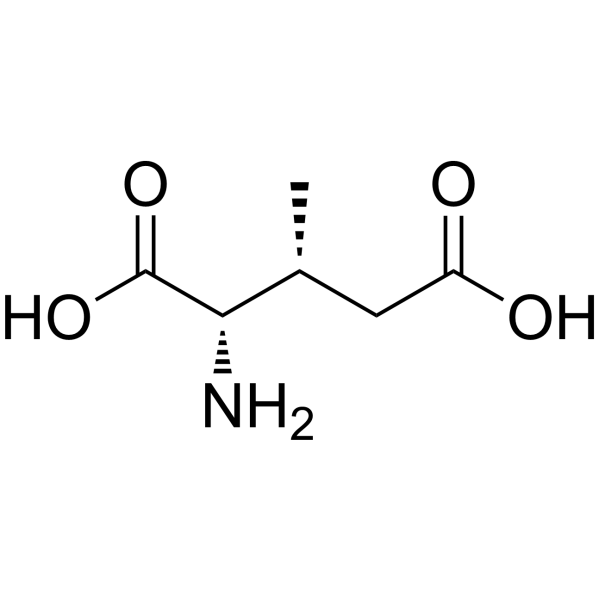 0 ImagesCat. No.: HY-101227CAS No.: 63088-04-0(±)-threo-3-Methylglutamic acid is a potent EAAT2/4 inhibitor. (±)-threo-3-Methylglutamic acid also is an ionotropic glutamate receptor agonist. (±)-threo-3-Methylglutamic acid inhibits glutamate uptake by rod outer segments.



