



EAAT3
The neuronal excitatory amino acid transporter 3 (EAAT3, also known as EAAC1) mediates Na+-dependent uptake of glutamate and the uncharged amino acid L-cysteine, which is essential for neuronal glutathione synthesis and prevention of oxidative stress[1][2][3]. Mechanistically, EAAT3 exhibits a high affinity for cysteine via thiolate formation in its binding site, allowing predominantly unidirectional transport without significant substrate release[1]. EAAT3 contributes to maintaining low extracellular glutamate concentrations at the synapse, thereby regulating excitatory neurotransmission and limiting excitotoxicity[3][4]. In disease models, EAAT3 expression is altered in the striatum of schizophrenia and bipolar disorder, implicating neuronal glutamate transport dysfunction in psychiatric pathology[5][6]. Compared with related isoforms, EAAT3 uniquely transports cysteine efficiently, whereas glial transporters EAAT1 and EAAT2 exhibit negligible cysteine transport[1][2]. EAAT3 also displays partial sensitivity to membrane lipid composition, associating with cholesterol-rich lipid rafts, which influences transporter localization and function[7]. Pharmacologically, EAAT3 can be inhibited by broad-spectrum EAAT inhibitors such as threo-beta-hydroxyaspartate, though selective activation remains challenging due to the scarcity of effective agonists[8][9][10]. Therefore, EAAT3 serves as a critical regulator of neuronal redox balance and glutamatergic signaling, providing a distinct target for studies of oxidative stress, synaptic modulation, and neuropsychiatric disease mechanisms[1][2][3][5].
Verweise:
- [1]. Shigeri Y, et al. Effects of threo-beta-hydroxyaspartate derivatives on excitatory amino acid transporters (EAAT4 and EAAT5). J Neurochem. 2001 Oct;79(2):297-302. [Content Brief]
- [2]. van Veggel L, et al. Still in Search for an EAAT Activator: GT949 Does Not Activate EAAT2, nor EAAT3 in Impedance and Radioligand Uptake Assays. ACS Chem Neurosci. 2024 Apr 3;15(7):1424-1431. [Content Brief]
- [3]. O'Kane RL, et al. Na(+)-dependent glutamate transporters (EAAT1, EAAT2, and EAAT3) of the blood-brain barrier. A mechanism for glutamate removal. J Biol Chem. 1999 Nov 5;274(45):31891-5. [Content Brief]
- [4]. Kovermann P, et al. Cellular Physiology and Pathophysiology of EAAT Anion Channels. Front Cell Neurosci. 2022 Jan 6;15:815279. [Content Brief]
- [5]. Rabezanahary H, et al. Live virus neutralizing antibodies against pre and post Omicron strains in food and retail workers in Québec, Canada. Heliyon. 2024 May 21;10(10):e31026. [Content Brief]
- [6]. Watts SD, et al. Cysteine transport through excitatory amino acid transporter 3 (EAAT3). PLoS One. 2014 Oct 2;9(10):e109245. [Content Brief]
- [7]. Chen Y, et al. The glutamate transporters EAAT2 and EAAT3 mediate cysteine uptake in cortical neuron cultures. J Neurochem. 2003 Mar;84(6):1332-9. [Content Brief]
- [8]. Jensen AA, et al. Pharmacological characterization of human excitatory amino acid transporters EAAT1, EAAT2 and EAAT3 in a fluorescence-based membrane potential assay. Biochem Pharmacol. 2004 Jun 1;67(11):2115-27. [Content Brief]
- [9]. McCullumsmith RE, et al. Striatal excitatory amino acid transporter transcript expression in schizophrenia, bipolar disorder, and major depressive disorder. Neuropsychopharmacology. 2002 Mar;26(3):368-75. [Content Brief]
- [10]. Butchbach ME, et al. Association of excitatory amino acid transporters, especially EAAT2, with cholesterol-rich lipid raft microdomains: importance for excitatory amino acid transporter localization and function. J Biol Chem. 2004 Aug 13;279(33):34388-96. [Content Brief]
All Product Categories
-
EAAT3 Verwandte Produkte (7)
Verwandte Produkte (7)

-
DL-TBOA
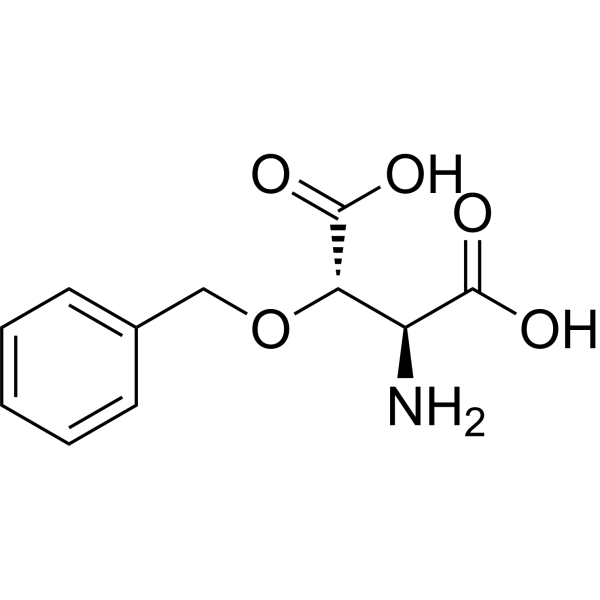 0 ImagesDL-TBOA is a potent non-transportable inhibitor of excitatory amino acid transporters with IC50s of 70 μM, 6 μM and 6 μM for excitatory amino acid transporter-1 (EAAT1), EAAT2 and EAAT3, respectively. DL-TBOA inhibits the uptake of [14C]glutamate in COS-1 cells expressing the human EAAT1 and EAAT2 with Ki valuesof 42 μM and 5.7 μM, respectively. DL-TBOA blocks EAAT4 and EAAT5 in a competitive manner with Ki values of 4.4 μM and 3.2 μM, respectively.
-
TFB-TBOA
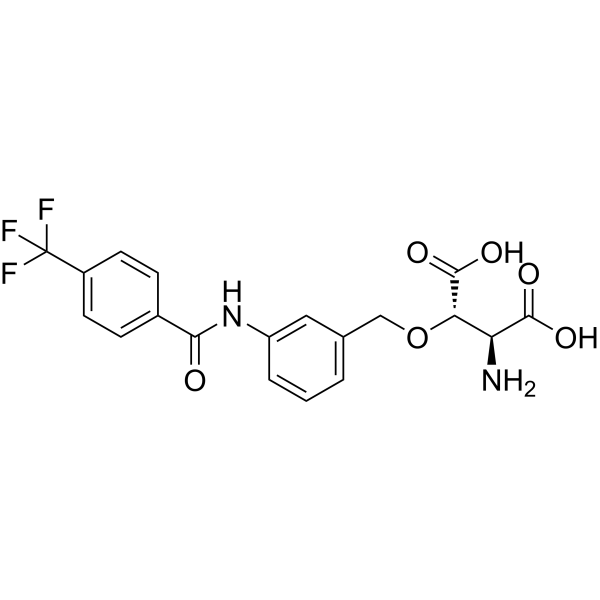 0 ImagesSynonyms: CF3-Bza-TBOATFB-TBOA (CF3-Bza-TBOA) is a potent glutamate transporter blocker that potently suppresses the activity of glial transporters. TFB-TBOA shows IC50 values of 22, 17, and 300 nM for glutamate transporters EAAT1, EAAT2, and EAAT3 respectively in an uptake assay using cells transiently expressing EAATs.
-
SLC1A1/EAAT3-IN-1
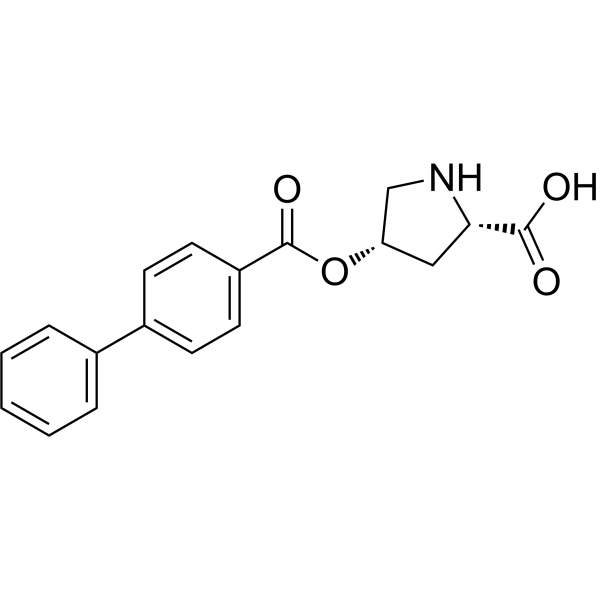
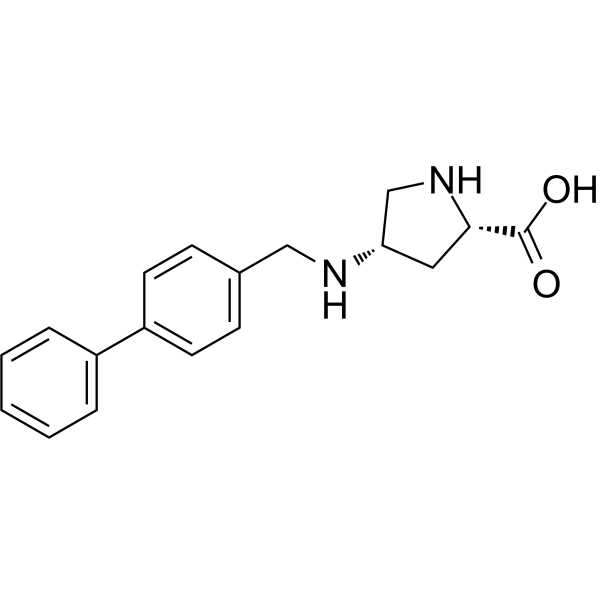
 0 ImagesSLC1A1/EAAT3-IN-1 (Compound 3e) is a selective EAAT3 inhibitor with an IC50 of 7.2 μM for hEAAT3 over EAAT1,2,4 (IC50: ∼ 250 μM). SLC1A1/EAAT3-IN-1 can be used for psychiatric disorders such as obsessive compulsive disorder and schizophrenia research.
-
Parawixin10
 0 ImagesArt. -Nr.: HY-182941Parawixin10 (Compound 2) is an N-acylpolyamine. Parawixin10 fails to enhance glutamate uptake in radioligand uptake assays of EAAT1, EAAT2 or EAAT3. Parawixin10 exhibits no positive allosteric modulatory activity in radioligand uptake assays of EAAT1−EAAT3, nor can it improve neuronal survival rates in mice in a dose-dependent and statistically significant manner. Parawixin10 has no neuroprotective activity.
-
DL-TBOA ammonium
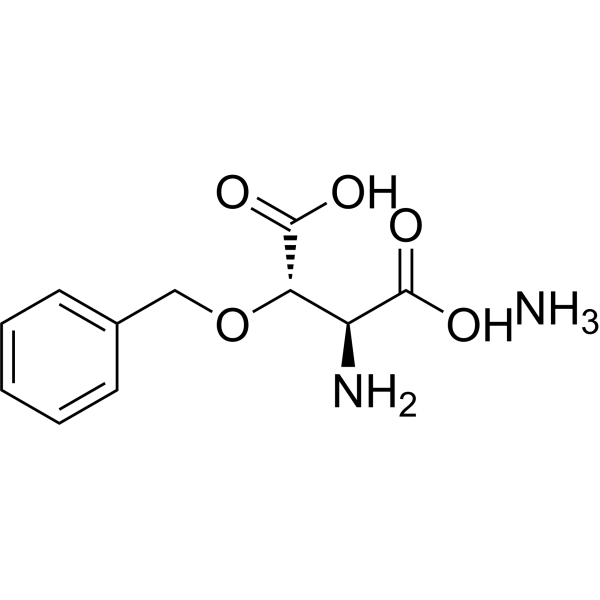 0 ImagesArt. -Nr.: HY-107522BCAS. Nr.: 2093503-71-8DL-TBOA ammonium is a potent non-transportable inhibitor of excitatory amino acid transporters with IC50s of 70 μM, 6 μM and 6 μM for excitatory amino acid transporter-1 (EAAT1), EAAT2 and EAAT3, respectively. DL-TBOA ammonium inhibits the uptake of [14C]glutamate in COS-1 cells expressing the human EAAT1 and EAAT2 with Ki valuesof 42 μM and 5.7 μM, respectively. DL-TBOA ammonium blocks EAAT4 and EAAT5 in a competitive manner with Ki values of 4.4 μM and 3.2 μM, respectively.



