



SIRT7
SIRT7 is a mammalian sirtuin and NAD+-dependent histone/protein deacetylase involved in genome stability, metabolism, stress responses, tumorigenesis, ribosome biogenesis, and transcriptional regulation[1]. Mechanistically, DNA activates SIRT7 to deacetylate histone H3 in chromatin, and RNA increases SIRT7 catalytic efficiency while ribosomal RNA acts as a predominant binding partner[1][2]. Therefore, SIRT7 connects nucleolar biology with chromatin regulation through deacetylation of fibrillarin, maintenance of H2AQ104 methylation, and support of cell-cycle-dependent rDNA transcription[3]. SIRT7 also deacetylates ribosomal RNA ac4C, indicating an epitranscriptional role in rRNA modification and aging-related regulation[4]. In DNA damage models, SIRT7 promotes genome integrity by PARP1-dependent recruitment to DNA damage sites, H3K18Ac modulation, 53BP1 recruitment, and non-homologous end joining repair[5]. In cellular senescence models, SIRT7 supports SNF2H association with rDNA sequences and protects against rDNA instability, rDNA copy loss, and acute senescence[6]. Compared with SIRT6, SIRT7 shows a distinct activation mechanism because DNA activates SIRT7 peptide deacetylation, whereas SIRT6 peptide deacetylation is not DNA-activated[1]. For experimental applications, improved DNA- or RNA-activated enzymatic assays and SIRT7 lysine deacylase profiling support development of SIRT7 modulators[1][2][7].
References:
- [1]. Tong Z, et al. SIRT7 Is Activated by DNA and Deacetylates Histone H3 in the Chromatin Context. ACS Chem Biol. 2016 Mar 18;11(3):742-7. [Content Brief]
- [2]. Tong Z, et al. SIRT7 Is an RNA-Activated Protein Lysine Deacylase. ACS Chem Biol. 2017 Jan 20;12(1):300-310. [Content Brief]
- [3]. Iyer-Bierhoff A, et al. SIRT7-Dependent Deacetylation of Fibrillarin Controls Histone H2A Methylation and rRNA Synthesis during the Cell Cycle. Cell Rep. 2018 Dec 11;25(11):2946-2954.e5. [Content Brief]
- [4]. Khalili M, et al. Underserved Does Not Mean Undeserved: Unfurling the HCV Care in the Safety Net. Dig Dis Sci. 2018 Dec;63(12):3250-3252. [Content Brief]
- [5]. Vazquez BN, et al. SIRT7 promotes genome integrity and modulates non-homologous end joining DNA repair. EMBO J. 2016 Jul 15;35(14):1488-503. [Content Brief]
- [6]. Paredes S, et al. The epigenetic regulator SIRT7 guards against mammalian cellular senescence induced by ribosomal DNA instability. J Biol Chem. 2018 Jul 13;293(28):11242-11250. [Content Brief]
- [7]. Kibria MG, et al. SIRT7 Is a Lysine Deacylase with a Preference for Depropionylation and Demyristoylation. Int J Mol Sci. 2025 Mar 28;26(7):3153. [Content Brief]
All Product Categories
-
SIRT7 Related Products (4)
Related Products (4)

-
SIRT7 inhibitor 97491
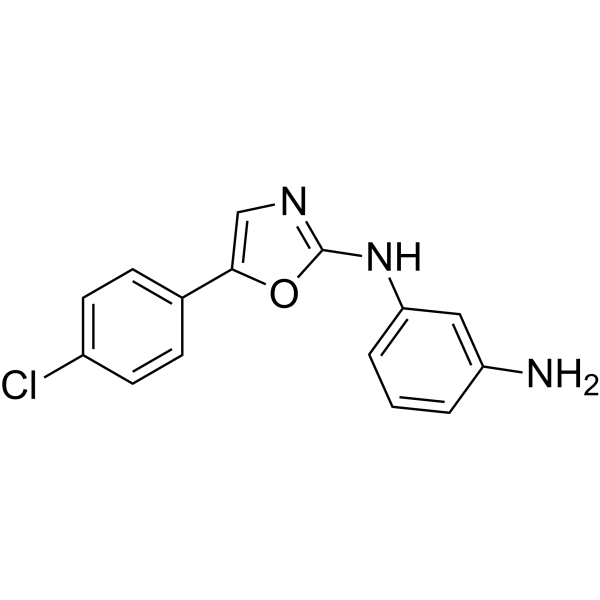 0 ImagesSIRT7 inhibitor 97491, a potent SIRT7 inhibitor with an IC50 of 325 nM, reduces deacetylase activity of SIRT7 in a dose-dependent manner. SIRT7 inhibitor 97491 prevents tumor progression by increasing p53 stability through acetylation at K373/382. SIRT7 inhibitor 97491 promotes apoptosis through caspase pathway..
-
YZL-51N
 0 ImagesCat. No.: HY-159124CAS No.: 3031072-69-9
-
SIRT5 inhibitor 4
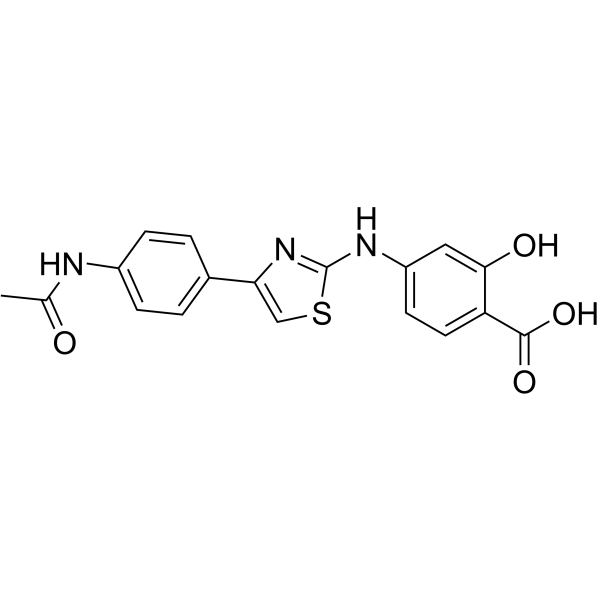 0 ImagesSIRT5 inhibitor 4 (compound 11) is a potent, selective SIRT5 inhibitor with IC50 values of 26.4 and >400μM for SIRT5 and other SIRT subtype, respectively.
-
Epigenetic factor-IN-1
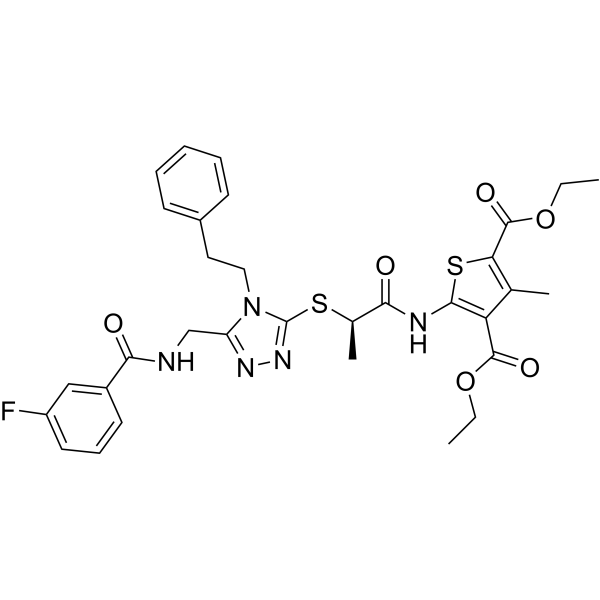 0 ImagesCat. No.: HY-156489CAS No.: 2640673-56-7Epigenetic factor-IN-1 (40569Z) is a epigenetic factor inhibitor. Epigenetic factor-IN-1 has strong binding effect on SIRT7. Epigenetic factor-IN-1 can be used for liver cancer research.



