



Drug Intermediate
Drug Iintermediate
Drug intermediates are used as raw materials for the production of bulk drugs, or they can refer to a material produced during synthesis of an API that must undergo further molecular change or processing before it becomes an API. Drug intermediates are hygienically formulated using high grade raw materials and they are used in the pharmaceutical and cosmetic industry[1][2].
References:
- [1]. Ma HC, et al. Homochiral Covalent Organic Framework for Catalytic Asymmetric Synthesis of a Drug Intermediate. J Am Chem Soc. 2020 Jul 22;142(29):12574-12578. [Content Brief]
- [2]. Ramachary D B, et al. Development of pharmaceutical drugs, drug intermediates and ingredients by using direct organo‐click reactions[J]. 2008.
All Product Categories
-
Drug Intermediate Related Products (4624)
Related Products (4624)

-
4-Fluoro-5-hydroxy-2-methylindole
 0 Images4-Fluoro-5-hydroxy-2-methylindole is a drug intermediate for synthesis of various active compounds.
-
Rivaroxaban impurity 48
 0 ImagesRivaroxaban impurity 48 is an impurity of Rivaroxaban (HY-50903). Rivaroxaban impurity 48 is a 3-morpholinone, and also serves as the starting material for the key intermediate used in the preparation of Baloxavir marboxil (HY-109025).
-
2,3,4,6-Tetra-O-acetyl-1-S-acetyl-1-thiohexopyranose
 0 ImagesCat. No.: HY-44323CAS No.: 13639-50-4Synonyms: (2R,3R,4S,5R,6S)-2-(Acetoxymethyl)-6-(acetylthio)tetrahydro-2H-pyran-3,4,5-triyl triacetate2,3,4,6-Tetra-O-acetyl-1-S-acetyl-1-thiohexopyranose ((2R,3R,4S,5R,6S)-2-(Acetoxymethyl)-6-(acetylthio)tetrahydro-2H-pyran-3,4,5-triyl triacetate) is a drug intermediate for synthesis of various active compounds.
-
(R)-(+)-Citronellic acid
 0 Images(R)-(+)-Citronellic acid is a chiral carboxylic acid and can be used as a drug intermediate.
-
(S)-5-Methoxy-N-propyl-N-(2-(thiophen-2-yl)ethyl)-1,2,3,4-tetrahydronaphthalen-2-amine hydrochloride
 0 Images(S)-5-Methoxy-N-propyl-N-(2-(thiophen-2-yl)ethyl)-1,2,3,4-tetrahydronaphthalen-2-amine hydrochloride is a drug intermediate for synthesis of various active compounds.
-
6-Benzothiazolemethanamine dihydrochloride
 0 Images6-Benzothiazolemethanamine dihydrochloride is a drug intermediate for synthesis of various active compounds.
-
4-Phenyl-2-pyrrolidinone
 0 Images4-Phenyl-2-pyrrolidinone is a precursor and synthetic intermediate. 4-Phenyl-2-pyrrolidinone can be used as a precursor in the synthesis of compounds with anticonvulsant and nootropic activities and is an intermediate in the synthesis of bromodomain-containing protein 4 (BRD4) bromodomain 1 inhibitors.
-
Methyl 3-hydroxy-4-nitrothiophene-2-carboxylate
 0 ImagesMethyl 3-hydroxy-4-nitrothiophene-2-carboxylate is a drug intermediate for synthesis of various active compounds.
-
TPP@CUR
 0 ImagesCat. No.: HY-186012CAS No.: 3032193-08-8TPP@CUR is the product formed by the esterification reaction between Curcumin (HY-N0005) and (5-hydroxy-5-oxopentyl)triphenylphosphonium bromide (TPP). TPP@CUR can be used to synthesize Ser@TPP@CUR (HY-151342), which can then be used in studies of acute kidney injury.
-
WZ4141
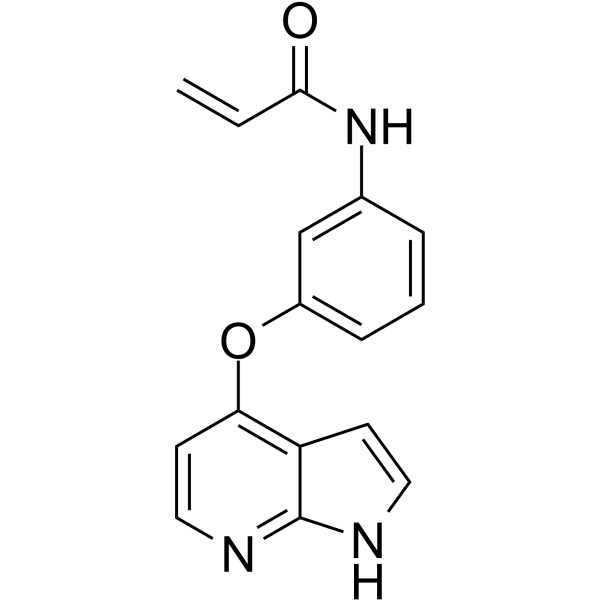 0 ImagesCat. No.: HY-103015CAS No.: 1222776-76-2WZ4141 is an intermediate in the synthesis of compounds.
-
L-Lactic acid-13C-1 sodium (20% w/w in water)
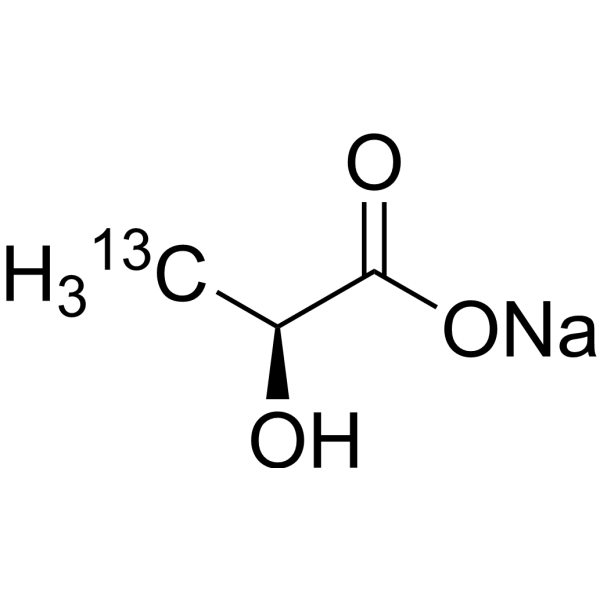 0 ImagesSynonyms: L-E-270-13C-1 sodiumL-Lactic acid-13C1 (L-E-270-13C1) sodium (20% in water) is the 13C-labeled L-Lactic acid sodium (HY-W040233). L-lactate Sodium is a buildiing block which can be used as a precursor for the production of the bioplastic polymer poly-lactic acid. L-Lactic acid Sodium has antiproliferative activityy.

-
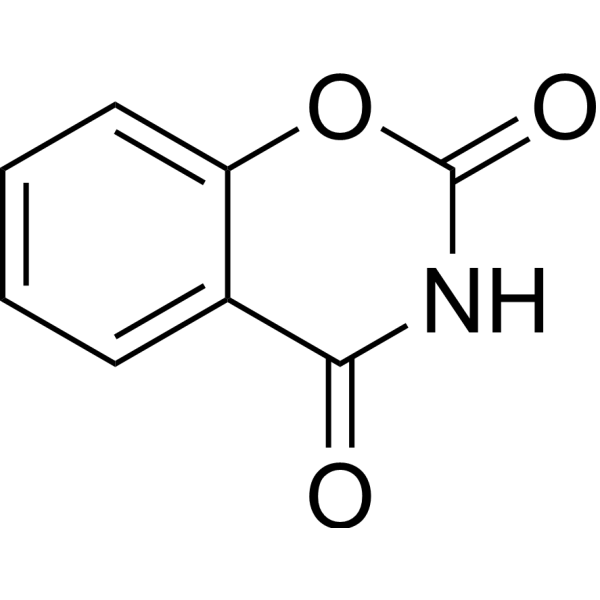
trans-2,5-Diethylpiperazine
 0 Imagestrans-2,5-Diethylpiperazine is a drug intermediate for synthesis of various active compounds.

-
2-(2,2,2-Trifluoroethoxy)pyridin-3-amine
 0 ImagesCat. No.: HY-Z0823CAS No.: 154584-73-32-(2,2,2-Trifluoroethoxy)pyridin-3-amine is a drug impurity.
-
1-(6-Aminonaphthalen-2-yl)ethan-1-one
 0 Images1-(6-Aminonaphthalen-2-yl)ethan-1-one is a drug intermediate for synthesis of various active compounds.
-
(R)-Ethyl 5-(2,2-dimethyltetrahydro-2H-pyran-4-yl)-1H-indole-2-carboxylate
 0 Images(R)-Ethyl 5-(2,2-dimethyltetrahydro-2H-pyran-4-yl)-1H-indole-2-carboxylate is a drug intermediate for synthesis of various active compounds.
-
3-Fluoro-2-(4,4,5,5-tetramethyl-1,3,2-dioxaborolan-2-yl)phenol
 0 Images3-Fluoro-2-(4,4,5,5-tetramethyl-1,3,2-dioxaborolan-2-yl)phenol is a drug intermediate for synthesis of various active compounds.
-
1-(2-(4-(Chloromethyl)phenoxy)ethyl)azepane hydrochloride
 0 Images1-(2-(4-(Chloromethyl)phenoxy)ethyl)azepane hydrochloride is a drug intermediate for synthesis of various active compounds.



