



Drug Intermediate
Drug Iintermediate
Drug intermediates are used as raw materials for the production of bulk drugs, or they can refer to a material produced during synthesis of an API that must undergo further molecular change or processing before it becomes an API. Drug intermediates are hygienically formulated using high grade raw materials and they are used in the pharmaceutical and cosmetic industry[1][2].
References:
- [1]. Ma HC, et al. Homochiral Covalent Organic Framework for Catalytic Asymmetric Synthesis of a Drug Intermediate. J Am Chem Soc. 2020 Jul 22;142(29):12574-12578. [Content Brief]
- [2]. Ramachary D B, et al. Development of pharmaceutical drugs, drug intermediates and ingredients by using direct organo‐click reactions[J]. 2008.
All Product Categories
-
Drug Intermediate Related Products (4595)
Related Products (4595)

-
2-Fluoro-5-formylbenzonitrile
 0 Images2-Fluoro-5-formylbenzonitrile is a drug intermediate for synthesis of various active compounds.
-
Chloromethyl methyl carbonate
 0 ImagesSynonyms: Tenofovir Impurity 66Chloromethyl methyl carbonate (Tenofovir Impurity 66) is a drug intermediate for synthesis of various active compounds.
-
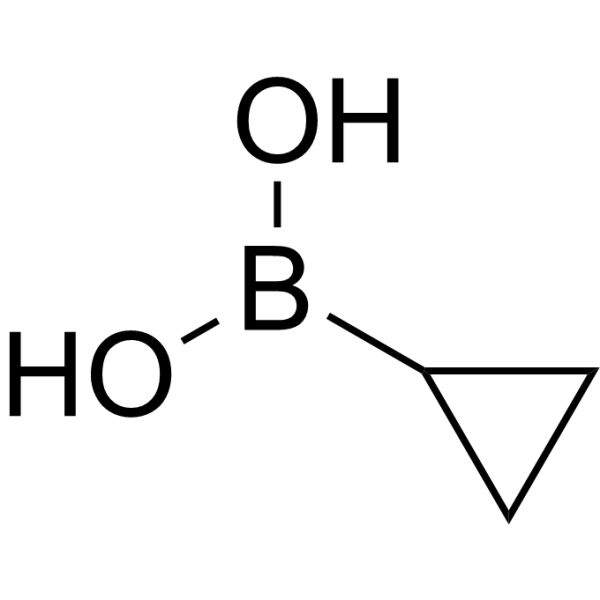
Adamantane-1,3,5-triol
 0 ImagesCat. No.: HY-W016287CAS No.: 99181-50-7Adamantane-1,3,5-triol is a drug intermediate for synthesis of various active compounds.

-
(4-Bromo-2-(methylamino)phenyl)diethylphosphine oxide
 0 Images(4-Bromo-2-(methylamino)phenyl)diethylphosphine oxide is a drug intermediate for synthesis of various active compounds.
-
GPhos Pd G6
 0 ImagesSynonyms: GPhos Pd G6 TESGPhos Pd G6 (GPhos Pd G6 TES) is a palladium catalyst. GPhos Pd G6 catalyzes the Buchwald-Hartwig amination reaction and promotes C-N bond formation between aryl chlorides and amines. GPhos Pd G6 is a pharmaceutical intermediate used for the synthesis of various active compounds.
-
7-Methyl-1,5,7-triazabicyclo[4.4.0]dec-5-ene
![7-Methyl-1,5,7-triazabicyclo[4.4.0]dec-5-ene](https://file.medchemexpress.com/product_pic/hy-59157.gif "Click to View 7-Methyl-1,5,7-triazabicyclo[4.4.0]dec-5-ene Product Detail") 0 Images7-Methyl-1,5,7-triazabicyclo[4.4.0]dec-5-ene is a drug intermediate for synthesis of various active compounds.
0 Images7-Methyl-1,5,7-triazabicyclo[4.4.0]dec-5-ene is a drug intermediate for synthesis of various active compounds.
-
3-(But-3-yn-1-yl)-3-(2-iodoethyl)-3H-diazirine
 0 Images3-(But-3-yn-1-yl)-3-(2-iodoethyl)-3H-diazirine is a diazirine-containing crosslinking agent, and it is used in chemical probe synthesis.
-
3-Methylazetidin-3-ol hydrochloride
 0 ImagesCat. No.: HY-59333CAS No.: 124668-46-83-Methylazetidin-3-ol hydrochloride is a drug intermediate for synthesis of various active compounds.
-
1,3-Dihydroxyacetone
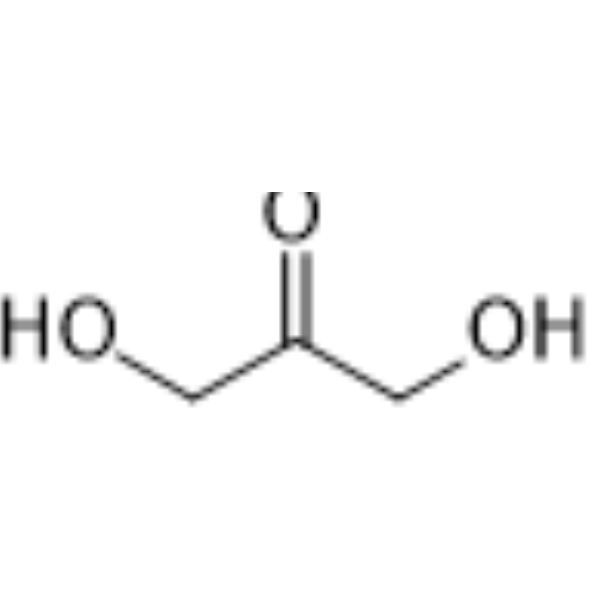 0 Images1,3-Dihydroxyacetone (DHA), the main active ingredient in sunless tanning skin-care preparations and an important precursor for the synthesis of various fine chemicals, is produced on an industrial scale by microbial fermentation of glycerol (HY-B1659) in Gluconobacter oxydans. 1,3-Dihydroxyacetone is also used for synthesis of new biodegradable polymers by combining with lactic acid (HY-B2227).
-
2-CTC Resin (100-200 mesh,1% DVB,0.4-3.0mmol/g)
 0 ImagesCat. No.: HY-142104CAS No.: 934816-82-7Synonyms: 2-Chlorotrityl Chloride Resin (100-200 mesh,1% DVB,0.4-3.0mmol/g)2-CTC Resin (100-200 mesh,1% DVB,0.4-3.0mmol/g) is a solid-phase synthesis carrier that has been used to study metabolic disorders in prostate cancer cells. 2-CTC Resin (100-200 mesh,1% DVB,0.4-3.0mmol/g) can be used as a reaction solution of terminal residues and adenine nucleotides to form cyclic peptides. 2-CTC Resin (100-200 mesh,1% DVB,0.4-3.0mmol/g) can prevent racemization during the incorporation of the first protected amino acid and minimized diketopiperazine formation. 2-CTC Resin (100-200 mesh,1% DVB,0.4-3.0mmol/g) is one of the most commonly used and versatile resins available for large-scale production of peptides.
-
5β-Cholanic acid
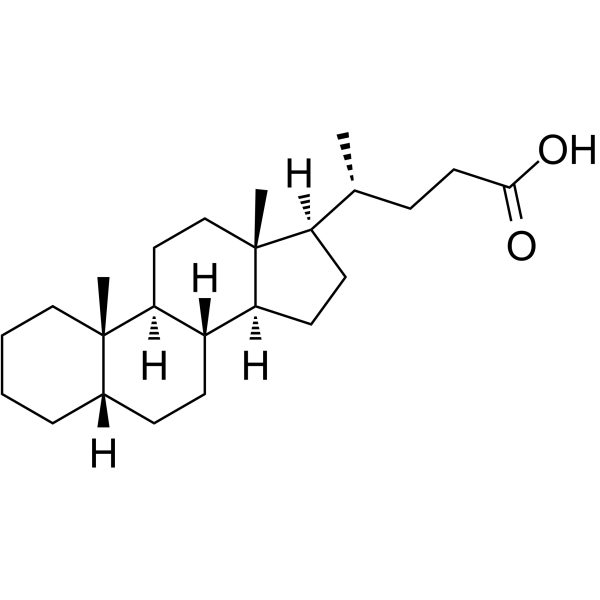 0 Images5β-Cholanic acid is a hydrophobic modifier used to modify polymer carriers. 5β-Cholanic acid can improve the acid stability, cell penetration efficiency and drug sustained release ability of nanocarriers, and optimize the oral effectiveness of delivered molecules. 5β-Cholanic acid can covalently bind to Glycol chitosan (GC) to form a GC-CA conjugate, which optimizes the hydrophobic anchoring ability of nanoparticles and enables them to be stably adsorbed on the surface of PLGA nanoparticles. Such nanoparticles can resist dissociation in the gastric acid environment and maintain positive charge to enhance endocytic uptake by intestinal epithelial cells (such as Caco-2 cells). 5β-Cholanic acid can be used in the development of drug delivery systems.
-
AS-Inclisiran sodium
 0 ImagesCat. No.: HY-143221AS-Inclisiran sodium is the antisense of Inclisiran (HY-132591). Inclisiran is a double-stranded small interfering RNA (siRNA) molecule. Inclisiran inhibits the transcription of PCSK9. Inclisiran inhibits Pyroptosis, activates PPARγ, and reduces NLRP3, cleaved caspase-1, IL-1β, and IL-18. Inclisiran has anti-inflammatory, lipid-regulating and anti-atherosclerotic activities. Inclisiran can be used in researches of hyperlipidemia and cardiovascular disease (CVD).
-
6-Azidohexanoic acid
 0 Images6-Azidohexanoic acid is an azide-containing carboxylic acid. 6-Azidohexanoic acid can serve as an azide-containing fragment to conjugate with peptides, enabling click chemistry-based radiolabeling with [18F]FNPB. 6-Azidohexanoic acid acts as a starting material for the synthesis of biotin azide.
-
4,4′-Dipyridyl
 0 Images4,4′-Dipyridyl is a heterocyclic compound. 4,4′-Dipyridyl is utilized as an electronic and photosensitive building block and bidentate ligand in supramolecular chemistry. 4,4′-Dipyridyl can also be used as a drug intermediate in the synthesis of paraquat, a widely used herbicide.
-
Naringenin chalcone
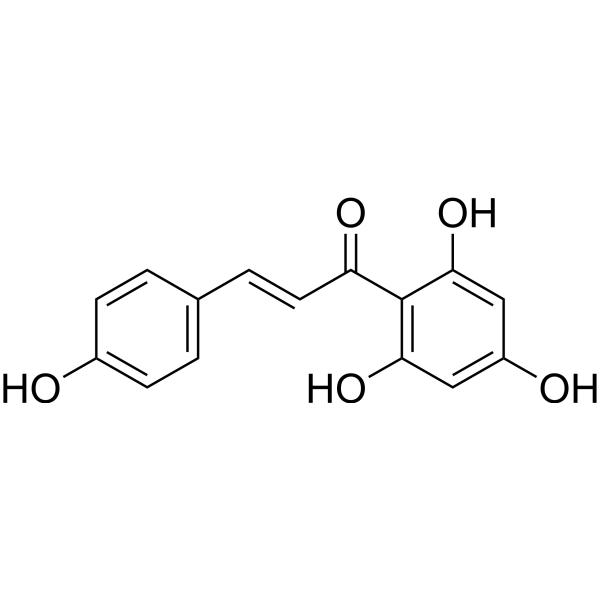 0 ImagesNaringenin chalcone is an orally active intermediate in flavonol biosynthesis. Naringenin chalcone induces Apoptosis. Naringenin chalcone inhibits the production of MCP-1 and NO. Naringenin chalcone exhibits anticancer activity against glioblastoma. Naringenin chalcone has anti-inflammatory and anti-allergic properties.
-
(R)-Azetidin-2-ylmethanol
 0 Images(R)-Azetidin-2-ylmethanol is a drug intermediate for synthesis of various active compounds.
-
tert-Butyl carbazate
 0 Imagestert-Butyl carbazate serves as a starting material for the preparation of heterocyclic and hydrazine derivatives. tert-Butyl carbazate undergoes coupling with aryl, heteroaryl, and alkenyl boronic acids to synthesize doubly protected monosubstituted hydrazines. Derivatives of tert-Butyl carbazate exhibit varying degrees of inhibitory activity against Gram-positive bacteria, Gram-negative bacteria, and various fungi.
-
Fmoc-D-β-Pro-OH
 0 ImagesSynonyms: (R)-1-Fmoc-3-pyrrolidinecarboxylic acidFmoc-D-β-Pro-OH ((R)-1-Fmoc-3-pyrrolidinecarboxylic acid) is a drug intermediate for synthesis of various active compounds.



