



1,3-Dihydroxyacetone
Based on 1 publication(s) in Google Scholar
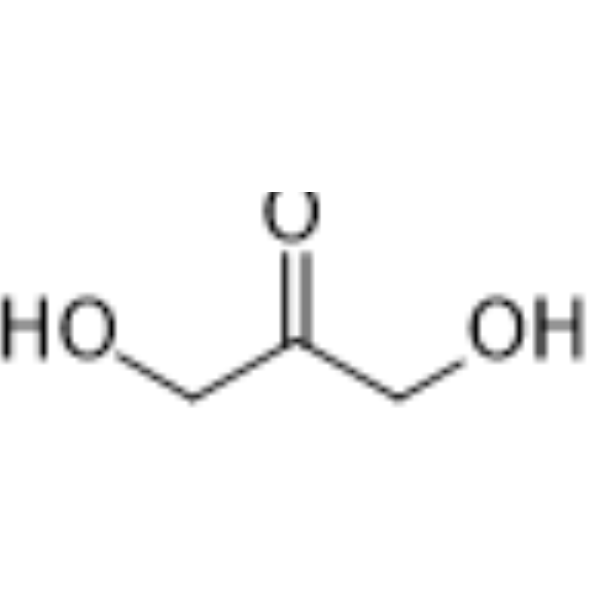
1,3-Dihydroxyacetone (DHA), the main active ingredient in sunless tanning skin-care preparations and an important precursor for the synthesis of various fine chemicals, is produced on an industrial scale by microbial fermentation of glycerol (HY-B1659) in Gluconobacter oxydans. 1,3-Dihydroxyacetone is also used for synthesis of new biodegradable polymers by combining with lactic acid (HY-B2227).
연구목적의 판매만을 진행합니다. 환자를 대상으로 한 판매는 하지 않습니다.
- Purity : 98.0%
- CAS No.: 96-26-4
- 화학식: C3H6O3
- 분자량:90.08
-
보관:
4°C, protect from light
* In solvent : -80°C, 6 months; -20°C, 1 month (protect from light)

To place orders, for customer services and technical support, please contact: MedChemExpress USA
Tel: 609-228-6898 E-mail: [email protected] [email protected]


-
 Biological Activity
-
Chemical Information
-
용액&용해도
- 순도&문서
- References
-
 Help & FAQs


-
HY-B1779
SucroseDisaccharide -
HY-13803
TazemetostatEZH2 Inhibitor -
HY-16560
CamptothecinTopo I inhibitor -
HY-N0469
L-LysineEssential Amino Acids -
HY-N0229
L-AlanineEndogenous Metabolite -
HY-128748
DL-GlyceraldehydeAldose -
HY-78139
L-XyloseLevo-Isomer Xylose -

HY-Y0335R
1,3-Dihydroxyacetone (Standard)Drug Intermediate -

HY-W004713
5′-Chloro-2′-hydroxyacetophenoneBiochemical Assay Reagent
Publications Citing Use of MedChemExpress (MCE) 1,3-Dihydroxyacetone
MoreAll Antibiotic Isoforms
More

Biological Activity
제품 설명
IC50 & Target
|
Microbial Metabolite |
In Vitro
DHA (20-30 g/L) can inhibit the mitotic activity of the gram-negative bacterium G. oxydans[3]. At higher concentrations of 1,3-Dihydroxyacetone (70 g/L), it completely inhibits G. oxydans cells, blocking the fermentation process and thereby affecting the production of 1,3-Dihydroxyacetone[3].
MedChemExpress (MCE) has not independently confirmed the accuracy of these methods. They are for reference only.
Clinical Trial
| NCT Number | Sponsor | Condition | Start Date |
Phase

|
|---|---|---|---|---|
| NCT01329991 | 2011-05 | PHASE1 |


Chemical Information
-
CAS No. 96-26-4
-
Appearance Solid
-
분자량 90.08
-
화학식 C3H6O3
-
Color White to off-white
-
SMILES
O=C(CO)CO
-
Synonyms
Dihydroxyacetone
-
Structure Classification
-
Initial Source
-
선적
Room temperature in continental US; may vary elsewhere.
-
보관
4°C, protect from light
* In solvent : -80°C, 6 months; -20°C, 1 month (protect from light)


Publications (1)
-
Journal Impact Factor
-
Most Recent
-
J Nanobiotechnology
Dihydroxyacetone nanoparticles ameliorate osteoarthritis via P21-mediated regulation of chondrocyte repair. [Abstract]2026 May 26. PMID: 42192449


용액&용해도
In Vitro:
H2O : 116.67 mg/mL (1295.18 mM; Need ultrasonic)
DMSO : 100 mg/mL (1110.12 mM; Need ultrasonic; Hygroscopic DMSO has a significant impact on the solubility of product, please use newly opened DMSO)
Please refer to the solubility information to select the appropriate solvent. Once prepared, please aliquot and store the solution to prevent product inactivation from repeated freeze-thaw cycles.
Storage method and period of stock solution: -80°C, 6 months; -20°C, 1 month (protect from light). When stored at -80°C, please use it within 6 months. When stored at -20°C, please use it within 1 month.
* Note: If you choose water as the stock solution, please dilute it to the working solution, then filter and sterilize it with a 0.22 μm filter before use.
Please refer to the solubility information to select the appropriate solvent. Once prepared, please aliquot and store the solution to prevent product inactivation from repeated freeze-thaw cycles.
Storage method and period of stock solution: -80°C, 6 months; -20°C, 1 month (protect from light). When stored at -80°C, please use it within 6 months. When stored at -20°C, please use it within 1 month.
* Note: If you choose water as the stock solution, please dilute it to the working solution, then filter and sterilize it with a 0.22 μm filter before use.
Concentration (start) × Volume (start) = Concentration (final) × Volume (final)
In Vivo:
Select the appropriate dissolution method based on your experimental animal and administration route.
- For the following dissolution methods, please ensure to first prepare a clear stock solution using an In Vitro approach and then sequentially add co-solvents:
- To ensure reliable experimental results, the clarified stock solution can be appropriately stored based on storage conditions. As for the working solution for In Vivo experiments, it is recommended to prepare freshly and use it on the same day.
- The percentages shown for the solvents indicate their volumetric ratio in the final prepared solution. If precipitation or phase separation occurs during preparation, heat and/or sonication can be used to aid dissolution.
Add each solvent one by one: 10% DMSO 40% PEG300 5% Tween-80 45% Saline
Solubility: ≥ 2.5 mg/mL (27.75 mM); Clear solution
This protocol yields a clear solution of ≥ 2.5 mg/mL (saturation unknown).
Taking 1 mL working solution as an example, add 100 μL DMSO stock solution (25.0 mg/mL) to 400 μL PEG300, and mix evenly; then add 50 μL Tween-80 and mix evenly; then add 450 μL Saline to adjust the volume to 1 mL.
Preparation of Saline: Dissolve 0.9 g sodium chloride in ddH₂O and dilute to 100 mL to obtain a clear Saline solution.
Add each solvent one by one: 10% DMSO 90% (20% SBE-β-CD in Saline)
Solubility: ≥ 2.5 mg/mL (27.75 mM); Clear solution
This protocol yields a clear solution of ≥ 2.5 mg/mL (saturation unknown).
Taking 1 mL working solution as an example, add 100 μL DMSO stock solution (25.0 mg/mL) to 900 μL 20% SBE-β-CD in Saline, and mix evenly.
Preparation of 20% SBE-β-CD in Saline (4°C, storage for one week): 2 g SBE-β-CD powder is dissolved in 10 mL Saline, completely dissolve until clear.
In Vivo Dissolution Calculator
Please enter the basic information of animal experiments:
-
-
-
-
Recommended: Prepare an additional quantity of animals to account for potential losses during experiments.
Working solution concentration: 0.22 mg/mL
This product has good water solubility, please refer to the measured solubility data in water/PBS/Saline for details.


순도&문서
-
Data Sheet (271 KB)
-
SDS (254 KB)
- English - EN (254 KB)
- Français - FR (254 KB)
- Deutsch - DE (254 KB)
- Norwegian - NO (254 KB)
- Español - ES (254 KB)
- Swedish - SV (254 KB)
- Italian - IT (254 KB)
- Korean - KR (254 KB)
- Portuguese - PT (254 KB)
-
Handling Instructions (2659 KB)
References
[2]. Dikshit PK, et al. Optimization of 1,3-dihydroxyacetone production from crude glycerol by immobilized Gluconobacter oxydans MTCC 904. Bioresour Technol. 2016 Sep;216:1058-65. [Content Brief]
[3]. Dikshit PK, et al. Process optimization and analysis of product inhibition kinetics of crude glycerol fermentation for 1,3-Dihydroxyacetone production. Bioresour Technol. 2017 Nov;244(Pt 1):362-370. [Content Brief]


Complete Stock Solution Preparation Table
Please refer to the solubility information to select the appropriate solvent. Once prepared, please aliquot and store the solution to prevent product inactivation from repeated freeze-thaw cycles.
Storage method and period of stock solution: -80°C, 6 months; -20°C, 1 month (protect from light). When stored at -80°C, please use it within 6 months. When stored at -20°C, please use it within 1 month.
| Optional Solvent | Concentration Solvent Mass | 1 mg | 5 mg | 10 mg | 25 mg |
|---|---|---|---|---|---|
| DMSO / H2O | 1 mM | 11.1012 mL | 55.5062 mL | 111.0124 mL | 277.5311 mL |
| 5 mM | 2.2202 mL | 11.1012 mL | 22.2025 mL | 55.5062 mL | |
| 10 mM | 1.1101 mL | 5.5506 mL | 11.1012 mL | 27.7531 mL | |
| 15 mM | 0.7401 mL | 3.7004 mL | 7.4008 mL | 18.5021 mL | |
| 20 mM | 0.5551 mL | 2.7753 mL | 5.5506 mL | 13.8766 mL | |
| 25 mM | 0.4440 mL | 2.2202 mL | 4.4405 mL | 11.1012 mL | |
| 30 mM | 0.3700 mL | 1.8502 mL | 3.7004 mL | 9.2510 mL | |
| 40 mM | 0.2775 mL | 1.3877 mL | 2.7753 mL | 6.9383 mL | |
| 50 mM | 0.2220 mL | 1.1101 mL | 2.2202 mL | 5.5506 mL | |
| 60 mM | 0.1850 mL | 0.9251 mL | 1.8502 mL | 4.6255 mL | |
| 80 mM | 0.1388 mL | 0.6938 mL | 1.3877 mL | 3.4691 mL | |
| 100 mM | 0.1110 mL | 0.5551 mL | 1.1101 mL | 2.7753 mL |
* Note: If you choose water as the stock solution, please dilute it to the working solution, then filter and sterilize it with a 0.22 μm filter before use.


1,3-Dihydroxyacetone Related Classifications
HY-Y0335 Related Classifications
 Powered by Bioz