



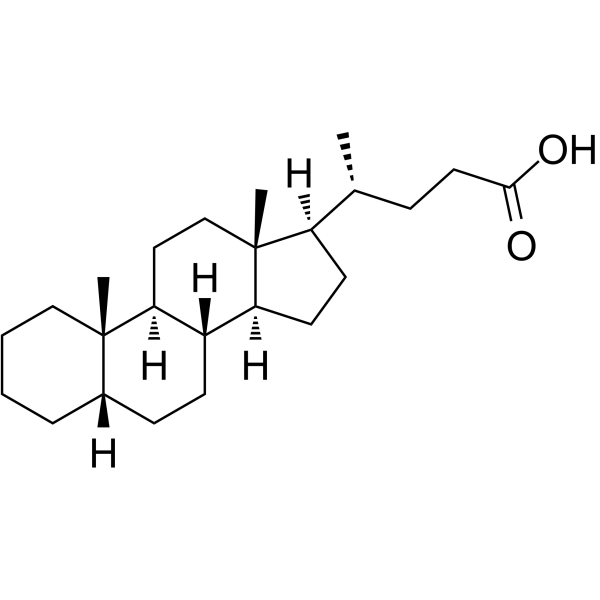
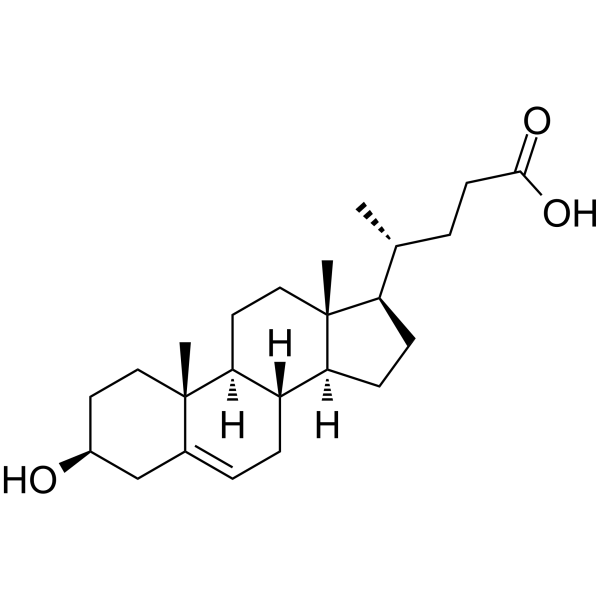
5β-Cholanic acid
Based on 1 publication(s) in Google Scholar
5β-Cholanic acid is a hydrophobic modifier used to modify polymer carriers. 5β-Cholanic acid can improve the acid stability, cell penetration efficiency and drug sustained release ability of nanocarriers, and optimize the oral effectiveness of delivered molecules. 5β-Cholanic acid can covalently bind to Glycol chitosan (GC) to form a GC-CA conjugate, which optimizes the hydrophobic anchoring ability of nanoparticles and enables them to be stably adsorbed on the surface of PLGA nanoparticles. Such nanoparticles can resist dissociation in the gastric acid environment and maintain positive charge to enhance endocytic uptake by intestinal epithelial cells (such as Caco-2 cells). 5β-Cholanic acid can be used in the development of drug delivery systems.
For research use only. We do not sell to patients.
- Purity : 99.87%
- CAS No.: 546-18-9
- Formula: C24H40O2
- Molecular Weight:360.57
-
Storage:Powder -20°C, 3 years , 4°C, 2 years ; In solvent -80°C, 6 months , -20°C, 1 month

To place orders, for customer services and technical support, please contact: MedChemExpress USA
Tel: 609-228-6898 E-mail: [email protected] [email protected]


-
 Biological Activity
-
Chemical Information
-
Solvent & Solubility
- Purity & Documentation
- References
-
 Help & FAQs



Publications Citing Use of MedChemExpress (MCE) 5β-Cholanic acid
More

Biological Activity
Description
Cellular Effect
|
Cell Line

|
Type | Value | Description | References |
|---|---|---|---|---|
| CHO | EC50 |
6.08 μM
Compound: 12
|
Agonist activity at human TGR5 expressed in CHO cells by luciferase assay
Agonist activity at human TGR5 expressed in CHO cells by luciferase assay
|
[PMID: 18307294] |
In Vitro
5β-Cholanic acid-modified Glycol chitosan conjugate significantly improves the endocytic uptake efficiency of insulin by Caco-2 cells by enhancing the acid stability and positive charge characteristics of PLGA nanoparticles, increasing the bioavailability of oral insulin to 30.43% and achieving sustained and stable release of the drug in the gastrointestinal tract[1].
MedChemExpress (MCE) has not independently confirmed the accuracy of these methods. They are for reference only.
In Vivo
HGC nanoparticles (particle size of about 211-360 nm) efficiently load proteins such as bovine serum albumin (BSA) and recombinant Noggin, and possess good stability and sustained release ability. 80%-90% of the protein is continuously released within 48 hours, and the cumulative release rate reaches 94% within 72 hours. Additionally, the released proteins such as Noggin still maintain their biological activity, effectively regulating the bone morphogenetic protein (BMP) signaling pathway and affecting mesenchymal cell aggregation and cartilage differentiation[2].
When HGC nanoparticles are precisely implanted into specific areas of mouse embryos through a microinjection system, they do not interfere with the bone development process or cause inflammatory reactions, showing excellent biocompatibility[2].
Moreover, compared with traditional agarose microbead carriers, HGC nanoparticles are smaller in size and have controlled release properties, making them more suitable for the detailed study of embryonic microstructures[2].
MedChemExpress (MCE) has not independently confirmed the accuracy of these methods. They are for reference only.


Chemical Information
-
CAS No. 546-18-9
-
Appearance Solid
-
Molecular Weight 360.57
-
Formula C24H40O2
-
Color White to off-white
-
SMILES
C[C@@]12[C@](CC[C@]2([H])[C@H](C)CCC(O)=O)([H])[C@@]3([H])[C@]([C@@]4([C@](CCCC4)([H])CC3)C)([H])CC1
-
Shipping
Room temperature in continental US; may vary elsewhere.
-
Storage
Powder -20°C 3 years 4°C 2 years In solvent -80°C 6 months -20°C 1 month


Publications (1)
-
Journal Impact Factor
-
Most Recent


Solvent & Solubility
In Vitro:
DMSO : 100 mg/mL (277.34 mM; Need ultrasonic; Hygroscopic DMSO has a significant impact on the solubility of product, please use newly opened DMSO)
Please refer to the solubility information to select the appropriate solvent. Once prepared, please aliquot and store the solution to prevent product inactivation from repeated freeze-thaw cycles.
Storage method and period of stock solution: -80°C, 6 months; -20°C, 1 month. When stored at -80°C, please use it within 6 months. When stored at -20°C, please use it within 1 month.
Please refer to the solubility information to select the appropriate solvent. Once prepared, please aliquot and store the solution to prevent product inactivation from repeated freeze-thaw cycles.
Storage method and period of stock solution: -80°C, 6 months; -20°C, 1 month. When stored at -80°C, please use it within 6 months. When stored at -20°C, please use it within 1 month.
Concentration (start) × Volume (start) = Concentration (final) × Volume (final)
In Vivo:
Select the appropriate dissolution method based on your experimental animal and administration route.
- For the following dissolution methods, please ensure to first prepare a clear stock solution using an In Vitro approach and then sequentially add co-solvents:
- To ensure reliable experimental results, the clarified stock solution can be appropriately stored based on storage conditions. As for the working solution for In Vivo experiments, it is recommended to prepare freshly and use it on the same day.
- The percentages shown for the solvents indicate their volumetric ratio in the final prepared solution. If precipitation or phase separation occurs during preparation, heat and/or sonication can be used to aid dissolution.
In Vivo Dissolution Calculator
Please enter the basic information of animal experiments:
-
-
-
-
Recommended: Prepare an additional quantity of animals to account for potential losses during experiments.
Please enter your animal formula composition:
-
%DMSO +
Recommended: Keep the proportion of DMSO in working solution below 2% if your animal is weak.
-
%+
-
+%Tween-80 + +
-
%Saline +
The co-solvents required include: DMSO, . All of co-solvents are available by MedChemExpress (MCE). , Tween 80. All of co-solvents are available by MedChemExpress (MCE).
Working solution concentration: 0.22 mg/mL
Method for preparing stock solution: mg drug dissolved in μL DMSO. Stock solution concentration: mg/mL.
1. Take μL DMSO stock solution;
2. Add μL .
μL , mix evenly;
3. Then add μL Tween 80, mix evenly;
4. Then add μL
Please ensure that the stock solution in the first step is dissolved to a clear state, and add co-solvents in sequence. You can use ultrasonic heating (ultrasonic cleaner, recommended frequency 20-40 kHz), vortexing, etc. to assist dissolution.


Purity & Documentation
-
Data Sheet (286 KB)
-
SDS (394 KB)
- English - EN (394 KB)
- Français - FR (394 KB)
- Deutsch - DE (394 KB)
- Norwegian - NO (394 KB)
- Español - ES (394 KB)
- Swedish - SV (394 KB)
- Italian - IT (394 KB)
- Korean - KR (394 KB)
- Portuguese - PT (394 KB)
-
Handling Instructions (2659 KB)
References
[1]. Weizhi Wang, et al. Improved oral delivery of insulin by PLGA nanoparticles coated with 5 β-cholanic acid conjugated glycol chitosan. Biomed Mater. 2021 Oct 12;16(6). [Content Brief]
[2]. Li T, et al. Use of glycol chitosan modified by 5beta-cholanic acid nanoparticles for the sustained release of proteins during murine embryonic limb skeletogenesis. J Control Release. 2010 May 21;144(1):101-8. [Content Brief]


Complete Stock Solution Preparation Table
Please refer to the solubility information to select the appropriate solvent. Once prepared, please aliquot and store the solution to prevent product inactivation from repeated freeze-thaw cycles.
Storage method and period of stock solution: -80°C, 6 months; -20°C, 1 month. When stored at -80°C, please use it within 6 months. When stored at -20°C, please use it within 1 month.
| Optional Solvent | Concentration Solvent Mass | 1 mg | 5 mg | 10 mg | 25 mg |
|---|---|---|---|---|---|
| DMSO | 1 mM | 2.7734 mL | 13.8669 mL | 27.7339 mL | 69.3347 mL |
| 5 mM | 0.5547 mL | 2.7734 mL | 5.5468 mL | 13.8669 mL | |
| 10 mM | 0.2773 mL | 1.3867 mL | 2.7734 mL | 6.9335 mL | |
| 15 mM | 0.1849 mL | 0.9245 mL | 1.8489 mL | 4.6223 mL | |
| 20 mM | 0.1387 mL | 0.6933 mL | 1.3867 mL | 3.4667 mL | |
| 25 mM | 0.1109 mL | 0.5547 mL | 1.1094 mL | 2.7734 mL | |
| 30 mM | 0.0924 mL | 0.4622 mL | 0.9245 mL | 2.3112 mL | |
| 40 mM | 0.0693 mL | 0.3467 mL | 0.6933 mL | 1.7334 mL | |
| 50 mM | 0.0555 mL | 0.2773 mL | 0.5547 mL | 1.3867 mL | |
| 60 mM | 0.0462 mL | 0.2311 mL | 0.4622 mL | 1.1556 mL | |
| 80 mM | 0.0347 mL | 0.1733 mL | 0.3467 mL | 0.8667 mL | |
| 100 mM | 0.0277 mL | 0.1387 mL | 0.2773 mL | 0.6933 mL |


5β-Cholanic acid Related Classifications
HY-W127512 Related Classifications
 Powered by Bioz