



Temephos
Based on 2 publication(s) in Google Scholar
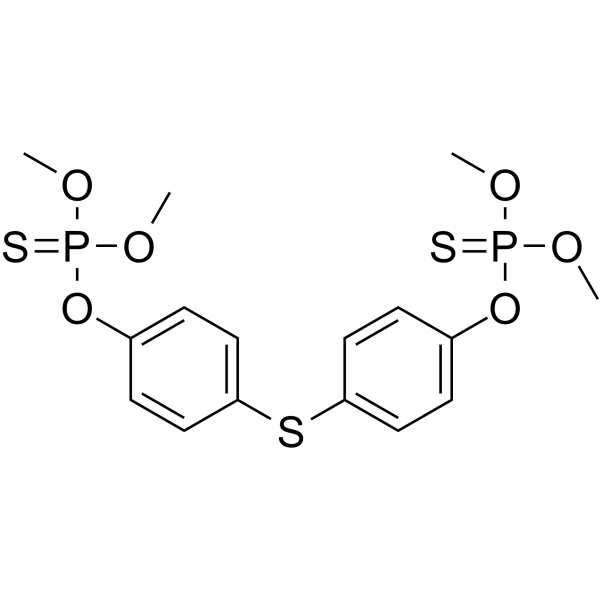
Temephos (Temefos) is an orally active, blood-brain barrier-permeable organophosphate insecticide and AChE inhibitor. By irreversibly inhibiting AChE to induce cholinergic overactivation, Temephos effectively blocks larval development of Aedes aegypti (yellow fever mosquito) and Aedes albopictus (Asian tiger mosquito), and is commonly used in studies related to Dengue Virus, Zika Virus and other relevant pathogens. Temephos exhibits genotoxicity and neurodevelopmental toxicity, and may also cause liver injury, reproductive system abnormalities and cholinergic poisoning symptoms in mammals. Temephos tends to accumulate in adipose tissues and aquatic organisms, and is excreted via feces after metabolism through oxidation and hydrolysis. Note that CYP-mediated metabolic detoxification may reduce the actual larvicidal efficacy of Temephos against some mosquito species. Temephos can be used in research related to dengue fever, Zika virus disease, chikungunya and dracunculiasis.
For research use only. We do not sell to patients.
- Purity : 99.35%
- CAS No.: 3383-96-8
- Formula: C16H20O6P2S3
- Molecular Weight:466.47
-
Storage:Pure form -20°C, 3 years , 4°C, 2 years ; In solvent -80°C, 6 months , -20°C, 1 month

To place orders, for customer services and technical support, please contact: MedChemExpress USA
Tel: 609-228-6898 E-mail: [email protected] [email protected]


-
 Biological Activity
-
Chemical Information
-
Solvent & Solubility
- Protocols
- Purity & Documentation
- References
-
 Help & FAQs


Publications Citing Use of MedChemExpress (MCE) Temephos
More

Biological Activity
Description
IC50 & Target
|
AChE |
In Vitro
Temephos (10 μM) exerts extremely weak genotoxic effects on human lymphocytes and HepG2 cells, and induces DNA fragmentation in blood cells; however, such toxicity is weaker than that of 0.05% DMSO (HY-Y0320C)[1].
Temephos (0.01-0.15 ppm; 24 h) exhibits an LC50 value 15-fold higher and an LC95 value 14-fold higher in temephos-resistant Aedes aegypti (Cucuta strain) than in the susceptible New Orleans strain, with an LC50 of 0.066 ppm and an LC95 of 0.18 ppm[3].
Co-incubation with temephos (0.05-0.15 ppm; 24 h) and 0.5 ppm DEF increases the sensitivity of temephos-resistant Aedes aegypti (Cucuta strain) to temephos by 36-fold, reducing the LC50 of temephos to 0.0019 ppm[3].
When applied in the field, Temephos (1 ppm; 24 h) maintains 100% mortality of temephos-resistant Aedes aegypti (Cucuta strain) for 8 weeks without water change, but the mortality decreases with two water changes per week[3].
Temephos (LC60; 24 h) induces overexpression of CYP6N12, CYP6M11 and CYP6F3 in temephos-resistant Aedes aegypti (Cucuta strain) larvae[3].
MedChemExpress (MCE) has not independently confirmed the accuracy of these methods. They are for reference only. Further protocols information, click here.
-
Cell Line:Aedes aegypti larvae
-
Concentration:LC60
-
Incubation Time:24 h
-
Result:Induced the overexpression of CYP6N12 (2.34-fold), CYP6M11 (2.32-fold) and CYP6F3 (1.71-fold) in temephos-resistant Aedes aegypti (Cucuta strain) larvae, compared with unexposed larvae.
Parmacokinetics
| Species | Dose | Route | T1/2 (Absorption) | Tmax | T1/2 (Elimination) |
|---|---|---|---|---|---|
| Rat[4] | 300 mg/kg | p.o. | 0.38 h | 2 h | 8.6 h |
In Vivo
Temephos (50 mg/kg; days 6-13 of gestation) causes hyperactivity and impaired social interaction in offspring of pregnant Swiss mice, indicating neurodevelopmental toxicity[1].
Temephos (100 ppm; dietary; continuous exposure via feed) reduces offspring duckling weight and increases liver damage indicators in mallard hens without causing miscarriage or fetal deformities[1].
Temephos (10-100 ppm; via drinking water) at 100 ppm is toxic to mallard ducklings, increasing mortality and inhibiting AChE activity, while 10 ppm does not increase mortality[1].
Temephos (LC50 concentration; egg exposure) causes general growth reduction in mallard embryos without inducing organ-specific defects or deformities[1].
Temephos (2.3-100 mg/kg/day; up to 44-90 days) exhibits a no-observed adverse effect level of 2.3 mg/kg/day over 90 days and a lowest observable adverse effect level of 100 mg/kg/day over 44 days in rats, with additional low-dose toxic effects including genotoxicity, reproductive harm, and liver damage[2].
Temephos (300 mg/kg; p.o.; single dose) is well absorbed, extensively metabolized into reactive metabolites including Tem-oxons and Tem-dioxons, widely distributed across rat tissues with preferential accumulation in fat, eliminated with an 8.6-hour elimination half-life, and produces temephos-sulfone-monohydrolyzed, which remains stable in blood until 36 hours, accumulates in the kidney, and may serve as an exposure biomarker[4].
MedChemExpress (MCE) has not independently confirmed the accuracy of these methods. They are for reference only.
-
Animal Model:Swiss mice (female, pregnant, embryofetal developmental toxicity model)[1]
-
Dosage:0.0043 mg/kg
-
Administration:daily; 18 consecutive days during gestation
-
Result:Was detected in the placenta.
Did not cause physiological malformations in mouse fetuses.
Showed a concentration-dependent genotoxic effect in female mice on the 16th and 17th days of gestation, as measured by micronucleus assay.
-
Animal Model:Swiss mice (female, pregnant, prenatal exposure model)[1]
-
Dosage:50 mg/kg
-
Administration:days 6-13 of gestation
-
Result:Induced hyperactivity in offspring in the open field test.
Caused reduced social interaction in offspring in the reciprocal social interaction test.
-
Animal Model:Mallard ducklings[1]
-
Dosage:100 ppm (mortality, AChE inhibition); 10 ppm (mortality)
-
Administration:via drinking water
-
Result:As for add to drinking water:
Caused higher mortality and depression of AChE activity at 100 ppm.
Did not increase mortality at 10 ppm.
As for add to via dietary feed:
Reduced body weight in offspring ducklings.
Increased indicators of liver damage in offspring ducklings.
Did not cause miscarriage or fetal abnormalities.
-
Animal Model:Rats (specific strain not specified)[2]
-
Dosage:2.3 mg/kg/day; 100 mg/kg/day
-
Administration:up to 90 days (for 2.3 mg/kg/day); up to 44 days (for 100 mg/kg/day)
-
Result:Identified a no-observed adverse effect level (NOAEL) of 2.3 mg/kg/day based on brain acetylcholinesterase (AChE) inhibition.
Identified a lowest observable adverse effect level (LOAEL) of 100 mg/kg/day based on cholinergic symptoms.
Caused genotoxic effects, adverse effects on male reproduction and fertility, and liver damage even at low doses.
-
Animal Model:Wistar rats (adult, male)[4]
-
Dosage:300 mg/kg
-
Administration:p.o.; single dose
-
Result:Reached peak blood concentrations at 2 hours (absorption half-life = 0.38 h), with only trace levels detected at 36 hours (elimination half-life = 8.6 h).
Was detected in all analyzed tissues and preferentially accumulated in fat tissue.
Detected at least eleven metabolites, including temephos-sulfoxide, temephos-oxon, temephos-oxon-sulfoxide, temephos-oxon-sulfoxide-monohydrolyzed, 4,4'-thiodiphenol, 4,4'-sulfinyldiphenol, and 4,4'-sulfonyldiphenol (bisphenol S).
Maintained constant temephos-sulfone-monohydrolyzed (Tem-SO2-OH) blood levels until 36 h, which gradually accumulated in the kidney.
Detected Tem-oxon in the brain, liver, kidney, and fat.
Exhibited liver and kidney clearance values of 7.59 and 5.52 mL/min, respectively.


Chemical Information
-
CAS No. 3383-96-8
-
Appearance Liquid (Density: 1.3200 g/cm3)
-
Molecular Weight 466.47
-
Formula C16H20O6P2S3
-
Color Colorless to light yellow
-
SMILES
COP(OC(C=C1)=CC=C1SC2=CC=C(OP(OC)(OC)=S)C=C2)(OC)=S
-
Synonyms
Temefos
-
Shipping
Room temperature in continental US; may vary elsewhere.
-
Storage
Pure form -20°C 3 years 4°C 2 years In solvent -80°C 6 months -20°C 1 month


Publications (2)
-
Journal Impact Factor
-
Most Recent
-
ACS Environ Au
Machine Learning-Assisted Recognition of Environmental Sulfur-Containing Chemicals in Nontargeted Mass Spectrometry Analysis of Inadequate Mass Resolution. [Abstract]2025 Aug 5;5(6):573-582. PMID: 41277996 -
Anal Chem
Exposome-Scale Investigation of Cl-/Br-Containing Chemicals Using High-Resolution Mass Spectrometry, Multistage Machine Learning, and Cloud Computing. [Abstract]2025 Jun 3;97(21):11099-11109. PMID: 40401576


Solvent & Solubility
In Vitro:
DMSO : 100 mg/mL (214.38 mM; Need ultrasonic; Hygroscopic DMSO has a significant impact on the solubility of product, please use newly opened DMSO)
Please refer to the solubility information to select the appropriate solvent. Once prepared, please aliquot and store the solution to prevent product inactivation from repeated freeze-thaw cycles.
Storage method and period of stock solution: -80°C, 6 months; -20°C, 1 month. When stored at -80°C, please use it within 6 months. When stored at -20°C, please use it within 1 month.
Please refer to the solubility information to select the appropriate solvent. Once prepared, please aliquot and store the solution to prevent product inactivation from repeated freeze-thaw cycles.
Storage method and period of stock solution: -80°C, 6 months; -20°C, 1 month. When stored at -80°C, please use it within 6 months. When stored at -20°C, please use it within 1 month.
Concentration (start) × Volume (start) = Concentration (final) × Volume (final)
In Vivo:
Select the appropriate dissolution method based on your experimental animal and administration route.
- For the following dissolution methods, please ensure to first prepare a clear stock solution using an In Vitro approach and then sequentially add co-solvents:
- To ensure reliable experimental results, the clarified stock solution can be appropriately stored based on storage conditions. As for the working solution for In Vivo experiments, it is recommended to prepare freshly and use it on the same day.
- The percentages shown for the solvents indicate their volumetric ratio in the final prepared solution. If precipitation or phase separation occurs during preparation, heat and/or sonication can be used to aid dissolution.
Add each solvent one by one: 10% DMSO 40% PEG300 5% Tween-80 45% Saline
Solubility: 2.5 mg/mL (5.36 mM); Suspended solution; Need ultrasonic
This protocol yields a suspended solution of 2.5 mg/mL. Suspended solution can be used for oral and intraperitoneal injection.
Taking 1 mL working solution as an example, add 100 μL DMSO stock solution (25.0 mg/mL) to 400 μL PEG300, and mix evenly; then add 50 μL Tween-80 and mix evenly; then add 450 μL Saline to adjust the volume to 1 mL.
Preparation of Saline: Dissolve 0.9 g sodium chloride in ddH₂O and dilute to 100 mL to obtain a clear Saline solution.
In Vivo Dissolution Calculator
Please enter the basic information of animal experiments:
-
-
-
-
Recommended: Prepare an additional quantity of animals to account for potential losses during experiments.
Please enter your animal formula composition:
-
%DMSO +
Recommended: Keep the proportion of DMSO in working solution below 2% if your animal is weak.
-
%+
-
+%Tween-80 + +
-
%Saline +
The co-solvents required include: DMSO, . All of co-solvents are available by MedChemExpress (MCE). , Tween 80. All of co-solvents are available by MedChemExpress (MCE).
Working solution concentration: 0.22 mg/mL
Method for preparing stock solution: mg drug dissolved in μL DMSO. Stock solution concentration: mg/mL.
1. Take μL DMSO stock solution;
2. Add μL .
μL , mix evenly;
3. Then add μL Tween 80, mix evenly;
4. Then add μL
Please ensure that the stock solution in the first step is dissolved to a clear state, and add co-solvents in sequence. You can use ultrasonic heating (ultrasonic cleaner, recommended frequency 20-40 kHz), vortexing, etc. to assist dissolution.

Protocols
-
Genotoxicity/Mutagenicity Study
The bacterial reverse mutation assay detects point mutations that restore amino-acid prototrophy in auxotrophic Salmonella typhimurium or Escherichia coli tester strains; after exposure to a test article, mutagenic activity is read out as an increased number of revertant colonies on minimal agar compared with the vehicle control. The assay uses tester strains with different mutation targets so that base-substitution and frameshift mutagens can be detected, and testing is performed with and without exogenous mammalian metabolic activation because some chemicals require biotransformation to become mutagenic.


Purity & Documentation
-
Data Sheet (287 KB)
-
SDS (563 KB)
- English - EN (563 KB)
- Français - FR (563 KB)
- Deutsch - DE (563 KB)
- Norwegian - NO (563 KB)
- Español - ES (563 KB)
- Swedish - SV (563 KB)
- Italian - IT (563 KB)
- Korean - KR (563 KB)
- Portuguese - PT (563 KB)
-
Handling Instructions (2659 KB)
References
[3]. Grisales N, et al. Temephos resistance in Aedes aegypti in Colombia compromises dengue vector control. PLoS Negl Trop Dis. 2013;7(9):e2438. Published 2013 Sep 19. [Content Brief]
[4]. Verdín-Betancourt FA, et al. Toxicokinetics of temephos after oral administration to adult male rats. Arch Toxicol. 2021;95(3):935-947. [Content Brief]


Complete Stock Solution Preparation Table
Please refer to the solubility information to select the appropriate solvent. Once prepared, please aliquot and store the solution to prevent product inactivation from repeated freeze-thaw cycles.
Storage method and period of stock solution: -80°C, 6 months; -20°C, 1 month. When stored at -80°C, please use it within 6 months. When stored at -20°C, please use it within 1 month.
| Optional Solvent | Concentration Solvent Mass | 1 mg | 5 mg | 10 mg | 25 mg |
|---|---|---|---|---|---|
| DMSO | 1 mM | 2.1438 mL | 10.7188 mL | 21.4376 mL | 53.5940 mL |
| 5 mM | 0.4288 mL | 2.1438 mL | 4.2875 mL | 10.7188 mL | |
| 10 mM | 0.2144 mL | 1.0719 mL | 2.1438 mL | 5.3594 mL | |
| 15 mM | 0.1429 mL | 0.7146 mL | 1.4292 mL | 3.5729 mL | |
| 20 mM | 0.1072 mL | 0.5359 mL | 1.0719 mL | 2.6797 mL | |
| 25 mM | 0.0858 mL | 0.4288 mL | 0.8575 mL | 2.1438 mL | |
| 30 mM | 0.0715 mL | 0.3573 mL | 0.7146 mL | 1.7865 mL | |
| 40 mM | 0.0536 mL | 0.2680 mL | 0.5359 mL | 1.3399 mL | |
| 50 mM | 0.0429 mL | 0.2144 mL | 0.4288 mL | 1.0719 mL | |
| 60 mM | 0.0357 mL | 0.1786 mL | 0.3573 mL | 0.8932 mL | |
| 80 mM | 0.0268 mL | 0.1340 mL | 0.2680 mL | 0.6699 mL | |
| 100 mM | 0.0214 mL | 0.1072 mL | 0.2144 mL | 0.5359 mL |


Temephos Related Classifications
HY-B1120 Related Classifications
 Powered by Bioz