



AA92593
Based on 2 publication(s) in Google Scholar
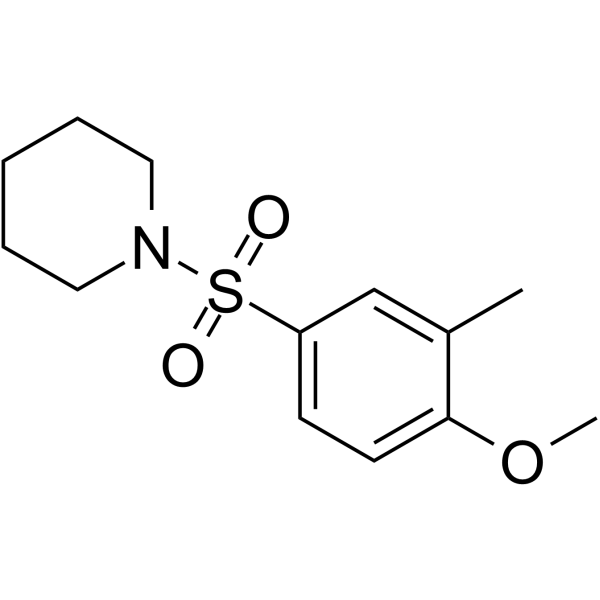
AA92593 is a selective and competitive melanopsin OPN4 antagonist.
For research use only. We do not sell to patients.
- Purity : 99.94%
- CAS No.: 457961-34-1
- Formula: C13H19NO3S
- Molecular Weight:269.36
-
Storage:Powder -20°C, 3 years , 4°C, 2 years ; In solvent -80°C, 6 months , -20°C, 1 month

To place orders, for customer services and technical support, please contact: MedChemExpress USA
Tel: 609-228-6898 E-mail: [email protected] [email protected]


-
 Biological Activity
-
Chemical Information
-
Solvent & Solubility
- Purity & Documentation
- References
-
 Help & FAQs



Publications Citing Use of MedChemExpress (MCE) AA92593
More

Biological Activity
Description
In Vitro
AA92593 is a competitive melanopsin antagonist, its presence in the retinal-binding pocket of melanopsin leads to the displacement of retinal, which could trigger a downstream signaling that would ultimately result in Per1 increased expression[1].
AA92593 is shown to be specific because it competes with retinaldehyde for the melanopsin retinal binding site which is very distinct from other opsins[1].
Inhibition of melanopsin activity with AA92593 increases a-MSH expression and induces melanin dispersion in the melanophores, which darkens the embryo[3].
AA92593 exhibits an IC50 of 665 nM in CHOOpn4 cells[4].
MedChemExpress (MCE) has not independently confirmed the accuracy of these methods. They are for reference only.
-
Cell Line:Melan-a melanocytes and B16-F10 melanoma cells[1].
-
Concentration:10 μM.
-
Incubation Time:1 hour (heat 39.5 °C).
-
Result:Pharmacologically inhibited melanopsin.
In Vivo
AA92593 produces an increment in melatonin levels resulting in a drop of IOP[2].
MedChemExpress (MCE) has not independently confirmed the accuracy of these methods. They are for reference only.
-
Animal Model:Wild type (WT) mice[4].
-
Dosage:30 mg/kg.
-
Administration:IP 20 min prior to PLR measurement.
-
Result:Attenuated pupil constriction in response to light (1013 ph.cm−2.s−1) by ~50%.


Chemical Information
-
CAS No. 457961-34-1
-
Appearance Solid
-
Molecular Weight 269.36
-
Formula C13H19NO3S
-
Color White to light yellow
-
SMILES
O=S(N1CCCCC1)(C2=CC=C(OC)C(C)=C2)=O
-
Shipping
Room temperature in continental US; may vary elsewhere.
-
Storage
Powder -20°C 3 years 4°C 2 years In solvent -80°C 6 months -20°C 1 month


Publications (2)
-
Journal Impact Factor
-
Most Recent
-
Environ Sci Technol
BDE-47 Causes Depression-like Effects in Zebrafish Larvae via a Non-Image-Forming Visual Mechanism. [Abstract]2023 Jul 4;57(26):9592-9602. PMID: 37354122 -
Invest Ophthalmol Vis Sci
Blue Light Damages Retinal Ganglion Cells Via Endoplasmic Reticulum Stress and Autophagy in Chickens. [Abstract]2025 Jan 2;66(1):3. PMID: 39745679


Solvent & Solubility
In Vitro:
DMSO : 100 mg/mL (371.25 mM; Need ultrasonic; Hygroscopic DMSO has a significant impact on the solubility of product, please use newly opened DMSO)
Please refer to the solubility information to select the appropriate solvent. Once prepared, please aliquot and store the solution to prevent product inactivation from repeated freeze-thaw cycles.
Storage method and period of stock solution: -80°C, 6 months; -20°C, 1 month. When stored at -80°C, please use it within 6 months. When stored at -20°C, please use it within 1 month.
Please refer to the solubility information to select the appropriate solvent. Once prepared, please aliquot and store the solution to prevent product inactivation from repeated freeze-thaw cycles.
Storage method and period of stock solution: -80°C, 6 months; -20°C, 1 month. When stored at -80°C, please use it within 6 months. When stored at -20°C, please use it within 1 month.
Concentration (start) × Volume (start) = Concentration (final) × Volume (final)
In Vivo:
Select the appropriate dissolution method based on your experimental animal and administration route.
- For the following dissolution methods, please ensure to first prepare a clear stock solution using an In Vitro approach and then sequentially add co-solvents:
- To ensure reliable experimental results, the clarified stock solution can be appropriately stored based on storage conditions. As for the working solution for In Vivo experiments, it is recommended to prepare freshly and use it on the same day.
- The percentages shown for the solvents indicate their volumetric ratio in the final prepared solution. If precipitation or phase separation occurs during preparation, heat and/or sonication can be used to aid dissolution.
Add each solvent one by one: 10% DMSO 40% PEG300 5% Tween-80 45% Saline
Solubility: ≥ 2.08 mg/mL (7.72 mM); Clear solution
This protocol yields a clear solution of ≥ 2.08 mg/mL (saturation unknown).
Taking 1 mL working solution as an example, add 100 μL DMSO stock solution (20.8 mg/mL) to 400 μL PEG300, and mix evenly; then add 50 μL Tween-80 and mix evenly; then add 450 μL Saline to adjust the volume to 1 mL.
Preparation of Saline: Dissolve 0.9 g sodium chloride in ddH₂O and dilute to 100 mL to obtain a clear Saline solution.
Add each solvent one by one: 10% DMSO 90% (20% SBE-β-CD in Saline)
Solubility: ≥ 2.08 mg/mL (7.72 mM); Clear solution
This protocol yields a clear solution of ≥ 2.08 mg/mL (saturation unknown).
Taking 1 mL working solution as an example, add 100 μL DMSO stock solution (20.8 mg/mL) to 900 μL 20% SBE-β-CD in Saline, and mix evenly.
Preparation of 20% SBE-β-CD in Saline (4°C, storage for one week): 2 g SBE-β-CD powder is dissolved in 10 mL Saline, completely dissolve until clear.
In Vivo Dissolution Calculator
Please enter the basic information of animal experiments:
-
-
-
-
Recommended: Prepare an additional quantity of animals to account for potential losses during experiments.
Please enter your animal formula composition:
-
%DMSO +
Recommended: Keep the proportion of DMSO in working solution below 2% if your animal is weak.
-
%+
-
+%Tween-80 + +
-
%Saline +
The co-solvents required include: DMSO, . All of co-solvents are available by MedChemExpress (MCE). , Tween 80. All of co-solvents are available by MedChemExpress (MCE).
Working solution concentration: 0.22 mg/mL
Method for preparing stock solution: mg drug dissolved in μL DMSO. Stock solution concentration: mg/mL.
1. Take μL DMSO stock solution;
2. Add μL .
μL , mix evenly;
3. Then add μL Tween 80, mix evenly;
4. Then add μL
Please ensure that the stock solution in the first step is dissolved to a clear state, and add co-solvents in sequence. You can use ultrasonic heating (ultrasonic cleaner, recommended frequency 20-40 kHz), vortexing, etc. to assist dissolution.


Purity & Documentation
-
Data Sheet (277 KB)
-
SDS (393 KB)
- English - EN (393 KB)
- Français - FR (393 KB)
- Deutsch - DE (393 KB)
- Norwegian - NO (393 KB)
- Español - ES (393 KB)
- Swedish - SV (393 KB)
- Italian - IT (393 KB)
- Korean - KR (393 KB)
- Portuguese - PT (393 KB)
-
Handling Instructions (2659 KB)
References
[1]. Maria Nathália Moraes, et al. Melanopsin, a Canonical Light Receptor, Mediates Thermal Activation of Clock Genes. Sci Rep. 2017 Oct 25;7(1):13977. [Content Brief]
[2]. Victoria Eugenia Lledó, et al. Yellow Filter Effect on Melatonin Secretion in the Eye: Role in IOP Regulation. Curr Eye Res. 2019 Jun;44(6):614-618. [Content Brief]
[3]. Gabriel E Bertolesi, et al. Melanopsin photoreception in the eye regulates light-induced skin colour changes through the production of α-MSH in the pituitary gland. Pigment Cell Melanoma Res. 2015 Sep;28(5):559-71. [Content Brief]
[4]. Kenneth A Jones, et al. Small-molecule antagonists of melanopsin-mediated phototransduction. Nat Chem Biol. 2013 Oct;9(10):630-5. [Content Brief]


Complete Stock Solution Preparation Table
Please refer to the solubility information to select the appropriate solvent. Once prepared, please aliquot and store the solution to prevent product inactivation from repeated freeze-thaw cycles.
Storage method and period of stock solution: -80°C, 6 months; -20°C, 1 month. When stored at -80°C, please use it within 6 months. When stored at -20°C, please use it within 1 month.
| Optional Solvent | Concentration Solvent Mass | 1 mg | 5 mg | 10 mg | 25 mg |
|---|---|---|---|---|---|
| DMSO | 1 mM | 3.7125 mL | 18.5625 mL | 37.1250 mL | 92.8126 mL |
| 5 mM | 0.7425 mL | 3.7125 mL | 7.4250 mL | 18.5625 mL | |
| 10 mM | 0.3713 mL | 1.8563 mL | 3.7125 mL | 9.2813 mL | |
| 15 mM | 0.2475 mL | 1.2375 mL | 2.4750 mL | 6.1875 mL | |
| 20 mM | 0.1856 mL | 0.9281 mL | 1.8563 mL | 4.6406 mL | |
| 25 mM | 0.1485 mL | 0.7425 mL | 1.4850 mL | 3.7125 mL | |
| 30 mM | 0.1238 mL | 0.6188 mL | 1.2375 mL | 3.0938 mL | |
| 40 mM | 0.0928 mL | 0.4641 mL | 0.9281 mL | 2.3203 mL | |
| 50 mM | 0.0743 mL | 0.3713 mL | 0.7425 mL | 1.8563 mL | |
| 60 mM | 0.0619 mL | 0.3094 mL | 0.6188 mL | 1.5469 mL | |
| 80 mM | 0.0464 mL | 0.2320 mL | 0.4641 mL | 1.1602 mL | |
| 100 mM | 0.0371 mL | 0.1856 mL | 0.3713 mL | 0.9281 mL |


AA92593 Related Classifications
HY-125145 Related Classifications
 Powered by Bioz