



OPN3 Antibody
(Synonyms: OPN3; ECPN; Opsin-3; Encephalopsin; Panopsin)
Based on 1 Customer Validation
OPN3 Antibody is a Rabbit-derived and non-conjugated IgG polyclonal antibody, targeting to OPN3.
-
Host:
Rabbit
-
Isotype:
IgG
-
Application:
WB, IHC-P, ICC/IF
-
Reactivity :
Human, Mouse
-
Formulation:
Supplied in PBS containing 50% glycerol, 0.5% BSA and 0.02% sodium azide.
-
Conjugation:
Non-conjugated


To place orders, for customer services and technical support, please contact: MedChemExpress USA
Tel: 609-228-6898 E-mail: [email protected] [email protected]





Applications
| Application |
WB

WB: Western Blot
|
IHC-P
IHC-P: Immunohistochemistry-Paraffin
|
ICC/IF
ICC/IF: Immunocytochemistry/
Immunofluorescence |
|---|---|---|---|
| Dilution Ratio | 1:500-1:2000 | 1:100-1:300 | 1:100-1:500 |


Product Details
OPN3 Antibody is a Rabbit-derived and non-conjugated IgG polyclonal antibody, targeting to OPN3.
-
Host Rabbit

-
Clonality Polyclonal

-
Species ReactivityHuman, Mouse
-
Observed Molecular WeightObserved band size: 45 kDa
Note: Due to possible protein modifications or aggregation, the molecular weight should be confirmed by actual measurement, and the predicted value is for reference only.

-
Calculated Molecular Weight Predicted band size: 45 kDa

SwissProt: Q9H1Y3 Human ; Q9WUK7 Mouse
Synthesized peptide derived from the Internal region of Human Encephalopsin.
Affinity Purified
Non-conjugated
Unmodified
IgG


Product Properties
-
Appearance
Liquid
-
Formulation
Supplied in PBS containing 50% glycerol, 0.5% BSA and 0.02% sodium azide.
-
Concentration
Batch-dependent, Please check the COA for the concentration of each lot. Check Lot Concentration
-
Storage & Stability
Stored at -20°C for 1 year. Avoid repeated freeze / thaw cycles.
-
Shipping
Shipping with blue ice.


Verification Images
-
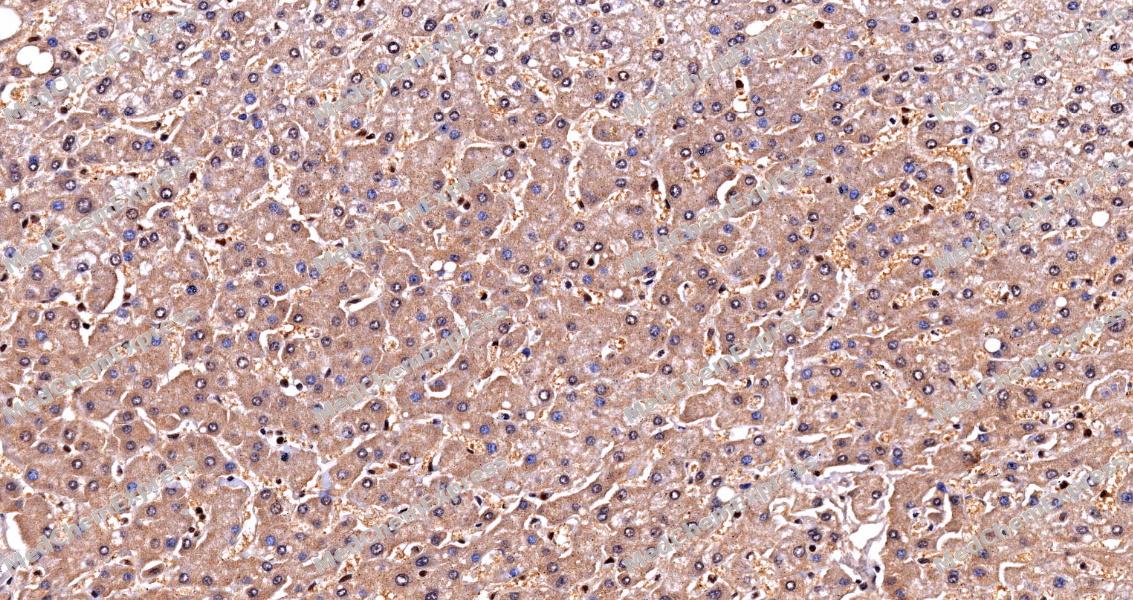 Immunohistochemical analysis of paraffin-embedded human liver tissue using OPN3 Antibody (HY-P83780, 1/200). The section was pretreated using heat mediated antigen retrieval with sodium citrate buffer (pH 6.0) for 8 minutes. The tissues were blocked with quick block buffer for 0.5 hours at room temperature, washed with PBS and PBST, and then incubated with the primary antibody overnight at 4℃. The detection was performed using an HRP conjugated compact polymer system. DAB was used as the chromogen. Tissues were counterstained with hematoxylin and mounted with DPX.
 -
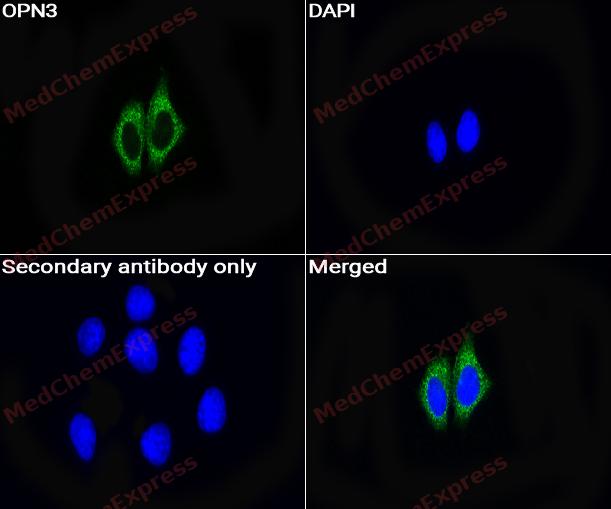 Immunocytochemistry analysis of MCF-7 cells labeling OPN3 with OPN3 Antibody (HY-P83780) at 1/100 dilution. Cells were fixed in 4% paraformaldehyde for 15 minutes at room temperature, permeabilized with 0.1% Triton X-100 for 10 minutes at room temperature, then blocked with BSA for Immunol Staining for 10 min at room temperature. Cells were then incubated with OPN3 Antibody (HY-P83780) at 1/100 dilution in BSA for Immunol Staining at 4 ℃ overnight. AF488-conjugated AffiniPure Goat Anti-Rabbit IgG H&L(HY-P8002,Green) was used as the secondary antibody at 1/1,000 dilution. PBS instead of the primary antibody was used as the secondary antibody only control. The Nuclear counterstain was DAPI (Blue).


Background
-
Function
OPN3 is a G-protein coupled receptor which selectively activates G proteins via ultraviolet A (UVA) light-mediated activation in the skin. Binds both 11-cis retinal and all-trans retinal. Regulates melanogenesis in melanocytes via inhibition of alpha-MSH-induced MC1R-mediated cAMP signaling, modulation of calcium flux, regulation of CAMK2 phosphorylation, and subsequently phosphorylation of CREB, p38, ERK and MITF in response to blue light. Plays a role in melanocyte survival through regulation of intracellular calcium levels and subsequent BCL2/RAF1 signaling. Additionally regulates apoptosis via cytochrome c release and subsequent activation of the caspase cascade. Required for TYR and DCT blue light-induced complex formation in melanocytes. Involved in keratinocyte differentiation in response to blue-light. Required for the UVA-mediated induction of calcium and mitogen-activated protein kinase signaling resulting in the expression of MMP1, MMP2, MMP3, MMP9 and TIMP1 in dermal fibroblasts. Plays a role in light-mediated glucose uptake, mitochondrial respiration and fatty acid metabolism in brown adipocyte tissues. May be involved in photorelaxation of airway smooth muscle cells, via blue-light dependent GPCR signaling pathways[1][2][3][4][5].
-
Subcellular Localization
Cell membrane; Multi-pass membrane protein; Cytoplasm
-
Expression
Tissue_specificity:Expressed in tracheal airway smooth muscle (at protein level) (PubMed:30284927) . Expressed throughout the epidermis and dermis, predominantly in the basal layer on the facial and abdominal skin (at protein level) (PubMed:30168605) . Expressed in dermal fibroblasts (at protein level) (PubMed:31380578) . Expressed in melanocytes (at protein level) (PubMed:28842328, PubMed:31097585, PubMed:31730232) . Expressed in keratinocytes (PubMed:28842328) . Expressed in the retina (PubMed:30284927)
Induction:Induced by low-level blue light (453nm) during epithelial wound healing (PubMed:30168605) . Induced by ultraviolet A light in dermal fibroblasts (PubMed:31380578) -
Isoforms & Post-Translational Modification
Q9H1Y3 has 2 isomers: Q9H1Y3-1: 44873 Da (predicted); Q9H1Y3-2: 35730 Da (predicted).
-
Subunit
Interacts with MC1R; the interaction results in a decrease in MC1R-mediated cAMP signaling and ultimately a decrease in melanin production in melanocytes
-
SwissProt ID
-
Synonyms
OPN3; ECPN; Opsin-3; Encephalopsin; Panopsin


Documentation
-
Data Sheet (234 KB)
-
SDS (251 KB)
- English - EN (251 KB)
- Français - FR (251 KB)
- Deutsch - DE (251 KB)
- Norwegian - NO (251 KB)
- Español - ES (251 KB)
- Swedish - SV (251 KB)
- Italian - IT (251 KB)
- Korean - KR (251 KB)
- Portuguese - PT (251 KB)
-
User Guide for Antibodies (1077 KB)

 Powered by Bioz
