



RICTOR Antibody (YA4339)
(Synonyms: PIA; mAVO3; KIAA1999; MGC39830; DKFZp686B11164; RICTOR)Based on 1 Customer Validation
RICTOR Antibody (YA4339) is a Mouse-derived and non-conjugated IgG1 monoclonal antibody, targeting to RICTOR.
-
Host:
Mouse
-
Isotype:
IgG
-
Application:
WB, IHC-P, ICC/IF, FC, ELISA
-
Reactivity :
Human, Mouse, Monkey
-
Formulation:
Supplied in PBS with 0.05% sodium azide.
-
Conjugation:
Non-conjugated


To place orders, for customer services and technical support, please contact: MedChemExpress USA
Tel: 609-228-6898 E-mail: [email protected] [email protected]





Applications
| Application |
WB

WB: Western Blot
|
IHC-P
IHC-P: Immunohistochemistry-Paraffin
|
ICC/IF
ICC/IF: Immunocytochemistry/
Immunofluorescence |
FC
FC: Flow Cytometry
|
ELISA
ELISA: Enzyme Linked Immunosorbent Assay
|
|---|---|---|---|---|---|
| Dilution Ratio | 1:500-1:2000 | 1:200-1:1000 | 1:200-1:1000 | 1:200-1:400 | 1:10000 |


Product Details
RICTOR Antibody (YA4339) is a Mouse-derived and non-conjugated IgG1 monoclonal antibody, targeting to RICTOR.
-
Host Mouse

-
Clonality Monoclonal

-
Species ReactivityHuman, Mouse, Monkey
-
Observed Molecular WeightObserved band size: 192 kDa
Note: Due to possible protein modifications or aggregation, the molecular weight should be confirmed by actual measurement, and the predicted value is for reference only.

-
Calculated Molecular Weight Predicted band size: 192 kDa

Purified recombinant fragment of human RICTOR aa 1502-1708.
affinity purified.
Non-conjugated
Unmodified
IgG


Product Properties
-
Appearance
Solution
-
Formulation
Supplied in PBS with 0.05% sodium azide.
-
Concentration
Batch-dependent, Please check the COA for the concentration of each lot. Check Lot Concentration
-
Storage & Stability
Stored at -20°C for 1 year. Avoid repeated freeze / thaw cycles.
-
Shipping
Shipping with blue ice.


Verification Images
-
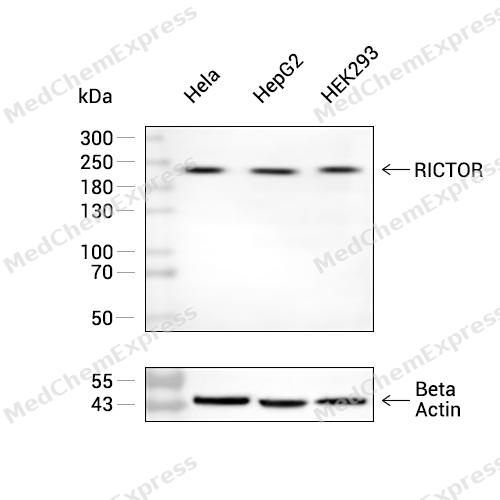 Western blot analysis of extracts from Hela (lane 2(20μg), HepG2 (lane 3(20μg) and HEK293(lane 4(20μg) using RICTOR (HY-P84642) Mouse mAb. Proteins were transferred to a PVDF membrane and blocked with 5% non-fat milk in TBST for 2 hour at room temperature. The primary antibody (1/1000) and Loading control antibody (Beta Actin, HY-P80438, 1/10000) was used in 5% non-fat milk in TBST at 4°C overnight. Goat Anti-Mouse IgG-HRP Secondary Antibody (1/10000) was used for 1 hour at room temperature.
 -
 Immunohistochemical analysis of paraffin-embedded Mouse liver tissue using RICTOR antibody. The section was pre-treated using heat mediated antigen retrieval with Tris-EDTA buffer (pH 9.0) for 8 minutes. The tissues were blocked in QuickBlock for 20 minutes at room temperature, washed with ddH2O and PBS, and then probed with the primary antibody (30090, 1/500) in 4℃ overnight. The detection was performed using an HRP conjugated compact polymer system. DAB was used as the chromogen. Tissues were counterstained with hematoxylin and mounted with DPX.
 -
 Immunohistochemical analysis of paraffin-embedded Mouse liver tissue using RICTOR antibody. The section was pre-treated using heat mediated antigen retrieval with Tris-EDTA buffer (pH 9.0) for 8 minutes. The tissues were blocked in QuickBlock for 20 minutes at room temperature, washed with ddH2O and PBS, and then probed with the primary antibody (30090, 1/500) in 4℃ overnight. The detection was performed using an HRP conjugated compact polymer system. DAB was used as the chromogen. Tissues were counterstained with hematoxylin and mounted with DPX.
 -
 Immunohistochemical analysis of paraffin-embedded mouse small intestine tissue using RICTOR Antibody (HY-P84642, 1/1000). The section was pretreated using heat mediated antigen retrieval with sodium citrate buffer (pH 6.0) for 8 minutes. The tissues were blocked with quick block buffer for 0.5 hours at room temperature, washed with PBS and PBST, and then incubated with the primary antibody overnight at 4℃. The detection was performed using an HRP conjugated compact polymer system. DAB was used as the chromogen. Tissues were counterstained with hematoxylin and mounted with DPX.
 -
 Immunohistochemical analysis of paraffin-embedded mouse rectum tissue using RICTOR Antibody (HY-P84642, 1/1000). The section was pretreated using heat mediated antigen retrieval with sodium citrate buffer (pH 6.0) for 8 minutes. The tissues were blocked with quick block buffer for 0.5 hours at room temperature, washed with PBS and PBST, and then incubated with the primary antibody overnight at 4℃. The detection was performed using an HRP conjugated compact polymer system. DAB was used as the chromogen. Tissues were counterstained with hematoxylin and mounted with DPX.
 -
 Immunohistochemical analysis of paraffin-embedded mouse pancreas tissue using RICTOR Antibody (HY-P84642, 1/1000). The section was pretreated using heat mediated antigen retrieval with sodium citrate buffer (pH 6.0) for 8 minutes. The tissues were blocked with quick block buffer for 0.5 hours at room temperature, washed with PBS and PBST, and then incubated with the primary antibody overnight at 4℃. The detection was performed using an HRP conjugated compact polymer system. DAB was used as the chromogen. Tissues were counterstained with hematoxylin and mounted with DPX.
 -
 Immunohistochemical analysis of paraffin-embedded mouse liver tissue using RICTOR Antibody (HY-P84642, 1/1000). The section was pretreated using heat mediated antigen retrieval with sodium citrate buffer (pH 6.0) for 8 minutes. The tissues were blocked with quick block buffer for 0.5 hours at room temperature, washed with PBS and PBST, and then incubated with the primary antibody overnight at 4℃. The detection was performed using an HRP conjugated compact polymer system. DAB was used as the chromogen. Tissues were counterstained with hematoxylin and mounted with DPX.
 -
 Immunohistochemical analysis of paraffin-embedded mouse duodenum tissue using RICTOR Antibody (HY-P84642, 1/1000). The section was pretreated using heat mediated antigen retrieval with sodium citrate buffer (pH 6.0) for 8 minutes. The tissues were blocked with quick block buffer for 0.5 hours at room temperature, washed with PBS and PBST, and then incubated with the primary antibody overnight at 4℃. The detection was performed using an HRP conjugated compact polymer system. DAB was used as the chromogen. Tissues were counterstained with hematoxylin and mounted with DPX.
 -
 Immunohistochemical analysis of paraffin-embedded mouse epididymis tissue using RICTOR Antibody (HY-P84642, 1/1000). The section was pretreated using heat mediated antigen retrieval with sodium citrate buffer (pH 6.0) for 8 minutes. The tissues were blocked with quick block buffer for 0.5 hours at room temperature, washed with PBS and PBST, and then incubated with the primary antibody overnight at 4℃. The detection was performed using an HRP conjugated compact polymer system. DAB was used as the chromogen. Tissues were counterstained with hematoxylin and mounted with DPX.
 -
 Immunohistochemical analysis of paraffin-embedded human breast tissue using RICTOR Antibody (HY-P84642, 1/1000). The section was pretreated using heat mediated antigen retrieval with sodium citrate buffer (pH 6.0) for 8 minutes. The tissues were blocked with quick block buffer for 0.5 hours at room temperature, washed with PBS and PBST, and then incubated with the primary antibody overnight at 4℃. The detection was performed using an HRP conjugated compact polymer system. DAB was used as the chromogen. Tissues were counterstained with hematoxylin and mounted with DPX.
 -
 Immunohistochemical analysis of paraffin-embedded human adrenal gland tissue using RICTOR Antibody (HY-P84642, 1/1000). The section was pretreated using heat mediated antigen retrieval with sodium citrate buffer (pH 6.0) for 8 minutes. The tissues were blocked with quick block buffer for 0.5 hours at room temperature, washed with PBS and PBST, and then incubated with the primary antibody overnight at 4℃. The detection was performed using an HRP conjugated compact polymer system. DAB was used as the chromogen. Tissues were counterstained with hematoxylin and mounted with DPX.
 -
 Immunohistochemical analysis of paraffin-embedded human tonsil tissue using RICTOR Antibody (HY-P84642, 1/1000). The section was pretreated using heat mediated antigen retrieval with sodium citrate buffer (pH 6.0) for 8 minutes. The tissues were blocked with quick block buffer for 0.5 hours at room temperature, washed with PBS and PBST, and then incubated with the primary antibody overnight at 4℃. The detection was performed using an HRP conjugated compact polymer system. DAB was used as the chromogen. Tissues were counterstained with hematoxylin and mounted with DPX.
 -
 Immunohistochemical analysis of paraffin-embedded mouse salivary gland tissue using RICTOR Antibody (HY-P84642, 1/1000). The section was pretreated using heat mediated antigen retrieval with sodium citrate buffer (pH 6.0) for 8 minutes. The tissues were blocked with quick block buffer for 0.5 hours at room temperature, washed with PBS and PBST, and then incubated with the primary antibody overnight at 4℃. The detection was performed using an HRP conjugated compact polymer system. DAB was used as the chromogen. Tissues were counterstained with hematoxylin and mounted with DPX.
 -
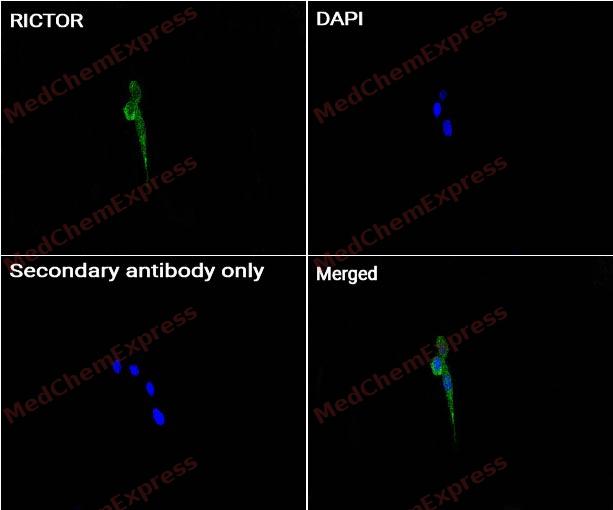 Immunocytochemistry analysis of NIH/3T3 cells labeling RICTOR with RICTOR antibody (HY-P84642) at 1/500 dilution. Cells were fixed in 4% paraformaldehyde for 15 minutes at room temperature, permeabilized with 0.1% Triton X-100 for 10 minutes at room temperature, then blocked with QuickBlock™ Blocking Buffer for Immunol Staining for 10 min at room temperature. Cells were then incubated with RICTOR antibody (HY-P84642) at 1/500 dilution in QuickBlock™ Blocking Buffer for Immunol Staining at 4 ℃. Alexa Fluor® 488-conjugated AffiniPure Goat Anti-Mouse IgG H&L(HY-P8005, Green) was used as the secondary antibody at 1/1,000 dilution. PBS instead of the primary antibody was used as the secondary antibody only control. The Nuclear counterstain was DAPI (Blue).
 -
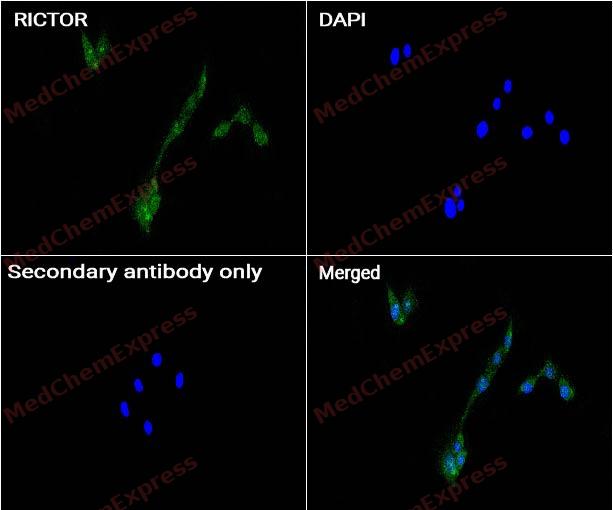 Immunocytochemistry analysis of NIH/3T3 cells labeling RICTOR with RICTOR antibody (HY-P84642) at 1/200 dilution. Cells were fixed in 4% paraformaldehyde for 15 minutes at room temperature, permeabilized with 0.1% Triton X-100 for 10 minutes at room temperature, then blocked with QuickBlock™ Blocking Buffer for Immunol Staining for 10 min at room temperature. Cells were then incubated with RICTOR antibody (HY-P84642) at 1/200 dilution in QuickBlock™ Blocking Buffer for Immunol Staining at 4 ℃. Alexa Fluor® 488-conjugated AffiniPure Goat Anti-Mouse IgG H&L(HY-P8005, Green) was used as the secondary antibody at 1/1,000 dilution. PBS instead of the primary antibody was used as the secondary antibody only control. The Nuclear counterstain was DAPI (Blue).


Background
-
Function
RICTOR component of the mechanistic target of rapamycin complex 2 (mTORC2), which transduces signals from growth factors to pathways involved in proliferation, cytoskeletal organization, lipogenesis and anabolic output. In response to growth factors, mTORC2 phosphorylates and activates AGC protein kinase family members, including AKT (AKT1, AKT2 and AKT3), PKC (PRKCA, PRKCB and PRKCE) and SGK1. In contrast to mTORC1, mTORC2 is nutrient-insensitive. Within the mTORC2 complex, RICTOR probably acts as a molecular adapter. RICTOR is responsible for the FKBP12-rapamycin-insensitivity of mTORC2. mTORC2 plays a critical role in AKT1 activation by mediating phosphorylation of different sites depending on the context, such as 'Thr-450', 'Ser-473', 'Ser-477' or 'Thr-479', facilitating the phosphorylation of the activation loop of AKT1 on 'Thr-308' by PDPK1/PDK1 which is a prerequisite for full activation. mTORC2 catalyzes the phosphorylation of SGK1 at 'Ser-422' and of PRKCA on 'Ser-657'. The mTORC2 complex also phosphorylates various proteins involved in insulin signaling, such as FBXW8 and IGF2BP1. mTORC2 acts upstream of Rho GTPases to regulate the actin cytoskeleton, probably by activating one or more Rho-type guanine nucleotide exchange factors. mTORC2 promotes the serum-induced formation of stress-fibers or F-actin[1][2][3][4][5][6][7][8][9][10].
-
Subcellular Localization
Cell membrane; Endoplasmic reticulum membrane; Lysosome membrane
-
Isoforms & Post-Translational Modification
Q6R327 has 3 isomers: Q6R327-1: 192218 Da (predicted); Q6R327-4: 28988 Da (predicted); Q6R327-3: 195011 Da (predicted).
Phosphorylated by MTOR; when part of mTORC2 (PubMed:15467718). Phosphorylated at Thr-1135 by RPS6KB1 downstream of the mTORC1 complex: phosphorylation of RICTOR inhibits mTORC2 signaling by creating a binding site for 14-3-3 proteins (PubMed:19720745, PubMed:19935711, PubMed:19995915). Phosphorylated at Thr-1695 by GSK3A and GSK3B which facilitates RICTOR ubiquitination and subsequent degradation (PubMed:25897075). Phosphorylated at Ser-1235 by GSK3B in response to endoplasmic stress, inhibiting mTORC2 signaling (PubMed:21343617);Ubiquitinated by the SCF(FBXW7) complex, leading to its degradation by the proteasome (PubMed:25897075). Deubiquitinated by USP9X; deubiquitination stabilizes RICTOR and enhances its binding to MTOR, thus promoting mTORC2 complex assembly (PubMed:33378666);Acetylated by EP300/p300 in response to glucose, leading to activate the mTORC2 complex (PubMed:22084251, PubMed:26170313). Acetylation by BLOC1S1/GCN5L1 in response to hypotoxic stress protects RICTOR against ubiquitination and subsequent degradation by the proteasome (PubMed:38281616) -
Subunit
Component of the mechanistic target of rapamycin complex 2 (mTORC2), consisting in two heterotretramers composed of MTOR, MLST8, RICTOR and MAPKAP1/SIN1 (PubMed:15268862, PubMed:15467718, PubMed:17461779, PubMed:17599906, PubMed:29424687, PubMed:29567957, PubMed:33158864, PubMed:34519268, PubMed:35926713). The mTORC2 core complex associates with PRR5/PROTOR1 and/or PRR5L/PROTOR2 (PubMed:17461779, PubMed:21964062, PubMed:29424687). Contrary to mTORC1, mTORC2 does not bind to and is not sensitive to FKBP12-rapamycin (PubMed:15467718, PubMed:33158864). Binds directly to MTOR and PRR5 within the TORC2 complex; interaction with MTOR is enhanced by deubiquitination of RICTOR by USP9X (PubMed:15268862, PubMed:17461779, PubMed:17599906, PubMed:33378666). Interaction with MAPKAP1 is not enhanced by RICTOR deubiquitination by USP9X (PubMed:33378666). Interacts with CCDC28B (PubMed:23727834). Interacts with NBN (PubMed:23762398). Interacts with SIK3 (PubMed:30232230). Interacts with NCKAP1L (PubMed:32647003). Interacts with kinases GSK3A and GSK3B; the interactions lead to phosphorylation of RICTOR at Thr-1695 which facilitates its FBXW7-mediated ubiquitination and subsequent degradation (PubMed:25897075). Interacts with FBXW7; the interaction is enhanced by GSK3-mediated phosphorylation of Thr-1695 and results in RICTOR ubiquitination and degradation (PubMed:25897075). Interacts with ARMH4 (via cytoplasmic tail); this interaction bridges ARMH4 to the mTORC2 complex and inhibits the mTORC2 kinase activity (By similarity). Interacts with UBXN2A (PubMed:37037900). Interacts with TSPAN8 (PubMed:25761241, PubMed:35904232)
-
SwissProt ID
-
Synonyms
PIA; mAVO3; KIAA1999; MGC39830; DKFZp686B11164; RICTOR


Documentation
-
Data Sheet (235 KB)
-
SDS (252 KB)
- English - EN (252 KB)
- Français - FR (252 KB)
- Deutsch - DE (252 KB)
- Norwegian - NO (252 KB)
- Español - ES (252 KB)
- Swedish - SV (252 KB)
- Italian - IT (252 KB)
- Korean - KR (252 KB)
- Portuguese - PT (252 KB)
-
User Guide for Antibodies (1077 KB)

 Powered by Bioz
