



WTAP Antibody
(Synonyms: hFL(2)D; WT1-associated protein; Wilms tumor 1-associating protein; Pre-mRNA-splicing regulator WTAP)
Based on 1 Customer Validation
WTAP Antibody is a Rabbit-derived and non-conjugated IgG polyclonal antibody, targeting to WTAP.
-
Host:
Rabbit
-
Isotype:
IgG
-
Application:
WB, IHC-P, ICC/IF
-
Reactivity :
Human, Mouse, Rat
-
Formulation:
Supplied in PBS (pH7.4), 0.1% BSA, 40% Glycerol. Preservative: 0.05% Sodium Azide.
-
Conjugation:
Non-conjugated


To place orders, for customer services and technical support, please contact: MedChemExpress USA
Tel: 609-228-6898 E-mail: [email protected] [email protected]





Applications
| Application |
WB

WB: Western Blot
|
IHC-P
IHC-P: Immunohistochemistry-Paraffin
|
ICC/IF
ICC/IF: Immunocytochemistry/
Immunofluorescence |
|---|---|---|---|
| Dilution Ratio | 1:1000 | 1:2000 | 1:200 |


Product Details
WTAP Antibody is a Rabbit-derived and non-conjugated IgG polyclonal antibody, targeting to WTAP.
-
Host Rabbit

-
Clonality Polyclonal

-
Species ReactivityHuman, Mouse, Rat
-
Observed Molecular WeightObserved band size: 55 kDa
Note: Due to possible protein modifications or aggregation, the molecular weight should be confirmed by actual measurement, and the predicted value is for reference only.

-
Calculated Molecular Weight Predicted band size: 44 kDa

Entrez Gene: 9589 Human ; 60532 Mouse ; 499020 Rat
SwissProt: Q15007 Human ; Q9ER69 Mouse ;
OMIM: 605442 Human
Recombinant protein within human WTAP aa 1-300 / 396.
Affinity Purified
Non-conjugated
Unmodified
IgG


Product Properties
-
Appearance
Liquid
-
Formulation
Supplied in PBS (pH7.4), 0.1% BSA, 40% Glycerol. Preservative: 0.05% Sodium Azide.
-
Concentration
Batch-dependent, Please check the COA for the concentration of each lot. Check Lot Concentration
-
Storage & Stability
Stored at -20°C for 1 year. Avoid repeated freeze / thaw cycles.
-
Shipping
Shipping with blue ice.


Verification Images
-
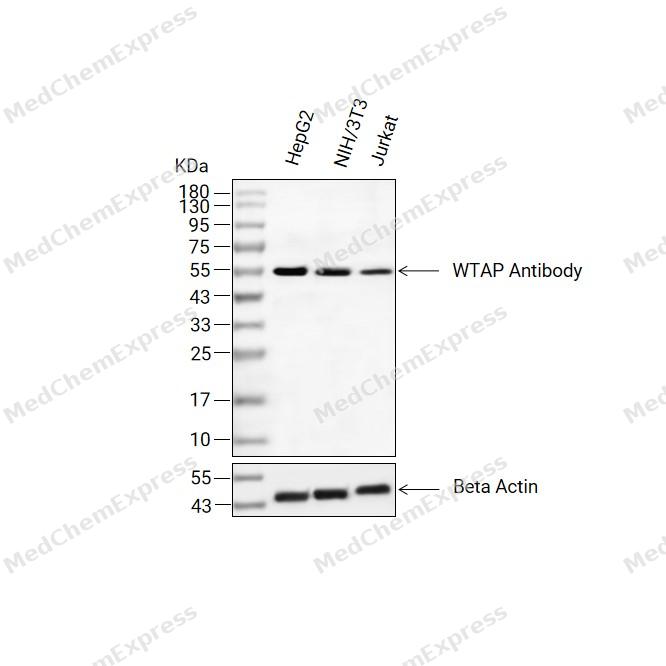 Western blot analysis of extracts from HepG2(lane 2(20ug) , NIH/3T3(lane 3(20ug) and Jurkat(lane 4(20ug) using WTAP Antibody (HY-P83721) Rabbit mAb. Proteins were transferred to a PVDF membrane and blocked with 5% non-fat milk in TBST for 2 hour at room temperature. The primary antibody (1/1000) and Loading control antibody (Beta Actin, HY-P83730, 1/10000) was used in 5% non-fat milk in TBST at 4°C overnight. Goat Anti-Mouse/Rabbit IgG-HRP Secondary Antibody (1/10000) was used for 1 hour at room temperature.
 -
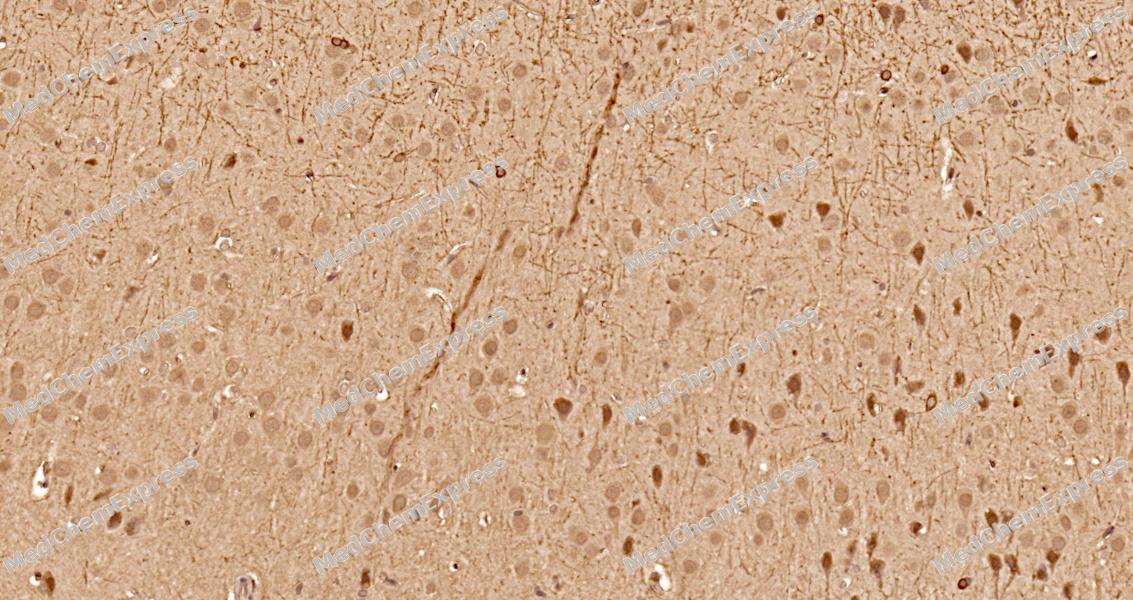 Immunohistochemical analysis of paraffin-embedded rat brain tissue using WTAP Antibody. The section was pre-treated using heat mediated antigen retrieval with sodium citrate buffer (pH 6.0) for 8 minutes. The tissues were blocked in QuickBlock for 20 minutes at room temperature, washed with ddH2O and PBS, and then probed with the primary antibody at 1/100 dilution in 4℃ overnight. The detection was performed using an HRP conjugated compact polymer system. DAB was used as the chromogen. Tissues were counterstained with hematoxylin and mounted with DPX.
 -
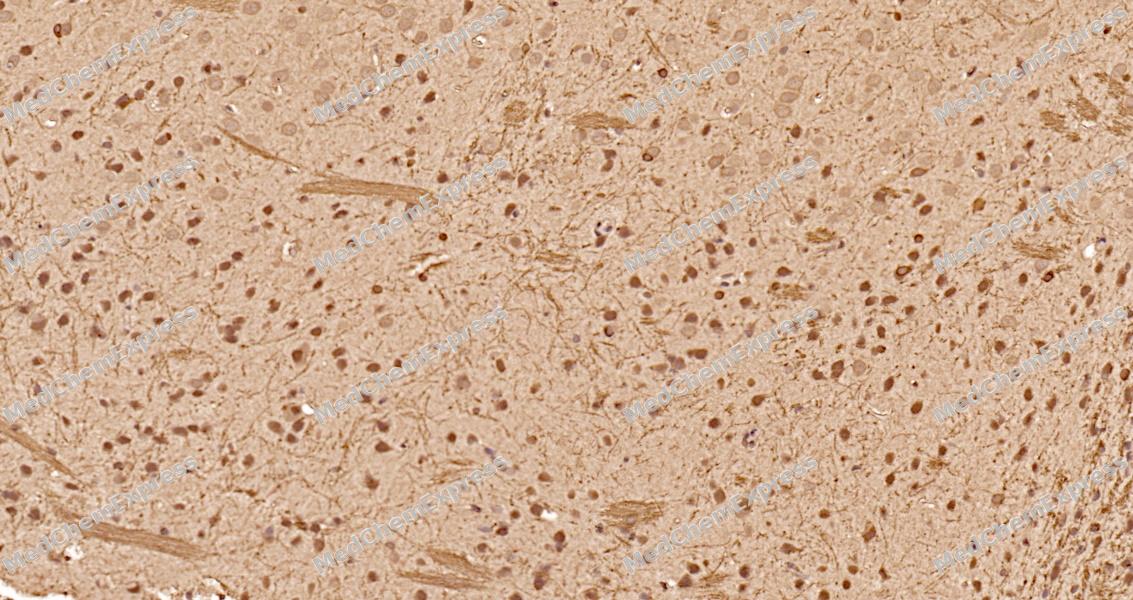 Immunohistochemical analysis of paraffin-embedded rat brain tissue using WTAP Antibody. The section was pre-treated using heat mediated antigen retrieval with sodium citrate buffer (pH 6.0) for 8 minutes. The tissues were blocked in QuickBlock for 20 minutes at room temperature, washed with ddH2O and PBS, and then probed with the primary antibody at 1/100 dilution in 4℃ overnight. The detection was performed using an HRP conjugated compact polymer system. DAB was used as the chromogen. Tissues were counterstained with hematoxylin and mounted with DPX.
 -
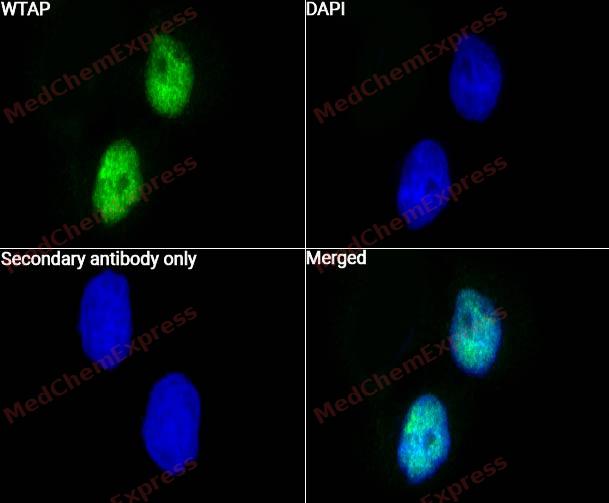 Immunocytochemistry analysis of Hela cells labeling WTAP with WTAP Antibody (HY-P83721)at 1/50 dilution. Cells were fixed in 4% paraformaldehyde for 15 minutes at room temperature, permeabilized with 0.1% Triton X-100 for 10 minutes at room temperature, then blocked with QuickBlock™ Blocking Buffer for Immunol Staining for 10 min at room temperature. Cells were then incubated with WTAP Antibody (HY-P83721) at 1/50 dilution in QuickBlock™ Blocking Buffer for Immunol Staining at 4 ℃. Alexa Fluor® 488-conjugated AffiniPure Goat Anti-Rabbit IgG H&L(HY-P8002, Green) was used as the secondary antibody at 1/1,000 dilution. PBS instead of the primary antibody was used as the secondary antibody only control. The Nuclear counterstain was DAPI (Blue).
 -
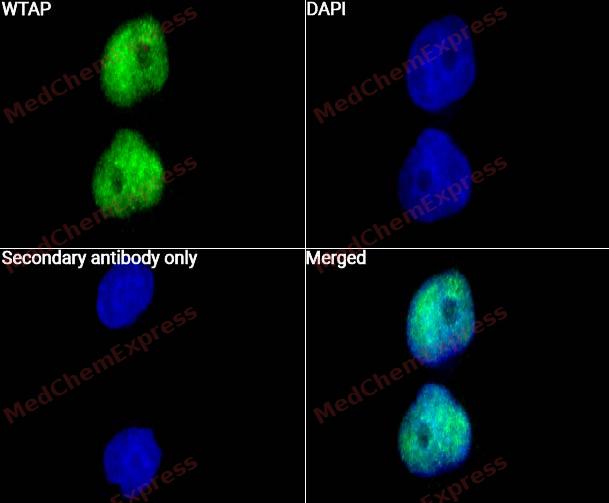 Immunocytochemistry analysis of NIH/3T3 cells labeling WTAP with WTAP Antibody (HY-P83721)at 1/50 dilution. Cells were fixed in 4% paraformaldehyde for 15 minutes at room temperature, permeabilized with 0.1% Triton X-100 for 10 minutes at room temperature, then blocked with QuickBlock™ Blocking Buffer for Immunol Staining for 10 min at room temperature. Cells were then incubated with WTAP Antibody (HY-P83721)at 1/50 dilution in QuickBlock™ Blocking Buffer for Immunol Staining at 4 ℃. Alexa Fluor® 488-conjugated AffiniPure Goat Anti-Rabbit IgG H&L(HY-P8002, Green) was used as the secondary antibody at 1/1,000 dilution. PBS instead of the primary antibody was used as the secondary antibody only control. The Nuclear counterstain was DAPI (Blue).


Background
-
Function
WTAP is an Associated component of the WMM complex, a complex that mediates N6-methyladenosine (m6A) methylation of RNAs, a modification that plays a role in the efficiency of mRNA splicing and RNA processing. Required for accumulation of METTL3 and METTL14 to nuclear speckle. Acts as a mRNA splicing regulator. Regulates G2/M cell-cycle transition by binding to the 3' UTR of CCNA2, which enhances its stability. Impairs WT1 DNA-binding ability and inhibits expression of WT1 target genes[1][2][3][4][5][6][7].
-
Subcellular Localization
Nucleus speckle; Nucleus, nucleoplasm; Cytoplasm
-
Expression
Tissue_specificity:general expression
Induction:In smooth muscle cells, up-regulated after serum withdrawal, when cells become mature and non proliferative
Positive sample: K562 cell lysate, Jurkat cell lysate, Hela cell lysate, HepG2 cell lysate, 293T cell lysate, NIH/3T3 cell lysate, PC-12 cell lysate, human breast carcinoma tissue, human colon tissue, -
Subunit
Component of the WMM complex, a N6-methyltransferase complex composed of a catalytic subcomplex, named MAC, and of an associated subcomplex, named MACOM (PubMed:24316715, PubMed:24407421, PubMed:24981863, PubMed:29348140, PubMed:29506078, PubMed:29507755). The MAC subcomplex is composed of METTL3 and METTL14 (PubMed:29507755). The MACOM subcomplex is composed of WTAP, ZC3H13, CBLL1/HAKAI, VIRMA, and, in some cases of RBM15 (RBM15 or RBM15B) (PubMed:29507755). Interacts with WT1 (PubMed:11001926, PubMed:17095724). Also a component of a MACOM-like complex, named WTAP complex, composed of WTAP, ZC3H13, CBLL1, VIRMA, RBM15, BCLAF1 and THRAP3 (PubMed:24100041)
-
SwissProt ID
-
Synonyms
hFL(2)D; WT1-associated protein; Wilms tumor 1-associating protein; Pre-mRNA-splicing regulator WTAP


Documentation
-
Data Sheet (234 KB)
-
SDS (252 KB)
- English - EN (252 KB)
- Français - FR (252 KB)
- Deutsch - DE (252 KB)
- Norwegian - NO (252 KB)
- Español - ES (252 KB)
- Swedish - SV (252 KB)
- Italian - IT (252 KB)
- Korean - KR (252 KB)
- Portuguese - PT (252 KB)
-
User Guide for Antibodies (1077 KB)

 Powered by Bioz
