



Atracurium
Based on 1 publication(s) in Google Scholar
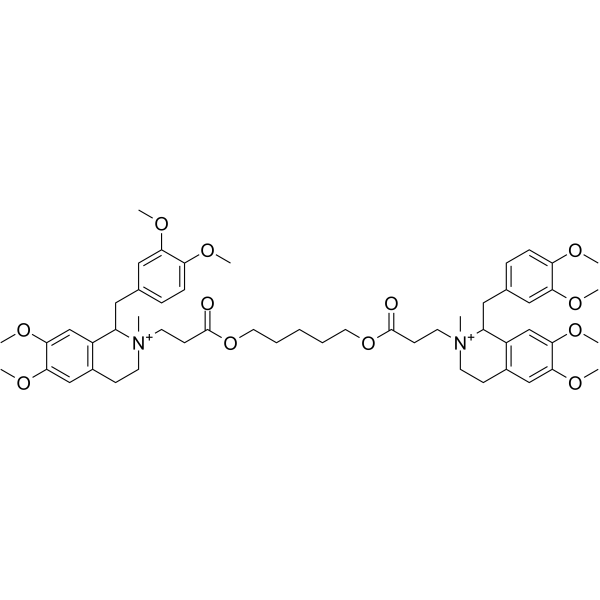
tracurium (BW-33A free acid) is a potent, competitive and non-depolarizing neuromuscular blocking agent.Atracurium also is an AChR receptor antagonist. Atracurium induces bronchoconstriction and neuromuscular blockade. Atracurium promotes astroglial differentiation.
For research use only. We do not sell to patients.
- CAS No.: 64228-79-1
- Formula: C53H72N2O122+
- Molecular Weight:929.14
-
Storage:
Please store the product under the recommended conditions in the Certificate of Analysis.

To place orders, for customer services and technical support, please contact: MedChemExpress USA
Tel: 609-228-6898 E-mail: [email protected] [email protected]


-
 Biological Activity
-
Chemical Information
- Purity & Documentation
- References
-
 Help & FAQs


Publications Citing Use of MedChemExpress (MCE) Atracurium
More

Biological Activity
Description
Cellular Effect
|
Cell Line

|
Type | Value | Description | References |
|---|---|---|---|---|
| Hepatocyte | IC50 |
3 μM
Compound: 5
|
Inhibition of apamin-sensitive SKCa channel of guinea-pig hepatocytes
Inhibition of apamin-sensitive SKCa channel of guinea-pig hepatocytes
|
[PMID: 15225721] |
In Vitro
Atracurium (10 µM; 72 h) promotes astroglial but not neuronal differentiation in HSR040622 and HSR040821 cells[4].
Atracurium (10 µM; 48 h) reduces tumor engraftment and increases survival of mice xenotransplanted with ex-vivo treated GSCs[4].
Atracurium (2.4 µM; 120 min) induces a complete fade of the tetanic contraction while only slightly affected the twitch in rat extensor digitorum longus muscle cells[5].
MedChemExpress (MCE) has not independently confirmed the accuracy of these methods. They are for reference only.
-
Cell Line:glioblastoma stem (GSC) cells
-
Concentration:3, 10, 20 µM
-
Incubation Time:72 h
-
Result:Increased the percentage of GFP-positive cells in a dose-dependent manner from 5.3% in DMSO to 15.4%, 81.1%, and 86.8% in 3 μM, 10 μM, and 20 μM, respectively.
In Vivo
Atracurium (4.8 mg/kg; i.v.) induces neuromuscular blockade in rats[3].
MedChemExpress (MCE) has not independently confirmed the accuracy of these methods. They are for reference only.
-
Animal Model:5-12 weeks, 15-20 g male mice[2]
-
Dosage:1, 5, 10, 20, 50 mg/kg
-
Administration:I.v.
-
Result:Induced bronchoconstriction and Atracurium-induced airway hyperresponsiveness in DBA/2 mice was eliminated in a dose-dependent manner by pretreatment with atropine or pancuronium.
-
Animal Model:290 ± 30 g Male Sprague±Dawley rats (60 mg/kg heat-killed Corynebacteriumparvum for i.v.)[3]
-
Dosage:4.8 mg/kg
-
Administration:I.v.
-
Result:Induced neuromuscular blockade in Corynebacteriumparvum-injected rats.
Clinical Trial
| NCT Number | Sponsor | Condition | Start Date |
Phase
|
|---|---|---|---|---|
| NCT01329991 | 2011-05 | PHASE1 |


Chemical Information
-
CAS No. 64228-79-1
-
Molecular Weight 929.14
-
Formula C53H72N2O122+
-
SMILES
O=C(OCCCCCOC(CC[N+]1(C)C(CC2=CC=C(OC)C(OC)=C2)C3=C(C=C(OC)C(OC)=C3)CC1)=O)CC[N+]4(C)C(CC5=CC=C(OC)C(OC)=C5)C6=C(C=C(OC)C(OC)=C6)CC4
-
Synonyms
BW-33A free acid
-
Shipping
Room temperature in continental US; may vary elsewhere.
-
Storage
Please store the product under the recommended conditions in the Certificate of Analysis.


Publications (1)
-
Journal Impact Factor
-
Most Recent
-
Cell Rep Methods
RECOVER identifies synergistic drug combinations in vitro through sequential model optimization. [Abstract]2023 Oct 23;3(10):100599. PMID: 37797618


Purity & Documentation
References
[1]. Basta SJ, et al. Clinical pharmacology of atracurium besylate (BW 33A): a new non-depolarizing muscle relaxant. Anesth Analg. 1982 Sep;61(9):723-9. [Content Brief]
[2]. Levitt RC, et al. Genetic susceptibility to atracurium-induced bronchoconstriction. Am J Respir Crit Care Med. 1995 May;151(5):1537-42. [Content Brief]
[3]. Mayer B, et al. Inflammatory liver disease shortens atracurium-induced neuromuscular blockade in rats. Eur J Anaesthesiol. 2001 Sep;18(9):599-604. [Content Brief]
[4]. Spina R, et al. Atracurium Besylate and other neuromuscular blocking agents promote astroglial differentiation and deplete glioblastoma stem cells. Oncotarget. 2016 Jan 5;7(1):459-72. [Content Brief]
[5]. Nascimento DC, et al. Cellular mechanisms of atracurium-induced tetanic fade in the isolated rat muscle. Basic Clin Pharmacol Toxicol. 2004 Jul;95(1):9-14. [Content Brief]

Calculators
Concentration (start) × Volume (start) = Concentration (final) × Volume (final)


Atracurium Related Classifications
HY-B0292 Related Classifications
 Powered by Bioz