



Benzamidine
Based on 4 publication(s) in Google Scholar
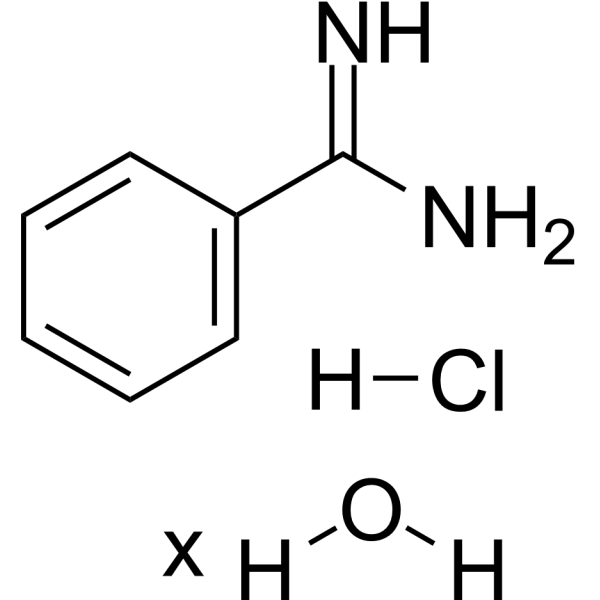
Benzamidine is a competitive protease inhibitor that blocks the hydrolytic cleavage of glucagon by plasmin, trypsin and thrombin. Benzamidine effectively inhibits the degradation of glucagon by relevant proteases during the collection, storage and analysis of human plasma and blood samples. During in vivo metabolism, Benzamidine undergoes N-hydroxylation and produces multiple metabolites, exhibiting characteristics of delayed excretion or biphasic elimination. Benzamidine only induces slight single-strand DNA breaks at high concentrations and shows no significant genotoxic potential overall. Benzamidine may interfere with the detection of some glucagon antisera, but does not affect key antigen-antibody affinity at specific concentrations. Benzamidine can be used as a stabilizer in glucagon radioimmunoassays to ensure the accuracy and recovery rate of detection results.
Nur für Forschungszwecke. Wir verkaufen nicht an Patienten.
- Reinheit : 95.0%
- CAS. Nr.: 618-39-3
- Formel: C7H8N2
- Molecular Weight:120.15
-
Speicherung:
Store at room temperature 3 years.
In solvent -80°C, 2 years , -20°C, 1 year


To place orders, for customer services and technical support, please contact: MedChemExpress USA
Tel: 609-228-6898 E-mail: [email protected] [email protected]


-
 Biologische Aktivität
-
Chemical Information
-
Lösungsmittel & Löslichkeit
- Protokoll
- Reinheit & Dokumentation
- Verweise
-
 Help & FAQs


Publications Citing Use of MedChemExpress (MCE) Benzamidine
More

Biologische Aktivität
Beschreibung
In Vitro
Benzamidine (0.05-0.1 M; 6-24 h at 4°C) inhibits the degradation of [125I]-glucagon in undiluted human plasma; the recovery rate of glucagon in undiluted human plasma treated with 0.05 M benzamidine exceeds 85%[1].
Benzamidine (1-20 μmoles/tube or 5-20 μmoles/tube; 1 h) exhibits only weak, marginal genotoxicity (inducing DNA single-strand breaks) in primary rat hepatocytes, and shows no genotoxicity in CO631 cells at the tested concentrations[2].
Benzamidine (1-10 μmoles/plate; 72 h) does not induce selective amplification of SV40 DNA in CO631 cells[2].
MedChemExpress (MCE) has not independently confirmed the accuracy of these methods. They are for reference only.
-
Cell Line:primary rat hepatocytes, CO631 cells
-
Concentration:1-20 μmoles/tube or 5-20 μmoles/tube
-
Incubation Time:1 h
-
Result:Exhibited only marginal, borderline genotoxic activity (induction of DNA single-strand breaks) in primary rat hepatocytes, and no genotoxic activity in CO631 cells at the tested concentrations
In Vivo
MedChemExpress (MCE) has not independently confirmed the accuracy of these methods. They are for reference only.
-
Animal Model:Wistar Hannover rat (male, 200-360 g for blood sampling; 177-395 g for urine collection)[3]
-
Dosage:10 mg/kg
-
Administration:i.v.; single dose
-
Result:Detected no free benzamidoxime in rat plasma or urine.
Detected benzamidoxime in rat plasma at 0.35-0.74 ng/μL after 24-hour hydrolysis with arylsulfatase.
Undetected benzamidine in rat plasma 5 hours post-administration.
Recovered 70.5 ± 29.8% of the administered dose in urine over 96 hours post-administration, with 3.3 ± 3.0% excreted on the fourth day.
Detected benzamide in rat urine samples.
-
Animal Model:grey (male, 4.8-5.1 kg)[3]
-
Dosage:10 mg/kg
-
Administration:i.v.; single dose
-
Result:Detected no free benzamidoxime in rabbit plasma.
Detected benzamidoxime in plasma collected 30 minutes post-administration at 3.58 ± 0.31 ng/μL (equivalent to 1.79 ± 0.15 ng/μL blood) after 30-minute incubation with β-glucuronidase.
Detected benzamidoxime in plasma collected 4 hours post-administration at 3.19 ± 0.58 ng/μL after 30-minute hydrolysis with arylsulfatase.
Detected benzamidoxime in plasma collected 6 hours post-administration at 1.81 ± 0.51 ng/μL after 24-hour hydrolysis with arylsulfatase.
Observed benzamidine concentrations in rabbit plasma reached a minimum at 24 hours post-administration then increased thereafter.


Chemical Information
-
CAS. Nr. 618-39-3
-
Appearance Solid
-
Molecular Weight 120.15
-
Formel C7H8N2
-
Color White to off-white
-
SMILES
N=C(C1=CC=CC=C1)N
-
Versand
Room temperature in continental US; may vary elsewhere.
-
Speicherung
Store at room temperature 3 years
In solvent -80°C 2 years -20°C 1 year


Publications (4)
-
Journal Impact Factor
-
Most Recent
-
J Invest Dermatol
Mast cells Initiate Type 2 Inflammation via Tryptase Released by MRGPRX2/MrgprB2 Activation in Atopic Dermatitis. [Abstract]2024 Jan;144(1):53-62.e2. PMID: 37482287 -
J Biol Chem
Golgi α-Mannosidases Regulate Cell Surface N-Glycan Type and Ectodomain Shedding of the Transmembrane Protease Corin. [Abstract]2023 Oct;299(10):105211. PMID: 37660903 -
STAR Protoc
Protocol for reconstituting enzymatic activities for ultra-large histone methyltransferases NSD1 and SETD2 using a baculovirus expression system. [Abstract]2025 Jul 18;6(3):103963. PMID: 40684435 -


Lösungsmittel & Löslichkeit
In Vitro:
DMSO : 50 mg/mL (416.15 mM; ultrasonic and warming and heat to 60°C; Hygroscopic DMSO has a significant impact on the solubility of product, please use newly opened DMSO)
Please refer to the solubility information to select the appropriate solvent. Once prepared, please aliquot and store the solution to prevent product inactivation from repeated freeze-thaw cycles.
Storage method and period of stock solution: -80°C, 2 years; -20°C, 1 year. When stored at -80°C, please use it within 2 years. When stored at -20°C, please use it within 1 year.
Please refer to the solubility information to select the appropriate solvent. Once prepared, please aliquot and store the solution to prevent product inactivation from repeated freeze-thaw cycles.
Storage method and period of stock solution: -80°C, 2 years; -20°C, 1 year. When stored at -80°C, please use it within 2 years. When stored at -20°C, please use it within 1 year.
Konzentration (Stammlösung) × Volumen (Stammlösung) = Konzentration (Ziellösung) × Volumen (Ziellösung)
In Vivo:
Select the appropriate dissolution method based on your experimental animal and administration route.
- For the following dissolution methods, please ensure to first prepare a clear stock solution using an In Vitro approach and then sequentially add co-solvents:
- To ensure reliable experimental results, the clarified stock solution can be appropriately stored based on storage conditions. As for the working solution for In Vivo experiments, it is recommended to prepare freshly and use it on the same day.
- The percentages shown for the solvents indicate their volumetric ratio in the final prepared solution. If precipitation or phase separation occurs during preparation, heat and/or sonication can be used to aid dissolution.
Add each solvent one by one: 10% DMSO 40% PEG300 5% Tween-80 45% Saline
Solubility: ≥ 5 mg/mL (41.61 mM); Clear solution
This protocol yields a clear solution of ≥ 5 mg/mL (saturation unknown).
Taking 1 mL working solution as an example, add 100 μL DMSO stock solution (50.0 mg/mL) to 400 μL PEG300, and mix evenly; then add 50 μL Tween-80 and mix evenly; then add 450 μL Saline to adjust the volume to 1 mL.
Preparation of Saline: Dissolve 0.9 g sodium chloride in ddH₂O and dilute to 100 mL to obtain a clear Saline solution.
In Vivo Dissolution Calculator
Please enter the basic information of animal experiments:
-
-
-
-
Recommended: Prepare an additional quantity of animals to account for potential losses during experiments.
Please enter your animal formula composition:
-
%DMSO +
Recommended: Keep the proportion of DMSO in working solution below 2% if your animal is weak.
-
%+
-
+%Tween-80 + +
-
%Saline +
The co-solvents required include: DMSO, . All of co-solvents are available by MedChemExpress (MCE). , Tween 80. All of co-solvents are available by MedChemExpress (MCE).
Working solution concentration: 0.22 mg/mL
Method for preparing stock solution: mg drug dissolved in μL DMSO. Stock solution concentration: mg/mL.
1. Take μL DMSO stock solution;
2. Add μL .
μL , mix evenly;
3. Then add μL Tween 80, mix evenly;
4. Then add μL
Please ensure that the stock solution in the first step is dissolved to a clear state, and add co-solvents in sequence. You can use ultrasonic heating (ultrasonic cleaner, recommended frequency 20-40 kHz), vortexing, etc. to assist dissolution.


Reinheit & Dokumentation
-
Data Sheet (279 KB)
-
SDS (393 KB)
- English - EN (393 KB)
- Français - FR (393 KB)
- Deutsch - DE (393 KB)
- Norwegian - NO (393 KB)
- Español - ES (393 KB)
- Swedish - SV (393 KB)
- Italian - IT (393 KB)
- Korean - KR (393 KB)
- Portuguese - PT (393 KB)
-
Handling Instructions (2659 KB)
Verweise
[2]. Clement B, et al. Genotoxic activities of benzamidine and its N-hydroxylated metabolite benzamidoxime in Salmonella typhimurium and mammalian cells. J Cancer Res Clin Oncol. 1988;114(4):363-368. [Content Brief]
[3]. Clement B, et al. Biotransformation of benzamidine and benzamidoxime in vivo. Arch Pharm (Weinheim). 1993;326(10):807-812. [Content Brief]


Complete Stock Solution Preparation Table
Please refer to the solubility information to select the appropriate solvent. Once prepared, please aliquot and store the solution to prevent product inactivation from repeated freeze-thaw cycles.
Storage method and period of stock solution: -80°C, 2 years; -20°C, 1 year. When stored at -80°C, please use it within 2 years. When stored at -20°C, please use it within 1 year.
| Optional Solvent | Concentration Solvent Mass | 1 mg | 5 mg | 10 mg | 25 mg |
|---|---|---|---|---|---|
| DMSO | 1 mM | 8.3229 mL | 41.6146 mL | 83.2293 mL | 208.0732 mL |
| 5 mM | 1.6646 mL | 8.3229 mL | 16.6459 mL | 41.6146 mL | |
| 10 mM | 0.8323 mL | 4.1615 mL | 8.3229 mL | 20.8073 mL | |
| 15 mM | 0.5549 mL | 2.7743 mL | 5.5486 mL | 13.8715 mL | |
| 20 mM | 0.4161 mL | 2.0807 mL | 4.1615 mL | 10.4037 mL | |
| 25 mM | 0.3329 mL | 1.6646 mL | 3.3292 mL | 8.3229 mL | |
| 30 mM | 0.2774 mL | 1.3872 mL | 2.7743 mL | 6.9358 mL | |
| 40 mM | 0.2081 mL | 1.0404 mL | 2.0807 mL | 5.2018 mL | |
| 50 mM | 0.1665 mL | 0.8323 mL | 1.6646 mL | 4.1615 mL | |
| 60 mM | 0.1387 mL | 0.6936 mL | 1.3872 mL | 3.4679 mL | |
| 80 mM | 0.1040 mL | 0.5202 mL | 1.0404 mL | 2.6009 mL | |
| 100 mM | 0.0832 mL | 0.4161 mL | 0.8323 mL | 2.0807 mL |


Benzamidine Related Classifications
HY-125913 Related Classifications
 Powered by Bioz