



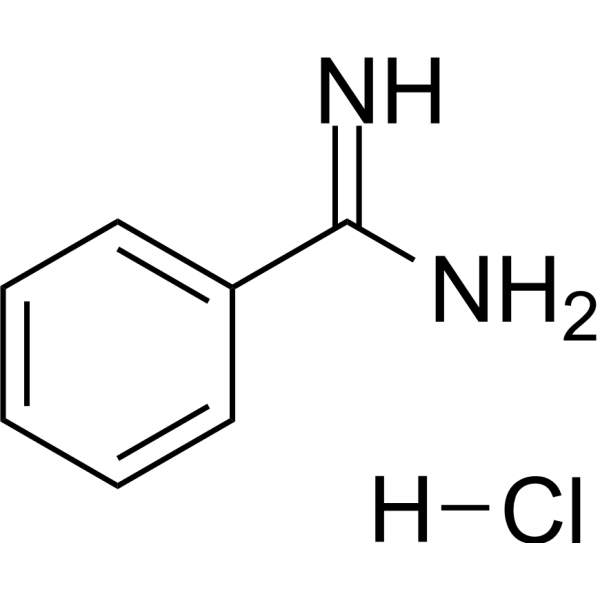
Benzamidine hydrochloride
Based on 4 publication(s) in Google Scholar
Benzamidine hydrochloride is a competitive protease inhibitor that blocks the hydrolytic cleavage of glucagon by plasmin, trypsin and thrombin. Benzamidine hydrochloride effectively inhibits the degradation of glucagon by relevant proteases during the collection, storage and analysis of human plasma and blood samples. During in vivo metabolism, Benzamidine hydrochloride undergoes N-hydroxylation and produces multiple metabolites, exhibiting characteristics of delayed excretion or biphasic elimination. Benzamidine hydrochloride only induces slight single-strand DNA breaks at high concentrations and shows no significant genotoxic potential overall. Benzamidine hydrochloride may interfere with the detection of some glucagon antisera, but does not affect key antigen-antibody affinity at specific concentrations. Benzamidine hydrochloride can be used as a stabilizer in glucagon radioimmunoassays to ensure the accuracy and recovery rate of detection results.
For research use only. We do not sell to patients.
- Purity: 99.94%
- CAS No.: 1670-14-0
- Formula: C7H9ClN2
- Molecular Weight:156.62
-
Storage:
4°C, stored under nitrogen, away from moisture
* In solvent : -80°C, 6 months; -20°C, 1 month (stored under nitrogen, away from moisture)

To place orders, for customer services and technical support, please contact: MedChemExpress USA
Tel: 609-228-6898 E-mail: [email protected] [email protected]


-
 Biological Activity
-
Chemical Information
-
Solvent & Solubility
- Purity & Documentation
- References
-
 Help & FAQs



Publications Citing Use of MedChemExpress (MCE) Benzamidine hydrochloride
More

Biological Activity
Description
IC50 & Target
Ki: 20 μM (Tryptase), 21 μM (Trypsin), 97 μM (uPA), 110 μM (Factor Xa), 320 μM (Thrombin), 750 μM (tPA)[1]
In Vitro
Benzamidine hydrochloride (0.05-0.1 M; 6-24 h at 4°C) inhibits the degradation of [125I]-glucagon in undiluted human plasma; the recovery rate of glucagon in undiluted human plasma treated with 0.05 M benzamidine exceeds 85%[1].
Benzamidine hydrochloride (1-20 μmoles/tube or 5-20 μmoles/tube; 1 h) exhibits only weak, marginal genotoxicity (inducing DNA single-strand breaks) in primary rat hepatocytes, and shows no genotoxicity in CO631 cells at the tested concentrations[2].
Benzamidine hydrochloride (1-10 μmoles/plate; 72 h) does not induce selective amplification of SV40 DNA in CO631 cells[2].
MedChemExpress (MCE) has not independently confirmed the accuracy of these methods. They are for reference only.
In Vivo
MedChemExpress (MCE) has not independently confirmed the accuracy of these methods. They are for reference only.


Chemical Information
-
CAS No. 1670-14-0
-
Appearance Solid
-
Molecular Weight 156.62
-
Formula C7H9ClN2
-
Color White to off-white
-
SMILES
[H]Cl.N=C(C1=CC=CC=C1)N
-
Shipping
Room temperature in continental US; may vary elsewhere.
-
Storage
4°C, stored under nitrogen, away from moisture
* In solvent : -80°C, 6 months; -20°C, 1 month (stored under nitrogen, away from moisture)


Publications (4)
-
Journal Impact Factor
-
Most Recent
-
J Invest Dermatol
Mast cells Initiate Type 2 Inflammation via Tryptase Released by MRGPRX2/MrgprB2 Activation in Atopic Dermatitis. [Abstract]2024 Jan;144(1):53-62.e2. PMID: 37482287 -
J Biol Chem
Golgi α-Mannosidases Regulate Cell Surface N-Glycan Type and Ectodomain Shedding of the Transmembrane Protease Corin. [Abstract]2023 Oct;299(10):105211. PMID: 37660903 -
STAR Protoc
Protocol for reconstituting enzymatic activities for ultra-large histone methyltransferases NSD1 and SETD2 using a baculovirus expression system. [Abstract]2025 Jul 18;6(3):103963. PMID: 40684435 -


Solvent & Solubility
In Vitro:
H2O : 100 mg/mL (638.49 mM; Need ultrasonic)
DMSO : 100 mg/mL (638.49 mM; Need ultrasonic; Hygroscopic DMSO has a significant impact on the solubility of product, please use newly opened DMSO)
Please refer to the solubility information to select the appropriate solvent. Once prepared, please aliquot and store the solution to prevent product inactivation from repeated freeze-thaw cycles.
Storage method and period of stock solution: -80°C, 6 months; -20°C, 1 month (stored under nitrogen, away from moisture). When stored at -80°C, please use it within 6 months. When stored at -20°C, please use it within 1 month.
* Note: If you choose water as the stock solution, please dilute it to the working solution, then filter and sterilize it with a 0.22 μm filter before use.
Please refer to the solubility information to select the appropriate solvent. Once prepared, please aliquot and store the solution to prevent product inactivation from repeated freeze-thaw cycles.
Storage method and period of stock solution: -80°C, 6 months; -20°C, 1 month (stored under nitrogen, away from moisture). When stored at -80°C, please use it within 6 months. When stored at -20°C, please use it within 1 month.
* Note: If you choose water as the stock solution, please dilute it to the working solution, then filter and sterilize it with a 0.22 μm filter before use.
Concentration (start) × Volume (start) = Concentration (final) × Volume (final)
In Vivo:
Select the appropriate dissolution method based on your experimental animal and administration route.
- For the following dissolution methods, please ensure to first prepare a clear stock solution using an In Vitro approach and then sequentially add co-solvents:
- To ensure reliable experimental results, the clarified stock solution can be appropriately stored based on storage conditions. As for the working solution for In Vivo experiments, it is recommended to prepare freshly and use it on the same day.
- The percentages shown for the solvents indicate their volumetric ratio in the final prepared solution. If precipitation or phase separation occurs during preparation, heat and/or sonication can be used to aid dissolution.
Add each solvent one by one: 10% DMSO 40% PEG300 5% Tween-80 45% Saline
Solubility: ≥ 2.5 mg/mL (15.96 mM); Clear solution
This protocol yields a clear solution of ≥ 2.5 mg/mL (saturation unknown).
Taking 1 mL working solution as an example, add 100 μL DMSO stock solution (25.0 mg/mL) to 400 μL PEG300, and mix evenly; then add 50 μL Tween-80 and mix evenly; then add 450 μL Saline to adjust the volume to 1 mL.
Preparation of Saline: Dissolve 0.9 g sodium chloride in ddH₂O and dilute to 100 mL to obtain a clear Saline solution.
Add each solvent one by one: 10% DMSO 90% (20% SBE-β-CD in Saline)
Solubility: ≥ 2.5 mg/mL (15.96 mM); Clear solution
This protocol yields a clear solution of ≥ 2.5 mg/mL (saturation unknown).
Taking 1 mL working solution as an example, add 100 μL DMSO stock solution (25.0 mg/mL) to 900 μL 20% SBE-β-CD in Saline, and mix evenly.
Preparation of 20% SBE-β-CD in Saline (4°C, storage for one week): 2 g SBE-β-CD powder is dissolved in 10 mL Saline, completely dissolve until clear.
In Vivo Dissolution Calculator
Please enter the basic information of animal experiments:
-
-
-
-
Recommended: Prepare an additional quantity of animals to account for potential losses during experiments.
Working solution concentration: 0.22 mg/mL
This product has good water solubility, please refer to the measured solubility data in water/PBS/Saline for details.


Purity & Documentation
-
Data Sheet (277 KB)
-
SDS (394 KB)
- English - EN (394 KB)
- Français - FR (394 KB)
- Deutsch - DE (394 KB)
- Norwegian - NO (394 KB)
- Español - ES (394 KB)
- Swedish - SV (394 KB)
- Italian - IT (394 KB)
- Korean - KR (394 KB)
- Portuguese - PT (394 KB)
-
Handling Instructions (2659 KB)
References
[2]. Clement B, et al. Genotoxic activities of benzamidine and its N-hydroxylated metabolite benzamidoxime in Salmonella typhimurium and mammalian cells. J Cancer Res Clin Oncol. 1988;114(4):363-368. [Content Brief]
[3]. Clement B, et al. Biotransformation of benzamidine and benzamidoxime in vivo. Arch Pharm (Weinheim). 1993;326(10):807-812. [Content Brief]


Complete Stock Solution Preparation Table
Please refer to the solubility information to select the appropriate solvent. Once prepared, please aliquot and store the solution to prevent product inactivation from repeated freeze-thaw cycles.
Storage method and period of stock solution: -80°C, 6 months; -20°C, 1 month (stored under nitrogen, away from moisture). When stored at -80°C, please use it within 6 months. When stored at -20°C, please use it within 1 month.
| Optional Solvent | Concentration Solvent Mass | 1 mg | 5 mg | 10 mg | 25 mg |
|---|---|---|---|---|---|
| H2O / DMSO | 1 mM | 6.3849 mL | 31.9244 mL | 63.8488 mL | 159.6220 mL |
| 5 mM | 1.2770 mL | 6.3849 mL | 12.7698 mL | 31.9244 mL | |
| 10 mM | 0.6385 mL | 3.1924 mL | 6.3849 mL | 15.9622 mL | |
| 15 mM | 0.4257 mL | 2.1283 mL | 4.2566 mL | 10.6415 mL | |
| 20 mM | 0.3192 mL | 1.5962 mL | 3.1924 mL | 7.9811 mL | |
| 25 mM | 0.2554 mL | 1.2770 mL | 2.5540 mL | 6.3849 mL | |
| 30 mM | 0.2128 mL | 1.0641 mL | 2.1283 mL | 5.3207 mL | |
| 40 mM | 0.1596 mL | 0.7981 mL | 1.5962 mL | 3.9906 mL | |
| 50 mM | 0.1277 mL | 0.6385 mL | 1.2770 mL | 3.1924 mL | |
| 60 mM | 0.1064 mL | 0.5321 mL | 1.0641 mL | 2.6604 mL | |
| 80 mM | 0.0798 mL | 0.3991 mL | 0.7981 mL | 1.9953 mL | |
| 100 mM | 0.0638 mL | 0.3192 mL | 0.6385 mL | 1.5962 mL |
* Note: If you choose water as the stock solution, please dilute it to the working solution, then filter and sterilize it with a 0.22 μm filter before use.


Benzamidine hydrochloride Related Classifications
HY-W018781 Related Classifications
 Powered by Bioz