



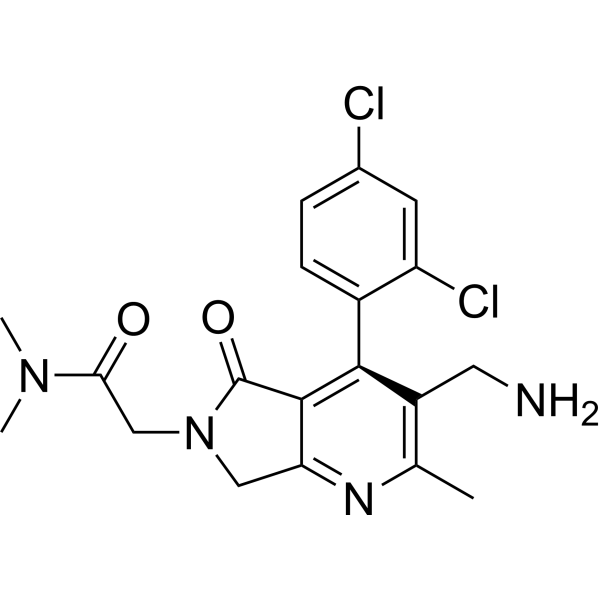
BMS-767778
BMS-767778 is an orally active and selective DPP4 inhibitor with Ki values of 0.94 nM, 4.9, 3.2 nM for DPP4, DPP8 and DPP9 respectively. BMS-767778 exhibits >3,000-fold selectivity over the related enzymes DPP8 and DPP9. BMS-767778 inhibits CYP-3A4 with IC50 of 5.2 μM. BMS-767778 significantly reduces blood glucose levels in high fat fed (HFD) ob/ob mice with safety profile. BMS-767778 can be used for diabetes mellitus research.
Nos produits utilisent uniquement pour la recherche. Nous ne vendons pas aux patients.
- CAS No.: 915729-95-2
- Formule: C19H20Cl2N4O2
- Masse moléculaire:407.29
-
Stockage:
Please store the product under the recommended conditions in the Certificate of Analysis.

To place orders, for customer services and technical support, please contact: MedChemExpress USA
Tel: 609-228-6898 E-mail: [email protected] [email protected]


-
 Activité biologique
-
Chemical Information
- Protocole
- Pureté et documentation
- Références
-
 Help & FAQs




Activité biologique
Description
IC50 & Target
[1]|
DPP-4 0.94 μM (Ki) |
DPP-8 4.9 nM (Ki) |
DPP-9 3.2 nM (Ki) |
In Vitro
BMS-767778 (compound 2s) exhibits good passive membrane permeability, with PAMPA effective permeability (Pe) values of 19.7, 129.7, and 330 × 10-6 cm/s at pH 5.5, 6.5, and 7.4, respectively[1].
BMS-767778 displays an efflux ratio (basolateral-to-apical / apical-to-basolateral permeability) of greater than 5 in Caco-2 cell assays (at pH > 6.5)[1].
BMS-767778 exhibits low plasma protein binding across species: 18% (human), 14% (mouse), 28% (rat), 27% (dog), and 16% (monkey) [1].
BMS-767778 demonstrates a low metabolic turnover in both liver microsomes and hepatocytes, and correspondingly, a low hepatic clearance is predicted in humans[1].
MedChemExpress (MCE) has not independently confirmed the accuracy of these methods. They are for reference only.
In Vivo
BMS-767778 (500 mg/kg, o.p., once) results no clinical chemistry or hemotology changes in rats[1].
BMS-767778 (300 mg/kg, o.p., 14 days) results no clinical chemistry or hemotology changes in rats[1].
BMS-767778 (25 mg/kg, o.p., 5 days) produces no significant changes in dogs[1].
BMS-767778 (50 mg/kg, o.p., 5 days) results a softening of stools in dog[1].
BMS-767778 (50 mg/kg) not demonstrate any potential for undesirable cardiovascular activity[1].
MedChemExpress (MCE) has not independently confirmed the accuracy of these methods. They are for reference only.
Essai clinique
| NCT Number | Sponsor | Condition | Start Date |
Phase

|
|---|---|---|---|---|
| NCT01329991 | Plexxikon| | 2011-05 | PHASE1 |


Chemical Information
-
CAS No. 915729-95-2
-
Masse moléculaire 407.29
-
Formule C19H20Cl2N4O2
-
SMILES
O=C(N(C)C)CN1CC2=NC(C)=C(CN)[C@]([C@]3=CC=C(Cl)C=C3Cl)=C2C1=O
-
Livraison
Room temperature in continental US; may vary elsewhere.
-
Stockage
Please store the product under the recommended conditions in the Certificate of Analysis.


Pureté et documentation
Références
[1]. Pratik Devasthale, et al. Optimization of activity, selectivity, and liability profiles in 5-oxopyrrolopyridine DPP4 inhibitors leading to clinical candidate (Sa)-2-(3-(aminomethyl)-4-(2,4-dichlorophenyl)-2-methyl-5-oxo-5H-pyrrolo[3,4-b]pyridin-6(7H)-yl)-N,N-dimethylacetamide (BMS-767778). J Med Chem . 2013 Sep 26;56(18):7343-57. [Content Brief]
[2]. Devasthale P, et al, Hamann LG. Optimization of activity, selectivity, and liability profiles in 5-oxopyrrolopyridine DPP4 inhibitors leading to clinical candidate (Sa)-2-(3-(aminomethyl)-4-(2,4-dichlorophenyl)-2-methyl-5-oxo-5H-pyrrolo[3,4-b]pyridin-6(7H)-yl)-N,N-dimethylacetamide (BMS-767778). J Med Chem. 2013 Sep 26;56(18):7343-57. [Content Brief]

Calculators
Concentration (start) × Volume (start) = Concentration (final) × Volume (final)


BMS-767778 Related Classifications
HY-16656 Related Classifications
 Powered by Bioz