



Ercalcitriol
Based on 3 publication(s) in Google Scholar
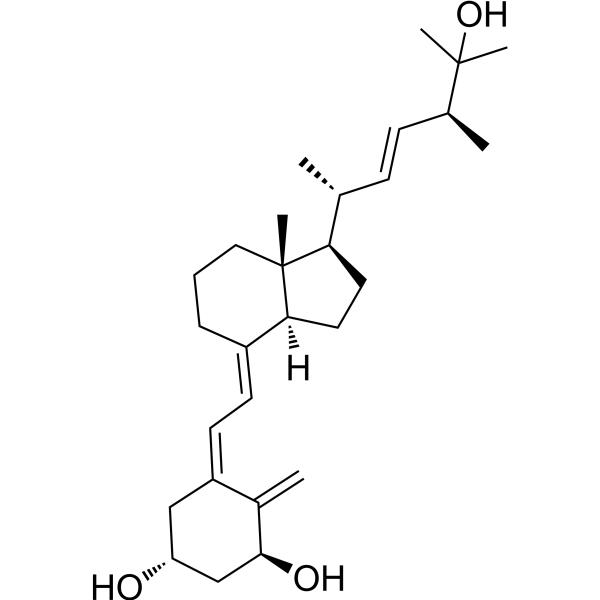
Ercalcitriol (1α,25-Dihydroxy Vitamin D2) is a vitamin D receptor (VDR) agonist with high binding affinity. After binding to VDR, Ercalcitriol forms a complex with retinoid X receptor (RXR) to regulate target gene transcription. For example, Ercalcitriol induces human gingival/oral epithelial cells to produce human cat antimicrobial peptide (hCAP-18/LL-37), which has antimicrobial activity against periodontal pathogens such as Porphyromonas gingivalis. Ercalcitriol enhances the innate immune defense of the oral mucosa by promoting the expression of antimicrobial peptides, and is mainly used in the study of periodontal diseases and immune-related oral diseases.
For research use only. We do not sell to patients.
- Purity: 99.71%
- CAS No.: 60133-18-8
- Formula: C28H44O3
- Molecular Weight:428.65
-
Storage:
-20°C, protect from light, stored under nitrogen
* The compound is unstable in solutions, freshly prepared is recommended.

To place orders, for customer services and technical support, please contact: MedChemExpress USA
Tel: 609-228-6898 E-mail: [email protected] [email protected]


-
 Biological Activity
-
Chemical Information
-
Solvent & Solubility
- Purity & Documentation
- References
-
 Help & FAQs



Publications Citing Use of MedChemExpress (MCE) Ercalcitriol
MoreAll Endogenous Metabolite Isoforms
More

Biological Activity
|
Human Endogenous Metabolite |
Ercalcitriol (100 nM; 24 h) significantly induces LL-37 mRNA expression in human gingival/oral epithelial cells (Ca9-22, HSC-2, HSC-3, HSC-4), with Ca9-22 cells showing the strongest response[1].
Ercalcitriol (100 nM; 6-72 h) induces LL-37 mRNA expression in human gingival epithelial Ca9-22 cells in a time-dependent manner, reaching a peak at 24-72 h, and promoted hCAP-18 protein synthesis and localization in the cytoplasm[1].
MedChemExpress (MCE) has not independently confirmed the accuracy of these methods. They are for reference only.
-
Cell Line:Human gingival epithelial cells (Ca9-22), oral epithelial cells (HSC-2, HSC-3, HSC-4)
-
Concentration:100 nM
-
Incubation Time:24 h
-
Result:Significantly upregulated LL-37 mRNA expression in all cell lines.
In Ca9-22 cells, expression increased 77-fold compared to the control, while HSC-2, HSC-3, and HSC-4 cells showed modest but significant increases (2-5-fold).
-
Cell Line:Human gingival epithelial Ca9-22 cells
-
Concentration:100 nM
-
Incubation Time:24 h
-
Result:Increased hCAP-18 protein (18 kDa) levels 5.5-fold in cell lysates after 24 h of treatment, while LL-37 protein (4.5 kDa) was not detected, likely due to lack of proteolytic processing.
-
Cell Line:Human gingival epithelial Ca9-22 cells
-
Concentration:100 nM
-
Incubation Time:24 h
-
Result:Intracellular hCAP-18 protein was visualized in the cytoplasm of Ca9-22 cells, with stronger staining in treated cells compared to untreated controls, confirming cytoplasmic localization of the induced protein.


Chemical Information
-
CAS No. 60133-18-8
-
Appearance Solid
-
Molecular Weight 428.65
-
Formula C28H44O3
-
Color White to off-white
-
SMILES
C=C1[C@H](C[C@@H](C/C1=C/C=C2[C@]3([C@@](C)([C@H](CC3)[C@@H](/C=C/[C@@H](C(C)(O)C)C)C)CCC/2)[H])O)O
-
Synonyms
1α,25-Dihydroxy Vitamin D2
-
Structure Classification
-
Initial Source
-
Shipping
Room temperature in continental US; may vary elsewhere.
-
Storage
-20°C, protect from light, stored under nitrogen
* The compound is unstable in solutions, freshly prepared is recommended.


Publications (3)
-
Journal Impact Factor
-
Most Recent
-
J Lipid Res
Acylation derivatization based LC-MS analysis of 25-hydroxyvitamin D from finger-prick blood. [Abstract]2019 May;60(5):1058-1064. PMID: 30902903 -
Virol Sin
Antiviral activity of vitamin D derivatives against severe fever with thrombocytopenia syndrome virus in vitro and in vivo. [Abstract]2024 Aug 19:S1995-820X(24)00134-2. PMID: 39168248 -
J Inorg Biochem
Interactions of human mitochondrial Ferredoxin 1 (Adrenodoxin) by NMR; modulation by cytochrome P450 substrate and by truncation of the C-terminal tail. [Abstract]2023 Dec:249:112370. PMID: 37734220


Solvent & Solubility
DMSO : 100 mg/mL (233.29 mM; Need ultrasonic; Hygroscopic DMSO has a significant impact on the solubility of product, please use newly opened DMSO)
Please refer to the solubility information to select the appropriate solvent. The compound is unstable in solutions, freshly prepared is recommended.
Please refer to the solubility information to select the appropriate solvent. The compound is unstable in solutions, freshly prepared is recommended.
Concentration (start) × Volume (start) = Concentration (final) × Volume (final)
Select the appropriate dissolution method based on your experimental animal and administration route.
- For the following dissolution methods, please ensure to first prepare a clear stock solution using an In Vitro approach and then sequentially add co-solvents:
- To ensure reliable experimental results, the clarified stock solution can be appropriately stored based on storage conditions. As for the working solution for In Vivo experiments, it is recommended to prepare freshly and use it on the same day.
- The percentages shown for the solvents indicate their volumetric ratio in the final prepared solution. If precipitation or phase separation occurs during preparation, heat and/or sonication can be used to aid dissolution.
Add each solvent one by one: 10% DMSO 40% PEG300 5% Tween-80 45% Saline
Solubility: ≥ 2.5 mg/mL (5.83 mM); Clear solution
This protocol yields a clear solution of ≥ 2.5 mg/mL (saturation unknown).
Taking 1 mL working solution as an example, add 100 μL DMSO stock solution (25.0 mg/mL) to 400 μL PEG300, and mix evenly; then add 50 μL Tween-80 and mix evenly; then add 450 μL Saline to adjust the volume to 1 mL.
Preparation of Saline: Dissolve 0.9 g sodium chloride in ddH₂O and dilute to 100 mL to obtain a clear Saline solution.
Add each solvent one by one: 10% DMSO 90% (20% SBE-β-CD in Saline)
Solubility: ≥ 2.5 mg/mL (5.83 mM); Clear solution
This protocol yields a clear solution of ≥ 2.5 mg/mL (saturation unknown).
Taking 1 mL working solution as an example, add 100 μL DMSO stock solution (25.0 mg/mL) to 900 μL 20% SBE-β-CD in Saline, and mix evenly.
Preparation of 20% SBE-β-CD in Saline (4°C, storage for one week): 2 g SBE-β-CD powder is dissolved in 10 mL Saline, completely dissolve until clear.
Please enter the basic information of animal experiments:
-
-
-
-
Recommended: Prepare an additional quantity of animals to account for potential losses during experiments.
Please enter your animal formula composition:
-
%DMSO +
Recommended: Keep the proportion of DMSO in working solution below 2% if your animal is weak.
-
%+
-
+%Tween-80 + +
-
%Saline +
The co-solvents required include: DMSO, . All of co-solvents are available by MedChemExpress (MCE). , Tween 80. All of co-solvents are available by MedChemExpress (MCE).
Working solution concentration: 0.22 mg/mL
Method for preparing stock solution: mg drug dissolved in μL DMSO. Stock solution concentration: mg/mL. * The compound is unstable in solutions, freshly prepared is recommended.
1. Take μL DMSO stock solution;
2. Add μL .
μL , mix evenly;
3. Then add μL Tween 80, mix evenly;
4. Then add μL
Please ensure that the stock solution in the first step is dissolved to a clear state, and add co-solvents in sequence. You can use ultrasonic heating (ultrasonic cleaner, recommended frequency 20-40 kHz), vortexing, etc. to assist dissolution.


Purity & Documentation
-
Data Sheet (280 KB)
-
SDS (644 KB)
- English - EN (644 KB)
- Français - FR (644 KB)
- Deutsch - DE (644 KB)
- Norwegian - NO (644 KB)
- Español - ES (644 KB)
- Swedish - SV (644 KB)
- Italian - IT (644 KB)
- Korean - KR (644 KB)
- Portuguese - PT (644 KB)
-
Handling Instructions (2659 KB)
References
[1]. Mawer EB, et al. A sensitive radioimmunoassay using a monoclonal antibody that is equipotent for ercalcitriol and calcitriol (1,25-dihydroxy vitamin D2 and D3).Clin Chim Acta. 1990 Oct 15;190(3):199-209. [Content Brief]
[2]. Tada H, et al. Vitamin D3 analog maxacalcitol (OCT) induces hCAP-18/LL-37 production in human oral epithelial cells. Biomed Res. 2016;37(3):199-205. [Content Brief]


Complete Stock Solution Preparation Table
Please refer to the solubility information to select the appropriate solvent. The compound is unstable in solutions, freshly prepared is recommended.
| Optional Solvent | Concentration Solvent Mass | 1 mg | 5 mg | 10 mg | 25 mg |
|---|---|---|---|---|---|
| DMSO | 1 mM | 2.3329 mL | 11.6645 mL | 23.3291 mL | 58.3226 mL |
| 5 mM | 0.4666 mL | 2.3329 mL | 4.6658 mL | 11.6645 mL | |
| 10 mM | 0.2333 mL | 1.1665 mL | 2.3329 mL | 5.8323 mL | |
| 15 mM | 0.1555 mL | 0.7776 mL | 1.5553 mL | 3.8882 mL | |
| 20 mM | 0.1166 mL | 0.5832 mL | 1.1665 mL | 2.9161 mL | |
| 25 mM | 0.0933 mL | 0.4666 mL | 0.9332 mL | 2.3329 mL | |
| 30 mM | 0.0778 mL | 0.3888 mL | 0.7776 mL | 1.9441 mL | |
| 40 mM | 0.0583 mL | 0.2916 mL | 0.5832 mL | 1.4581 mL | |
| 50 mM | 0.0467 mL | 0.2333 mL | 0.4666 mL | 1.1665 mL | |
| 60 mM | 0.0389 mL | 0.1944 mL | 0.3888 mL | 0.9720 mL | |
| 80 mM | 0.0292 mL | 0.1458 mL | 0.2916 mL | 0.7290 mL | |
| 100 mM | 0.0233 mL | 0.1166 mL | 0.2333 mL | 0.5832 mL |


Ercalcitriol Related Classifications
HY-32350 Related Classifications
 Powered by Bioz