



Guanidine hydrochloride
Based on 3 publication(s) in Google Scholar
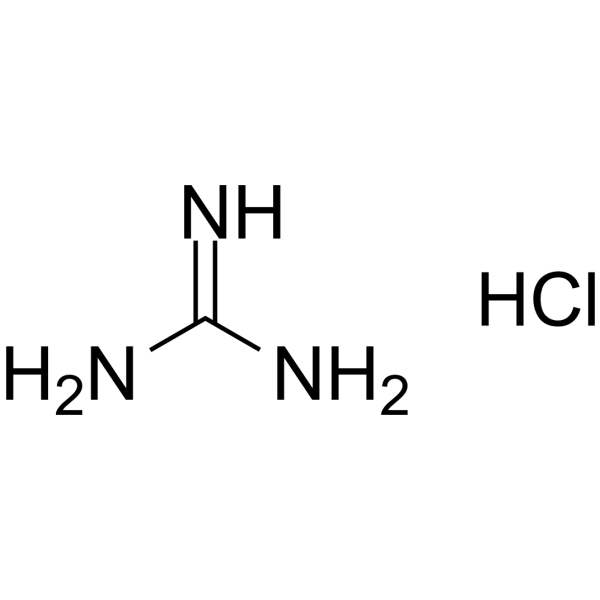
Guanidine hydrochloride (Guanidinium chloride) is a strong protein denaturant. Guanidine hydrochloride causes proteins to assume a random coil conformation.
For research use only. We do not sell to patients.
- Purity: 98.0%
- CAS No.: 50-01-1
- Formula: CH6ClN3
- Molecular Weight:95.53
-
Storage:
Store at room temperature, keep dry and cool.
In solvent -80°C, 1 year , -20°C, 6 months

To place orders, for customer services and technical support, please contact: MedChemExpress USA
Tel: 609-228-6898 E-mail: [email protected] [email protected]


-
 Biological Activity
-
Chemical Information
-
Solvent & Solubility
- Purity & Documentation
- References
-
 Help & FAQs



Publications Citing Use of MedChemExpress (MCE) Guanidine hydrochloride
More Customer Validation & Images

-
Bio/Physico-chemical Assay
-
IF


Biological Activity
Guanidine hydrochloride induces a random coil conformation in proteins[1].
MedChemExpress (MCE) has not independently confirmed the accuracy of these methods. They are for reference only.


Chemical Information
-
CAS No. 50-01-1
-
Appearance Solid
-
Molecular Weight 95.53
-
Formula CH6ClN3
-
Color White to off-white
-
SMILES
NC(N)=N.Cl
-
Synonyms
Guanidinium chloride; Aminoformamidine hydrochloride
-
Initial Source
-
Shipping
Room temperature in continental US; may vary elsewhere.
-
Storage
Store at room temperature, keep dry and cool
In solvent -80°C 1 year -20°C 6 months


Publications (3)
-
Journal Impact Factor
-
Most Recent
-
Int J Biol Macromol
α-Conotoxin LvID, an antagonist of α7 nicotinic acetylcholine receptor, mitigates Alzheimer-associated phenotypes by inhibiting Aβ deposition and reactive astrogliosis. [Abstract]2026 Mar:349:150933. PMID: 41692211 -
Virol J
Enhanced human enterovirus 71 infection by endocytosis inhibitors reveals multiple entry pathways by enterovirus causing hand-foot-and-mouth diseases. [Abstract]2018 Jan 3;15(1):1. PMID: 29298696
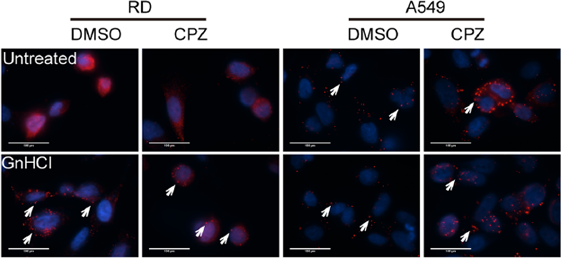
Guanidine hydrochloride purchased from MedChemExpress. Usage Cited in: Virol J. 2018 Jan 3;15(1):1. [Abstract]
Immunofluorescence analysis is performed on RD and A549 cells infected with EV71 at an MOI of 10 (in RD) and 50 (in A549) in the presence or absence of 2.5 mM GnHCl.
-
Virus Res
2020 Jul 2:283:197974. PMID: 32289342
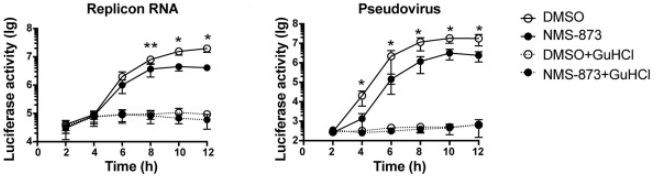
Guanidine hydrochloride purchased from MedChemExpress. Usage Cited in: Virus Res. 2020 Jul 2:283:197974. [Abstract]
RD cells were pretreated with DMSO, NMS-873 (8 μM), DMSO plus GuHCl (2 μM) or NMS-873 plus GuHCl for 30 min. Then cells were transfected with EVA71 replicon RNA (0.1 μg/well) or infected with EVA71 pesudovirus (25 μl/well). Luciferase activity was quantified at different time points post transfection or infection.


Solvent & Solubility
DMSO : ≥ 100 mg/mL (1046.79 mM; Hygroscopic DMSO has a significant impact on the solubility of product, please use newly opened DMSO)
H2O : 100 mg/mL (1046.79 mM; Need ultrasonic)
* "≥" means soluble, but saturation unknown.
Please refer to the solubility information to select the appropriate solvent. Once prepared, please aliquot and store the solution to prevent product inactivation from repeated freeze-thaw cycles.
Storage method and period of stock solution: -80°C, 1 year; -20°C, 6 months. When stored at -80°C, please use it within 1 year. When stored at -20°C, please use it within 6 months.
* Note: If you choose water as the stock solution, please dilute it to the working solution, then filter and sterilize it with a 0.22 μm filter before use.
Please refer to the solubility information to select the appropriate solvent. Once prepared, please aliquot and store the solution to prevent product inactivation from repeated freeze-thaw cycles.
Storage method and period of stock solution: -80°C, 1 year; -20°C, 6 months. When stored at -80°C, please use it within 1 year. When stored at -20°C, please use it within 6 months.
* Note: If you choose water as the stock solution, please dilute it to the working solution, then filter and sterilize it with a 0.22 μm filter before use.
Concentration (start) × Volume (start) = Concentration (final) × Volume (final)
Select the appropriate dissolution method based on your experimental animal and administration route.
- For the following dissolution methods, please ensure to first prepare a clear stock solution using an In Vitro approach and then sequentially add co-solvents:
- To ensure reliable experimental results, the clarified stock solution can be appropriately stored based on storage conditions. As for the working solution for In Vivo experiments, it is recommended to prepare freshly and use it on the same day.
- The percentages shown for the solvents indicate their volumetric ratio in the final prepared solution. If precipitation or phase separation occurs during preparation, heat and/or sonication can be used to aid dissolution.
Add each solvent one by one: 10% DMSO 40% PEG300 5% Tween-80 45% Saline
Solubility: ≥ 2.08 mg/mL (21.77 mM); Clear solution
This protocol yields a clear solution of ≥ 2.08 mg/mL (saturation unknown).
Taking 1 mL working solution as an example, add 100 μL DMSO stock solution (20.8 mg/mL) to 400 μL PEG300, and mix evenly; then add 50 μL Tween-80 and mix evenly; then add 450 μL Saline to adjust the volume to 1 mL.
Preparation of Saline: Dissolve 0.9 g sodium chloride in ddH₂O and dilute to 100 mL to obtain a clear Saline solution.
Add each solvent one by one: 10% DMSO 90% (20% SBE-β-CD in Saline)
Solubility: ≥ 2.08 mg/mL (21.77 mM); Clear solution
This protocol yields a clear solution of ≥ 2.08 mg/mL (saturation unknown).
Taking 1 mL working solution as an example, add 100 μL DMSO stock solution (20.8 mg/mL) to 900 μL 20% SBE-β-CD in Saline, and mix evenly.
Preparation of 20% SBE-β-CD in Saline (4°C, storage for one week): 2 g SBE-β-CD powder is dissolved in 10 mL Saline, completely dissolve until clear.
For the following dissolution methods, please prepare the working solution directly:
It is recommended to prepare fresh solutions and use them promptly within a short period of time.
The percentages shown for the solvents indicate their volumetric ratio in the final prepared solution. If precipitation or phase separation occurs during preparation, heat and/or sonication can be used to aid dissolution.
Add each solvent one by one: PBS
Solubility: 100 mg/mL (1046.79 mM); Clear solution; Need ultrasonic
Please enter the basic information of animal experiments:
-
-
-
-
Recommended: Prepare an additional quantity of animals to account for potential losses during experiments.
Working solution concentration: 0.22 mg/mL
This product has good water solubility, please refer to the measured solubility data in water/PBS/Saline for details.


Purity & Documentation
-
Data Sheet (268 KB)
-
SDS (394 KB)
- English - EN (394 KB)
- Français - FR (394 KB)
- Deutsch - DE (394 KB)
- Norwegian - NO (394 KB)
- Español - ES (394 KB)
- Swedish - SV (394 KB)
- Italian - IT (394 KB)
- Korean - KR (394 KB)
- Portuguese - PT (394 KB)
-
Handling Instructions (2659 KB)
References


Complete Stock Solution Preparation Table
Please refer to the solubility information to select the appropriate solvent. Once prepared, please aliquot and store the solution to prevent product inactivation from repeated freeze-thaw cycles.
Storage method and period of stock solution: -80°C, 1 year; -20°C, 6 months. When stored at -80°C, please use it within 1 year. When stored at -20°C, please use it within 6 months.
| Optional Solvent | Concentration Solvent Mass | 1 mg | 5 mg | 10 mg | 25 mg |
|---|---|---|---|---|---|
| DMSO / H2O | 1 mM | 10.4679 mL | 52.3396 mL | 104.6792 mL | 261.6979 mL |
| 5 mM | 2.0936 mL | 10.4679 mL | 20.9358 mL | 52.3396 mL | |
| 10 mM | 1.0468 mL | 5.2340 mL | 10.4679 mL | 26.1698 mL | |
| 15 mM | 0.6979 mL | 3.4893 mL | 6.9786 mL | 17.4465 mL | |
| 20 mM | 0.5234 mL | 2.6170 mL | 5.2340 mL | 13.0849 mL | |
| 25 mM | 0.4187 mL | 2.0936 mL | 4.1872 mL | 10.4679 mL | |
| 30 mM | 0.3489 mL | 1.7447 mL | 3.4893 mL | 8.7233 mL | |
| 40 mM | 0.2617 mL | 1.3085 mL | 2.6170 mL | 6.5424 mL | |
| 50 mM | 0.2094 mL | 1.0468 mL | 2.0936 mL | 5.2340 mL | |
| 60 mM | 0.1745 mL | 0.8723 mL | 1.7447 mL | 4.3616 mL | |
| 80 mM | 0.1308 mL | 0.6542 mL | 1.3085 mL | 3.2712 mL | |
| 100 mM | 0.1047 mL | 0.5234 mL | 1.0468 mL | 2.6170 mL |
* Note: If you choose water as the stock solution, please dilute it to the working solution, then filter and sterilize it with a 0.22 μm filter before use.


Guanidine hydrochloride Related Classifications
HY-B0178A Related Classifications
 Powered by Bioz