



CBB1007 hydrochloride
Based on 2 publication(s) in Google Scholar
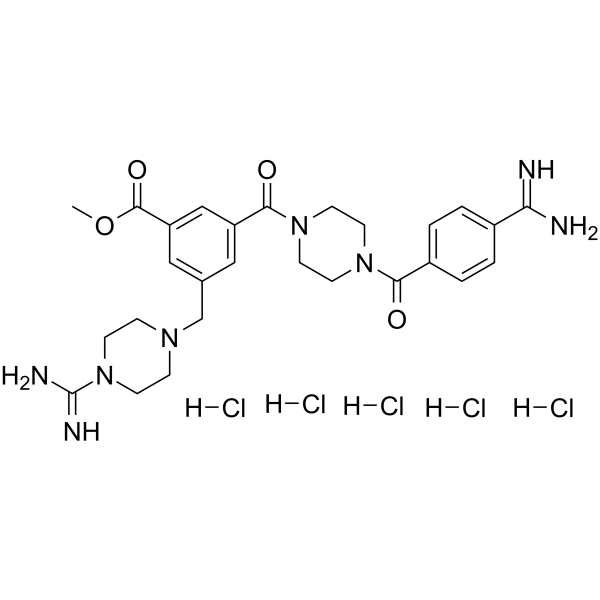
CBB1007 hydrochloride is a reversible and selective LSD1 inhibitor with an IC50 of 5.27 µM for human LSD1. CBB1007 hydrochloride significantly blocks the demethylase activity of LSD1 on H3K4Me2 and H3K4Me. CBB1007 hydrochloride shows selectivity for LSD1 over LSD2 or JARID1A, and induces differentiation-related genes in pluripotent cells. CBB1007 hydrochloride is studied in non-pluripotent cancer research, targeting teratocarcinoma, embryonic carcinoma, and seminoma.
Nos produits utilisent uniquement pour la recherche. Nous ne vendons pas aux patients.
- Pureté: 98.0%
- CAS No.: 2070014-96-7
- Formule: C27H39Cl5N8O4
- Masse moléculaire:716.91
-
Stockage:
4°C, sealed storage, away from moisture
* In solvent : -80°C, 6 months; -20°C, 1 month (sealed storage, away from moisture)

To place orders, for customer services and technical support, please contact: MedChemExpress USA
Tel: 609-228-6898 E-mail: [email protected] [email protected]


-
 Activité biologique
-
Chemical Information
- Pureté et documentation
- Références
-
 Help & FAQs



Publications Citing Use of MedChemExpress (MCE) CBB1007 hydrochloride
More Customer Validation & Images

-
WB


Activité biologique
|
KDM1/LSD1 5.27 μM (IC50) |
CBB1007 (0-100 μM; 30 h; F9) hydrochloride inhibits F9 cell growth[2].
CBB1007 (5-20 μM; 14 days; hESCs) hydrochloride increases lipid droplet formation in hESCs during adipogenesis[1].
CBB1007 (5-20 μM; 14 days; hESCs) hydrochloride reduces LSD1 and histone H3 levels while increasing H3K4me2 in human embryonic stem cells (hESCs)[1].
CBB1007 (5-20 μM; 14 days; hESCs) hydrochloride upregulates adipocyte marker genes PPARγ-2 and C/EBPα in hESCs[1].
CBB1007 (0.5-20 μM; 24 h; F9) hydrochloride activates the expression of CHRM4 and SCN3A genes[2].
CBB1007 (10 μM) hydrochloride significantly blocks the demethylase activity of LSD1 on mono- and di-methylated H3K4, but not tri-methylated H3K4 or di-methylated H3K9[2].
MedChemExpress (MCE) has not independently confirmed the accuracy of these methods. They are for reference only.
-
Cell Line:F9 cell
-
Concentration:1 μM, 5 μM, 10 μM, 50 μM, 100 μM
-
Incubation Time:30 h
-
Result:Cell growth was significantly inhibited.
-
Cell Line:hESCs
-
Concentration:5 μM, 10 μM, 20 μM
-
Incubation Time:14 days
-
Result:Lipid droplet density increased, and droplets fused due to high density.
-
Cell Line:hESCs
-
Concentration:5 μM, 10 μM, 20 μM
-
Incubation Time:14 days
-
Result:LSD1 and histone H3 expression decreased, while H3K4me2 levels increased with higher doses.
-
Cell Line:hESCs
-
Concentration:5 μM, 10 μM, 20 μM
-
Incubation Time:14 days
-
Result:PPARγ-2 and C/EBPα expression increased with increasing doses.
-
Cell Line:F9
-
Concentration:0.5 μM, 1 μM, 5 μM, 20 μM
-
Incubation Time:24 h
-
Result:The expression of CHRM4 and SCN3A genes were activated. And markedly induced the expression of genes for differentiation, such as FOXA2.


Chemical Information
-
CAS No. 2070014-96-7
-
Appearance Solid
-
Masse moléculaire 716.91
-
Formule C27H39Cl5N8O4
-
Color White to off-white
-
SMILES
[H]Cl.[H]Cl.[H]Cl.[H]Cl.[H]Cl.NC(N1CCN(CC1)CC2=CC(C(OC)=O)=CC(C(N3CCN(CC3)C(C4=CC=C(C=C4)C(N)=N)=O)=O)=C2)=N
-
Livraison
Room temperature in continental US; may vary elsewhere.
-
Stockage
4°C, sealed storage, away from moisture
* In solvent : -80°C, 6 months; -20°C, 1 month (sealed storage, away from moisture)


Publications (2)
-
Journal Impact Factor
-
Most Recent
-
Clin Exp Med
Corin: a dual inhibitor for KDM1A/HDAC1, suppresses hepatocellular carcinoma by triggering cuproptosis. [Abstract]2025 Nov 25;26(1):33. PMID: 41286164 -
BMC Neurosci
Mechanism of LSD1 in oxygen-glucose deprivation/reoxygenation-induced pyroptosis of retinal ganglion cells via the miR-21-5p/NLRP12 axis. [Abstract]2022 Nov 10;23(1):63. PMID: 36357913
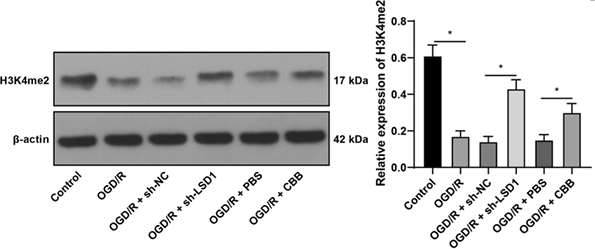
CBB1007 hydrochloride purchased from MedChemExpress. Usage Cited in: BMC Neurosci. 2022 Nov 10;23(1):63. [Abstract]
CBB1007 (CBB) elevates H3K4me2 expression in RGC-5 cells, after which miR-21-5p expression levels are increased .


Pureté et documentation
-
Fiche technique (277 KB)
-
SDS (252 KB)
- English - EN (252 KB)
- Français - FR (252 KB)
- Deutsch - DE (252 KB)
- Norwegian - NO (252 KB)
- Español - ES (252 KB)
- Swedish - SV (252 KB)
- Italian - IT (252 KB)
- Korean - KR (252 KB)
- Portuguese - PT (252 KB)
-
Instruction de manipulation (2659 KB)
Références
[1]. Xiong Y, et al. Inhibition of Lysine-Specific Demethylase-1 (LSD1/KDM1A) Promotes the Adipogenic Differentiation of hESCs Through H3K4 Methylation. Stem Cell Rev Rep. 2016;12(3):298-304. [Content Brief]
[2]. Wang J, et al. Novel histone demethylase LSD1 inhibitors selectively target cancer cells with pluripotent stem cell properties. Cancer Res. 2011;71(23):7238-7249. [Content Brief]

Calculators
Concentration (start) × Volume (start) = Concentration (final) × Volume (final)


CBB1007 hydrochloride Related Classifications
HY-15313B Related Classifications
 Powered by Bioz
- CBB1007
- 2070014-96-7
- CBB 1007
- CBB-1007
- Histone Demethylase
- Adipogenesis
- LSD1 protein level
- hESCs
- ovarian tumors
- embryonic stem cells
- FIGO stage
- LSD1 mRNA overexpression
- seminoma
- ovarian cancer cell lines
- H3K4 methylation
- Histone modification
- transcriptomic signature
- cytotoxicity
- cancer-selective
- LSD1 inhibitors
- teratocarcinoma
- MTS/PMS assay
- LSD1
- Sox2
- embryonic carcinoma
- RNA interference
- epigenetic targets
- chemical inhibition
- pluripotent cancer cells
- Oct4
- histone demethylase
- Inhibitor
- inhibitor
- inhibit