



Lotusine hydroxide

Based on 1 Customer Validation
Lotusine hydroxide is an orally active signaling pathway modulator and enzyme inhibitor, with an IC50 of 30.60 μg/mL against α-amylase and an IC50 of 36.15 μg/mL against α-glucosidase. Lotusine hydroxide inhibits the EGFR-Akt-ERK signaling pathway by reducing the levels of phosphorylated EGFR, Akt and ERK. Lotusine hydroxide induces apoptosis, triggers G0/G1 cell cycle arrest and inhibits cancer cell proliferation. Lotusine hydroxide reduces lipid peroxidation and increases the activities of SOD, CAT and GPx. Lotusine hydroxide is applicable to researches related to non-small cell lung cancer, type 2 diabetes and autism spectrum disorder.
Nos produits utilisent uniquement pour la recherche. Nous ne vendons pas aux patients.
- Pureté: 99.56%
- CAS No.: 3721-76-4
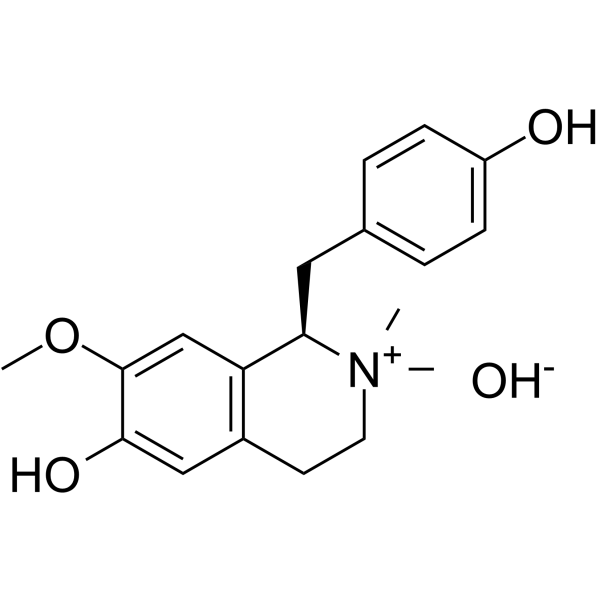
- Formule: C19H25NO4
- Masse moléculaire:331.41
-
Stockage:
4°C, sealed storage, away from moisture and light
* In solvent : -80°C, 6 months; -20°C, 1 month (sealed storage, away from moisture and light)

To place orders, for customer services and technical support, please contact: MedChemExpress USA
Tel: 609-228-6898 E-mail: [email protected] [email protected]


-
 Activité biologique
-
Chemical Information
-
Solvant et solubilité
- Pureté et documentation
- Références
-
 Help & FAQs
-

Metabolism/Protease Compound Library
HY-L012
-
Natural Product Library
HY-L021
-
Anti-Aging Compound Library
HY-L034
-
Anti-diabetic Compound Library
HY-L040
-
Oxygen Sensing Compound Library
HY-L045
-
Anti-Cardiovascular Disease Compound Library
HY-L046
-
Ferroptosis Compound Library
HY-L051
-
Medicine Food Homology Compound Library
HY-L055
-
Phenols Library
HY-L057
-
Alkaloids Library
HY-L071
-
Anti-Lung Cancer Compound Library
HY-L075
-
Plant-Sourced Natural Product Library
HY-L115
-
Human Metabolite Library
HY-L123
-
Metabolic Enzyme Compound Library
HY-L146
-
Bioactive Compound Library Max
HY-L181
-
MCE Bioactive Compound Library
HY-L001V
-
Natural Product Library Plus
HY-L021P
-
Natural Product and Natural Product-Like Compound Library
HY-L021M
-
Bioactive Compound Library
HY-L001
-
RO5 Drug-like Natural Product Library
HY-L200
-
High-Throughput Bioactive Compound Library
HY-L205
-
High-Throughput Natural Product Library
HY-L206
-
Mass Spectrometry Human Metabolite Library
HY-L215
-
Natural Product Diversity Scaffold Library
HY-L245
-
Mass Spectrometry Natural Product Library
HY-L262




Activité biologique
Lotusine hydroxide (2, 4, 10 μM; 24, 48, 72 h) potently inhibits proliferation of EGFR-mutant HCC827 NSCLC cells and EGFR-wildtype A549 NSCLC cells in time- and concentration-dependent manners, with stronger activity against HCC827 cells (73% inhibition at 10 μM for 72 h)[1].
Lotusine hydroxide (2.5, 5, 10 μM; 24 h) induces concentration-dependent apoptosis in EGFR-mutant HCC827 NSCLC cells, with 80% of cells undergoing apoptosis at 10 μM for 24 h[1].
Lotusine hydroxide (2.5, 5, 10 μM; 24 h) disrupts mitochondrial membrane potential in EGFR-mutant HCC827 NSCLC cells in a concentration-dependent manner, as evidenced by reduced JC-1 fluorescence ratios at 2.5, 5, and 10 μM for 24 h[1].
Lotusine hydroxide (2.5, 5, 10 μM; 72 h) induces concentration-dependent G0/G1 phase cell cycle arrest in EGFR-mutant HCC827 NSCLC cells, halting progression into the DNA synthesis phase[1].
Lotusine hydroxide (2.5, 5, 10 μM; 24 h) inhibits the EGFR-Akt-ERK signaling pathway in EGFR-mutant HCC827 NSCLC cells in vitro in a concentration-dependent manner, reducing p-EGFR, p-Akt, and p-ERK levels most significantly at 10 μM for 24 h[1].
Lotusine hydroxide (25-50 μM; 48-72 h) does not significantly reduce the viability of HepG2 cells when administered alone or in combination with 25 mM D-glucose, maintaining 85-90% cell viability[2].
Lotusine hydroxide (25-50 μM; 48-72 h, co-treated with 25 mM D-glucose) reverses hyperglycemia-induced reductions in SOD, CAT, and GPx antioxidant enzyme activities and lowers elevated MDA levels in HepG2 cells[2].
Lotusine hydroxide (1.56-200 μg/mL; 10 min) inhibits alpha-amylase activity with an IC50 of 30.60 μg/mL, and achieves 80.36% inhibition at a concentration of 200 μg/mL in a cell-free biochemical assay[2].
Lotusine hydroxide (1.56-200 μg/mL; 20 min) inhibits alpha-glucosidase activity with an IC50 of 36.15 μg/mL, and achieves 82.6% inhibition at a concentration of 200 μg/mL in a cell-free biochemical assay[2].
Lotusine hydroxide (10-1000 μM; 24 h) exhibits low cytotoxicity in H9c2 cells, with an IC50 of 701 μM, and concentrations of 10, 50, and 100 μM maintain cell viability near control levels[3].
Lotusine hydroxide (10-100 μM) enhances endogenous antioxidant (SOD, CAT, GSH) levels in H9c2 cells exposed to doxorubicin, supporting protection against oxidative stress[3].
Lotusine hydroxide (10-100 μM) significantly reduces doxorubicin-induced lipid peroxidation in H9c2 cells, with 50 μM showing the greatest reduction[3].
Lotusine hydroxide (10-50 μM; 24 h pretreatment) prevents doxorubicin-induced morphological and nuclear abnormalities in H9c2 cells[3].
Lotusine hydroxide (10-50 μM) completely inhibits doxorubicin-induced ROS generation in H9c2 cells[3].
Lotusine hydroxide (10-50 μM) modulates apoptotic gene expression in H9c2 cells exposed to doxorubicin, upregulating Bcl-2 and downregulating Bax and Cas-3 to inhibit apoptosis[3].
Lotusine hydroxide (10-50 μM; 24 h pretreatment) reduces doxorubicin-induced caspase-3/7 activity in H9c2 cells, with 50 μM showing activity comparable to control cells[3].
Lotusine hydroxide (50 μM; 3 h) directly interacts with and stabilizes DRD1 protein in PC12 cells[4].
Lotusine hydroxide (3.12-25 μM; 48 h following 1 h 38 mM PPA pretreatment) protects PC12 cells against PPA-induced cytotoxicity[4].
MedChemExpress (MCE) has not independently confirmed the accuracy of these methods. They are for reference only.
-
Cell Line:human EGFR-mutant HCC827 NSCLC cells, human EGFR-wildtype A549 NSCLC cells
-
Concentration:2.5, 5, 10 μM
-
Incubation Time:24 h, 48 h, 72 h
-
Result:Inhibited approximately 73% of HCC827 cell proliferation at 10 μM for 72 h.
Inhibited approximately 52% of A549 cell proliferation at 10 μM for 72 h.
Exhibited time- and concentration-dependent inhibitory effects on both cell lines, with more pronounced activity in HCC827 cells.
-
Cell Line:human EGFR-mutant HCC827 NSCLC cells
-
Concentration:2.5 μM (24 h); 5 μM (24 h); 10 μM (24 h)
-
Incubation Time:24 h (2.5 μM); 24 h (5 μM); 24 h (10 μM)
-
Result:Induced a substantial increase in apoptosis relative to untreated cells at 2.5 μM for 24 h.
Induced apoptosis in more than 50% of HCC827 cells at 5 μM for 24 h.
Induced apoptosis in approximately 80% of HCC827 cells at 10 μM for 24 h.
-
Cell Line:human EGFR-mutant HCC827 NSCLC cells
-
Concentration:2.5 μM (72 h); 5 μM (72 h); 10 μM (72 h)
-
Incubation Time:72 h (2.5 μM); 72 h (5 μM); 72 h (10 μM)
-
Result:Increased the proportion of cells in the G0/G1 phase in a concentration-dependent manner.
Decreased the S and G2/M phase cell populations in a concentration-dependent manner.
-
Cell Line:human EGFR-mutant HCC827 NSCLC cells
-
Concentration:2.5 μM (24 h); 5 μM (24 h); 10 μM (24 h)
-
Incubation Time:24 h (2.5 μM); 24 h (5 μM); 24 h (10 μM)
-
Result:Reduced phosphorylated EGFR (p-EGFR) levels in a concentration-dependent manner.
Reduced phosphorylated Akt (p-Akt) levels in a concentration-dependent manner.
Reduced phosphorylated ERK (p-ERK) levels in a concentration-dependent manner.
Showed the highest inhibitory activity at 10 μM for 24 h.
-
Cell Line:HepG2 cells
-
Concentration:25 μM (alone; combined with 25 mM D-glucose); 50 μM (alone; combined with 25 mM D-glucose)
-
Incubation Time:48 h (25 μM alone; 25 μM + 25 mM D-glucose); 72 h (50 μM alone; 50 μM + 25 mM D-glucose)
-
Result:Maintained 85-90% of HepG2 cell viability.
Showed no significant reduction in viability relative to control cells.
-
Cell Line:H9c2
-
Concentration:10, 50, 100, 250, 500, 1000 μM
-
Incubation Time:24 h
-
Result:Exhibited an IC50 value of 701 μM.
Maintained cell viability near control levels at 10, 50, and 100 μM.
Caused significant decreases in cell viability at concentrations from 250 to 1000 μM.
-
Cell Line:H9c2
-
Concentration:10, 50, 100 μM (pretreated prior to doxorubicin exposure)
-
Incubation Time:24 h (pretreatment); 24 h (doxorubicin exposure)
-
Result:Maintained cell viability near control levels at 10 μM.
Induced cell proliferation at 50 μM, with viability values of 118.53 % (SRB assay) and 110.36 % (MTT assay).
Caused significantly reduced cell viability at 100 μM (84.41% in SRB assay, 79.84 % in MTT assay).
-
Cell Line:rat pheochromocytoma PC12 cells
-
Concentration:6.25 μM
-
Incubation Time:48 h (following 1 h 38 mM PPA pretreatment)
-
Result:Restored PPA-induced reductions in DRD1, c-fos, GluA1, p-GluA1 Ser 845, and p-GluA1 Ser 831 protein levels.
Had its rescue effect abolished when co-treated with the DRD1 antagonist SCH23390.
Lotusine hydroxide (5-20 mg/kg; p.o.; daily; 5 days) ameliorates propionic acid-induced ASD-like social deficits and cognitive impairments in mice, with 10 and 20 mg/kg doses also restoring mPFC neuronal activity and AMPA receptor function via upregulation of c-fos and phosphorylated GluA1 levels[4].
MedChemExpress (MCE) has not independently confirmed the accuracy of these methods. They are for reference only.
-
Animal Model:Wistar (Sprague Dawley) (male, 160 ± 20 g, streptozotocin-induced diabetes mellitus)[2]
-
Dosage:50 mg/kg bw
-
Administration:diet supplementation; daily; 4 weeks
-
Result:Restored serum, liver, and pancreatic vitamin C and E concentrations to near-normal values (liver vitamin C: 160 mg/100g; liver vitamin E: 2990 mg/100g).
Increased liver cell protein content to 11.6 mg/g.
Enhanced body weight gain by 45% compared to untreated diabetic rats (final body weight: 225.5 g; body weight gain: 65.3 g).
Reduced feed conversion ratio to 1.45, matching the ratio of non-diabetic control rats.
Lowered relative organ weight to 2.49%, a level comparable to non-diabetic control rats.
Maintained 100% survival rate.
-
Animal Model:C57BL/6J (male, 6-8 weeks old, 20 ± 2 g, intracerebroventricular injection of propionic acid to induce ASD-like behavior)[4]
-
Dosage:5 mg/kg; 10 mg/kg; 20 mg/kg
-
Administration:p.o.; daily; 5 days
-
Result:Significantly increased interaction time with a stranger mouse in the sociability test and with a novel stranger mouse in the social novelty test reversing PPA-induced social deficits.
Significantly increased the percentage of spontaneous alternations in the Y-maze test.
Significantly reversed the PPA-induced reduction in miniature excitatory postsynaptic current frequency in the medial prefrontal cortex at 10 mg/kg, with no effect on amplitude.
Significantly increased c-fos protein levels in the mPFC, reversing PPA-induced reductions.
Reversed PPA-induced reductions in p-GluA1 Ser845 protein levels in the mPFC; reversed PPA-induced reductions in p-GluA1 Ser831 protein levels in the mPFC .


Chemical Information
-
CAS No. 3721-76-4
-
Appearance Solid
-
Masse moléculaire 331.41
-
Formule C19H25NO4
-
Color White to off-white
-
SMILES
C[N+]1(C)[C@H](CC2=CC=C(O)C=C2)C3=C(C=C(O)C(OC)=C3)CC1.[OH-]
-
Structure Classification
-
Initial Source
-
Livraison
Room temperature in continental US; may vary elsewhere.
-
Stockage
4°C, sealed storage, away from moisture and light
* In solvent : -80°C, 6 months; -20°C, 1 month (sealed storage, away from moisture and light)


Solvant et solubilité
DMSO : 33.33 mg/mL (100.57 mM; ultrasonic and warming and heat to 60°C; Hygroscopic DMSO has a significant impact on the solubility of product, please use newly opened DMSO)
Please refer to the solubility information to select the appropriate solvent. Once prepared, please aliquot and store the solution to prevent product inactivation from repeated freeze-thaw cycles.
Storage method and period of stock solution: -80°C, 6 months; -20°C, 1 month (sealed storage, away from moisture and light). When stored at -80°C, please use it within 6 months. When stored at -20°C, please use it within 1 month.
Please refer to the solubility information to select the appropriate solvent. Once prepared, please aliquot and store the solution to prevent product inactivation from repeated freeze-thaw cycles.
Storage method and period of stock solution: -80°C, 6 months; -20°C, 1 month (sealed storage, away from moisture and light). When stored at -80°C, please use it within 6 months. When stored at -20°C, please use it within 1 month.
Concentration (start) × Volume (start) = Concentration (final) × Volume (final)


Pureté et documentation
-
Fiche technique (292 KB)
-
SDS (252 KB)
- English - EN (252 KB)
- Français - FR (252 KB)
- Deutsch - DE (252 KB)
- Norwegian - NO (252 KB)
- Español - ES (252 KB)
- Swedish - SV (252 KB)
- Italian - IT (252 KB)
- Korean - KR (252 KB)
- Portuguese - PT (252 KB)
-
Instruction de manipulation (2659 KB)
Références
[1]. Lan Y, et al. Anti-lung cancer activity of lotusine in non-small cell lung cancer HCC827 via reducing proliferation, oxidative stress, induction of apoptosis, and G0/G1 cell cycle arrest via suppressing EGFR-Akt-ERK signalling. In Vitro Cell Dev Biol Anim. 2025;61(4):450-458. [Content Brief]
[3]. Harishkumar R, et al. Lotusine, an alkaloid from Nelumbo nucifera (Gaertn.), attenuates doxorubicin-induced toxicity in embryonically derived H9c2 cells. In Vitro Cell Dev Biol Anim. 2020;56(5):367-377. [Content Brief]
[4]. Liu QQ, et al. Lotusine ameliorates propionic acid-induced autism spectrum disorder-like behavior in mice by activating D1 dopamine receptor in medial prefrontal cortex. Phytother Res. 2024;38(2):1089-1103. [Content Brief]
[5]. Le Crouéour G, et al. Lotusine G: a new cyclopeptide alkaloid from Zizyphus lotus. Fitoterapia. 2002;73(1):63-68. [Content Brief]


Complete Stock Solution Preparation Table
Please refer to the solubility information to select the appropriate solvent. Once prepared, please aliquot and store the solution to prevent product inactivation from repeated freeze-thaw cycles.
Storage method and period of stock solution: -80°C, 6 months; -20°C, 1 month (sealed storage, away from moisture and light). When stored at -80°C, please use it within 6 months. When stored at -20°C, please use it within 1 month.
| Optional Solvent | Concentration Solvent Mass | 1 mg | 5 mg | 10 mg | 25 mg |
|---|---|---|---|---|---|
| DMSO | 1 mM | 3.0174 mL | 15.0871 mL | 30.1741 mL | 75.4353 mL |
| 5 mM | 0.6035 mL | 3.0174 mL | 6.0348 mL | 15.0871 mL | |
| 10 mM | 0.3017 mL | 1.5087 mL | 3.0174 mL | 7.5435 mL | |
| 15 mM | 0.2012 mL | 1.0058 mL | 2.0116 mL | 5.0290 mL | |
| 20 mM | 0.1509 mL | 0.7544 mL | 1.5087 mL | 3.7718 mL | |
| 25 mM | 0.1207 mL | 0.6035 mL | 1.2070 mL | 3.0174 mL | |
| 30 mM | 0.1006 mL | 0.5029 mL | 1.0058 mL | 2.5145 mL | |
| 40 mM | 0.0754 mL | 0.3772 mL | 0.7544 mL | 1.8859 mL | |
| 50 mM | 0.0603 mL | 0.3017 mL | 0.6035 mL | 1.5087 mL | |
| 60 mM | 0.0503 mL | 0.2515 mL | 0.5029 mL | 1.2573 mL | |
| 80 mM | 0.0377 mL | 0.1886 mL | 0.3772 mL | 0.9429 mL | |
| 100 mM | 0.0302 mL | 0.1509 mL | 0.3017 mL | 0.7544 mL |


Lotusine hydroxide Related Classifications
HY-N4309A Related Classifications
 Powered by Bioz