



Nardoguaianone K
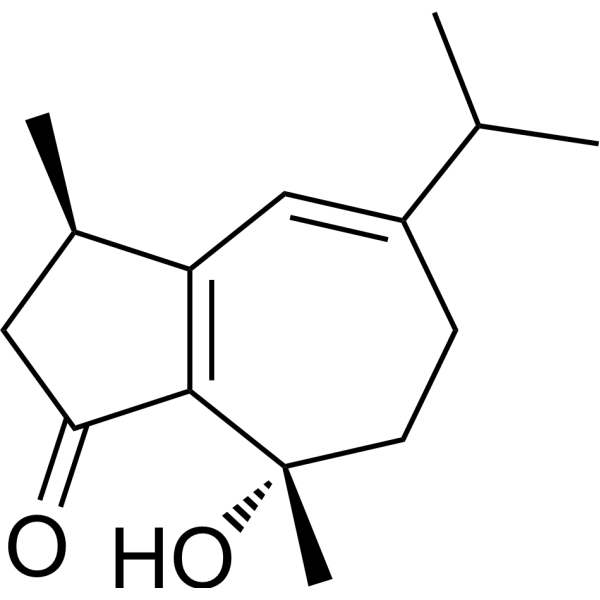
Nardoguaianone K, a guaiane-type compound, can be isolated from Nardostachys chinensis roots. Nardoguaianone K cam be used in the research of pancreatic cancer.
Nos produits utilisent uniquement pour la recherche. Nous ne vendons pas aux patients.
- Pureté: 99.58%
- CAS No.: 443128-65-2
- Formule: C15H22O2
- Masse moléculaire:234.33
-
Stockage:
-20°C, protect from light
* In solvent : -80°C, 6 months; -20°C, 1 month (protect from light)

To place orders, for customer services and technical support, please contact: MedChemExpress USA
Tel: 609-228-6898 E-mail: [email protected] [email protected]


-
 Activité biologique
-
Chemical Information
- Pureté et documentation
- Références
-
 Help & FAQs





Activité biologique
Nardoguaianone K (72 h) shows remarkable cytotoxicity against SW1990 cell and CFPAC-1 cell[2].
MedChemExpress (MCE) has not independently confirmed the accuracy of these methods. They are for reference only.
-
Cell Line:SW1990 and CFPAC-1 cell
-
Concentration:0-20 μM approxiamately
-
Incubation Time:72 h
-
Result:Inhibited SW1990 cell and CFPAC-1 cell viability, with IC50 values of 4.82 μM and 15.85 μM respectively.


Chemical Information
-
CAS No. 443128-65-2
-
Appearance Liquid
-
Masse moléculaire 234.33
-
Formule C15H22O2
-
Color Colorless to light yellow
-
SMILES
C[C@]1(C2=C([C@@H](CC2=O)C)C=C(CC1)C(C)C)O
-
Synonyms
10-epi-Nardoguaianone J
-
Structure Classification
-
Initial Source
-
Livraison
Room temperature in continental US; may vary elsewhere.
-
Stockage
-20°C, protect from light
* In solvent : -80°C, 6 months; -20°C, 1 month (protect from light)


Pureté et documentation
-
Fiche technique (276 KB)
-
SDS (252 KB)
- English - EN (252 KB)
- Français - FR (252 KB)
- Deutsch - DE (252 KB)
- Norwegian - NO (252 KB)
- Español - ES (252 KB)
- Swedish - SV (252 KB)
- Italian - IT (252 KB)
- Korean - KR (252 KB)
- Portuguese - PT (252 KB)
-
Instruction de manipulation (2659 KB)
Références
[1]. Tanitsu MA, et al. Guaiane- and aristolane-type sesquiterpenoids of Nardostachys chinensis roots. Phytochemistry. 2002 Apr;59(8):845-9. [Content Brief]
[2]. Ma LM, et al. Terpenoids from Nardostachys jatamansi and their cytotoxic activity against human pancreatic cancer cell lines. Phytochemistry. 2022 Aug;200:113228. [Content Brief]

Calculators
Concentration (start) × Volume (start) = Concentration (final) × Volume (final)


Nardoguaianone K Related Classifications
HY-N10588 Related Classifications
 Powered by Bioz