



CRF, bovine TFA
Based on 2 publication(s) in Google Scholar
CRF, bovine (TFA) is a potent agonist of CRF receptor, and displaces [125I-Tyr]ovine CRF with a Ki of 3.52 nM.
For research use only. We do not sell to patients.
- Purity : 98.25%
- Formula: C206H340N60O63S.xC2HF3O2
- Molecular Weight:4697.34 (free base)
-
Storage:
Sealed storage, away from moisture.
Powder -80°C, 2 years , -20°C, 1 year* In solvent : -80°C, 6 months; -20°C, 1 month (sealed storage, away from moisture)

To place orders, for customer services and technical support, please contact: MedChemExpress USA
Tel: 609-228-6898 E-mail: [email protected] [email protected]


-
 Biological Activity
-
Chemical Information
-
Solvent & Solubility
- Purity & Documentation
- References
-
 Help & FAQs


Publications Citing Use of MedChemExpress (MCE) CRF, bovine TFA
More

Biological Activity
Description
IC50 & Target
Ki: 3.52 nM (CRF receptor)[1].
In Vitro
CRF, bovine is a potent agonist of CRF receptor, and displaces [125I-Tyr]ovine CRF with a Ki of 3.52 nM[1]. CRF shows pEC50s of 11.16, 8.53 and 8.70 for human CRF1, human CRF2 and rat CRF2α[2]. CRF is released from hypothalamic-pituitary-adrenal (HPA) axis induced by stress, and leads to production of glucocorticoids which down regulate immune responses. CRF also has proinflammatory effects. CRF affects brain microvessel endothelial cells (BMEC) structure or function, CRF (100 nM) significantly increases cAMP in BMEC[3].
MedChemExpress (MCE) has not independently confirmed the accuracy of these methods. They are for reference only. .


Chemical Information
-
Appearance Solid
-
Molecular Weight 4697.34 (free base)
-
Formula C206H340N60O63S.xC2HF3O2
-
Color White to off-white
-
Synonyms
Corticotropin Releasing Factor bovine TFA
-
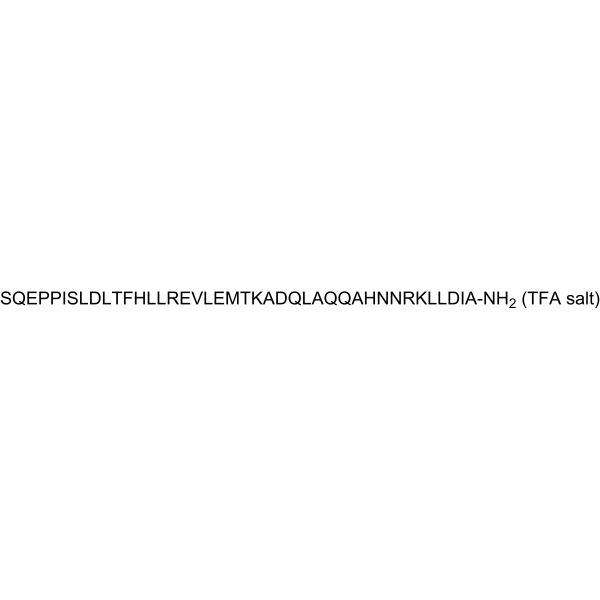
Sequence
Ser-Gln-Glu-Pro-Pro-Ile-Ser-Leu-Asp-Leu-Thr-Phe-His-Leu-Leu-Arg-Glu-Val-Leu-Glu-Met-Thr-Lys-Ala-Asp-Gln-Leu-Ala-Gln-Gln-Ala-His-Asn-Asn-Arg-Lys-Leu-Leu-Asp-Ile-Ala-NH2
-
Sequence Shortening
SQEPPISLDLTFHLLREVLEMTKADQLAQQAHNNRKLLDIA-NH2
-
Shipping
Room temperature in continental US; may vary elsewhere.
-
Storage
Sealed storage, away from moisture
Powder -80°C 2 years -20°C 1 year * In solvent : -80°C, 6 months; -20°C, 1 month (sealed storage, away from moisture)


Publications (2)
-
Journal Impact Factor
-
Most Recent
-
Sci Adv
Hyperexcitation of ovBNST CRF neurons during stress contributes to female-biased expression of anxiety-like avoidance behaviors. [Abstract]2024 May 10;10(19):eadk7636. PMID: 38728397 -
Pain
Mast cell corticotropin-releasing factor receptor 1 contributes to pancreatic cancer pain via mitogen-activated protein kinase/sphingosine kinases type 1 signaling. [Abstract]2026 Apr 1;167(4):962-975. PMID: 41615309


Solvent & Solubility
In Vitro:
DMSO : 50 mg/mL (Need ultrasonic; Hygroscopic DMSO has a significant impact on the solubility of product, please use newly opened DMSO)
H2O : 25 mg/mL (Need ultrasonic)


Purity & Documentation
-
Data Sheet (269 KB)
-
SDS (252 KB)
- English - EN (252 KB)
- Français - FR (252 KB)
- Deutsch - DE (252 KB)
- Norwegian - NO (252 KB)
- Español - ES (252 KB)
- Swedish - SV (252 KB)
- Italian - IT (252 KB)
- Korean - KR (252 KB)
- Portuguese - PT (252 KB)
-
Handling Instructions (2659 KB)
References
[1]. CRF, bovine is a potent agonist of CRF receptor, and displaces [125I-Tyr]ovine CRF with a Ki of 3.52 nM[1]. CRF shows pEC50s of 11.16, 8.53 and 8.70 for human CRF1, human CRF2 and rat CRF2α[2]. CRF is released from hypothalamic-pituitary-adrenal (HPA) axis induced by stress, and leads to production of glucocorticoids which down regulate immune responses. CRF also has proinflammatory effects. CRF affects brain microvessel endothelial cells (BMEC) structure or function, CRF (100 nM) significantly increases cAMP in BMEC[3]. [Content Brief]
[2]. Smart D, et al. Characterisation using microphysiometry of CRF receptor pharmacology. Eur J Pharmacol. 1999 Aug 27;379(2-3):229-35. [Content Brief]
[3]. Esposito P, et al. Corticotropin-releasing factor (CRF) can directly affect brain microvessel endothelial cells. Brain Res. 2003 Apr 11;968(2):192-8. [Content Brief]

Calculators
Concentration (start) × Volume (start) = Concentration (final) × Volume (final)


CRF, bovine TFA Related Classifications
HY-P1533A Related Classifications
 Powered by Bioz