



Cys-LT7

Based on 1 Customer Validation
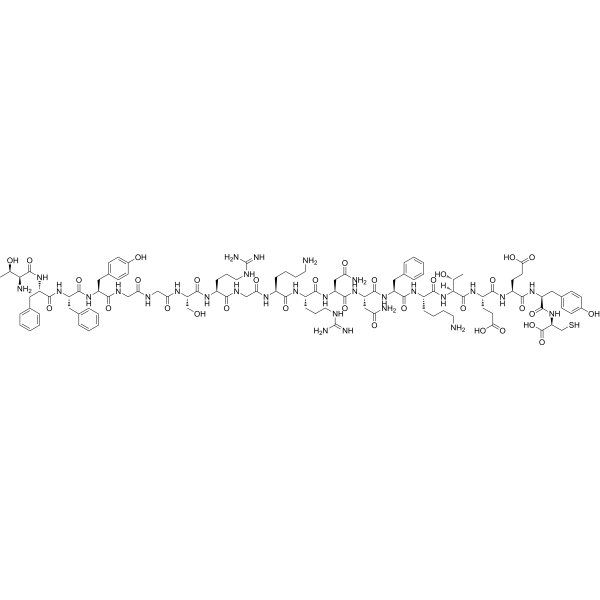
Cys-LT7 is a transferrin receptor (TfR)-targeting peptide ligand. Cys-LT7 binds to a TfR site distinct from endogenous transferrin, mediates conjugated Doxorubicin (HY-15142A) delivery to TfR-overexpressed tumor cells, and exhibits low toxicity to TfR-low-expressed normal cells. Cys-LT7 is an L-configuration peptide susceptible to proteolytic enzymes, leading to poor biostability in peptide-drug conjugates. Cys-LT7 can be used for the research of glioblastoma, hepatocellular carcinoma, lung carcinoma.
For research use only. We do not sell to patients.
- Purity : 99.90%
- CAS No.: 1254540-73-2
- Formula: C44H65N15O10S
- Molecular Weight:996.15
-
Storage:
Sealed storage, away from moisture.
Powder -80°C, 2 years , -20°C, 1 year* In solvent : -80°C, 6 months; -20°C, 1 month (sealed storage, away from moisture)


To place orders, for customer services and technical support, please contact: MedChemExpress USA
Tel: 609-228-6898 E-mail: [email protected] [email protected]


-
 Biological Activity
-
Chemical Information
-
Solvent & Solubility
- Protocols
- Purity & Documentation
- References
-
 Help & FAQs




Biological Activity
Description
In Vitro
Cys-LT7 conjugated with Doxorubicin exhibits poor serum stability in mouse serum, with a half-life of 0.37 h and nearly complete degradation by 1 h[1].
Cys-LT7 conjugated with Doxorubicin undergoes rapid reduction-triggered degradation in 5 mM GSH (complete degradation by 1 h, T1/2 = 0.26 h) and slower degradation in 5 µM GSH (71.4% intact after 24 h)[1].
Cys-LT7 conjugated with Doxorubicin is selectively taken up into the cytoplasm of TfR-overexpressed A549, HepG2, and U87 tumor cells (with time-dependent uptake) but shows minimal uptake into TfR-low-expressed LO2 normal cells[1].
Cys-LT7 conjugated with Doxorubicin exhibits weak in vitro antiproliferative activity against TfR-overexpressed U87, HepG2, and A549 tumor cells, with higher cell viability maintained even at an equivalent Doxorubicin concentration of 40 µM after 48 h of incubation[1].
MedChemExpress (MCE) has not independently confirmed the accuracy of these methods. They are for reference only.


Chemical Information
-
CAS No. 1254540-73-2
-
Appearance Solid
-
Molecular Weight 996.15
-
Formula C44H65N15O10S
-
Color White to off-white
-
Sequence
Cys-His-Ala-Ile-Tyr-Pro-Arg-His
-
Sequence Shortening
CHAIYPRH
-
Shipping
Room temperature in continental US; may vary elsewhere.
-
Storage
Sealed storage, away from moisture
Powder -80°C 2 years -20°C 1 year * In solvent : -80°C, 6 months; -20°C, 1 month (sealed storage, away from moisture)


Solvent & Solubility
In Vitro:
H2O : ≥ 100 mg/mL (100.39 mM)
* "≥" means soluble, but saturation unknown.
Please refer to the solubility information to select the appropriate solvent. Once prepared, please aliquot and store the solution to prevent product inactivation from repeated freeze-thaw cycles.
Storage method and period of stock solution: -80°C, 6 months; -20°C, 1 month (sealed storage, away from moisture). When stored at -80°C, please use it within 6 months. When stored at -20°C, please use it within 1 month.
* Note: If you choose water as the stock solution, please dilute it to the working solution, then filter and sterilize it with a 0.22 μm filter before use.
Please refer to the solubility information to select the appropriate solvent. Once prepared, please aliquot and store the solution to prevent product inactivation from repeated freeze-thaw cycles.
Storage method and period of stock solution: -80°C, 6 months; -20°C, 1 month (sealed storage, away from moisture). When stored at -80°C, please use it within 6 months. When stored at -20°C, please use it within 1 month.
* Note: If you choose water as the stock solution, please dilute it to the working solution, then filter and sterilize it with a 0.22 μm filter before use.
Concentration (start) × Volume (start) = Concentration (final) × Volume (final)


Purity & Documentation
-
Data Sheet (279 KB)
-
SDS (254 KB)
- English - EN (254 KB)
- Français - FR (254 KB)
- Deutsch - DE (254 KB)
- Norwegian - NO (254 KB)
- Español - ES (254 KB)
- Swedish - SV (254 KB)
- Italian - IT (254 KB)
- Korean - KR (254 KB)
- Portuguese - PT (254 KB)
-
Handling Instructions (2659 KB)
References


Complete Stock Solution Preparation Table
Please refer to the solubility information to select the appropriate solvent. Once prepared, please aliquot and store the solution to prevent product inactivation from repeated freeze-thaw cycles.
Storage method and period of stock solution: -80°C, 6 months; -20°C, 1 month (sealed storage, away from moisture). When stored at -80°C, please use it within 6 months. When stored at -20°C, please use it within 1 month.
| Optional Solvent | Concentration Solvent Mass | 1 mg | 5 mg | 10 mg | 25 mg |
|---|---|---|---|---|---|
| H2O | 1 mM | 1.0039 mL | 5.0193 mL | 10.0386 mL | 25.0966 mL |
| 5 mM | 0.2008 mL | 1.0039 mL | 2.0077 mL | 5.0193 mL | |
| 10 mM | 0.1004 mL | 0.5019 mL | 1.0039 mL | 2.5097 mL | |
| 15 mM | 0.0669 mL | 0.3346 mL | 0.6692 mL | 1.6731 mL | |
| 20 mM | 0.0502 mL | 0.2510 mL | 0.5019 mL | 1.2548 mL | |
| 25 mM | 0.0402 mL | 0.2008 mL | 0.4015 mL | 1.0039 mL | |
| 30 mM | 0.0335 mL | 0.1673 mL | 0.3346 mL | 0.8366 mL | |
| 40 mM | 0.0251 mL | 0.1255 mL | 0.2510 mL | 0.6274 mL | |
| 50 mM | 0.0201 mL | 0.1004 mL | 0.2008 mL | 0.5019 mL | |
| 60 mM | 0.0167 mL | 0.0837 mL | 0.1673 mL | 0.4183 mL | |
| 80 mM | 0.0125 mL | 0.0627 mL | 0.1255 mL | 0.3137 mL | |
| 100 mM | 0.0100 mL | 0.0502 mL | 0.1004 mL | 0.2510 mL |
* Note: If you choose water as the stock solution, please dilute it to the working solution, then filter and sterilize it with a 0.22 μm filter before use.


Cys-LT7 Related Classifications
HY-P11099 Related Classifications
 Powered by Bioz