



Devazepide
Based on 6 publication(s) in Google Scholar
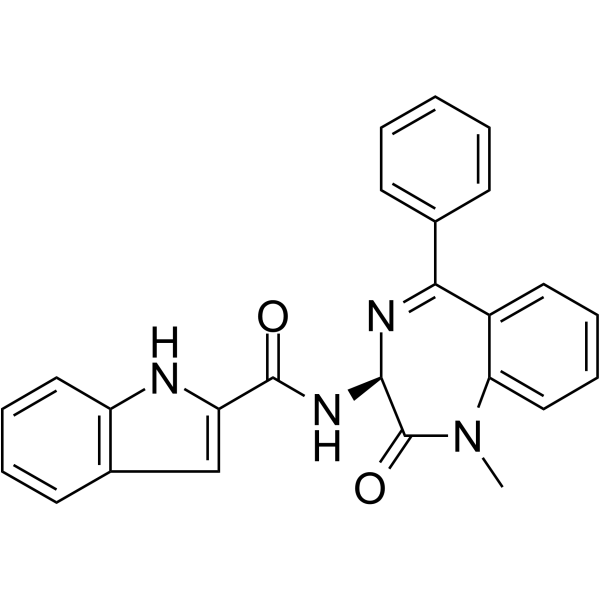
Devazepide (L-364,718) is a potent, competitive, selective and orally active nonpeptide antagonist of cholecystokinin (CCK) receptor, with IC50s of 81 pM, 45 pM and 245 nM for rat pancreatic, bovine gallbladder and guinea pig brain CCK receptors, respectively. Devazepide (L-364,718) is effective for gastrointestinal disorders.
For research use only. We do not sell to patients.
- Purity: 99.55%
- CAS No.: 103420-77-5
- Formula: C25H20N4O2
- Molecular Weight:408.45
-
Storage:
-20°C, sealed storage, away from moisture and light
* In solvent : -80°C, 6 months; -20°C, 1 month (sealed storage, away from moisture and light)

To place orders, for customer services and technical support, please contact: MedChemExpress USA
Tel: 609-228-6898 E-mail: [email protected] [email protected]


-
 Biological Activity
-
Chemical Information
-
Solvent & Solubility
- Purity & Documentation
- References
-
 Help & FAQs
-


Bioactive Compound Library Max
HY-L181
-
Bioactive Compound Library
HY-L001
-
GPCR/G Protein Compound Library
HY-L006
-
Neuronal Signaling Compound Library
HY-L013
-
Neurotransmitter Receptor Compound Library
HY-L062
-
Human Metabolite Library
HY-L123
-
Membrane Protein-targeted Compound Library
HY-L149
-
Membrane Receptor-targeted Compound Library
HY-L150
-
Mitochondrial Toxicity Compound Library
HY-L155
-
Highly Selective Inhibitors Library
HY-L158
-
MCE Bioactive Compound Library
HY-L001V
-
High-Throughput Bioactive Compound Library
HY-L205
-
Mass Spectrometry Human Metabolite Library
HY-L215
-
Lactylation Compound Library
HY-L249


Publications Citing Use of MedChemExpress (MCE) Devazepide
More

Biological Activity
IC50: 45 pM (Rat pancreatic CCK receptor), 81 pM (Bovine gallbladder CCK receptor), 245 nM (Guinea pig brain CCK receptor)[1]
MedChemExpress (MCE) has not independently confirmed the accuracy of these methods. They are for reference only.
-
Animal Model:Male C57BL/6J mice[2]
-
Dosage:4 mg/kg
-
Administration:Oral gavage; 4 mg/kg; twice per day
-
Result:Increased susceptibility to gallstone formation by impairing gallbladder emptying function.Disrupted biliary cholesterol metabolism and enhanced intestinal cholesterol absorption in mice.


Chemical Information
-
CAS No. 103420-77-5
-
Appearance Solid
-
Molecular Weight 408.45
-
Formula C25H20N4O2
-
Color Off-white to yellow
-
SMILES
O=C(C1=CC2=C(C=CC=C2)N1)N[C@H]3N=C(C4=CC=CC=C4)C5=CC=CC=C5N(C)C3=O
-
Synonyms
L-364,718; MK-329
-
Shipping
Room temperature in continental US; may vary elsewhere.
-
Storage
-20°C, sealed storage, away from moisture and light
* In solvent : -80°C, 6 months; -20°C, 1 month (sealed storage, away from moisture and light)


Publications (6)
-
Journal Impact Factor
-
Most Recent
-
Nature
2026 Apr;652(8109):442-450. PMID: 41813891 -
Cell
Gut-to-brain signaling restricts dietary protein intake during recovery from catabolic states. [Abstract]2025 Dec 24;188(26):7481-7494.e16. PMID: 41192423 -
J Physiol
Ca2+ signals in pancreatic acinar cells in response to physiological stimulation in vivo. [Abstract]2023 Jun;601(12):2391-2405. PMID: 36965132 -
Biology (Basel)
Role of Cholecystokinin (cck) in Feeding Regulation of Largemouth Bass (Micropterus salmoides): Peptide Activation and Antagonist Inhibition. [Abstract]2024 Aug 20;13(8):635. PMID: 39194573 -
Neurobiol Stress
Cholecystokinin-expressing interneurons mediated inhibitory transmission and plasticity in basolateral amygdala modulate stress-induced anxiety-like behaviors in mice. [Abstract]2024 Oct 16:33:100680. PMID: 39502835 -
Neuropeptides
Liangxue Tongyu prescription attenuates neuroinflammation by increasing cholecystokinin octapeptide in acute intracerebral hemorrhage rats. [Abstract]2024 Oct:107:102452. PMID: 38941823


Solvent & Solubility
DMSO : 200 mg/mL (489.66 mM; Need ultrasonic; Hygroscopic DMSO has a significant impact on the solubility of product, please use newly opened DMSO)
Please refer to the solubility information to select the appropriate solvent. Once prepared, please aliquot and store the solution to prevent product inactivation from repeated freeze-thaw cycles.
Storage method and period of stock solution: -80°C, 6 months; -20°C, 1 month (sealed storage, away from moisture and light). When stored at -80°C, please use it within 6 months. When stored at -20°C, please use it within 1 month.
Please refer to the solubility information to select the appropriate solvent. Once prepared, please aliquot and store the solution to prevent product inactivation from repeated freeze-thaw cycles.
Storage method and period of stock solution: -80°C, 6 months; -20°C, 1 month (sealed storage, away from moisture and light). When stored at -80°C, please use it within 6 months. When stored at -20°C, please use it within 1 month.
Concentration (start) × Volume (start) = Concentration (final) × Volume (final)
Select the appropriate dissolution method based on your experimental animal and administration route.
- For the following dissolution methods, please ensure to first prepare a clear stock solution using an In Vitro approach and then sequentially add co-solvents:
- To ensure reliable experimental results, the clarified stock solution can be appropriately stored based on storage conditions. As for the working solution for In Vivo experiments, it is recommended to prepare freshly and use it on the same day.
- The percentages shown for the solvents indicate their volumetric ratio in the final prepared solution. If precipitation or phase separation occurs during preparation, heat and/or sonication can be used to aid dissolution.
Add each solvent one by one: 10% DMSO 90% (20% SBE-β-CD in Saline)
Solubility: 5 mg/mL (12.24 mM); Suspended solution; Need ultrasonic
This protocol yields a suspended solution of 5 mg/mL. Suspended solution can be used for oral and intraperitoneal injection.
Taking 1 mL working solution as an example, add 100 μL DMSO stock solution (50.0 mg/mL) to 900 μL 20% SBE-β-CD in Saline, and mix evenly.
Preparation of 20% SBE-β-CD in Saline (4°C, storage for one week): 2 g SBE-β-CD powder is dissolved in 10 mL Saline, completely dissolve until clear.
Please enter the basic information of animal experiments:
-
-
-
-
Recommended: Prepare an additional quantity of animals to account for potential losses during experiments.
Please enter your animal formula composition:
-
%DMSO +
Recommended: Keep the proportion of DMSO in working solution below 2% if your animal is weak.
-
%+
-
+%Tween-80 + +
-
%Saline +
The co-solvents required include: DMSO, . All of co-solvents are available by MedChemExpress (MCE). , Tween 80. All of co-solvents are available by MedChemExpress (MCE).
Working solution concentration: 0.22 mg/mL
Method for preparing stock solution: mg drug dissolved in μL DMSO. Stock solution concentration: mg/mL. * In solvent : -80°C, 6 months; -20°C, 1 month (sealed storage, away from moisture and light)
1. Take μL DMSO stock solution;
2. Add μL .
μL , mix evenly;
3. Then add μL Tween 80, mix evenly;
4. Then add μL
Please ensure that the stock solution in the first step is dissolved to a clear state, and add co-solvents in sequence. You can use ultrasonic heating (ultrasonic cleaner, recommended frequency 20-40 kHz), vortexing, etc. to assist dissolution.


Purity & Documentation
-
Data Sheet (278 KB)
-
SDS (479 KB)
- English - EN (479 KB)
- Français - FR (479 KB)
- Deutsch - DE (479 KB)
- Norwegian - NO (479 KB)
- Español - ES (479 KB)
- Swedish - SV (479 KB)
- Italian - IT (479 KB)
- Korean - KR (479 KB)
- Portuguese - PT (479 KB)
-
Handling Instructions (2659 KB)
References
[1]. Chang RS, et al. Biochemical and pharmacological characterization of an extremely potent and selective nonpeptide cholecystokinin antagonist. Proc Natl Acad Sci U S A. 1986 Jul;83(13):4923-6. [Content Brief]
[2]. Helen H Wang, et al. The cholecystokinin-1 receptor antagonist devazepide increases cholesterol cholelithogenesis in mice. Eur J Clin Invest [Content Brief]
[3]. E Vasar, et al. Differential involvement of CCK-A and CCK-B receptors in the regulation of locomotor activity in the mouse. Psychopharmacology (Berl). 1991;105(3):393-9 [Content Brief]


Complete Stock Solution Preparation Table
Please refer to the solubility information to select the appropriate solvent. Once prepared, please aliquot and store the solution to prevent product inactivation from repeated freeze-thaw cycles.
Storage method and period of stock solution: -80°C, 6 months; -20°C, 1 month (sealed storage, away from moisture and light). When stored at -80°C, please use it within 6 months. When stored at -20°C, please use it within 1 month.
| Optional Solvent | Concentration Solvent Mass | 1 mg | 5 mg | 10 mg | 25 mg |
|---|---|---|---|---|---|
| DMSO | 1 mM | 2.4483 mL | 12.2414 mL | 24.4828 mL | 61.2070 mL |
| 5 mM | 0.4897 mL | 2.4483 mL | 4.8966 mL | 12.2414 mL | |
| 10 mM | 0.2448 mL | 1.2241 mL | 2.4483 mL | 6.1207 mL | |
| 15 mM | 0.1632 mL | 0.8161 mL | 1.6322 mL | 4.0805 mL | |
| 20 mM | 0.1224 mL | 0.6121 mL | 1.2241 mL | 3.0604 mL | |
| 25 mM | 0.0979 mL | 0.4897 mL | 0.9793 mL | 2.4483 mL | |
| 30 mM | 0.0816 mL | 0.4080 mL | 0.8161 mL | 2.0402 mL | |
| 40 mM | 0.0612 mL | 0.3060 mL | 0.6121 mL | 1.5302 mL | |
| 50 mM | 0.0490 mL | 0.2448 mL | 0.4897 mL | 1.2241 mL | |
| 60 mM | 0.0408 mL | 0.2040 mL | 0.4080 mL | 1.0201 mL | |
| 80 mM | 0.0306 mL | 0.1530 mL | 0.3060 mL | 0.7651 mL | |
| 100 mM | 0.0245 mL | 0.1224 mL | 0.2448 mL | 0.6121 mL |


Devazepide Related Classifications
HY-106301 Related Classifications
 Powered by Bioz