



Dofequidar sesquifumarate
Based on 2 publication(s) in Google Scholar
Dofequidar (MS-209) sesquifumarate is an orally active quinoline compoundthat blocks P-glycoprotein (P-gp) and multidrug resistance-associated protein-1 (MDR-1). Dofequidar sesquifumarate has highly potent reversing effect on multidrug-resistant tumor cells. Dofequidar sesquifumarate competitively inhibits ABCB1/P-gp, ABCC1/MRP-1, blocks the efflux of chemotherapeutic agents, increases the drug concentration in cancer cells, and enhances the chemotherapeutic effect.
For research use only. We do not sell to patients.
- CAS No.: 158681-49-3
- Formula: C30H31N3O3.3/2C4H4O4
- Molecular Weight:1311.39
-
Storage:
Please store the product under the recommended conditions in the Certificate of Analysis.


To place orders, for customer services and technical support, please contact: MedChemExpress USA
Tel: 609-228-6898 E-mail: [email protected] [email protected]


-
 Biological Activity
-
Chemical Information
- Purity & Documentation
- References
-
 Help & FAQs


Publications Citing Use of MedChemExpress (MCE) Dofequidar sesquifumarate
More Customer Validation & Images

-
Cell Proliferation/Viability Assay


Biological Activity
Description
In Vitro
Dofequidar sesquifumarate in the in vitro proliferation and chemosensitivity assays of human small cell lung cancer SBC-3/ADM and SBC-3 cells completely reverses the multidrug resistance of SBC-3/ADM cells to Etoposide (VP-16) (HY-13629), Adriamycin, and Vincristine (HY-N0488) at concentrations of 3-10 μM, with little effect on the sensitivity of SBC-3 cells[1].
Dofequidar sesquifumarate in the P-gp expression analysis experiment of human small cell lung cancer SBC-3/ADM and SBC-3 cells does not change the P-gp expression of SBC-3 cells, while SBC-3/ADM cells express P-gp[1].
Dofequidar sesquifumarate at various concentrations reduces the proportion of side population (SP) cells in a dose-dependent manner in the SP cell sorting experiment of multiple cancer cell lines[2].
Dofequidar sesquifumarate increases the intracellular concentration of ABCC1⁄MDR-associated protein (MRP) in K562/BCRP cells in the intracellular drug accumulation experiment[2].
MedChemExpress (MCE) has not independently confirmed the accuracy of these methods. They are for reference only. .
In Vivo
Dofequidar (200 mg/kg; orally administered; given 30 minutes before Irinotecan (CPT-11) (HY-16562) injection, and both are administered on days 0, 4, and 8; throughout the experiment) sesquifumarate in nude mice inoculated with HeLa SP cells significantly reduces the tumor volume when combined with Irinotecan[2].
MedChemExpress (MCE) has not independently confirmed the accuracy of these methods. They are for reference only.
-
Animal Model:6- to 8-week-old male severe combined immunodeficiency (SCID) mice, depleted of natural killer (NK) cells by intraperitoneal injection of TM-β1 Ab (1 mg/mouse) 2 days before tumor inoculation, and then inoculated intravenously with SBC-3 or SBC-3/ADM cells[1]
-
Dosage:200 mg/kg
-
Administration:Orally administered; the mice inoculated with SBC-3 cells were treated on days 14, 15, 21, and 22; the mice inoculated with SBC-3/ADM cells were treated on days 10, 11, 17, and 18.
-
Result:Combined use with Etoposide (VP-16) (HY-13629) or Adriamycin can significantly inhibit metastasis formation by SBC-3/ADM cells to the liver, kidneys, and lymph nodes, and the weight of the liver of the treated mice was significantly less than that of other groups.
-
Animal Model:5- to 6-week-old female BALB/c-nu/nu (nude) mice, inoculated subcutaneously with HeLa SP cells[2]
-
Dosage:200 mg/kg
-
Administration:Orally administered 30 minutes before intravenous injection of Irinotecan (67 mg/kg); on days 0, 4, and 8.
-
Result:Co-treatment with Irinotecan drastically decreased the tumor volume.


Chemical Information
-
CAS No. 158681-49-3
-
Molecular Weight 1311.39
-
Formula C30H31N3O3.3/2C4H4O4
-
SMILES
OC(COC1=C2C=CC=NC2=CC=C1)CN3CCN(C(C(C4=CC=CC=C4)C5=CC=CC=C5)=O)CC3.O=C(O)/C=C/C(O)=O.[1.5]
-
Synonyms
MS-209 sesquifumarate
-
Shipping
Room temperature in continental US; may vary elsewhere.
-
Storage
Please store the product under the recommended conditions in the Certificate of Analysis.


Publications (2)
-
Journal Impact Factor
-
Most Recent
-
Am J Transl Res
MARK2 enhances cisplatin resistance via PI3K/AKT/NF-κB signaling pathway in osteosarcoma cells. [Abstract]2020 May 15;12(5):1807-1823. PMID: 32509178
Dofequidar sesquifumarate purchased from MedChemExpress. Usage Cited in: Am J Transl Res. 2020 May 15;12(5):1807-1823. [Abstract]
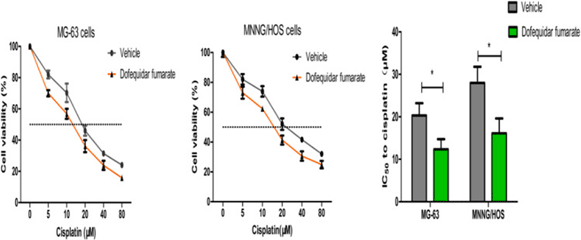
CCK-8 assay showing a significantly lower cisplatin IC50 for the P-gp inhibitor Dofequidar fumarate (5 μM) treatment group compared with the vehicle control group in MG-63 and MNNG/HOS cells.
-
Anticancer Res
P-Glycoprotein Overexpression Is Associated With Cisplatin Resistance in Human Osteosarcoma. [Abstract]2019 Apr;39(4):1711-1718. PMID: 30952710


Purity & Documentation
References
[1]. Nokihara H, et al. A new quinoline derivative MS-209 reverses multidrug resistance and inhibits multiorgan metastases by P-glycoprotein-expressing human small cell lung cancer cells. Jpn J Cancer Res. 2001 Jul;92(7):785-92. [Content Brief]
[2]. Katayama R, et al. Dofequidar fumarate sensitizes cancer stem-like side population cells to chemotherapeutic drugs by inhibiting ABCG2/BCRP-mediated drug export. Cancer Sci. 2009 Nov;100(11):2060-8. [Content Brief]

Calculators
Concentration (start) × Volume (start) = Concentration (final) × Volume (final)


Dofequidar sesquifumarate Related Classifications
HY-17013D Related Classifications
 Powered by Bioz