



JA2131
Based on 2 publication(s) in Google Scholar
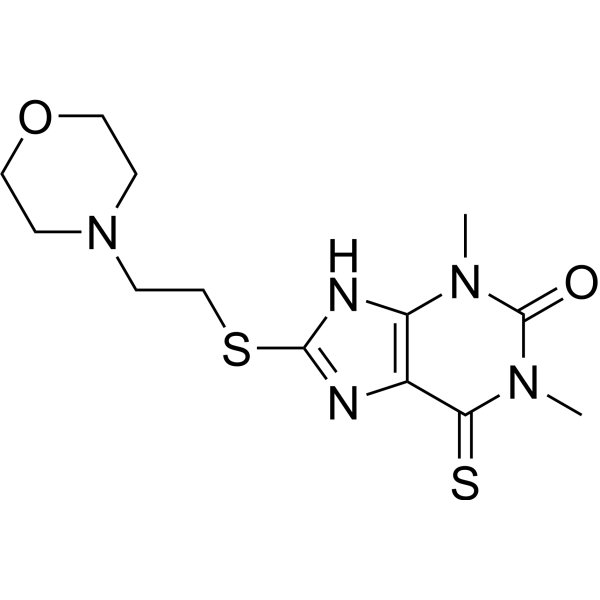
JA2131 is a small molecular inhibitor of Poly(ADP-ribose) Glycohydrolase (PARG) (IC50=0.4 μM). JA2131 regulate DNA damage responses, causes replication fork stalling and cancer cell death.
Para uso exclusivo en investigación. No vendemos a pacientes.
- Pureza : 99.7%
- No. CAS: 6505-99-3
- Fòrmula: C13H19N5O2S2
- Peso molecular:341.45
-
Almacenamiento:Powder -20°C, 3 years , 4°C, 2 years ; In solvent -80°C, 6 months , -20°C, 1 month

To place orders, for customer services and technical support, please contact: MedChemExpress USA
Tel: 609-228-6898 E-mail: [email protected] [email protected]


-
 Actividad biológica
-
Chemical Information
-
Solvente y solubilidad
- Protocolo
- Pureza y Documentación
- Referencias
-
 Help & FAQs


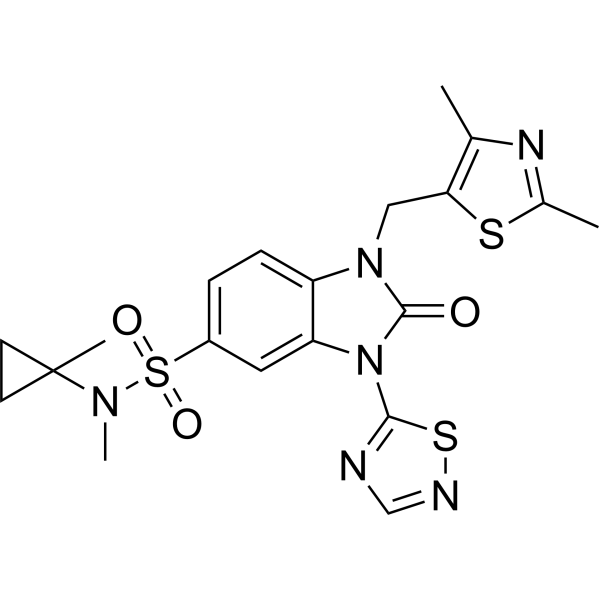
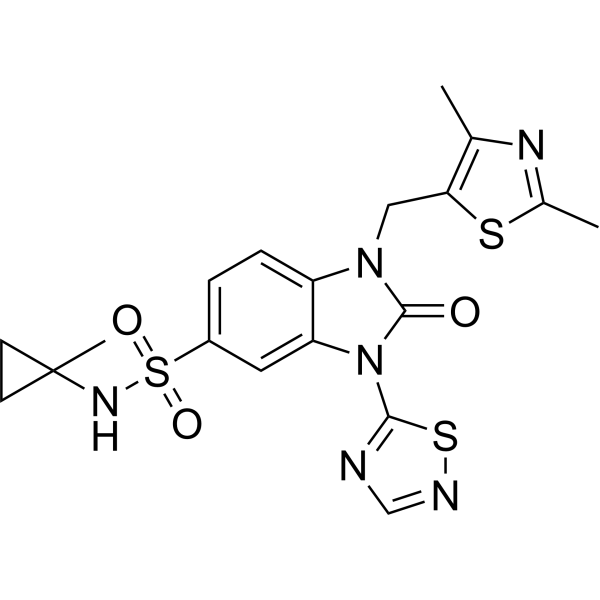
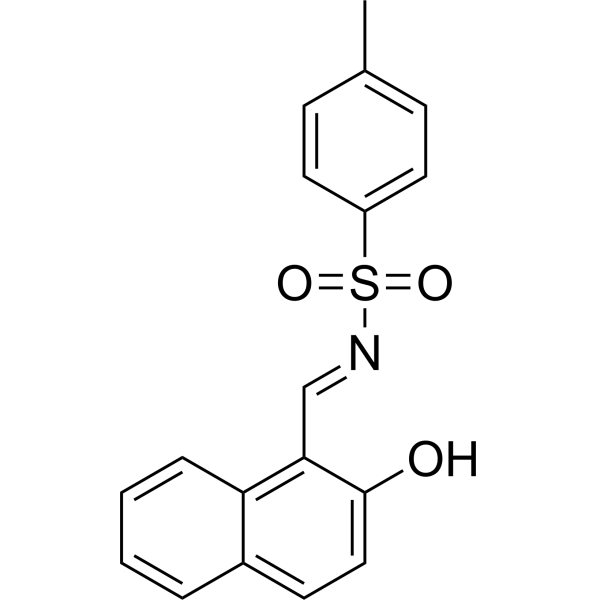

Publications Citing Use of MedChemExpress (MCE) JA2131
More

Actividad biológica
Descripciòn
In Vitro
JA2131 (10 mM; 1-2 h) induces hyperPARylation of PARP1 in PC3 cells[1].
JA2131 (10 μM; 2 wk) inhibits colony formation of MCF-7, PC3, and MDA-MB-231 cells, and (0.1 μM-1 mM; 72 h) shows cytotoxicity to inhibit MRC-50 cells with an IC50 value of 132 μM[1].
JA2131 (5 μM; 72 h) inhibits PC3, and A172 glioblastoma cells viability[1].
JA2131 (10 μM; 2 h) could be acting at the replication fork in HeLa cells[1].
MedChemExpress (MCE) has not independently confirmed the accuracy of these methods. They are for reference only.
-
Cell Line:PC3, and A172 glioblastoma cells
-
Concentration:0.1 μM-10 mM
-
Incubation Time:72 hours
-
Result:Inhibited cell viability with IC50s of 33.05 μM (PC3 cells) and 55.34 μM (A172 cells), respectively.


Chemical Information
-
No. CAS 6505-99-3
-
Appearance Solid
-
Peso molecular 341.45
-
Fòrmula C13H19N5O2S2
-
Color White to off-white
-
SMILES
O=C(N1C)N(C)C2=C(N=C(SCCN3CCOCC3)N2)C1=S
-
Envío
Room temperature in continental US; may vary elsewhere.
-
Almacenamiento
Powder -20°C 3 years 4°C 2 years In solvent -80°C 6 months -20°C 1 month


Publications (2)


Solvente y solubilidad
In Vitro:
DMSO : 12.5 mg/mL (36.61 mM; ultrasonic and warming and heat to 60°C; Hygroscopic DMSO has a significant impact on the solubility of product, please use newly opened DMSO)
Please refer to the solubility information to select the appropriate solvent. Once prepared, please aliquot and store the solution to prevent product inactivation from repeated freeze-thaw cycles.
Storage method and period of stock solution: -80°C, 6 months; -20°C, 1 month. When stored at -80°C, please use it within 6 months. When stored at -20°C, please use it within 1 month.
Please refer to the solubility information to select the appropriate solvent. Once prepared, please aliquot and store the solution to prevent product inactivation from repeated freeze-thaw cycles.
Storage method and period of stock solution: -80°C, 6 months; -20°C, 1 month. When stored at -80°C, please use it within 6 months. When stored at -20°C, please use it within 1 month.
Concentration (start) × Volume (start) = Concentration (final) × Volume (final)
In Vivo:
Select the appropriate dissolution method based on your experimental animal and administration route.
- For the following dissolution methods, please ensure to first prepare a clear stock solution using an In Vitro approach and then sequentially add co-solvents:
- To ensure reliable experimental results, the clarified stock solution can be appropriately stored based on storage conditions. As for the working solution for In Vivo experiments, it is recommended to prepare freshly and use it on the same day.
- The percentages shown for the solvents indicate their volumetric ratio in the final prepared solution. If precipitation or phase separation occurs during preparation, heat and/or sonication can be used to aid dissolution.
In Vivo Dissolution Calculator
Please enter the basic information of animal experiments:
-
-
-
-
Recommended: Prepare an additional quantity of animals to account for potential losses during experiments.
Please enter your animal formula composition:
-
%DMSO +
Recommended: Keep the proportion of DMSO in working solution below 2% if your animal is weak.
-
%+
-
+%Tween-80 + +
-
%Saline +
The co-solvents required include: DMSO, . All of co-solvents are available by MedChemExpress (MCE). , Tween 80. All of co-solvents are available by MedChemExpress (MCE).
Working solution concentration: 0.22 mg/mL
Method for preparing stock solution: mg drug dissolved in μL DMSO. Stock solution concentration: mg/mL.
1. Take μL DMSO stock solution;
2. Add μL .
μL , mix evenly;
3. Then add μL Tween 80, mix evenly;
4. Then add μL
Please ensure that the stock solution in the first step is dissolved to a clear state, and add co-solvents in sequence. You can use ultrasonic heating (ultrasonic cleaner, recommended frequency 20-40 kHz), vortexing, etc. to assist dissolution.


Pureza y Documentación
-
Ficha de datos (274 KB)
-
SDS (251 KB)
- English - EN (251 KB)
- Français - FR (251 KB)
- Deutsch - DE (251 KB)
- Norwegian - NO (251 KB)
- Español - ES (251 KB)
- Swedish - SV (251 KB)
- Italian - IT (251 KB)
- Korean - KR (251 KB)
- Portuguese - PT (251 KB)
-
Instrucciones de manejo (2659 KB)
Referencias
[1]. Houl JH, et al. Selective small molecule PARG inhibitor causes replication fork stalling and cancer cell death. Nat Commun. 2019 Dec 11;10(1):5654. [Content Brief]
[2]. Brosey CA, et al. Targeting SARS-CoV-2 Nsp3 macrodomain structure with insights from human poly(ADP-ribose) glycohydrolase (PARG) structures with inhibitors. Prog Biophys Mol Biol. 2021 Aug;163:171-186. [Content Brief]


Complete Stock Solution Preparation Table
Please refer to the solubility information to select the appropriate solvent. Once prepared, please aliquot and store the solution to prevent product inactivation from repeated freeze-thaw cycles.
Storage method and period of stock solution: -80°C, 6 months; -20°C, 1 month. When stored at -80°C, please use it within 6 months. When stored at -20°C, please use it within 1 month.
| Optional Solvent | Concentration Solvent Mass | 1 mg | 5 mg | 10 mg | 25 mg |
|---|---|---|---|---|---|
| DMSO | 1 mM | 2.9287 mL | 14.6434 mL | 29.2869 mL | 73.2172 mL |
| 5 mM | 0.5857 mL | 2.9287 mL | 5.8574 mL | 14.6434 mL | |
| 10 mM | 0.2929 mL | 1.4643 mL | 2.9287 mL | 7.3217 mL | |
| 15 mM | 0.1952 mL | 0.9762 mL | 1.9525 mL | 4.8811 mL | |
| 20 mM | 0.1464 mL | 0.7322 mL | 1.4643 mL | 3.6609 mL | |
| 25 mM | 0.1171 mL | 0.5857 mL | 1.1715 mL | 2.9287 mL | |
| 30 mM | 0.0976 mL | 0.4881 mL | 0.9762 mL | 2.4406 mL |


JA2131 Related Classifications
HY-137924 Related Classifications
 Powered by Bioz