



Ganirelix acetate

Based on 1 Customer Validation
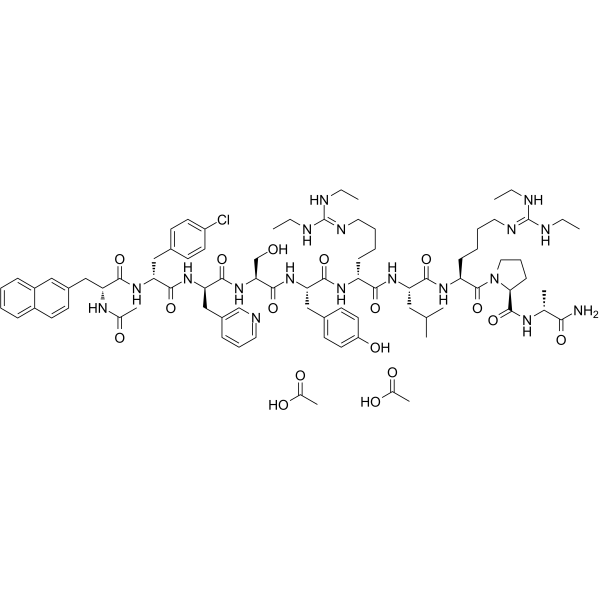
Ganirelix acetate (Ganirest) is a competitive and selective gonadotropin-releasing hormone (GnRH) antagonist. Ganirelix acetate blocks endogenous GnRH-induced release of luteinizing hormone (LH) and follicle-stimulating hormone. Ganirelix acetate antagonizes Prostaglandin E2 (HY-101952)-induced detrusor overactivity and enhances Carbachol (HY-B1208)-induced detrusor contraction. Ganirelix acetate is applicable to research related to female infertility and detrusor overactivity.
For research use only. We do not sell to patients.
- Purity : 99.19%
- CAS No.: 129311-55-3
- Formula: C84H121ClN18O17
- Molecular Weight:1690.42
-
Storage:
-20°C, protect from light, stored under nitrogen
* In solvent : -80°C, 6 months; -20°C, 1 month (protect from light, stored under nitrogen)

To place orders, for customer services and technical support, please contact: MedChemExpress USA
Tel: 609-228-6898 E-mail: [email protected] [email protected]


-
 Biological Activity
-
Chemical Information
-
Solvent & Solubility
- Protocols
- Purity & Documentation
- References
-
 Help & FAQs


-
HY-100353
C12-CeramideNatural Ceramide -

HY-116865
EquileninOestrogen -
HY-B1341
NorethynodrelProgestogen Analog -
HY-W587733
17α,20β-Dihydroxy-4-pregnen-3-oneMaturation-inducing Hormone -

HY-100353R
C12-Ceramide (Standard)Natural Ceramide -
HY-P0056A
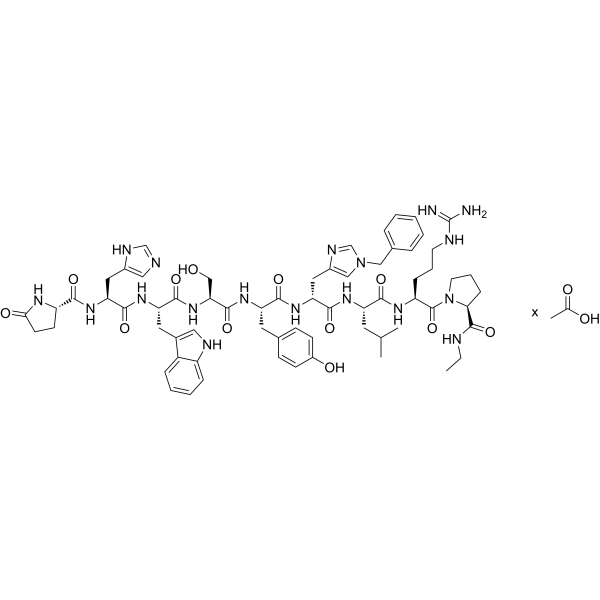
Histrelin acetateGnRH Receptor Agonist -
HY-105634
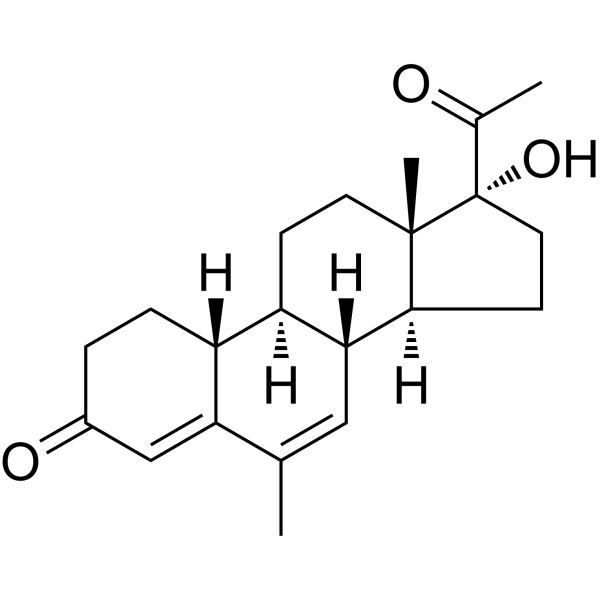
NomegestrolProgesterone Receptor Agonist -
HY-N7710
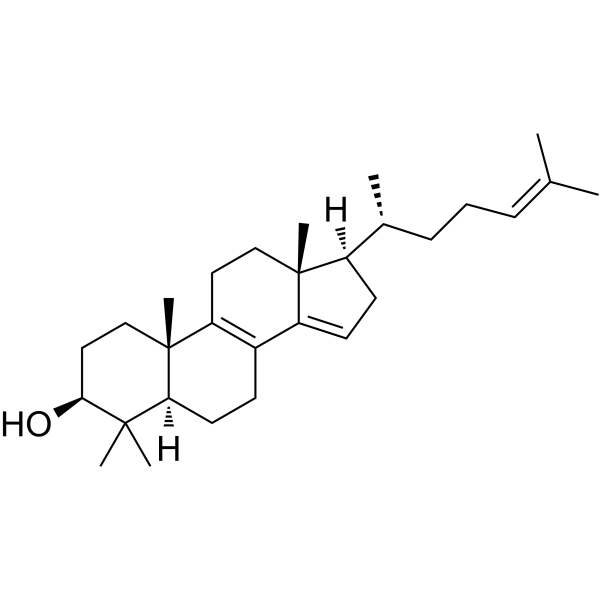
FF-MASMeiotic Maturation Agonist -

HY-145751
7α-Hydroxy-DHEADrug Metabolites -

HY-116503
Methyl 3-hydroxytridecanoateEster Product


Biological Activity
Description
IC50 & Target
GnRH[1]
Cellular Effect
|
Cell Line

|
Type | Value | Description | References |
|---|---|---|---|---|
| HEK293 | IC50 |
3.6 nM
Compound: 3 (Ganirelix)
|
Antagonism of human GnHR receptor, determined in a reporter gene assay in HEK293 cells
Antagonism of human GnHR receptor, determined in a reporter gene assay in HEK293 cells
|
[PMID: 11462984] |
In Vitro
Ganirelix (1 nM-1 μM) acetate has no effect on Carbachol-induced or nerve-induced detrusor contractions in isolated bladder preparations from female rats[2].
MedChemExpress (MCE) has not independently confirmed the accuracy of these methods. They are for reference only. Further protocols information, click here.
In Vivo
Ganirelix (1.4 mg/L; intravesical administration; single dose) acetate regulates normal micturition function in female rats by prolonging micturition intervals, increasing voided volume and bladder capacity, while reducing basal urodynamic pressure, threshold urodynamic pressure and maximum urodynamic pressure parameters; its reduction in flow pressure does not reach statistical significance[2].
MedChemExpress (MCE) has not independently confirmed the accuracy of these methods. They are for reference only.
-
Animal Model:Sprague-Dawley (female, 225-300 g, intravesical infusion of 50 μM prostaglandin E2-induced detrusor overactivity)[2]
-
Dosage:0.1 mg/kg
-
Administration:s.c.; daily; 14 days
-
Result:Reduced plasma luteinising hormone (LH) levels to 0.48 ng/mL.
Reduced micturition interval (MI) by 22%.
Reduced micturition volume (MV) by 23%.
Reduced bladder capacity (BC) by 21% (.
Increased threshold pressure (TP) by 16%.
Increased flow pressure (FP) by 16%.
Enhanced maximal carbachol-induced contraction force to 231% of 60 mM K+-induced contractions at 10 μM Carbachol.
Showed no significant differences in body weight, bladder weight, or baseline urodynamic parameters compared to controls.
-
Animal Model:Sprague-Dawley (female, 225-300 g)[2]
-
Dosage:1.4 mg/L; 0.14 mg/L
-
Administration:intravesical; single dose
-
Result:Increased micturition interval (MI) to 7.06 min at 1.4 mg/L.
Increased micturition volume (MV) to 1.17 mL at 1.4 mg/L.
Increased bladder capacity (BC) to 1.17 mL 1.4 mg/L.
Reduced basal pressure (BP) to 21.5 cm H2O at 1.4 mg/L.
Reduced threshold pressure (TP) to 34.9 cm H2O at 1.4 mg/L.
Reduced maximum pressure (MP) to 126.0 cm H2O at 1.4 mg/L.
Reduced flow pressure (FP) with no statistical significance at 1.4 mg/L.
Showed no effect on any measured urodynamic parameters at 0.14 mg/L.


Chemical Information
-
CAS No. 129311-55-3
-
Appearance Solid
-
Molecular Weight 1690.42
-
Formula C84H121ClN18O17
-
Color White to off-white
-
SMILES
OC(C=C1)=CC=C1C[C@H](NC([C@H](CO)NC([C@@H](CC2=CN=CC=C2)NC([C@H](NC([C@H](NC(C)=O)CC3=CC4=CC=CC=C4C=C3)=O)CC5=CC=C(Cl)C=C5)=O)=O)=O)C(N[C@H](CCCC/N=C(NCC)/NCC)C(N[C@@H](CC(C)C)C(N[C@@H](CCCC/N=C(NCC)/NCC)C(N6[C@@H](CCC6)C(N[C@H](C)C(N)=O)=O)=O)=O)=O)=O.CC(O)=O.CC(O)=O
-
Synonyms
Ganirest
-
Shipping
Room temperature in continental US; may vary elsewhere.
-
Storage
-20°C, protect from light, stored under nitrogen
* In solvent : -80°C, 6 months; -20°C, 1 month (protect from light, stored under nitrogen)


Solvent & Solubility
In Vitro:
H2O : 50 mg/mL (29.58 mM; Need ultrasonic)
Please refer to the solubility information to select the appropriate solvent. Once prepared, please aliquot and store the solution to prevent product inactivation from repeated freeze-thaw cycles.
Storage method and period of stock solution: -80°C, 6 months; -20°C, 1 month (protect from light, stored under nitrogen). When stored at -80°C, please use it within 6 months. When stored at -20°C, please use it within 1 month.
* Note: If you choose water as the stock solution, please dilute it to the working solution, then filter and sterilize it with a 0.22 μm filter before use.
Please refer to the solubility information to select the appropriate solvent. Once prepared, please aliquot and store the solution to prevent product inactivation from repeated freeze-thaw cycles.
Storage method and period of stock solution: -80°C, 6 months; -20°C, 1 month (protect from light, stored under nitrogen). When stored at -80°C, please use it within 6 months. When stored at -20°C, please use it within 1 month.
* Note: If you choose water as the stock solution, please dilute it to the working solution, then filter and sterilize it with a 0.22 μm filter before use.
Concentration (start) × Volume (start) = Concentration (final) × Volume (final)
In Vivo:
For the following dissolution methods, please prepare the working solution directly:
It is recommended to prepare fresh solutions and use them promptly within a short period of time.
The percentages shown for the solvents indicate their volumetric ratio in the final prepared solution. If precipitation or phase separation occurs during preparation, heat and/or sonication can be used to aid dissolution.
Add each solvent one by one: PBS
Solubility: 50 mg/mL (29.58 mM); Clear solution; Need ultrasonic

Protocols
-
Research Protocol for Endocrine Diseases
Endocrine diseases often arise from disrupted hormone production, hormone signaling, or target-tissue responsiveness; for diabetes-focused endocrine disease models, insulin signaling regulates glucose uptake, hepatic glucose output, lipid metabolism, and β-cell compensation. Type 2 diabetes develops through interacting defects in insulin resistance, β-cell dysfunction, adipose inflammation, hepatic glucose overproduction, altered incretin signaling, and ectopic lipid metabolism. A major unresolved question is whether endocrine dysfunction is driven primarily by target-tissue insulin resistance, intrinsic β-cell failure, immune/inflammatory stress, or combined multi-organ failure that differs by disease stage.


Purity & Documentation
-
Data Sheet (278 KB)
-
SDS (393 KB)
- English - EN (393 KB)
- Français - FR (393 KB)
- Deutsch - DE (393 KB)
- Norwegian - NO (393 KB)
- Español - ES (393 KB)
- Swedish - SV (393 KB)
- Italian - IT (393 KB)
- Korean - KR (393 KB)
- Portuguese - PT (393 KB)
-
Handling Instructions (2659 KB)
References
[1]. Gustofson RL, et al. Ganirelix acetate causes a rapid reduction in estradiol levels without adversely affecting oocyte maturation in women pretreated with leuprolide acetate who are at risk of ovarian hyperstimulation syndrome. Hum Reprod. 2006;21(11):2830-2837. [Content Brief]
[2].
Russo A. et al. Effects of the gonadotropin-releasing hormone antagonist ganirelix on normal micturtion and prostaglandin
E(2)-induced detrusor overactivity in conscious female rats. Eur Urol. 2011;59(5):868-874.
[Content Brief]


Complete Stock Solution Preparation Table
Please refer to the solubility information to select the appropriate solvent. Once prepared, please aliquot and store the solution to prevent product inactivation from repeated freeze-thaw cycles.
Storage method and period of stock solution: -80°C, 6 months; -20°C, 1 month (protect from light, stored under nitrogen). When stored at -80°C, please use it within 6 months. When stored at -20°C, please use it within 1 month.
| Optional Solvent | Concentration Solvent Mass | 1 mg | 5 mg | 10 mg | 25 mg |
|---|---|---|---|---|---|
| H2O | 1 mM | 0.5916 mL | 2.9578 mL | 5.9157 mL | 14.7892 mL |
| 5 mM | 0.1183 mL | 0.5916 mL | 1.1831 mL | 2.9578 mL | |
| 10 mM | 0.0592 mL | 0.2958 mL | 0.5916 mL | 1.4789 mL | |
| 15 mM | 0.0394 mL | 0.1972 mL | 0.3944 mL | 0.9859 mL | |
| 20 mM | 0.0296 mL | 0.1479 mL | 0.2958 mL | 0.7395 mL | |
| 25 mM | 0.0237 mL | 0.1183 mL | 0.2366 mL | 0.5916 mL |
* Note: If you choose water as the stock solution, please dilute it to the working solution, then filter and sterilize it with a 0.22 μm filter before use.


Ganirelix acetate Related Classifications
HY-109532 Related Classifications
 Powered by Bioz