



Pimodivir
Based on 8 publication(s) in Google Scholar
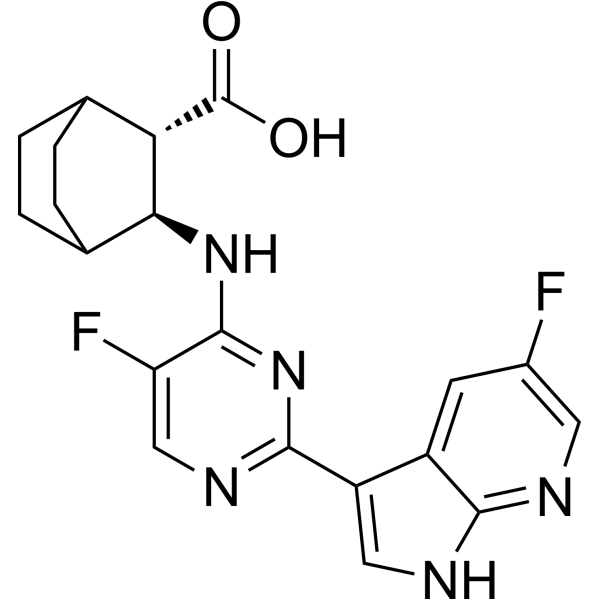
Pimodivir (VX-787) is an orally bioavailable inhibitor of influenza A virus polymerases through interaction with the viral PB2 subunit.
Para uso exclusivo en investigación. No vendemos a pacientes.
- Pureza: 99.62%
- No. CAS: 1629869-44-8
- Fòrmula: C20H19F2N5O2
- Peso molecular:399.39
-
Almacenamiento:Powder -20°C, 3 years , 4°C, 2 years ; In solvent -80°C, 2 years , -20°C, 1 year

To place orders, for customer services and technical support, please contact: MedChemExpress USA
Tel: 609-228-6898 E-mail: [email protected] [email protected]


-
 Actividad biológica
-
Chemical Information
-
Solvente y solubilidad
- Protocolo
- Pureza y Documentación
- Referencias
-
 Help & FAQs


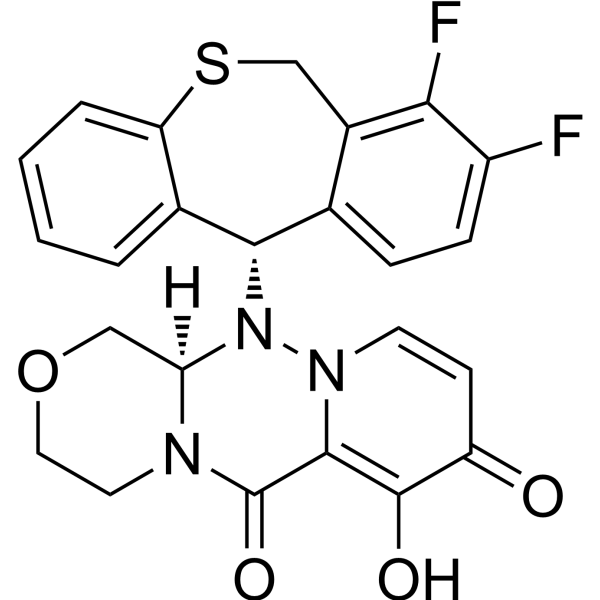
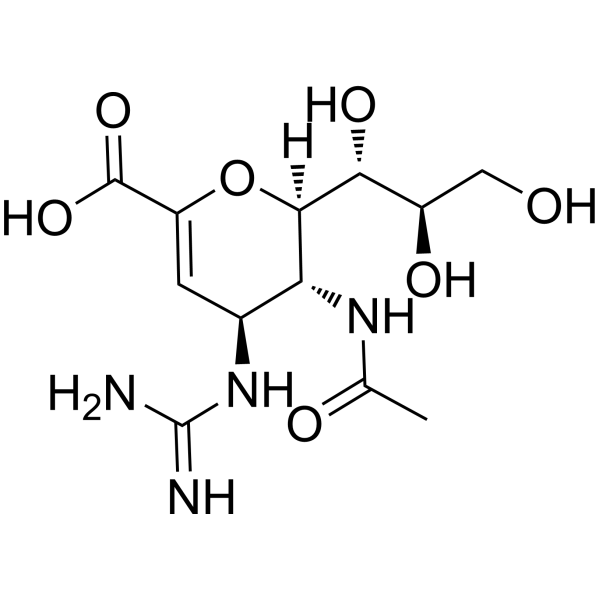
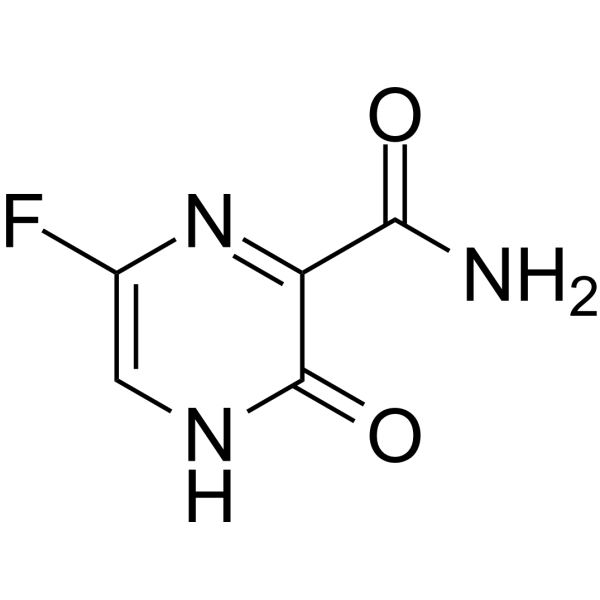
Publications Citing Use of MedChemExpress (MCE) Pimodivir
More- NPJ Digit Med. 2025 Nov 21;8(1):712. [Abstract]
- Nucleic Acids Res. 2018 Jan 25;46(2):956-971. [Abstract]
- Cell Rep Med. 2026 Mar 9:102646. [Abstract]
- ACS Infect Dis. 2025 Jun 13;11(6):1437-1447. [Abstract]
- Antiviral Res. 2025 Aug:240:106209. [Abstract]
- Antiviral Res. 2021 Apr:188:105035. [Abstract]
- SLAS Discov. 2024 Jan;29(1):66-76. [Abstract]
- bioRxiv. 2021 Jan 5.


Actividad biológica
Descripciòn
Cellular Effect
|
Cell Line

|
Type | Value | Description | References |
|---|---|---|---|---|
| A549 | CC50 |
20 μM
Compound: 3; JNJ-63623872
|
Cytotoxicity against human A549 cells
Cytotoxicity against human A549 cells
|
[PMID: 31493987] |
| CCRF-CEM | CC50 |
48.9 μM
Compound: 3; JNJ-63623872
|
Cytotoxicity against human CEM cells
Cytotoxicity against human CEM cells
|
[PMID: 31493987] |
| Huh-7 | CC50 |
95.8 μM
Compound: 3; JNJ-63623872
|
Cytotoxicity against human HuH7 cells
Cytotoxicity against human HuH7 cells
|
[PMID: 31493987] |
| MDCK | EC50 |
0.0018 μM
Compound: 2, VX-787
|
Antiviral activity against Influenza A virus A/California/07/2009 infected in MDCK cells assessed as cell protection after 3 days by cytopathic effect assay
Antiviral activity against Influenza A virus A/California/07/2009 infected in MDCK cells assessed as cell protection after 3 days by cytopathic effect assay
|
[PMID: 25019388] |
| MDCK | EC50 |
0.0026 μM
Compound: 2, VX-787
|
Antiviral activity against Influenza A virus A/Georgia/20/2006 infected in MDCK cells assessed as cell protection after 3 days by cytopathic effect assay
Antiviral activity against Influenza A virus A/Georgia/20/2006 infected in MDCK cells assessed as cell protection after 3 days by cytopathic effect assay
|
[PMID: 25019388] |
| MDCK | EC50 |
0.0027 μM
Compound: 2, VX-787
|
Antiviral activity against Influenza A virus A/Mexico/4108/2009 infected in MDCK cells assessed as cell protection after 3 days by cytopathic effect assay
Antiviral activity against Influenza A virus A/Mexico/4108/2009 infected in MDCK cells assessed as cell protection after 3 days by cytopathic effect assay
|
[PMID: 25019388] |
| MDCK | EC50 |
0.0028 μM
Compound: 2, VX-787
|
Antiviral activity against Influenza A virus A/Texas/48/2009 infected in MDCK cells assessed as cell protection after 3 days by cytopathic effect assay
Antiviral activity against Influenza A virus A/Texas/48/2009 infected in MDCK cells assessed as cell protection after 3 days by cytopathic effect assay
|
[PMID: 25019388] |
| MDCK | EC50 |
<0.00015 μM
Compound: 2, VX-787
|
Antiviral activity against Influenza A virus A/Viet Nam/1203/2004(H5N1) infected in MDCK cells assessed as cell protection after 3 days by cytopathic effect assay
Antiviral activity against Influenza A virus A/Viet Nam/1203/2004(H5N1) infected in MDCK cells assessed as cell protection after 3 days by cytopathic effect assay
|
[PMID: 25019388] |
| MDCK | EC50 |
<0.15 nM
Compound: 2, VX-787
|
Antiviral activity against Influenza A virus A/Viet Nam/1203/2004(H5N1) infected in MDCK cells assessed as cell protection after 3 days by cytopathic effect assay
Antiviral activity against Influenza A virus A/Viet Nam/1203/2004(H5N1) infected in MDCK cells assessed as cell protection after 3 days by cytopathic effect assay
|
[PMID: 25019388] |
| MDCK | EC50 |
0.00032 μM
Compound: 2, VX-787
|
Antiviral activity against Influenza A virus A/Puerto Rico/8/34 infected in MDCK cells assessed as cell protection after 3 days by cytopathic effect assay
Antiviral activity against Influenza A virus A/Puerto Rico/8/34 infected in MDCK cells assessed as cell protection after 3 days by cytopathic effect assay
|
[PMID: 25019388] |
| MDCK | EC50 |
0.00059 μM
Compound: 2, VX-787
|
Antiviral activity against Influenza A virus A/New York/18/2009 infected in MDCK cells assessed as cell protection after 3 days by cytopathic effect assay
Antiviral activity against Influenza A virus A/New York/18/2009 infected in MDCK cells assessed as cell protection after 3 days by cytopathic effect assay
|
[PMID: 25019388] |
| MDCK | EC50 |
0.32 nM
Compound: 2, VX-787
|
Antiviral activity against Influenza A virus A/Puerto Rico/8/34 infected in MDCK cells assessed as cell protection after 3 days by cytopathic effect assay
Antiviral activity against Influenza A virus A/Puerto Rico/8/34 infected in MDCK cells assessed as cell protection after 3 days by cytopathic effect assay
|
[PMID: 25019388] |
| MDCK | EC50 |
0.59 nM
Compound: 2, VX-787
|
Antiviral activity against Influenza A virus A/New York/18/2009 infected in MDCK cells assessed as cell protection after 3 days by cytopathic effect assay
Antiviral activity against Influenza A virus A/New York/18/2009 infected in MDCK cells assessed as cell protection after 3 days by cytopathic effect assay
|
[PMID: 25019388] |
| MDCK | EC50 |
0.002 μM
Compound: 1, VX-787
|
Antiviral activity against influenza A virus A/PR/8/34 strain incubated with MDCK cells assessed as reduction of viral RNA level equal to 1% of control level after 72 hrs by branched DNA assay
Antiviral activity against influenza A virus A/PR/8/34 strain incubated with MDCK cells assessed as reduction of viral RNA level equal to 1% of control level after 72 hrs by branched DNA assay
|
[PMID: 25827523] |
| MDCK | IC50 |
0.002 μM
Compound: 1, VX-787
|
Antiviral activity against Influenza A virus A/PR/8/34 strain incubated with MDCK cells assessed as cell protection after 72 hrs by phenotypic cell protection assay
Antiviral activity against Influenza A virus A/PR/8/34 strain incubated with MDCK cells assessed as cell protection after 72 hrs by phenotypic cell protection assay
|
[PMID: 25827523] |
| MDCK | CC50 |
12 μM
Compound: VX-787
|
Cytotoxicity against MDCK cells assessed as reduction in cell viability after 5 days by CCK-8 assay
Cytotoxicity against MDCK cells assessed as reduction in cell viability after 5 days by CCK-8 assay
|
[PMID: 30448415] |
| MDCK | EC50 |
0.6 nM
Compound: VX-787
|
Inhibition of PB2 in Influenza A virus (A/Weiss/1943(H1N1)) infected in MDCK cells assessed as reduction in virus induced cell death after 5 days by CCK-8 assay
Inhibition of PB2 in Influenza A virus (A/Weiss/1943(H1N1)) infected in MDCK cells assessed as reduction in virus induced cell death after 5 days by CCK-8 assay
|
[PMID: 30448415] |
| MDCK | CC50 |
>100 μM
Compound: VX787
|
Cytotoxicity against MDCK cells assessed as reduction in cell viability measured after 72 hrs by alamar blue assay
Cytotoxicity against MDCK cells assessed as reduction in cell viability measured after 72 hrs by alamar blue assay
|
[PMID: 31053507] |
| MDCK | CC50 |
>100 μM
Compound: VX-787
|
Cytotoxicity against MDCK cells assessed as reduction in cell viability measured after 72 hrs by CCK8 analysis
Cytotoxicity against MDCK cells assessed as reduction in cell viability measured after 72 hrs by CCK8 analysis
|
[PMID: 34839161] |
| PBMC | CC50 |
>100 μM
Compound: 3; JNJ-63623872
|
Cytotoxicity against human PBMC cells
Cytotoxicity against human PBMC cells
|
[PMID: 31493987] |
| Vero | CC50 |
>100 μM
Compound: 3; JNJ-63623872
|
Cytotoxicity against African green monkey Vero cells
Cytotoxicity against African green monkey Vero cells
|
[PMID: 31493987] |
In Vitro
Pimodivir rescues macrophages from virus-mediated death at non-cytotoxic concentrations 24 hpi. The EC50 value for Pimodivir are 8 and 12 nM for A(H1N1) and A(H3N2) strains, respectively, whereas the CC50 values are >1 μM, giving selectivity indexes (SI) > 125 and > 83 for A(H1N1) and A(H3N2) strains, respectively. Pimodivir significantly attenuates the transcription of viral M1 RNA in macrophages, which are infected with A(H1N1) or A(H3N2) strains for 8 h. Pimodivir inhibits the transcription of viral but not cellular genes. Pimodivir allows some activation of IAV-mediated expression of several cellular genes, which are involved in tryptophan and nucleotide metabolism. Pimodivir possesses excellent anti-IAV but not immuno/metabolo-modulating effect[2].
Pimodivir (VX-787) is very potent against influenza A strains, including pandemic 2009 H1N1 and avian H5N1[3].
Pimodivir (VX-787) shows potent activity against all influenza A virus strains tested, with an EC50 range of 0.13 to 3.2 nM. Pimodivir-selected PB2 variant viruses maintain susceptibility to neuraminidase inhibitors in vitro[4].
MedChemExpress (MCE) has not independently confirmed the accuracy of these methods. They are for reference only.
In Vivo
Moreover, Pimodivir (VX-787) shows 100% survival in a +48 h delay to treatment mouse influenza model at 10, 3 and 1 mpk (BID × 10 days) whereas the SOC, GS 4071, provide no survival benefit in this model at 10 mpk[3].
Pimodivir (VX-787; 1, 3, or 10 mg/kg, bid) provided complete survival, with a dose-dependent reduction in BW loss of the mice[4].
MedChemExpress (MCE) has not independently confirmed the accuracy of these methods. They are for reference only.
Ensayo clínico
| NCT Number | Sponsor | Condition | Start Date |
Phase
|
|---|---|---|---|---|
| NCT01329991 | Plexxikon| | 2011-05 | PHASE1 |


Chemical Information
-
No. CAS 1629869-44-8
-
Appearance Solid
-
Peso molecular 399.39
-
Fòrmula C20H19F2N5O2
-
Color White to light yellow
-
SMILES
O=C([C@H]1C(CC2)CCC2[C@@H]1NC3=NC(C4=CNC5=NC=C(F)C=C54)=NC=C3F)O
-
Synonyms
VX-787
-
Envío
Room temperature in continental US; may vary elsewhere.
-
Almacenamiento
Powder -20°C 3 years 4°C 2 years In solvent -80°C 2 years -20°C 1 year


Publications (8)
-
Journal Impact Factor
-
Most Recent
-
NPJ Digit Med
Predictive modeling & mechanistic validation of synergistic pimodivir combinations for anti-influenza therapy via PB2cap affinity boost. [Abstract]2025 Nov 21;8(1):712. PMID: 41272280 -
Nucleic Acids Res
Capped RNA primer binding to influenza polymerase and implications for the mechanism of cap-binding inhibitors. [Abstract]2018 Jan 25;46(2):956-971. PMID: 29202182 -
Cell Rep Med
Human liver-derived organoids recapitulate Oropouche virus infection and manifestation, enabling antiviral drug discovery. [Abstract]2026 Mar 9:102646. PMID: 41806841 -
ACS Infect Dis
Development of a Universal Type A Influenza Viral RdRp-Induced Reporter System with Potential for Antiviral Drug Screening. [Abstract]2025 Jun 13;11(6):1437-1447. PMID: 40421776 -
Antiviral Res
High-throughput screening for identification of influenza a inhibitors using a cell-based immunofluorescence assay. [Abstract]2025 Aug:240:106209. PMID: 40484321 -
Antiviral Res
Susceptibility of widely diverse influenza a viruses to PB2 polymerase inhibitor pimodivir. [Abstract]2021 Apr:188:105035. PMID: 33581212 -
SLAS Discov
2024 Jan;29(1):66-76. PMID: 37925159 -


Solvente y solubilidad
In Vitro:
DMSO : 5 mg/mL (12.52 mM; ultrasonic and warming and heat to 60°C; Hygroscopic DMSO has a significant impact on the solubility of product, please use newly opened DMSO)
Please refer to the solubility information to select the appropriate solvent. Once prepared, please aliquot and store the solution to prevent product inactivation from repeated freeze-thaw cycles.
Storage method and period of stock solution: -80°C, 2 years; -20°C, 1 year. When stored at -80°C, please use it within 2 years. When stored at -20°C, please use it within 1 year.
Please refer to the solubility information to select the appropriate solvent. Once prepared, please aliquot and store the solution to prevent product inactivation from repeated freeze-thaw cycles.
Storage method and period of stock solution: -80°C, 2 years; -20°C, 1 year. When stored at -80°C, please use it within 2 years. When stored at -20°C, please use it within 1 year.
Concentration (start) × Volume (start) = Concentration (final) × Volume (final)
In Vivo:
Select the appropriate dissolution method based on your experimental animal and administration route.
- For the following dissolution methods, please ensure to first prepare a clear stock solution using an In Vitro approach and then sequentially add co-solvents:
- To ensure reliable experimental results, the clarified stock solution can be appropriately stored based on storage conditions. As for the working solution for In Vivo experiments, it is recommended to prepare freshly and use it on the same day.
- The percentages shown for the solvents indicate their volumetric ratio in the final prepared solution. If precipitation or phase separation occurs during preparation, heat and/or sonication can be used to aid dissolution.
Add each solvent one by one: 10% DMSO 40% PEG300 5% Tween-80 45% Saline
Solubility: ≥ 2.5 mg/mL (6.26 mM); Clear solution
This protocol yields a clear solution of ≥ 2.5 mg/mL (saturation unknown).
Taking 1 mL working solution as an example, add 100 μL DMSO stock solution (25.0 mg/mL) to 400 μL PEG300, and mix evenly; then add 50 μL Tween-80 and mix evenly; then add 450 μL Saline to adjust the volume to 1 mL.
Preparation of Saline: Dissolve 0.9 g sodium chloride in ddH₂O and dilute to 100 mL to obtain a clear Saline solution.
Add each solvent one by one: 10% DMSO 90% (20% SBE-β-CD in Saline)
Solubility: ≥ 2.5 mg/mL (6.26 mM); Clear solution
This protocol yields a clear solution of ≥ 2.5 mg/mL (saturation unknown).
Taking 1 mL working solution as an example, add 100 μL DMSO stock solution (25.0 mg/mL) to 900 μL 20% SBE-β-CD in Saline, and mix evenly.
Preparation of 20% SBE-β-CD in Saline (4°C, storage for one week): 2 g SBE-β-CD powder is dissolved in 10 mL Saline, completely dissolve until clear.
In Vivo Dissolution Calculator
Please enter the basic information of animal experiments:
-
-
-
-
Recommended: Prepare an additional quantity of animals to account for potential losses during experiments.
Please enter your animal formula composition:
-
%DMSO +
Recommended: Keep the proportion of DMSO in working solution below 2% if your animal is weak.
-
%+
-
+%Tween-80 + +
-
%Saline +
The co-solvents required include: DMSO, . All of co-solvents are available by MedChemExpress (MCE). , Tween 80. All of co-solvents are available by MedChemExpress (MCE).
Working solution concentration: 0.22 mg/mL
Method for preparing stock solution: mg drug dissolved in μL DMSO. Stock solution concentration: mg/mL.
1. Take μL DMSO stock solution;
2. Add μL .
μL , mix evenly;
3. Then add μL Tween 80, mix evenly;
4. Then add μL
Please ensure that the stock solution in the first step is dissolved to a clear state, and add co-solvents in sequence. You can use ultrasonic heating (ultrasonic cleaner, recommended frequency 20-40 kHz), vortexing, etc. to assist dissolution.

Protocolo
Cell Assay[2]
The compound cytotoxicity and efficacy testing is performed in 96-well plates with macrophages at 95% confluence. The compounds are added to the medium, and 30 min later, the cells are infected with virus or non-infected. The cell viability is analyzed with the Cell Titer Glo assay at 24 hpi. The luminescence is read with a PHERAstar FS plate reader.
MedChemExpress (MCE) has not independently confirmed the accuracy of these methods. They are for reference only.
Animal Administration[1]
The mice are anesthetized, and the animals are infected intranasally with a 90-μL suspension of influenza virus. The virus challenge is approximately four 50% mouse lethal infectious doses. Treatments are given twice a day (at 12 h intervals) for 10 days starting 2 h before virus challenge. Parameters for assessing the infection are survival, mean day of death, body weight changes, and lung infection parameters (hemorrhage score, weight, and virus titer). Animals are weighed individually every other day through day 21 of the infection. Initially, there are 15 mice per group treated with compound and 25 placebos. Five mice in each group are subsequently sacrificed for determination of lung infection parameters. A larger number of placebos are used than compound-treated mice to achieve greater statistical power, especially if some animals in that group survive the infection. One mouse that dies during the treatment period is presumed to have died from treatment trauma because its death occurs well before other mice die from influenza. It is excluded from the total counts. Animals that die during infection are accounted for in the tabular data.
MedChemExpress (MCE) has not independently confirmed the accuracy of these methods. They are for reference only.


Pureza y Documentación
-
Ficha de datos (286 KB)
-
SDS (396 KB)
- English - EN (396 KB)
- Français - FR (396 KB)
- Deutsch - DE (396 KB)
- Norwegian - NO (396 KB)
- Español - ES (396 KB)
- Swedish - SV (396 KB)
- Italian - IT (396 KB)
- Korean - KR (396 KB)
- Portuguese - PT (396 KB)
-
Instrucciones de manejo (2659 KB)
Referencias
[1]. Smee DF, et al. Activities of JNJ63623872 and GS 4071 against influenza A H1N1pdm and H3N2 virus infections in mice. Antiviral Res. 2016 Dec;136:45-50. [Content Brief]
[2]. Fu Y, et al. JNJ872 inhibits influenza A virus replication without altering cellular antiviral responses. Antiviral Res. 2016 Sep;133:23-31. [Content Brief]
[3]. Boyd MJ, et al. Isosteric replacements of the carboxylic acid of drug candidate VX-787: Effect of charge on antiviral potency and kinase activity of azaindole-based influenza PB2 inhibitors. Bioorg Med Chem Lett. 2015 May 1;25(9):1990-4. [Content Brief]
[4]. Byrn RA, et al. Preclinical activity of VX-787, a first-in-class, orally bioavailable inhibitor of the influenza virus polymerase PB2 subunit. Antimicrob Agents Chemother. 2015 Mar;59(3):1569-82. [Content Brief]


Complete Stock Solution Preparation Table
Please refer to the solubility information to select the appropriate solvent. Once prepared, please aliquot and store the solution to prevent product inactivation from repeated freeze-thaw cycles.
Storage method and period of stock solution: -80°C, 2 years; -20°C, 1 year. When stored at -80°C, please use it within 2 years. When stored at -20°C, please use it within 1 year.
| Optional Solvent | Concentration Solvent Mass | 1 mg | 5 mg | 10 mg | 25 mg |
|---|---|---|---|---|---|
| DMSO | 1 mM | 2.5038 mL | 12.5191 mL | 25.0382 mL | 62.5955 mL |
| 5 mM | 0.5008 mL | 2.5038 mL | 5.0076 mL | 12.5191 mL | |
| 10 mM | 0.2504 mL | 1.2519 mL | 2.5038 mL | 6.2595 mL |


Pimodivir Related Classifications
HY-12353A Related Classifications
 Powered by Bioz