



GCN2iB acetate
Based on 65 publication(s) in Google Scholar
GCN2iB acetate is an ATP-competitive, selective GCN2 inhibitor with an IC50 of 2.4 nM. GCN2iB acetate inhibits the activation of the GCN2 pathway and upregulates GPX4. GCN2iB acetate enhances the anticancer effect of ASNase against acute lymphoblastic leukemia. GCN2iB acetate increases left ventricular ejection fraction, while reducing fasting blood glucose and myocardial fibrosis. GCN2iB acetate can be used in research related to acute lymphoblastic leukemia, acute myeloid leukemia and diabetic cardiomyopathy.
For research use only. We do not sell to patients.
- CAS No.: 2183470-13-3
- Formula: C20H16ClF2N5O5S
- Molecular Weight:511.89
-
Storage:
Please store the product under the recommended conditions in the Certificate of Analysis.


To place orders, for customer services and technical support, please contact: MedChemExpress USA
Tel: 609-228-6898 E-mail: [email protected] [email protected]


-
 Biological Activity
-
Chemical Information
- Protocols
- Purity & Documentation
- References
-
 Help & FAQs


Publications Citing Use of MedChemExpress (MCE) GCN2iB acetate
More- Cell. 2025 Sep 4;188(18):4950-4967.e22. [Abstract]
- Cell Metab. 2023 Dec 5;35(12):2216-2230.e8. [Abstract]
- Cell Metab. 2022 Aug 2;34(8):1151-1167.e7. [Abstract]
- Nat Methods. 2025 Jun;22(6):1237-1246. [Abstract]
- Nat Cancer. 2022 Nov;3(11):1386-1403. [Abstract]
- Nat Metab. 2024 Aug;6(8):1529-1548. [Abstract]
- Cancer Res. 2025 Aug 8. [Abstract]
- Nat Commun. 2026 Feb 24;17(1):1963. [Abstract]
- Nat Commun. 2023 Aug 8;14(1):4758. [Abstract]
- Cell Discov. 2021 Oct 26;7(1):98. [Abstract]
- Mol Cell. 2025 Jul 3;85(13):2581-2596.e6. [Abstract]
- Mol Cell. 2025 Feb 20;85(4):756-769.e5. [Abstract]
- Mol Cell. 2023 Sep 21;83(18):3303-3313.e6. [Abstract]
- Nat Chem Biol. 2021 Jun;17(6):665-674. [Abstract]
- Adv Sci (Weinh). 2024 Sep;11(35):e2401748. [Abstract]
- Chem Eng J. 2025 Feb 1.
- Clin Cancer Res. 2024 Aug 15;30(16):3603-3621. [Abstract]
- Cell Death Discov. 2026 Feb 5;12(1):94. [Abstract]
- Cell Death Discov. 2022 Oct 4;8(1):406. [Abstract]
- Environ Int. 2025 Mar:197:109346. [Abstract]
- Environ Int. 2022 Jul 14;167:107393. [Abstract]
- Proc Natl Acad Sci U S A. 2026 Jul 8;123(28):e2602536123.
- Antioxidants (Basel). 2022 Aug 16;11(8):1584. [Abstract]
- Antioxidants (Basel). 2022 Jul 16;11(7):1379. [Abstract]
- Cell Rep. 2025 Jan 3;44(1):115130. [Abstract]
- Cell Rep. 2022 Jul 19;40(3):111092. [Abstract]
- Cell Syst. 2022 Feb 16;13(2):158-172.e9. [Abstract]
- Sci Signal. 2024 Nov 26;17(864):eadp1375. [Abstract]
- Cells. 2026 Jan 16;15(2):164.
- EMBO Rep. 2022 Feb 3;23(3):e53373. [Abstract]
- Int J Mol Sci. 2022 Jun 16;23(12):6727. [Abstract]
- ACS Omega. 2025 Oct 17;10(42):50208-50217. [Abstract]
- iScience. 2025 Nov 30.
- FASEB J. 2023 Mar;37(3):e22820. [Abstract]
- J Biol Chem. 2026 Jun;302(6):111482. [Abstract]
- Pharm Res. 2024 Nov;41(11):2213-2223. [Abstract]
- J Biol Chem. 2023 Apr;299(4):104595 [Abstract]
- J Biol Chem. 2022 Oct;298(10):102406. [Abstract]
- J Biol Chem. 2021 Nov;297(5):101257. [Abstract]
- Life Sci Alliance. 2025 Mar 3;8(5):e202403014. [Abstract]
- Mol Biol Cell. 2025 Sep 24:mbcE25060277. [Abstract]
- Biochem Biophys Res Commun. 2019 Aug 13;516(1):285-292. [Abstract]
- SSRN. 2026 Jul 11.
- bioRxiv. 2026 Apr 6.
- bioRxiv. 2026 Apr 23.
- bioRxiv. 2026 Mar 28.
- bioRxiv. 2026 Jan 13.
- bioRxiv. 2026 Jan 20:2026.01.16.699988. [Abstract]
- bioRxiv. 2025 Dec 23:2025.12.21.694897. [Abstract]
- Indiana University. 2025 Oct.
- Indiana University Indianapolis. 2025.
- bioRxiv. 2025 Oct 17.
- bioRxiv. 2025 Aug 31:2025.08.26.672367. [Abstract]
- bioRxiv. 2025 Aug 5:2025.08.04.668575. [Abstract]
- bioRxiv. 2025 Aug 12:2025.08.10.669191. [Abstract]
- SSRN. 2025 May 7.
- bioRxiv. 2025 March 13.
- bioRxiv. 2024 August 16.
- bioRxiv. 2024 Dec 20:2024.12.19.629301. [Abstract]
- bioRxiv. 2024 September 13.
- bioRxiv. 2024 June 28.
- Imperial College London. 2022 Aug.
- Sci Total Environ. 2021 Aug 10:781:146730. [Abstract]
- bioRxiv. 2019 Oct 31.
- bioRxiv. 2019 Oct.
 Customer Validation & Images

-
IP
-
WB
-
Others
-
WB
-
IP


Biological Activity
Description
IC50 & Target
[1]|
GPX4 |
GCN2 2.4 nM (IC50) |
In Vitro
GCN2iB (1 μmol/L) acetate potently inhibits recombinant GCN2 with an IC50 of 2.4 nmol/L, and exhibits high kinase selectivity, showing only extremely low off-target inhibitory activity in a screening panel containing 468 kinases[1].
GCN2iB (10-9-10-5 M; 72 h) acetate enhances the antiproliferative effect of ASNase in GCN2-WT MEF cells, but shows no such effect in GCN2-KO MEF cells, confirming its inhibitory activity targeting GCN2[1].
GCN2iB (1 μmol/L; 72 h) acetate sensitizes CCRF-CEM, MV-4-11 and SU.86.86 cells to the antiproliferative effect induced by ASNase[1].
MedChemExpress (MCE) has not independently confirmed the accuracy of these methods. They are for reference only.
-
Cell Line:GCN2-WT MEF cells
-
Concentration:10-9-10-5 M
-
Incubation Time:72 h
-
Result:Exhibited no antiproliferative effect when combined with ASNase in GCN2-KO MEF cells.
Robustly reduced viability of cells when combined with ASNase in GCN2-WT MEF cells.
In Vivo
GCN2iB (10 mg/kg; twice daily; 3 days per week; for 28 consecutive days) acetate acts synergistically with 1,000 U/kg ASNase to improve the survival rate of mice with disseminated MOLT-3 acute lymphoblastic leukemia (ALL)[1].
GCN2iB (3 mg/kg; i.p.; once every other day; for 6 consecutive weeks) acetate improves cardiac systolic function in diabetic mice induced by high-fat diet combined with Streptozotocin (HY-13753), increases left ventricular ejection fraction by 34.7%, and simultaneously reduces fasting blood glucose, myocardial lipid accumulation, oxidative stress and fibrosis[2].
GCN2iB (3 mg/kg; intraperitoneal injection; once every 2 days; for 6 consecutive weeks) acetate improves cardiac systolic function in db/db mice, increases left ventricular ejection fraction by 14.5%, while reducing fasting blood glucose, decreasing myocardial lipid accumulation and alleviating oxidative stress[2].
MedChemExpress (MCE) has not independently confirmed the accuracy of these methods. They are for reference only.
-
Animal Model:SCID[1]
-
Dosage:10 mg/kg; co-administered with 1,000 U/kg ASNase
-
Administration:twice daily; daily; 7 days
-
Result:Did not significantly affect tumor growth (P = 0.99).
Elicited potent antitumor activity (P = 0.0002) with synergistic effects (main effect of ASNase, P = 0.0053; main effect of GCN2iB, P = 0.0006; interaction effect, P = 0.0007) when combined with ASNase.
Achieved a tumor growth inhibition resulting in a treatment over control (T/C) value significantly lower than vehicle, ASNase alone, or GCN2iB alone when combined with ASNase.
-
Animal Model:C57BL/6J (male; diabetic cardiomyopathy induced by 8 weeks of high-fat diet + intraperitoneal streptozotocin injection, fasting blood glucose ≥ 11.1 mmol/L)[2]
-
Dosage:3 mg/kg
-
Administration:i.p.; every other day; 6 weeks
-
Result:Decreased fasting blood glucose to 11.18 mmol/L.
Decreased body weight to 28.94 g.
Increased left ventricular ejection fraction to 70.41%.
Increased heart weight to body weight ratio.
Decreased myocardial fibrosis, myocyte cross-sectional area, and cardiac triglyceride levels.
Decreased mRNA levels of hypertrophic/fibrotic genes (ANP, BNP, β-MHC, Calm3, Collagen-I, Collagen-III) and lipid metabolism-related genes (CD36, Fasn, Plin4, Plin2, Pparγ, SCD1, Srebp1c).
Decreased myocardial 3'-NT, 4-HNE, and superoxide levels.
Upregulated antioxidative genes (Gpx1/4/7, Gstp1/2, Mt1, Prdx2, Trx2) and proteins (GPX4, PRDX2, TRX2).
Decreased protein expression of ANP, FAS, and CIDEA.
Increased myocardial phosphocreatine and taurine levels.
Upregulated oxidative phosphorylation, glycolysis/gluconeogenesis, proteasome, and amino acid biosynthesis pathway genes.
Downregulated hypertrophic cardiomyopathy, dilated cardiomyopathy, and PPAR signaling pathway genes associated with disease progression.
-
Animal Model:leptin receptor deficient (db/db) (male; spontaneous type 2 diabetes due to leptin receptor deletion)[2]
-
Dosage:3 mg/kg
-
Administration:i.p.; every other day; 6 weeks
-
Result:Decreased fasting blood glucose to 9.64 mmol/L.
Decreased body weight to 44.67 g.
Decreased heart weight to 145.7 mg.
Increased left ventricular ejection fraction to 84.05%.
Decreased cardiac triglyceride, 3'-NT, and 4-HNE levels.
Decreased mRNA levels of hypertrophic/fibrotic genes (β-MHC, BNP, Calm3, Collagen-I, Collagen-III) and lipid metabolism-related genes (Fasn, Srebp1c).
Increased mRNA levels of oxidative phosphorylation genes (Atcg1, Atp5d, Atp5j1, Ndufa8, Ndufs6).
Decreased protein expression of ANP, FAS, CD36, and Cidea.
Increased protein expression of GPX4, PRDX2, and TRX2.


Chemical Information
-
CAS No. 2183470-13-3
-
Molecular Weight 511.89
-
Formula C20H16ClF2N5O5S
-
SMILES
O=S(C1=CC(Cl)=CN=C1OC)(NC2=CC=C(C(C#CC3=CN=C(N=C3)N)=C2F)F)=O.CC(O)=O
-
Shipping
Room temperature in continental US; may vary elsewhere.
-
Storage
Please store the product under the recommended conditions in the Certificate of Analysis.


Publications (65)
-
Journal Impact Factor
-
Most Recent
-
Cell
2025 Sep 4;188(18):4950-4967.e22. PMID: 40651473 -
Cell Metab
2023 Dec 5;35(12):2216-2230.e8. PMID: 37979583
GCN2iB acetate purchased from MedChemExpress. Usage Cited in: Cell Metab. 2023 Dec 5;35(12):2216-2230.e8. [Abstract]
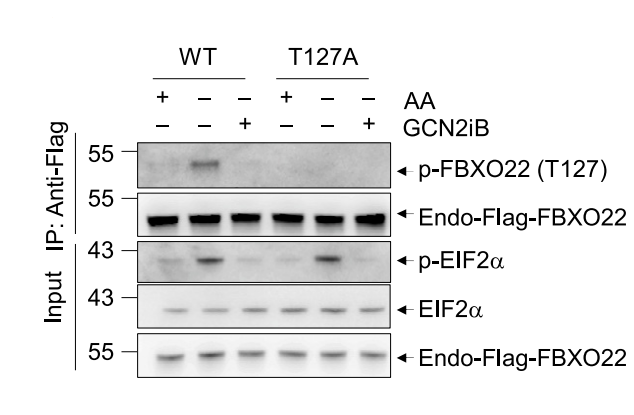
FBXO22-WT and FBXO22-T127A-KI 293T-Endo-FLAG-FBXO22 cells were deprived of amino acids in the presence or absence of 1 μM GCN2iB and subjected to IP with an anti-FLAG antibody, followed by WB analysis of the indicated proteins.
GCN2iB acetate purchased from MedChemExpress. Usage Cited in: Cell Metab. 2023 Dec 5;35(12):2216-2230.e8. [Abstract]
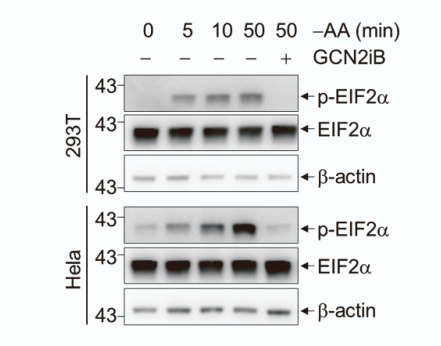
293T and HeLa cells deprived of amino acids for the indicated times were treated with or without 1 μM GCN2iB, followed by WB analysis of the indicated proteins.
GCN2iB acetate purchased from MedChemExpress. Usage Cited in: Cell Metab. 2023 Dec 5;35(12):2216-2230.e8. [Abstract]
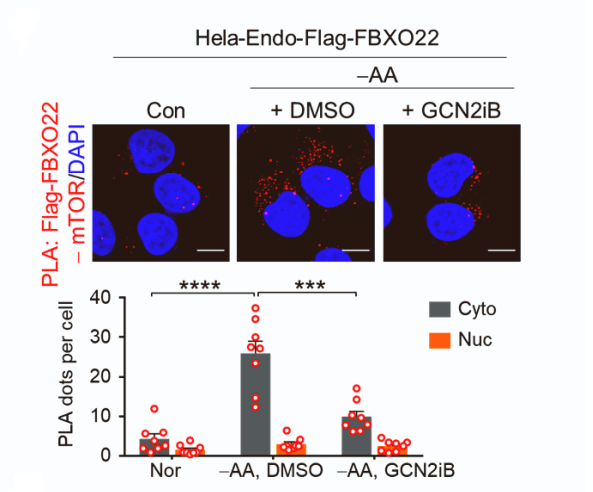
HeLa-Endo-Flag-FBXO22 cells were cultured in normal medium or amino-acidfree medium containing DMSO or 1 μM GCN2iB for 60 min, then subjected to Duolink. PLA assay with anti-Flag and anti-mTOR antibodies (top). PLA dots per cell (mean ±SEM) from n = 8 images were calculated (bottom).
GCN2iB acetate purchased from MedChemExpress. Usage Cited in: Cell Metab. 2023 Dec 5;35(12):2216-2230.e8. [Abstract]
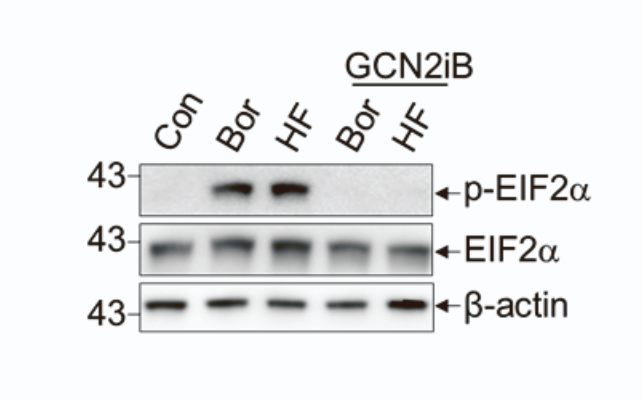
293T-Endo-HA-mTOR cells were treated with 100 ng/mL borrelidin (Bor) or 200 ng/mL halofuginone (HF) in the presence or absence of 1 μM GCN2iB for 4 h, followed by WB analysis of the indicated proteins.
GCN2iB acetate purchased from MedChemExpress. Usage Cited in: Cell Metab. 2023 Dec 5;35(12):2216-2230.e8. [Abstract]
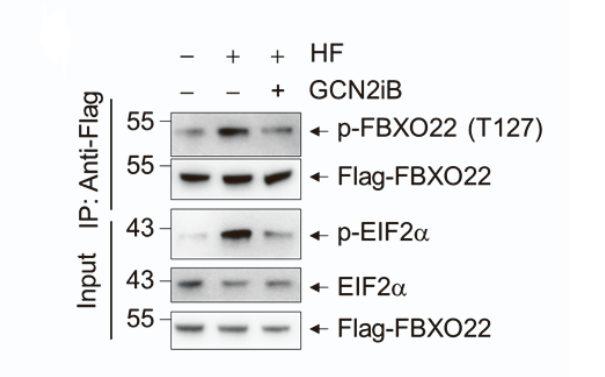
293T-Endo-Flag-FBXO22 cells were treated with 200 ng/mL halofuginone (HF) in the presence or absence of 1 μM GCN2iB for 4 h, and subjected to IP with an anti-Flag antibody, followed by WB analysis of the indicated proteins.
-
Cell Metab
GCN2 inhibition sensitizes arginine-deprived hepatocellular carcinoma cells to senolytic treatment. [Abstract]2022 Aug 2;34(8):1151-1167.e7. PMID: 35839757 -
Nat Methods
Decoding post-transcriptional regulatory networks by RNA-linked CRISPR screening in human cells. [Abstract]2025 Jun;22(6):1237-1246. PMID: 40442371 -
Nat Cancer
Differential integrated stress response and asparagine production drive symbiosis and therapy resistance of pancreatic adenocarcinoma cells. [Abstract]2022 Nov;3(11):1386-1403. PMID: 36411320 -
Nat Metab
The unique catalytic properties of PSAT1 mediate metabolic adaptation to glutamine blockade. [Abstract]2024 Aug;6(8):1529-1548. PMID: 39192144 -
Cancer Res
Caloric Restriction Enhances the Efficacy of Anti-Androgen Therapy in Prostate Cancer by Inhibiting Androgen Receptor Translation. [Abstract]2025 Aug 8. PMID: 40779415 -
Nat Commun
2026 Feb 24;17(1):1963. PMID: 41735331 -
Nat Commun
Intermittent dietary methionine deprivation facilitates tumoral ferroptosis and synergizes with checkpoint blockade. [Abstract]2023 Aug 8;14(1):4758. PMID: 37553341 -
Cell Discov
Selective and competitive functions of the AAR and UPR pathways in stress-induced angiogenesis. [Abstract]2021 Oct 26;7(1):98. PMID: 34697290 -
Mol Cell
2025 Jul 3;85(13):2581-2596.e6. PMID: 40555234 -
Mol Cell
2025 Feb 20;85(4):756-769.e5. PMID: 39694034 -
Mol Cell
2023 Sep 21;83(18):3303-3313.e6. PMID: 37683648 -
Nat Chem Biol
2021 Jun;17(6):665-674. PMID: 33686292 -
Adv Sci (Weinh)
2024 Sep;11(35):e2401748. PMID: 38994891 -
-
Clin Cancer Res
A PDE3A-SLFN12 Molecular Glue Exhibits Significant Antitumor Activity in TKI-Resistant Gastrointestinal Stromal Tumors. [Abstract]2024 Aug 15;30(16):3603-3621. PMID: 38864850 -
Cell Death Discov
Activating GCN2 and subsequently the Unfolded Protein Response with the small oral molecule NXP800 delays tumor growth in osteosarcoma. [Abstract]2026 Feb 5;12(1):94. PMID: 41644942 -
Cell Death Discov
Integrated stress response is involved in the 24(S)-hydroxycholesterol-induced unconventional cell death mechanism. [Abstract]2022 Oct 4;8(1):406. PMID: 36195595 -
Environ Int
Mitochondrial ROS-associated integrated stress response is involved in arsenic-induced blood-testis barrier disruption and protective effect of melatonin. [Abstract]2025 Mar:197:109346. PMID: 39999483 -
Environ Int
Mitochondrial ROS-mediated ribosome stalling and GCN2 activation are partially involved in 1-nitropyrene-induced steroidogenic inhibition in testes. [Abstract]2022 Jul 14;167:107393. PMID: 35843074 -
-
Antioxidants (Basel)
Genetic and Pharmacological Inhibition of GCN2 Ameliorates Hyperglycemia and Insulin Resistance in Type 2 Diabetic Mice. [Abstract]2022 Aug 16;11(8):1584. PMID: 36009303 -
Antioxidants (Basel)
Inhibition of GCN2 Alleviates Cardiomyopathy in Type 2 Diabetic Mice via Attenuating Lipotoxicity and Oxidative Stress. [Abstract]2022 Jul 16;11(7):1379. PMID: 35883870 -
Cell Rep
2025 Jan 3;44(1):115130. PMID: 39756034 -
Cell Rep
Stress-induced perturbations in intracellular amino acids reprogram mRNA translation in osmoadaptation independently of the ISR. [Abstract]2022 Jul 19;40(3):111092. PMID: 35858571 -
Cell Syst
2022 Feb 16;13(2):158-172.e9. PMID: 34706266 -
Sci Signal
Coordination between the eIF2 kinase GCN2 and p53 signaling supports purine metabolism and the progression of prostate cancer. [Abstract]2024 Nov 26;17(864):eadp1375. PMID: 39591412 -
-
EMBO Rep
Amino acid starvation-induced LDLR trafficking accelerates lipoprotein endocytosis and LDL clearance. [Abstract]2022 Feb 3;23(3):e53373. PMID: 34994492 -
Int J Mol Sci
Lysine Deprivation Regulates Npy Expression via GCN2 Signaling Pathway in Mandarin Fish (Siniperca chuatsi). [Abstract]2022 Jun 16;23(12):6727. PMID: 35743178 -
ACS Omega
2025 Oct 17;10(42):50208-50217. PMID: 41179162 -
-
FASEB J
Cholic acid exposure during late pregnancy causes placental dysfunction and fetal growth restriction by reactive oxygen species-mediated activation of placental GCN2/eIF2α pathway. [Abstract]2023 Mar;37(3):e22820. PMID: 36801982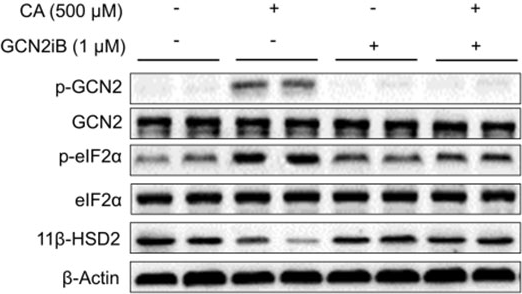
GCN2iB acetate purchased from MedChemExpress. Usage Cited in: FASEB J. 2023 Mar;37(3):e22820. [Abstract]
GCN2iB (1 μM; 12 h) significantly inhibits Cholic acid (CA)-induced phosphorylation of GCN2 and eIF2α in HTR8/SVneo cells.
-
J Biol Chem
An inhibitor of GCN2 and the integrated stress response directly targets ZAK protein kinase to limit cytotoxicity. [Abstract]2026 Jun;302(6):111482. PMID: 42031169 -
Pharm Res
Regulatory Role of eIF2αK4 in Amino Acid Transporter Expression in Mouse Brain Capillary Endothelial Cells. [Abstract]2024 Nov;41(11):2213-2223. PMID: 39532778 -
J Biol Chem
2023 Apr;299(4):104595 PMID: 36898579 -
J Biol Chem
2022 Oct;298(10):102406. PMID: 35988641 -
J Biol Chem
The eIF2 kinase GCN2 directs keratinocyte collective cell migration during wound healing via coordination of reactive oxygen species and amino acids. [Abstract]2021 Nov;297(5):101257. PMID: 34597669 -
Life Sci Alliance
An ISR-independent role of GCN2 prevents excessive ribosome biogenesis and mRNA translation. [Abstract]2025 Mar 3;8(5):e202403014. PMID: 40032489 -
Mol Biol Cell
PERK protein kinase facilitates keratinocyte collective cell migration by engagement with cell adhesion molecules, independent of its kinase activity. [Abstract]2025 Sep 24:mbcE25060277. PMID: 40991407 -
Biochem Biophys Res Commun
GCN2 suppression attenuates cerebral ischemia in mice by reducing apoptosis and endoplasmic reticulum (ER) stress through the blockage of FoxO3a-regulated ROS production. [Abstract]2019 Aug 13;516(1):285-292. PMID: 31255283 -
-
-
-
-
-
bioRxiv
Environmental Amino Acid Sensing Regulates the Rate of ASC Translation and NLRP3 Inflammasome Assembly. [Abstract]2026 Jan 20:2026.01.16.699988. PMID: 41648523 -
bioRxiv
A dietary pan-amino acid dropout screen in vivo reveals a critical role for histidine in T-ALL. [Abstract]2025 Dec 23:2025.12.21.694897. PMID: 41509383 -
-
-
-
bioRxiv
Replating induces mTOR-dependent rescue of protein synthesis in Charcot-Marie-Tooth diseased neurons. [Abstract]2025 Aug 31:2025.08.26.672367. PMID: 40909707 -
bioRxiv
2025 Aug 5:2025.08.04.668575. PMID: 40799579 -
bioRxiv
The mevalonate pathway couples lipid metabolism to amino acid synthesis via ubiquinone-dependent redox control. [Abstract]2025 Aug 12:2025.08.10.669191. PMID: 40832310 -
-
-
-
bioRxiv
BRAFV600 and ErbB inhibitors directly activate GCN2 in an off-target manner to limit cancer cell proliferation. [Abstract]2024 Dec 20:2024.12.19.629301. PMID: 39763857 -
-
-
-
Sci Total Environ
Microcystin-LR inhibits testosterone synthesis via reactive oxygen species-mediated GCN2/eIF2α pathway in mouse testes. [Abstract]2021 Aug 10:781:146730. PMID: 33798882 -
-


Purity & Documentation
References
[1]. Nakamura A, et al. Inhibition of GCN2 sensitizes ASNS-low cancer cells to asparaginase by disrupting the amino acid response. Proc Natl Acad Sci U S A. 2018;115(33):E7776-E7785. [Content Brief]
[2]. Yuan J, et al. Inhibition of GCN2 Alleviates Cardiomyopathy in Type 2 Diabetic Mice via Attenuating Lipotoxicity and Oxidative Stress. Antioxidants (Basel). 2022;11(7):1379. Published 2022 Jul 16. [Content Brief]

Calculators
Concentration (start) × Volume (start) = Concentration (final) × Volume (final)


GCN2iB acetate Related Classifications
HY-112654A Related Classifications
 Powered by Bioz