



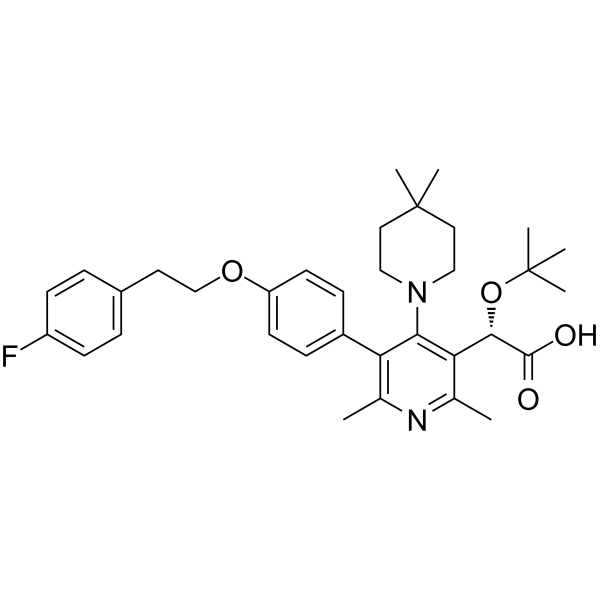
GSK3739936
GSK3739936 (BMS-986180) is a potent HIV-1 allosteric integrase inhibitor with an IC50 value of 11.1 nM and an EC50 value of 1.7 nM. GSK3739936 is also a weak CYP inhibitor (IC50>24.3 μM). GSK3739936 shows favorable pharmacokinetic property in preclinical species with rapid absorption, low to moderate clearance and excellent oral bioavailability.
For research use only. We do not sell to patients.
- CAS No.: 1803444-21-4
- Formula: C34H43FN2O4
- Molecular Weight:562.71
-
Storage:
Please store the product under the recommended conditions in the Certificate of Analysis.

To place orders, for customer services and technical support, please contact: MedChemExpress USA
Tel: 609-228-6898 E-mail: [email protected] [email protected]


-
 Biological Activity
-
Chemical Information
- Protocols
- Purity & Documentation
- References
-
 Help & FAQs




Biological Activity
Description
IC50 & Target
IC50: 11.1 nM (HIV-1 integrase)[1]
EC50: 1.7 nM (HIV-1 integrase)[1]
IC50: >24.3 μM (CYP)[1]
Cellular Effect
|
Cell Line

|
Type | Value | Description | References |
|---|---|---|---|---|
| MT2 | CC50 |
≥33.5 μM
Compound: 29
|
Cytotoxicity against human MT2 cells assessed as cell viability measured after 4 days by XTT assay
Cytotoxicity against human MT2 cells assessed as cell viability measured after 4 days by XTT assay
|
[PMID: 35235334] |
| MT2 | CC50 |
>=18.2 μM
Compound: 1
|
Cytotoxicity against human MT2 cells infected with HIV1 NLRep-Rluc harbouring polymorphic 124T/125T integrase
Cytotoxicity against human MT2 cells infected with HIV1 NLRep-Rluc harbouring polymorphic 124T/125T integrase
|
[PMID: 35605346] |
| MT2 | CC50 |
>=22 μM
Compound: 4; GSK37399363
|
Cytotoxicity against human MT2 cells
Cytotoxicity against human MT2 cells
|
[PMID: 35707159] |
In Vitro
GSK3739936 is not cytotoxic to MT-2 cells, exhibiting CC50 values of >20 μM[1].
MedChemExpress (MCE) has not independently confirmed the accuracy of these methods. They are for reference only.
In Vivo
Pharmacokinetic Parameters of GSK3739936 in Preclinical Species[1].
| Male CD-1 mice | Male Sprague-Dawley rats | Cynomolgus monkey | Male beagle dogs | |
| IV dose (mg/kg) | 1 | 1 | 1 | 1 |
| CL (mL/min/kg) | 5.4 | 5.5 | 14.5 | 2.9 |
| t1/2 (h) | 6.3 | 4.3 | 2.4 | 5.1 |
| Vss (L/kg) | 2.4 | 1.8 | 1.5 | 0.7 |
| PO dose (mg/kg) | 5 | 5 | 2 | 2 |
| Cmax (nM) | 2361 | 2762 | 525 | 2963 |
| tmax (h) | 5 | 2.7 | 2 | 2 |
| AUC (nM·h) | 24516 | 14022 | 2231 | 18471 |
| F (%) | 89 | 52 | 54 | 75 |
MedChemExpress (MCE) has not independently confirmed the accuracy of these methods. They are for reference only.
-
Animal Model:Male CD-1 mice, male Sprague-Dawley rats, cynomolgus monkey and male beagle dogs[1]
-
Dosage:1 mg/kg for IV; 5 or 2 mg/kg for PO
-
Administration:PO or IV; single dosage
-
Result:Exhibited a low clearance in the mouse, rat, and dog with moderate to long elimination half-lives, while displays moderate clearance and a short elimination half-life in the cynomolgus monkey.
The absolute oral bioavailability ranged between 52 and 89%.
The tmax value of 2-5 h suggesting rapid absorption in all four species.


Chemical Information
-
CAS No. 1803444-21-4
-
Molecular Weight 562.71
-
Formula C34H43FN2O4
-
SMILES
CC1=NC(C)=C(C(N2CCC(C)(CC2)C)=C1[C@@H](C(O)=O)OC(C)(C)C)C3=CC=C(C=C3)OCCC4=CC=C(C=C4)F
-
Synonyms
BMS-986180
-
Shipping
Room temperature in continental US; may vary elsewhere.
-
Storage
Please store the product under the recommended conditions in the Certificate of Analysis.


Purity & Documentation
References

Calculators
Concentration (start) × Volume (start) = Concentration (final) × Volume (final)


GSK3739936 Related Classifications
HY-150080 Related Classifications
 Powered by Bioz