



HPA-12
Based on 1 publication(s) in Google Scholar
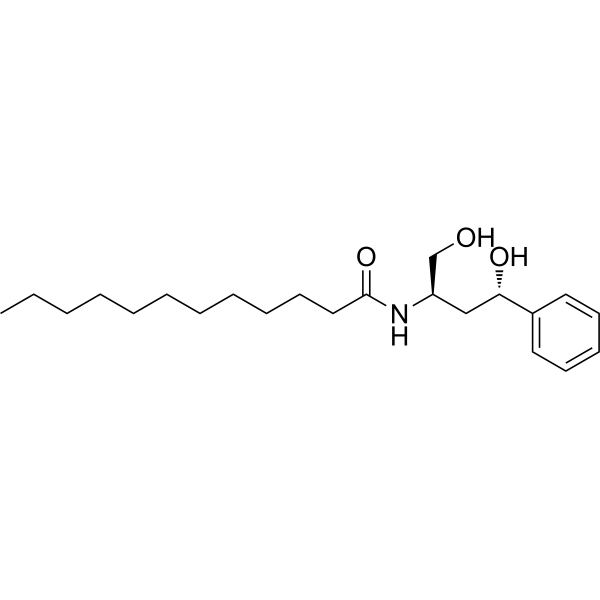
HPA-12 is a blood-brain barrier-permeable small-molecule inhibitor of ceramide transfer protein (CERT) with four stereoisomers (the (1R,3R)-stereoisomer exhibits the highest activity). HPA-12 blocks the transport of ceramide from the endoplasmic reticulum to the Golgi apparatus by binding to the START domain of CERT, leading to intracellular ceramide accumulation and inhibition of sphingomyelin (SM) synthesis. HPA-12 induces endoplasmic reticulum stress via the GRP78/ATF6/CHOP axis and activates mitochondrial autophagy, thereby inhibiting cell growth and inducing apoptosis. In in vivo experiments, HPA-12 significantly reduces the leukemia burden and splenomegaly in mouse models of acute myeloid leukemia (AML) and prolongs survival. HPA-12 is applicable for the research of lipid metabolism in acute myeloid leukemia and Alzheimer's disease.
Nos produits utilisent uniquement pour la recherche. Nous ne vendons pas aux patients.
- Pureté : 99.4%
- CAS No.: 383418-30-2
- Formule: C22H37NO3
- Masse moléculaire:363.53
-
Stockage:Powder -20°C, 3 years , 4°C, 2 years ; In solvent -80°C, 6 months , -20°C, 1 month

To place orders, for customer services and technical support, please contact: MedChemExpress USA
Tel: 609-228-6898 E-mail: [email protected] [email protected]


-
 Activité biologique
-
Chemical Information
-
Solvant et solubilité
- Protocole
- Pureté et documentation
- Références
-
 Help & FAQs


Publications Citing Use of MedChemExpress (MCE) HPA-12
More

Activité biologique
Description
In Vitro
HPA-12 (60-100 μM; 48 h) reduces the viability and proliferation of FLT3ITD+ MV4-11 and Molm13 acute myeloid leukemia (AML) cell lines in a dose-dependent manner, but exerts no effect on FLT3-WT AML cell lines after 48 h of treatment[1].
Treatment with HPA-12 (100 μM; 48 h) induces apoptosis in FLT3ITD+-type Molm13 AML cells[1].
HPA-12 (2.5 μM; 30 min) inhibits CERT-mediated intracellular trafficking of fluorescent ceramide analogs in HeLa cells and prevents the accumulation of such analogs in the perinuclear Golgi region[2].
HPA-12 (0.1-2.5 μM; 2-5 h) potently and concentration-dependently inhibits de novo SM synthesis in CHO cells, exerts weak effects on Cer and GlcCer synthesis, and has no impact on the synthesis of phosphatidylethanolamine or phosphatidylserine[3].
HPA-12 (2.5 μM; 48 h) reduces the content of SM by approximately 30% in CHO cells, while increasing the content of glycosphingolipids, without altering the content of total phospholipids or Cer, nor inhibiting the synthesis of PC (1 μM HPA-12; 4 h)[3].
HPA-12 (20 μM; 10 min-1 h) is not an in vitro inhibitor of SM synthase or other key enzymes involved in de novo sphingolipid synthesis[3].
(1R,3R)-HPA-12 (1 μM; 15 min pre-treatment + 30 min exposure) primarily inhibits the ATP-dependent pathway of ceramide transport from the endoplasmic reticulum to sphingomyelin (SM) synthesis sites in CHO cells[3].
(1R,3R)-HPA-12 (2.5 μM; 0-120 min) does not inhibit the trafficking of GPI-anchored or transmembrane glycoproteins from the endoplasmic reticulum (ER) to the Golgi apparatus in CHO cells[3].
MedChemExpress (MCE) has not independently confirmed the accuracy of these methods. They are for reference only.
-
Cell Line:FLT3-ITD+ MV4-11, Molm13; FLT3-WT HL-60, THP-1, OCI-AML3, Kasumi-1, KG-1α
-
Concentration:60-100 μM
-
Incubation Time:48 h
-
Result:Significantly inhibited the viability of FLT3ITD+ MV4-11 and Molm13 cells in a dose-dependent manner.
Had no obvious effect on FLT3WT AML cell lines at the same concentrations.
-
Cell Line:FLT3-ITD+ Molm13 AML cell line
-
Concentration:60-100 μM
-
Incubation Time:48 h
-
Result:Induced a dose-dependent decrease in cell proliferation.
Significantly reduced EdU-positive cell percentages at 100 μM compared to vehicle control.
-
Cell Line:FLT3-ITD+ Molm13 AML cell line
-
Concentration:60-100 μM
-
Incubation Time:48 h
-
Result:Promoted apoptosis.
Significantly increased the percentage of apoptotic cells at 100 μM compared to vehicle control.
In Vivo
[18F]HPA-12 (1.5 MBq; i.v.; single administration), a radiolabeled form of HPA-12, crosses the blood-brain barrier and accumulates in the brain of wild-type mice. Its uptake exhibits brain region dependence, with an average SUV of approximately 0.3 at 1 h post-injection[2].
MedChemExpress (MCE) has not independently confirmed the accuracy of these methods. They are for reference only.
-
Animal Model:B-NDG mice with Acute myeloid leukemia (AML) (6-8-week-old female; AML xenograft model via intravenous injection of 1×10⁶ MV4-11-luc+ cells)[1]
-
Dosage:4 mg/kg (monotherapy);
4 mg/kg + 15 mg/kg Creno (combination therapy) -
Administration:s.c.; 5 days on, 2 days off; 2 cycles; i.p. (Creno, 5 days on, 2 days off; 2 cycles)
-
Result:Reduced spleen enlargement compared to untreated mice.
Lowered human CD33+/CD45+ cell burden in bone marrow compared to untreated mice.
Dramatically reduced bioluminescence signals on Day 27 when combined with Creno.
Prolonged survival compared to untreated, HPA-12 monotherapy, or Creno monotherapy groups when combined with Creno.
Achieved the greatest reduction in spleen weight when combined with Creno.
Resulted in the lowest human CD33+/CD45+ cell burden in bone marrow when combined with Creno.
Led to the lowest leukemia burden in bone marrow and spleen as measured by human CD45 IHC staining when combined with Creno.
Caused slight body weight loss in monotherapy group; showed no obvious body weight change in combination group.
-
Animal Model:C57Bl6/J mice (male, 2 months of age)[2]
-
Dosage:1.5 MBq
-
Administration:i.v.; single dose
-
Result:Reached a standard uptake value (SUV) of ~0.3 in brain one hour post-injection.
Showed highest regional SUV in the olfactory bulb, followed by cortex, hypothalamus, basal forebrain septum, and cerebellum.
Achieved brain uptake of 0.64%ID/g (hindbrain-midbrain), 0.70%ID/g (forebrain), and 0.89%ID/g (olfactory bulb) post-perfusion.
Revealed 12% of radioactivity as intact target reagent, 20% as free 18F, 1% as an unknown metabolite, and 67% bound to brain cells via HPLC analysis of brain tissue.
- Annexin V plus membrane-impermeant dye apoptosis staining
- Somatic Cell Culture
- CCK-8/WST-8 Cell Proliferation Assay
- Cell Counting-Based Growth Curve Assay
- Cell Viability Determination by MTT Colorimetric Assay
- Alzheimer’s Disease Modeling
- Detection of Apoptosis
- TUNEL staining for apoptotic DNA fragmentation
- Protocol for Cell Counting and Cell Density Analysis
- Autophagy
- Apoptosis Solutions
- Lysosome and acidic-vesicle live-cell staining
- Mitophagy Solutions
- MTT Cell Proliferation Assay
- Macroautophagy Solutions


Chemical Information
-
CAS No. 383418-30-2
-
Appearance Solid
-
Masse moléculaire 363.53
-
Formule C22H37NO3
-
Color White to off-white
-
SMILES
CCCCCCCCCCCC(N[C@@H](CO)C[C@H](O)C1=CC=CC=C1)=O
-
Livraison
Room temperature in continental US; may vary elsewhere.
-
Stockage
Powder -20°C 3 years 4°C 2 years In solvent -80°C 6 months -20°C 1 month


Publications (1)
-
Journal Impact Factor
-
Most Recent


Solvant et solubilité
In Vitro:
DMSO : ≥ 2 mg/mL (5.50 mM; Hygroscopic DMSO has a significant impact on the solubility of product, please use newly opened DMSO)
* "≥" means soluble, but saturation unknown.
Please refer to the solubility information to select the appropriate solvent. Once prepared, please aliquot and store the solution to prevent product inactivation from repeated freeze-thaw cycles.
Storage method and period of stock solution: -80°C, 6 months; -20°C, 1 month. When stored at -80°C, please use it within 6 months. When stored at -20°C, please use it within 1 month.
Please refer to the solubility information to select the appropriate solvent. Once prepared, please aliquot and store the solution to prevent product inactivation from repeated freeze-thaw cycles.
Storage method and period of stock solution: -80°C, 6 months; -20°C, 1 month. When stored at -80°C, please use it within 6 months. When stored at -20°C, please use it within 1 month.
Concentration (start) × Volume (start) = Concentration (final) × Volume (final)


Pureté et documentation
-
Fiche technique (279 KB)
-
SDS (393 KB)
- English - EN (393 KB)
- Français - FR (393 KB)
- Deutsch - DE (393 KB)
- Norwegian - NO (393 KB)
- Español - ES (393 KB)
- Swedish - SV (393 KB)
- Italian - IT (393 KB)
- Korean - KR (393 KB)
- Portuguese - PT (393 KB)
-
Instruction de manipulation (2659 KB)
Références
[1]. Sun X, et al. Targeting ceramide transfer protein sensitizes AML to FLT3 inhibitors via a GRP78-ATF6-CHOP axis. Nat Commun. 2025;16(1):1358. Published 2025 Feb 4. [Content Brief]
[2]. Crivelli SM, et al. Synthesis, Radiosynthesis, and Preliminary in vitro and in vivo Evaluation of the Fluorinated Ceramide Trafficking Inhibitor (HPA-12) for Brain Applications. J Alzheimers Dis. 2017;60(3):783-794. [Content Brief]
[3]. Yasuda S, et al. A novel inhibitor of ceramide trafficking from the endoplasmic reticulum to the site of sphingomyelin synthesis. J Biol Chem. 2001;276(47):43994-44002. [Content Brief]


Complete Stock Solution Preparation Table
Please refer to the solubility information to select the appropriate solvent. Once prepared, please aliquot and store the solution to prevent product inactivation from repeated freeze-thaw cycles.
Storage method and period of stock solution: -80°C, 6 months; -20°C, 1 month. When stored at -80°C, please use it within 6 months. When stored at -20°C, please use it within 1 month.
| Optional Solvent | Concentration Solvent Mass | 1 mg | 5 mg | 10 mg | 25 mg |
|---|---|---|---|---|---|
| DMSO | 1 mM | 2.7508 mL | 13.7540 mL | 27.5080 mL | 68.7701 mL |
| 5 mM | 0.5502 mL | 2.7508 mL | 5.5016 mL | 13.7540 mL |


HPA-12 Related Classifications
HY-132182 Related Classifications
 Powered by Bioz