



Inosine oxime
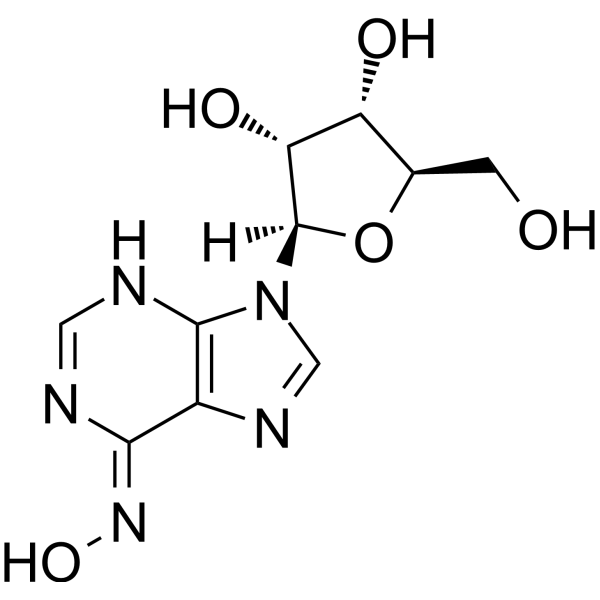
Inosine oxime (6-Hydroxyadenosine) is an endogenous metabolite in the course of cell metabolism by cytochrome P450, by oxidative stress or by deviating nucleotide biosynthesis. Inosine oxime has toxic and mutagenic for procaryotic and eucaryotic cells.
For research use only. We do not sell to patients.
- CAS No.: 3414-62-8
- Formula: C10H13N5O5
- Molecular Weight:283.24
-
Storage:
Please store the product under the recommended conditions in the Certificate of Analysis.

To place orders, for customer services and technical support, please contact: MedChemExpress USA
Tel: 609-228-6898 E-mail: [email protected] [email protected]


-
 Biological Activity
-
Chemical Information
- Protocols
- Purity & Documentation
- References
-
 Help & FAQs


All Endogenous Metabolite Isoforms
More

Biological Activity
Description
Cellular Effect
|
Cell Line

|
Type | Value | Description | References |
|---|---|---|---|---|
| Caco-2 | GI50 |
>100 μM
Compound: 1
|
Antiproliferative activity against human Caco2 cells after 72 hrs by MTS assay
Antiproliferative activity against human Caco2 cells after 72 hrs by MTS assay
|
[PMID: 21349610] |
| HeLa | GI50 |
3.4 μM
Compound: 1
|
Antiproliferative activity against human HeLa cells after 72 hrs by MTS assay
Antiproliferative activity against human HeLa cells after 72 hrs by MTS assay
|
[PMID: 21349610] |
| HT-29 | GI50 |
15 μM
Compound: 1
|
Antiproliferative activity against human HT-29 cells after 72 hrs by MTS assay
Antiproliferative activity against human HT-29 cells after 72 hrs by MTS assay
|
[PMID: 21349610] |
| K562 | GI50 |
31 μM
Compound: 1
|
Antiproliferative activity against human K562 cells after 72 hrs by MTS assay
Antiproliferative activity against human K562 cells after 72 hrs by MTS assay
|
[PMID: 21349610] |
| KB | CC50 |
44.3 μM
Compound: 1a
|
Cytotoxicity against human KB cells
Cytotoxicity against human KB cells
|
[PMID: 17548196] |
| Leukemia cell | IC50 |
0.9 μM
Compound: 13
|
Cytotoxicity against mouse leukemia cells
Cytotoxicity against mouse leukemia cells
|
[PMID: 26314922] |
| MCF7 | GI50 |
>100 μM
Compound: 1
|
Antiproliferative activity against human MCF7 cells after 72 hrs by MTS assay
Antiproliferative activity against human MCF7 cells after 72 hrs by MTS assay
|
[PMID: 21349610] |
In Vitro
Inosine oxime (6-Hydroxyadenosine) (1-5 nM) has reductive detoxication through direct dehydroxylamination catalyzed by adenosine deaminase to inosine and decreases inosine formation by 35% with knockdown of mARC1 in HEK-293.
MedChemExpress (MCE) has not independently confirmed the accuracy of these methods. They are for reference only. Further protocols information, click here.


Chemical Information
-
CAS No. 3414-62-8
-
Molecular Weight 283.24
-
Formula C10H13N5O5
-
SMILES
O[C@H]1[C@](O[C@@H]([C@H]1O)CO)([H])N2C3=C(/C(N=CN3)=N/O)N=C2
-
Synonyms
6-Hydroxyadenosine
-
Structure Classification
-
Initial Source
-
Shipping
Room temperature in continental US; may vary elsewhere.
-
Storage
Please store the product under the recommended conditions in the Certificate of Analysis.

Protocols
-
ROS/oxidative-stress fluorescent staining
ROS/oxidative-stress fluorescent staining uses cell-permeant fluorogenic probes that become fluorescent after oxidation inside cells or tissues; commonly used examples include DCFH-DA/DCFDA for broad cellular oxidant detection, DHE for superoxide-related signal detection, MitoSOX for mitochondrial superoxide-related signal detection, and CellROX probes for oxidative-stress-associated fluorescence readouts. The assay detects probe oxidation rather than a single ROS species unless the probe and analysis method have been chemically validated for that species. DCFH-DA enters cells, is deacetylated by intracellular esterases to DCFH, and produces fluorescent DCF after oxidation, so the readout is used as an operational measure of total cellular oxidative stress rather than a species-specific ROS measurement. DHE and MitoSOX can report superoxide-related oxidation, but red fluorescence alone can include non-specific ethidium-like oxidation products; HPLC or optimized spectral approaches are
-
Genotoxicity/Mutagenicity Study
The bacterial reverse mutation assay detects point mutations that restore amino-acid prototrophy in auxotrophic Salmonella typhimurium or Escherichia coli tester strains; after exposure to a test article, mutagenic activity is read out as an increased number of revertant colonies on minimal agar compared with the vehicle control. The assay uses tester strains with different mutation targets so that base-substitution and frameshift mutagens can be detected, and testing is performed with and without exogenous mammalian metabolic activation because some chemicals require biotransformation to become mutagenic.


Purity & Documentation
References
[1]. Plitzko B, et, al. The pivotal role of the mitochondrial amidoxime reducing component 2 in protecting human cells against apoptotic effects of the base analog N6-hydroxylaminopurine. J Biol Chem. 2015 Apr 17;290(16):10126-35. [Content Brief]
[2]. Krompholz N, et, al. The mitochondrial Amidoxime Reducing Component (mARC) is involved in detoxification of N-hydroxylated base analogues. Chem Res Toxicol. 2012 Nov 19;25(11):2443-50. [Content Brief]

Calculators
Concentration (start) × Volume (start) = Concentration (final) × Volume (final)


Inosine oxime Related Classifications
HY-118793 Related Classifications
 Powered by Bioz