



Yes
YES1, a Src family non-receptor tyrosine kinase, regulates adhesion, motility, survival, mitosis, viability, growth, cell-cycle progression, and genomic stability in cancer models[1]. Mechanistically, YES1 connects tyrosine kinase signaling with the Hippo-YAP1 axis, because YES1 phosphorylation of YAP1 supports a β-catenin-YAP1-TBX5 transcriptional complex required for β-catenin-driven cancer survival[2]. In lung cancer models, YES1 or YAP1 overexpression promoted EGF-independent growth and resistance to EGFR or ALK inhibitors, while dual inhibition of the primary driver and YES1 restored sensitivity[3]. In triple-negative breast cancer, sustained YES1 expression supported viability and growth, whereas YES1 loss increased apoptosis, G2/M delay, micronucleation, multinucleation, dysmorphic nuclei, and γ-H2AX staining[1]. Compared with SRC, YES1 showed divergent endothelial signaling: YES1 activation blunted cytomix-induced ERK signaling and increased apoptosis, whereas SRC activated PI3K-Akt-ERK signaling and attenuated apoptosis[4]. For experimental applications, NXP900/eCF506 inhibited YES1 at 0.47 nM, locked SRC-family kinases in a closed conformation, reduced YAP1 nuclear localization, and inhibited proliferation in NSCLC, ESCC, FAT1-mutated xenograft, and endocrine-resistant breast cancer models[1].
References:
- [1]. Ali SR, et al. Nerve Density and Neuronal Biomarkers in Cancer. Cancers (Basel). 2022 Oct 1;14(19):4817. [Content Brief]
- [2]. Rosenbluh J, et al. β-Catenin-driven cancers require a YAP1 transcriptional complex for survival and tumorigenesis. Cell. 2012 Dec 21;151(7):1457-73. [Content Brief]
- [3]. Sato H, et al. SRC Family Kinase Inhibition Targets YES1 and YAP1 as Primary Drivers of Lung Cancer and as Mediators of Acquired Resistance to ALK and Epidermal Growth Factor Receptor Inhibitors. JCO Precis Oncol. 2022 Aug;6:e2200088. [Content Brief]
- [4]. Nelin LD, et al. The Src family tyrosine kinases src and yes have differential effects on inflammation-induced apoptosis in human pulmonary microvascular endothelial cells. Am J Physiol Lung Cell Mol Physiol. 2016 May 1;310(9):L880-8. [Content Brief]
All Product Categories
-
Yes Related Products (6)
Related Products (6)

-
GLPG3312
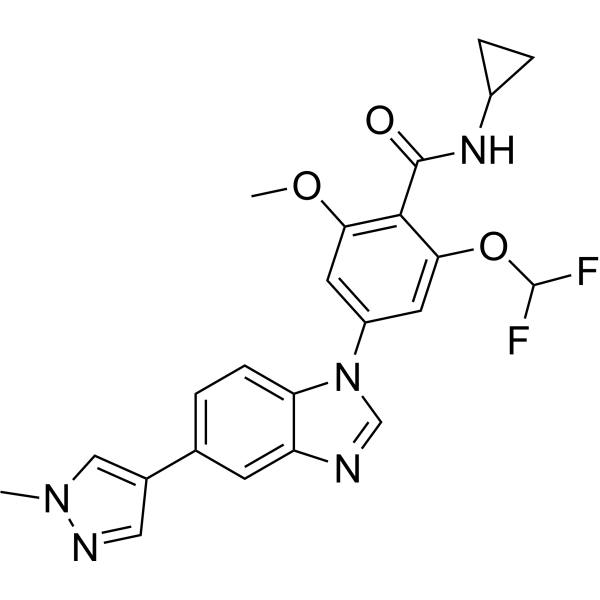 0 ImagesGLPG3312 (Compound 28) is an orally active SIK inhibitor with IC50 values of 2.0 nM, 0.7 nM and 0.6 nM for SIK1, SIK2 and SIK3, respectively. GLPG3312 exhibits anti-inflammatory and immunomodulatory activity in vitro on human primary myeloid cells and in vivo in mouse models. GLPG3312 has good oral bioavailability and can be used for research on inflammatory and immune diseases.
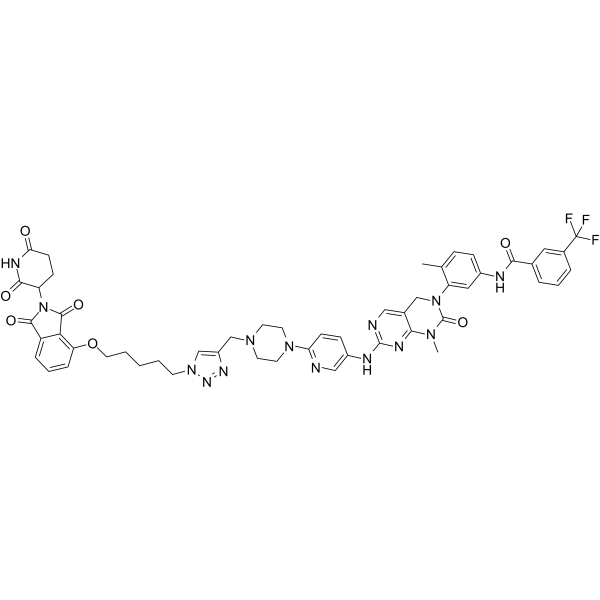
-
AP-24567
 0 ImagesCat. No.: HY-125142CAS No.: 943319-87-7AP-24567 is a Ligands for Target Protein for PROTAC, which can be used for the synthesis of SB1-G-187 (HY-137342).
-
Antifibrotic agent 1
 0 ImagesCat. No.: HY-176194Antifibrotic agent 1 is an orally active anti-idiopathic pulmonary fibrosis (IPF) agent. Antifibrotic agent 1 effectively attenuates IPF-related processes, including TGF-β induced EMT and FMT processes, as well as pro-fibrotic M2 polarization. Antifibrotic agent 1 selectively inhibits CSF-1R, PDGFR-α and Src family kinases (SFKs), while sparing VEGFRs, FGFRs and Abl to minimize off-target toxicity. Antifibrotic agent 1 has potent anti-fibrotic activity in Bleomycin (BLM) (HY-108345)-induced pulmonary fibrosis mice model.

-
SIK1-IN-1
 0 ImagesCat. No.: HY-178014SIK1-IN-1 (Compound 27) is a selective Salt-inducible kinase 1 (SIK1) inhibitor with an IC50 of 0.7 nM for SIK1 over SIK2 and SIK3. SIK1-IN-1 has no cytotoxicity against HEK293 cells and PBMCs (maximum concentration of 30 μM). SIK1-IN-1 also has potent inhibitory activities for 392 kinases, in particular tyrosine kinases, such as FGR, HCK and LYN).



