



Dynole 34-2
Based on 1 publication(s) in Google Scholar
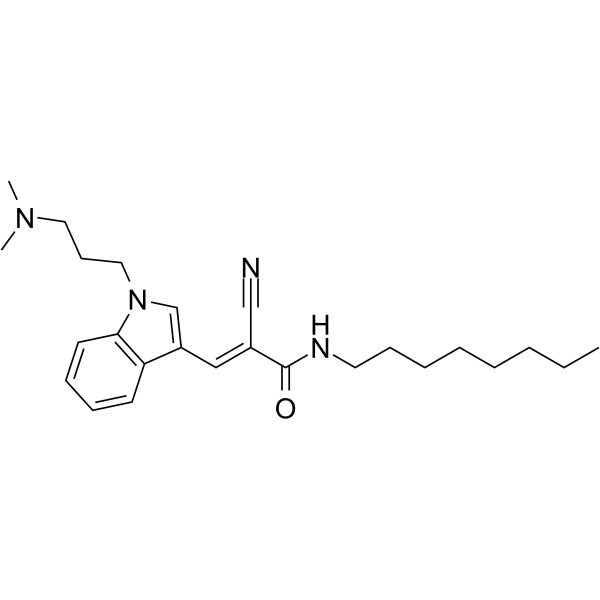
Dynole 34-2 is a potent dynamin GTPase inhibitor (IC50s=6.9 and 14.2 µM for dynamin1 and dynamin2 GTPase activity, respectively) with antimitotic effect. Dynole 34-2 induces apoptosis, as revealed by cell blebbing, DNA fragmentation, and PARP cleavage. Dynole 34-2 also potently inhibits receptor mediated endocytosis (RME).
For research use only. We do not sell to patients.
- Purity: 99.25%
- CAS No.: 1128165-88-7
- Formula: C25H36N4O
- Molecular Weight:408.58
-
Storage:
4°C, protect from light
* In solvent : -80°C, 6 months; -20°C, 1 month (protect from light)

To place orders, for customer services and technical support, please contact: MedChemExpress USA
Tel: 609-228-6898 E-mail: [email protected] [email protected]


-
 Biological Activity
-
Chemical Information
-
Solvent & Solubility
- Purity & Documentation
- References
-
 Help & FAQs
-


Apoptosis Compound Library
HY-L003
-
Anti-Cancer Compound Library
HY-L025
-
Covalent Screening Library
HY-L036
-
Cytoskeleton Compound Library
HY-L060
-
Cell Death Library
HY-L162
-
Bioactive Compound Library Max
HY-L181
-
MCE Bioactive Compound Library
HY-L001V
-
Covalent Screening Library Plus
HY-L036P
-
Bioactive Compound Library
HY-L001
-
Non-Alcoholic Fatty Liver Disease (NAFLD) Compound Library
HY-L199
-
High-Throughput Bioactive Compound Library
HY-L205


Publications Citing Use of MedChemExpress (MCE) Dynole 34-2
More

Biological Activity
|
Cell Line

|
Type | Value | Description | References |
|---|---|---|---|---|
| U2OS | IC50 |
5 μM
Compound: 12451
|
Inhibition of dynamin 1-mediated endocytosis internalization of Tf-A594 in human U2OS cells pretreated for 30 mins
Inhibition of dynamin 1-mediated endocytosis internalization of Tf-A594 in human U2OS cells pretreated for 30 mins
|
[PMID: 19459681] |
| U2OS | IC50 |
5 μM
Compound: 2
|
Inhibition of dyn2 in human U2OS cells assessed as clathrin-mediated endocytosis of Tfn after 30 mins
Inhibition of dyn2 in human U2OS cells assessed as clathrin-mediated endocytosis of Tfn after 30 mins
|
[PMID: 23167654] |
Dynole 34-2 (10 μM, 7 days) remaines >98% of cells viable in five fibroblast cell lines (hTert-immortalized breast stromal fibroblast, two primary skin fibroblast lines, a primary myoblast cell line, and NIH3T3 mouse fibroblasts), showing little cytotoxicity[1].
Dynole 34-2 (10 μM, 30 min) inhibition leads to a complete block in receptor mediated endocytosis in U2OS cells[1].
Dynole 34-2 (10 μM, 6 h, over 20 h, 72 h) induces multinucleation, causes cytokinesis failure, blocking cell growth and inducing cell death in HeLa cells and SMA-560 cells[2].
MedChemExpress (MCE) has not independently confirmed the accuracy of these methods. They are for reference only.
-
Cell Line:U2OS cells
-
Concentration:10 μM
-
Incubation Time:30 min
-
Result:Blocked internalization of Tf-TxR in U2OS cells.
-
Cell Line:HeLa cells
-
Concentration:10 μM
-
Incubation Time:72 h
-
Result:Prevented cell proliferation and reduced viability in a range of cancer cell lines.


Chemical Information
-
CAS No. 1128165-88-7
-
Appearance Solid
-
Molecular Weight 408.58
-
Formula C25H36N4O
-
Color Light yellow to yellow
-
SMILES
N#C/C(C(NCCCCCCCC)=O)=C\C1=CN(CCCN(C)C)C2=C1C=CC=C2
-
Shipping
Room temperature in continental US; may vary elsewhere.
-
Storage
4°C, protect from light
* In solvent : -80°C, 6 months; -20°C, 1 month (protect from light)


Publications (1)
-
Journal Impact Factor
-
Most Recent
-
Cell Mol Immunol
Depleting profibrotic macrophages using bioactivated in vivo assembly peptides ameliorates kidney fibrosis. [Abstract]2024 Aug;21(8):826-841. PMID: 38871810


Solvent & Solubility
DMSO : 100 mg/mL (244.75 mM; Need ultrasonic; Hygroscopic DMSO has a significant impact on the solubility of product, please use newly opened DMSO)
Please refer to the solubility information to select the appropriate solvent. Once prepared, please aliquot and store the solution to prevent product inactivation from repeated freeze-thaw cycles.
Storage method and period of stock solution: -80°C, 6 months; -20°C, 1 month (protect from light). When stored at -80°C, please use it within 6 months. When stored at -20°C, please use it within 1 month.
Please refer to the solubility information to select the appropriate solvent. Once prepared, please aliquot and store the solution to prevent product inactivation from repeated freeze-thaw cycles.
Storage method and period of stock solution: -80°C, 6 months; -20°C, 1 month (protect from light). When stored at -80°C, please use it within 6 months. When stored at -20°C, please use it within 1 month.
Concentration (start) × Volume (start) = Concentration (final) × Volume (final)
Select the appropriate dissolution method based on your experimental animal and administration route.
- For the following dissolution methods, please ensure to first prepare a clear stock solution using an In Vitro approach and then sequentially add co-solvents:
- To ensure reliable experimental results, the clarified stock solution can be appropriately stored based on storage conditions. As for the working solution for In Vivo experiments, it is recommended to prepare freshly and use it on the same day.
- The percentages shown for the solvents indicate their volumetric ratio in the final prepared solution. If precipitation or phase separation occurs during preparation, heat and/or sonication can be used to aid dissolution.
Add each solvent one by one: 10% DMSO 40% PEG300 5% Tween-80 45% Saline
Solubility: ≥ 2.5 mg/mL (6.12 mM); Clear solution
This protocol yields a clear solution of ≥ 2.5 mg/mL (saturation unknown).
Taking 1 mL working solution as an example, add 100 μL DMSO stock solution (25.0 mg/mL) to 400 μL PEG300, and mix evenly; then add 50 μL Tween-80 and mix evenly; then add 450 μL Saline to adjust the volume to 1 mL.
Preparation of Saline: Dissolve 0.9 g sodium chloride in ddH₂O and dilute to 100 mL to obtain a clear Saline solution.
Please enter the basic information of animal experiments:
-
-
-
-
Recommended: Prepare an additional quantity of animals to account for potential losses during experiments.
Please enter your animal formula composition:
-
%DMSO +
Recommended: Keep the proportion of DMSO in working solution below 2% if your animal is weak.
-
%+
-
+%Tween-80 + +
-
%Saline +
The co-solvents required include: DMSO, . All of co-solvents are available by MedChemExpress (MCE). , Tween 80. All of co-solvents are available by MedChemExpress (MCE).
Working solution concentration: 0.22 mg/mL
Method for preparing stock solution: mg drug dissolved in μL DMSO. Stock solution concentration: mg/mL. * In solvent : -80°C, 6 months; -20°C, 1 month (protect from light)
1. Take μL DMSO stock solution;
2. Add μL .
μL , mix evenly;
3. Then add μL Tween 80, mix evenly;
4. Then add μL
Please ensure that the stock solution in the first step is dissolved to a clear state, and add co-solvents in sequence. You can use ultrasonic heating (ultrasonic cleaner, recommended frequency 20-40 kHz), vortexing, etc. to assist dissolution.


Purity & Documentation
-
Data Sheet (270 KB)
-
SDS (393 KB)
- English - EN (393 KB)
- Français - FR (393 KB)
- Deutsch - DE (393 KB)
- Norwegian - NO (393 KB)
- Español - ES (393 KB)
- Swedish - SV (393 KB)
- Italian - IT (393 KB)
- Korean - KR (393 KB)
- Portuguese - PT (393 KB)
-
Handling Instructions (2659 KB)
References
[1]. Chircop M, et al. Inhibition of dynamin by dynole 34-2 induces cell death following cytokinesis failure in cancer cells. Mol Cancer Ther. 2011 Sep;10(9):1553-62. [Content Brief]
[2]. Hill TA, et al. Inhibition of dynamin mediated endocytosis by the dynoles--synthesis and functional activity of a family of indoles. J Med Chem. 2009 Jun 25;52(12):3762-73. [Content Brief]


Complete Stock Solution Preparation Table
Please refer to the solubility information to select the appropriate solvent. Once prepared, please aliquot and store the solution to prevent product inactivation from repeated freeze-thaw cycles.
Storage method and period of stock solution: -80°C, 6 months; -20°C, 1 month (protect from light). When stored at -80°C, please use it within 6 months. When stored at -20°C, please use it within 1 month.
| Optional Solvent | Concentration Solvent Mass | 1 mg | 5 mg | 10 mg | 25 mg |
|---|---|---|---|---|---|
| DMSO | 1 mM | 2.4475 mL | 12.2375 mL | 24.4750 mL | 61.1875 mL |
| 5 mM | 0.4895 mL | 2.4475 mL | 4.8950 mL | 12.2375 mL | |
| 10 mM | 0.2448 mL | 1.2238 mL | 2.4475 mL | 6.1188 mL | |
| 15 mM | 0.1632 mL | 0.8158 mL | 1.6317 mL | 4.0792 mL | |
| 20 mM | 0.1224 mL | 0.6119 mL | 1.2238 mL | 3.0594 mL | |
| 25 mM | 0.0979 mL | 0.4895 mL | 0.9790 mL | 2.4475 mL | |
| 30 mM | 0.0816 mL | 0.4079 mL | 0.8158 mL | 2.0396 mL | |
| 40 mM | 0.0612 mL | 0.3059 mL | 0.6119 mL | 1.5297 mL | |
| 50 mM | 0.0490 mL | 0.2448 mL | 0.4895 mL | 1.2238 mL | |
| 60 mM | 0.0408 mL | 0.2040 mL | 0.4079 mL | 1.0198 mL | |
| 80 mM | 0.0306 mL | 0.1530 mL | 0.3059 mL | 0.7648 mL | |
| 100 mM | 0.0245 mL | 0.1224 mL | 0.2448 mL | 0.6119 mL |


Dynole 34-2 Related Classifications
HY-107545 Related Classifications
 Powered by Bioz