



ENMD-1068
Based on 3 publication(s) in Google Scholar
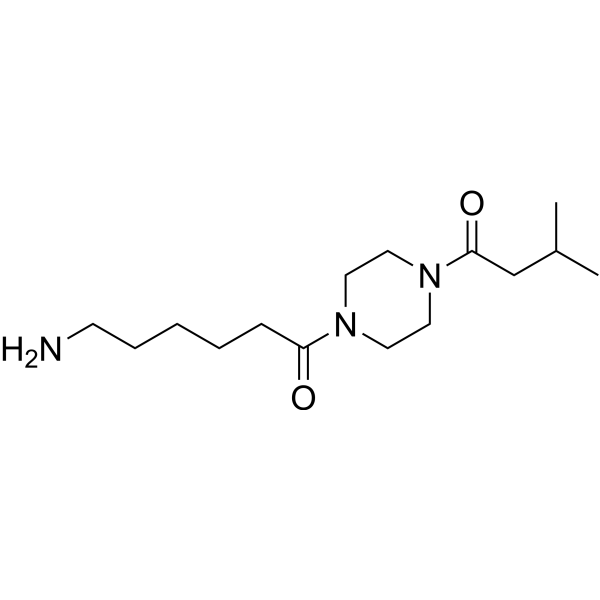
ENMD-1068 is a selective protease-activated receptor 2 (PAR2) antagonist. ENMD-1068 reduces hepatic stellate cell activation and collagen expression by inhibiting TGF-β1/Smad signaling. ENMD-1068 also inhibits the proliferation of endometrial cells and induces apoptosis of epithelial cells in the lesion. ENMD-1068 can be used in the study of endometriosis and liver fibrosis.
For research use only. We do not sell to patients.
- CAS No.: 789488-77-3
- Formula: C15H29N3O2
- Molecular Weight:283.41
-
Storage:
Please store the product under the recommended conditions in the Certificate of Analysis.

To place orders, for customer services and technical support, please contact: MedChemExpress USA
Tel: 609-228-6898 E-mail: [email protected] [email protected]


-
 Biological Activity
-
Chemical Information
- Purity & Documentation
- References
-
 Help & FAQs


Publications Citing Use of MedChemExpress (MCE) ENMD-1068
More

Biological Activity
|
PAR2 |
ENMD-1068 (10 mM; 24 h) blocks TGF-β1/Smad signaling in primary mouse HSCs (TGF-β1/Smad signal pathway plays a crucial role in HSCs activation and collagen production)[1].
ENMD-1068 (10 mM) inhibits trypsin or SLIGRL-NH2 stimulated calcium release in HSCs[1].
MedChemExpress (MCE) has not independently confirmed the accuracy of these methods. They are for reference only.
-
Cell Line:Hepatic stellate cells (HSCs) (TGF-β1-stimulated)
-
Concentration:10 mM
-
Incubation Time:24 h
-
Result:Inhibited TGF-β1-induced expression of α-SMA, Col α1(І),Col α1(III), and Smad2/3 C-terminal phosphorylation.
ENMD-1068 (25, 50 mg/kg; i.p.; single daily for 5 days) inhibits endometriosis growth and suppresses the levels of IL-6 and MCP-1 in a dose-dependent manner[2].
ENMD-1068 (25, 50 mg/kg; i.p.; single daily for 5 days) causes a decrease in epithelial cell proliferation and an increase in the apoptotic index in mice[2].
MedChemExpress (MCE) has not independently confirmed the accuracy of these methods. They are for reference only.
-
Animal Model:ICR mice (8-week-old; CCl4-induced liver fibrosis model)[1].
-
Dosage:25, 50 mg/kg
-
Administration:Intraperitoneal injection; twice per week for 4 weeks
-
Result:Markedly attenuated collagen deposition.
-
Animal Model:Mice with surgically induced endometriosis[2].
-
Dosage:25, 50 mg/kg
-
Administration:Intraperitoneal injection; single daily for 5 days
-
Result:Reduced the volume of observed lesions in a dose-dependent manner.
Inhibited the expression of IL-6 and MCP-1.
Decreased the proliferation rate of endometriotic cells and increased the percentage of apoptotic epithelial cells in the lesions.


Chemical Information
-
CAS No. 789488-77-3
-
Molecular Weight 283.41
-
Formula C15H29N3O2
-
SMILES
O=C(N1CCN(C(CC(C)C)=O)CC1)CCCCCN
-
Shipping
Room temperature in continental US; may vary elsewhere.
-
Storage
Please store the product under the recommended conditions in the Certificate of Analysis.


Publications (3)
-
Journal Impact Factor
-
Most Recent
-
Cancer Cell
Coagulation factor X promotes resistance to androgen-deprivation therapy in prostate cancer. [Abstract]2024 Oct 14;42(10):1676-1692.e11. PMID: 39303726 -
J Inflamm Res
Astragalus membranaceus and Salvia miltiorrhiza Inhibit Tryptase/PAR2-Mediated Mast Cells - Peritoneal Mesothelial Cells Crosstalk to Ameliorate Peritoneal Fibrosis. [Abstract]2026 May 11:19:577472. PMID: 42147796 -


Purity & Documentation
References
[1]. Sun Q, et al. ENMD-1068 inhibits liver fibrosis through attenuation of TGF-β1/Smad2/3 signaling in mice. Sci Rep. 2017 Jul 14;7(1):5498. doi: 10.1038/s41598-017-05190-7. Erratum in: Sci Rep. 2019 Dec 10;9(1):19125. [Content Brief]
[2]. Wang Y, et al. ENMD-1068, a protease-activated receptor 2 antagonist, inhibits the development of endometriosis in a mouse model. Am J Obstet Gynecol. 2014 Jun;210(6):531.e1-8. [Content Brief]

Calculators
Concentration (start) × Volume (start) = Concentration (final) × Volume (final)


ENMD-1068 Related Classifications
HY-124748 Related Classifications
 Powered by Bioz