



Pachypodol
Based on 1 publication(s) in Google Scholar
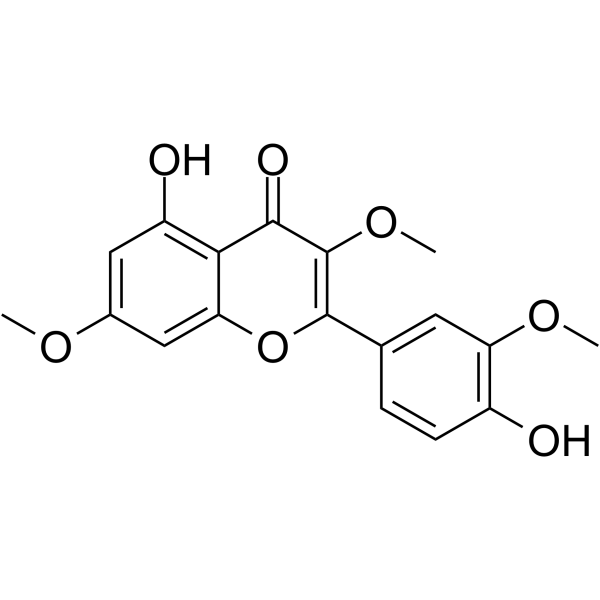
Pachypodol is an orally active methoxyflavonoid compound. Pachypodol activates the ERK-dependent Nrf2 pathway and inhibits Apoptosis. Pachypodol exhibits activities such as antioxidant, cytoprotective, anti-inflammatory effects. Pachypodol improves cognition. Pachypodol exerts protective effects against cardiac and liver damage. Pachypodol has anticancer activity against colon cancer.
商品は「研究用試薬」です。人や動物の医療用・臨床診断用・食品用の製品ではありません。
研究用途以外に使用した場合、当社は一切の責任を負いかねます。
- 純度: 99.82%
- CAS 番号: 33708-72-4
- 分子式: C18H16O7
- 分子量:344.32
-
保管条件:
4°C, sealed storage, away from moisture and light
* In solvent : -80°C, 6 months; -20°C, 1 month (sealed storage, away from moisture and light)

To place orders, for customer services and technical support, please contact: MedChemExpress USA
Tel: 609-228-6898 E-mail: [email protected] [email protected]


-
 生物活性
生物活性
-
化学情報
-
溶剤 & 溶解度
- 純度とドキュメンテーション
- 参考文献
-
 Help & FAQs
-

Apoptosis Compound Library
HY-L003
-
Cell Cycle/DNA Damage Compound Library
HY-L004
-
Immunology/Inflammation Compound Library
HY-L007
-
NF-κB Signaling Compound Library
HY-L014
-
Stem Cell Signaling Compound Library
HY-L017
-
Natural Product Library
HY-L021
-
Anti-Cancer Compound Library
HY-L025
-
Anti-Aging Compound Library
HY-L034
-
Antioxidant Compound Library
HY-L037
-
Oxygen Sensing Compound Library
HY-L045
-
Anti-Cardiovascular Disease Compound Library
HY-L046
-
Ferroptosis Compound Library
HY-L051
-
Endoplasmic Reticulum Stress Compound Library
HY-L054
-
Medicine Food Homology Compound Library
HY-L055
-
Phenols Library
HY-L057
-
Orally Active Compound Library
HY-L061
-
Traditional Chinese Medicine Active Compound Library
HY-L065
-
Flavonoids Library
HY-L068
-
Anti-Cancer Metabolism Compound Library
HY-L083
-
Anti-Obesity Compound Library
HY-L087
-
Transcription Factor-Targeted Library
HY-L090
-
Anti-Colorectal Cancer Compound Library
HY-L103
-
Anti-Cancer Natural Product Library
HY-L107
-
Anti-inflammatory Traditional Chinese Medicine Active Compound Library
HY-L114
-
Plant-Sourced Natural Product Library
HY-L115
-
Anti-Pulmonary Fibrosis Compound Library
HY-L125
-
Cell Death Library
HY-L162
-
Multi-Target Compound Library
HY-L176
-
Radioprotector Library
HY-L178
-
Bioactive Compound Library Max
HY-L181
-
MCE Bioactive Compound Library
HY-L001V
-
Natural Product Library Plus
HY-L021P
-
Natural Product and Natural Product-Like Compound Library
HY-L021M
-
Bioactive Compound Library
HY-L001
-
Anti-Fibrosis Compound Library
HY-L185
-
Miao Ethnicity Medicine Compound Library
HY-L190
-
Non-Alcoholic Fatty Liver Disease (NAFLD) Compound Library
HY-L199
-
RO5 Drug-like Natural Product Library
HY-L200
-
High-Throughput Bioactive Compound Library
HY-L205
-
High-Throughput Natural Product Library
HY-L206
-
Ancient Chinese Classical Formulas Traditional Chinese Medicine Active Compound Library
HY-L209
-
Diarrhea-Related Traditional Chinese Medicine Active Compound Library
HY-L224
-
Mongolian Medicine Compound Library
HY-L238
-
Lactylation Compound Library
HY-L249
-
Mass Spectrometry Natural Product Library
HY-L262


MedChemExpress(MCE)の使用を引用している文献 Pachypodol
More

生物活性
|
Cell Line

|
Type | Value | Description | References |
|---|---|---|---|---|
| KB | IC50 |
>47.8 μM
Compound: 7
|
Cytotoxicity against human KB cells by sulforhodamine B assay
Cytotoxicity against human KB cells by sulforhodamine B assay
|
[PMID: 26928423] |
| NCI-H460 | IC50 |
17.2 μM
Compound: 10
|
Inhibition of ABCG2 expressed in human NCI-H460 cells assessed as inhibition of PhA accumulation after 2 to 20 hrs relative to fumitremorgin C
Inhibition of ABCG2 expressed in human NCI-H460 cells assessed as inhibition of PhA accumulation after 2 to 20 hrs relative to fumitremorgin C
|
[PMID: 21275386] |
| Neutrophil | IC50 |
0.99 μg/mL
Compound: 11
|
Antiinflammatory activity in human neutrophils assessed as inhibition of fMet-Leu-Phe/Cytochalasin B-induced elastase release
Antiinflammatory activity in human neutrophils assessed as inhibition of fMet-Leu-Phe/Cytochalasin B-induced elastase release
|
[PMID: 18163582] |
| Neutrophil | IC50 |
1 μg/mL
Compound: 11
|
Antiinflammatory activity in human neutrophils assessed as inhibition of fMet-Leu-Phe/Cytochalasin B-induced superoxide anion generation
Antiinflammatory activity in human neutrophils assessed as inhibition of fMet-Leu-Phe/Cytochalasin B-induced superoxide anion generation
|
[PMID: 18163582] |
| Vero | IC50 |
>47.8 μM
Compound: 7
|
Cytotoxicity against African green monkey Vero cells by sulforhodamine B assay
Cytotoxicity against African green monkey Vero cells by sulforhodamine B assay
|
[PMID: 26928423] |
Pachypodol (3-30 μM; 1-12 h) significantly prevents oxidative stress-induced cell death in HepG2 cells in a concentration-dependent manner[1].
Pachypodol (0-30 μM; 24 h) inhibits the growth of CaCo-2 colon cancer cell line, with an IC50 value of 185.6 μM[2].
MedChemExpress (MCE) has not independently confirmed the accuracy of these methods. They are for reference only.
-
Cell Line:HepG2 cells
-
Concentration:30 μM
-
Incubation Time:10 min, 30 min, 1 h, 3 h, 6 h, 12 h, 24 h
-
Result:Upregulated the protein levels of Nrf2-controlled antioxidant genes such as GCLC and NQO1.
Increased ERK phosphorylation.
Pachypodol (10-30 mg/kg; i.v.; 30 min before isoflurane exposure) reduces neuronal apoptosis and oxidative stress in Isoflurane (HY-A0134)-induced neuron-injured rats by regulating the JNK/ERK pathway, and also ameliorates cognitive function and neurological scores[4].
Pachypodol (20 mg/kg; p.o.; once a day; 7-28 days) significantly alleviates Cisplatin (HY-17394)-induced hepatic impairment in albino rats by inhibiting oxidative stress, inflammation, and apoptosis, and mitigates histopathological liver damage[5].
MedChemExpress (MCE) has not independently confirmed the accuracy of these methods. They are for reference only.
-
Animal Model:Seven-day-old Sprague-Dawley rat pups (15-18 g), Isoflurane (HY-A0134)-induced neuronal injury model in developing brain[4]
-
Dosage:10 mg/kg, 30 mg/kg
-
Administration:Intravenous injection, once (30 min before Isoflurane exposure)
-
Result:Reduced the levels of inflammatory mediators such as TNF-α, IL-6, and IL-1β in the serum.
Reduced oxidative stress in the brain tissue, as shown by decreased ROS and MDA levels and increased iNOS activity and protein expression.
Ameliorated neuronal cell apoptosis, as indicated by the reduced expression of Bax and caspase-3 and increased expression of Bcl-2, and decreased the number of TUNEL-positive cells in the hippocampus.
Regulated the JNK/ERK/Akt pathway, reducing the expression of p-JNK/JNK and p-ERK/ERK and increasing the expression of p-Akt/Akt.
Improved cognitive function, as shown by increased time spent in the target quadrant and number of crossings and decreased escape latency, and reduced the neurological score.


化学情報
-
CAS 番号 33708-72-4
-
性状 Solid
-
分子量 344.32
-
分子式 C18H16O7
-
Color White to yellow
-
SMILES
O=C1C(OC)=C(C2=CC(OC)=C(O)C=C2)OC3=CC(OC)=CC(O)=C13
-
別名
パキポドール
-
Structure Classification
-
Initial Source
-
輸送条件
Room temperature in continental US; may vary elsewhere.
-
保管条件
4°C, sealed storage, away from moisture and light
* In solvent : -80°C, 6 months; -20°C, 1 month (sealed storage, away from moisture and light)


Publications (1)
-
Journal Impact Factor
-
Most Recent
-
Nat Biomed Eng
DeepDrugDiscovery identifies blood-brain barrier permeable autophagy enhancers for Alzheimer's disease. [Abstract]2026 Apr 24. PMID: 42032039


溶剤 & 溶解度
DMSO : 100 mg/mL (290.43 mM; Need ultrasonic; Hygroscopic DMSO has a significant impact on the solubility of product, please use newly opened DMSO)
Please refer to the solubility information to select the appropriate solvent. Once prepared, please aliquot and store the solution to prevent product inactivation from repeated freeze-thaw cycles.
Storage method and period of stock solution: -80°C, 6 months; -20°C, 1 month (sealed storage, away from moisture and light). When stored at -80°C, please use it within 6 months. When stored at -20°C, please use it within 1 month.
Please refer to the solubility information to select the appropriate solvent. Once prepared, please aliquot and store the solution to prevent product inactivation from repeated freeze-thaw cycles.
Storage method and period of stock solution: -80°C, 6 months; -20°C, 1 month (sealed storage, away from moisture and light). When stored at -80°C, please use it within 6 months. When stored at -20°C, please use it within 1 month.
濃度 (開始) × 体積 (開始) = 濃度 (終了) × 体積 (終了)


純度とドキュメンテーション
-
データシート (279 KB)
-
SDS (252 KB)
- English - EN (252 KB)
- Français - FR (252 KB)
- Deutsch - DE (252 KB)
- Norwegian - NO (252 KB)
- Español - ES (252 KB)
- Swedish - SV (252 KB)
- Italian - IT (252 KB)
- Korean - KR (252 KB)
- Portuguese - PT (252 KB)
-
取扱説明書 (2659 KB)
参考文献
[1]. Kim EK, et al. Pachypodol, a Methoxyflavonoid Isolated from Pogostemon cablin Bentham Exerts Antioxidant and Cytoprotective Effects in HepG2 Cells: Possible Role of ERK-Dependent Nrf2 Activation. Int J Mol Sci. 2019;20(17):4082. Published 2019 Aug 21. [Content Brief]
[2]. Ali HA,et al. Pachypodol, a flavonol from the leaves of Calycopteris floribunda, inhibits the growth of CaCo 2 colon cancer cell line in vitro. Phytother Res. 2008;22(12):1684-1687. [Content Brief]
[4]. Zhang J, et al. Pachypodol protects newborn rats from anaesthesia-induced apoptosis in the developing brain by regulating the JNK/ERK pathway. Int J Dev Neurosci. 2021 Nov;81(7):633-642. [Content Brief]


Complete Stock Solution Preparation Table
Please refer to the solubility information to select the appropriate solvent. Once prepared, please aliquot and store the solution to prevent product inactivation from repeated freeze-thaw cycles.
Storage method and period of stock solution: -80°C, 6 months; -20°C, 1 month (sealed storage, away from moisture and light). When stored at -80°C, please use it within 6 months. When stored at -20°C, please use it within 1 month.
| Optional Solvent | Concentration Solvent Mass | 1 mg | 5 mg | 10 mg | 25 mg |
|---|---|---|---|---|---|
| DMSO | 1 mM | 2.9043 mL | 14.5214 mL | 29.0428 mL | 72.6069 mL |
| 5 mM | 0.5809 mL | 2.9043 mL | 5.8086 mL | 14.5214 mL | |
| 10 mM | 0.2904 mL | 1.4521 mL | 2.9043 mL | 7.2607 mL | |
| 15 mM | 0.1936 mL | 0.9681 mL | 1.9362 mL | 4.8405 mL | |
| 20 mM | 0.1452 mL | 0.7261 mL | 1.4521 mL | 3.6303 mL | |
| 25 mM | 0.1162 mL | 0.5809 mL | 1.1617 mL | 2.9043 mL | |
| 30 mM | 0.0968 mL | 0.4840 mL | 0.9681 mL | 2.4202 mL | |
| 40 mM | 0.0726 mL | 0.3630 mL | 0.7261 mL | 1.8152 mL | |
| 50 mM | 0.0581 mL | 0.2904 mL | 0.5809 mL | 1.4521 mL | |
| 60 mM | 0.0484 mL | 0.2420 mL | 0.4840 mL | 1.2101 mL | |
| 80 mM | 0.0363 mL | 0.1815 mL | 0.3630 mL | 0.9076 mL | |
| 100 mM | 0.0290 mL | 0.1452 mL | 0.2904 mL | 0.7261 mL |


Pachypodol 関連分類
HY-N3121 関連分類
 Powered by Bioz